DD
MM
YYYY

PAGES

DD
MM
YYYY

spot_img

PAGES

Home Blog Page 6628

A Call for Nigerian Government-Owned Hospitals to Go Digital

0

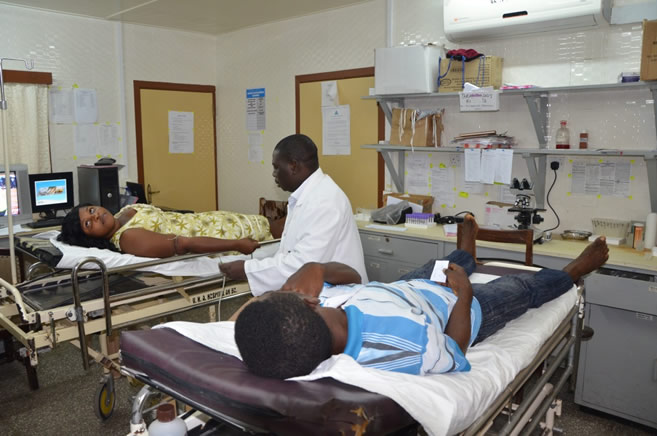
I went to ESUTH University Teaching Hospital, Park-Lane, Enugu (popularly known as Park-Lane) recently. I got to the hospital shortly before 10 am and went straight to their NHIS records office so I can get my folders and go to the General Out-Patient (GOP) Unit to seek a doctor. When I got there (the Park-Lane NHIS records office), the crowd I saw that were waiting to be attended to was much. I felt discouraged. I was given a sheet of paper to write my name and wait for my turn, which will be according to my serial number on the ‘attendance sheet’. No problem; I wrote my name against number 69 (in attendance sheet C since A and B have been taken into the office) and sat down knowing that I’ll spend the whole day there.

When I looked around me, I realised I shouldn’t even complain because there were people that really needed immediate medical attention waiting on the line with me. Funny to say that what we were even waiting for was folders that we will take and then start the rigorous processes involved in seeing a doctor. We were not even sure we will succeed in seeing any doctor that day – as if I know already.

People were called in based on their serial numbers in the ‘attendance sheet’. Each set of people that go in to ‘prepare’ and pick their folders spend nothing less than 20 minutes before coming out and then giving chance for another set to go in. My turn came a few minutes to 12 noon and I walked out with my folder when it was some minutes to 1 in the afternoon. I got to the GOP Unit and there found another story to tell.

The nurses there refused to collect my folder and allow me to see a doctor because it was already late. It is not like the doctors have gone home (after all it was just 1pm), but the crowd there was so much that the nurses knew that all of them may not be able to see the doctors till it’s very late in the evening. Well, I didn’t argue; I didn’t even want to argue because what I saw there spoke for itself. Honestly, I was a bit relieved when the nurses asked me to come back the following day because I don’t think I would have wanted to sit down there wondering when a doctor will see me. But my small mind didn’t remind me that I may still come ‘late’ the following day.

I had this experience at Park-Lane, Enugu, but I know it is the same thing with most government-owned hospitals. To be honest with you, our health sector needs total overhauling. A lot of work needs to be done.

The essence of writing this article is to call the attention of those concerned to some of my observations, which may need to be addressed soon.

MY OBSERVATIONS
1. Wrong handling of confidential materials: This is not seen as something wrong in government owned hospitals, but I believe it is wrong for non-staff members to handle patients’ folders and files. When I said something about it at the hospital, a fellow patient told me that it is not the same thing with all sections. According to this person, this act is more prevalent in NHIS office, where the NHIS beneficiaries are expected to move their folders to and from the consultation areas (because they don’t pay much). But I believe it doesn’t happen only in NHIS records office because I saw other people moving around with theirs. I think hospitals need to look into this.

2. Delays and Waste of Time: I spent over two hours just to get my folder. The staff members in the office are actually doing their best, but then their best wasn’t enough. It is quite unfortunate that someone that is not healthy will be made to spend so much time waiting to be attended to. This is quite unfair.

3. Inability to See Doctors Easily: In as much as I was relieved that I didn’t have to stay any longer in the hospital (even if it means seeing a doctor), I still think the system made it hard for people to see doctors there. What then is the essence of someone going to a hospital if not to see a doctor (and to see him as soon as possible)?

I brought up this issue in the hospital and one of the patients there told me that if I don’t want to waste time seeing a doctor (that is if I will succeed in seeing one that day), I should go to the Emergency Unit and someone will definitely attend to me. But that I should be ready to pay heavily for the services. Anyway, I didn’t confirm that; but I hope it’s not true.

4. Large Number of Patients: Government owned hospitals have good doctors, and they are cheaper than private ones. For that, a lot of patients troop to their hospitals. But these hospitals find it difficult to manage this large number of patients. The waiting areas are always rowdy and filled to the brim, with some people standing, or sitting on make-shift seats. Sometimes I couldn’t help wondering if doctors actually have enough time to attend to all these patients very well.

Kindly note that I’m not against many people going to government owned hospitals (I use them too, you know); my own is that these hospitals should make provisions for the comfort of these patients, and ensure that they are well attended to.

5. Shortage of Staff: I think Nigerian health sector is understaffed. The workers I met in Park-Lane are really good, but they were over-stretched. One of the nurses at the GOP Unit was already antsy when I went there. She was yelling at patients, especially those that didn’t do as she instructed. I know that her approach was unethical but I didn’t blame her: she had more than she could chew and she didn’t know how to manage them.

THE WAY OUT
It is not enough to just observe the problems at our hospitals without finding out their causes and possible solutions. Well here are a few suggestions I can make based on what I’ve been seeing in most hospitals, especially government-owned:

1. Embracing ICT: I wasn’t impressed with the way patients folders were packed at shelves and on the floor at the NHIS record office. The worst is that when you want to collect your folder, they have to search through the shelves to bring it out, and then perform other ‘rituals’ involved in setting up a folder before a doctor is consulted. If someone’s folder mistakenly gets misplaced, or a paper falls out of it, a lot of records and information will get misplaced too. Besides, searching for folders the way they do wastes time.

But if these hospitals decide to store patients’ records and histories in their digital database, to be pulled up whenever they (the patients) visit, a lot of troubles will be saved. Someone needs to tell these Medical Directors about that.

2. Recruiting More Workers: There is no debating this: government hospitals should recruit more staff. These staff should be placed on shift-duties. I mean, I can’t come to the hospital for an urgent attention in the evening only to be told that NHIS office has closed for the day. And it is wrong to be told that the GOP Unit will no longer ‘accept’ patients because many are waiting to see doctors. Let the hospital management team do something about staffing in the hospital.

I Started With 8 Snails In A Bowl But Today I Have Over 5000 Snails. The Diary of an Entrepreneur – Joy Tope Akintan

2

As we celebrate the World Food Day today, I have the pleasure of interviewing the manager of Afrifarm and Seeders Venture.

She talked about creating your own business even when everything is at your disadvantage. You will always find a way to live your dreams.

It’s good to have you here. Can you please introduce yourself to our readers?
My name is Joy Tope Akintan, and I am the farm manager of Afrifarm and Seeders Venture.”


Where do you hail from?
”I am from Ondo state but I reside and do our business in Otukpo, Benue state.”


Wow, that’s really a long distance away from home. What brought you to Benue state and how long have you been there?
”I came to Benue state with my parents in 2010 (that was after my secondary school education) and I have been here ever since. It’s about 9 years ago now.

Though my parents are no longer here, I am still here alone to get a life of my own and live my dreams.”


You talked about doing your business here earlier on, can you shed light on the business?
”My business is Afrifarm venture. It specializes in snail farming, snail management, snail production and snail packaging.”


It is unusual to see ladies do the hustling and bustling. You seem to be different from this societal mindset. If I may ask, what actually led you to be self-independent?
Everything leads me to be independent. My family, my dad worked as a civil servant for many years with little or nothing to fall back on. He was educated and was conditioned that – he had to work for someone to make ends meet. And that has brought him years of wasted time and resources.

The society told us, ”go to school to get good grades so that u can get a good job”, and I always wonder, why must it be all about getting “a good job”?

Who are the people trained to own companies?
What special schools do people who own companies and businesses attend and why must they train us to always work for them?

That’s how I got to know that we have been erroneously schooled. So, I committed myself to self schooling. I began to read different books, I became so irritated by mediocre associations, and I change the network of people I mingle with.

I started doing many things that an average Nigerians would not do. I volunteer, I attend conferences/workshops instead of clubs and parties.

So, I broke out of the circle of the people who look for jobs as I create my own job and also give others the opportunity to earn a living.”


Everything you’ve said here is nothing but the truth. You got me at creating your own job. How did manage to do that?
”I did through my farm – Afrifarm Venture.

Afrifarm Venture is an agro-based company (duly registered under Corporate Affairs Commission) and what we do for now is snail production.

We make snail meal consumables to all Nigerians and Africans at their own convenience. We also have a sub outlet as well that supplies crayfish and locust beans seasonings in Nigeria. But our concentration over time has been in snail farming, snail business and snail production.”


It’s good to see so many women going into entrepreneurship. Gone are those days when our society believes that they belong to the kitchen. Joy, how fast is your company growing and how many years have you been in operation?
We started about 9 months ago with 8 snails in a bowl and as we speak, we have over 5000 snails.

Social media has been one of our largest markets. In fact, social media is a blessing to us.”


5000 snails. That’s really a great number. Can you share what it takes to start this business?

  • Diligence
  • Determination
  • Relentless
  • Knowledge
  • And the last is Capital

The mistake many young entrepreneurs make is that they put capital first and they miss it all.”


This is a deep statement. Where do you see your business in the next five years?
We see us owning a food plant because we want to go fully into food production and many more consumable items that have their source in our natural food.

By then, we intend to have our branch offices and industries in the major states in Nigeria and extend to other African nations.

By the virtue of Afrifarm Venture, we want to create employment opportunities for hundreds of graduates in Nigeria and beyond.

Our goal is to make Nigerians and Africans healthy by offering them valued packed products from its natural source.”

That’s a great vision, my friend. Here’s my last question for you, if you will ever need support from the government or private sector, in what area of your business would it be?
In the area of plantations – some of the trees are experiencing huge deforestation which is not healthy for our planet and that’s the reason why the Chinese/Asians are trooping in to exploit our natural resources because they know we don’t value it.

Study shows that in less than 10 years, the locust bean trees would have gone into extinction and no one is planting.

Also, we will need some machinery to enhance our production.

These are the areas we feel the government can come in for us, to save our continents from being sold out completely.”


I am really impressed with everything you’ve shared with me. You are indeed a role model for many women out there. In a few years to come, I hope to see you as one of the greatest female entrepreneurs to have emerged from Africa.
My pleasure always.
I believe it is time to create wealth in Nigeria, by Nigerians and for Nigerians.

We love Nigeria, we love Nigerians and we love Africa. It’s our home and we must make it conducive for generations to come.

Thank you for having me in your interview series.”

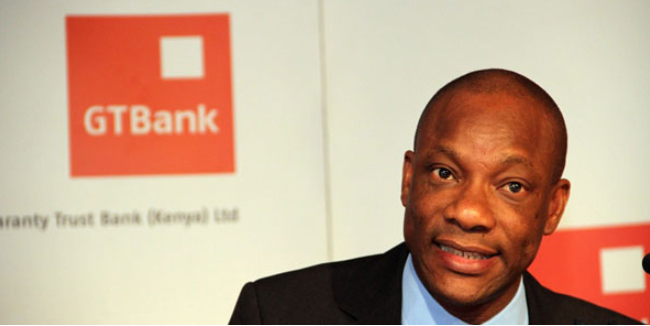
The GTBank’s Q3 2019 Results

2

Nigeria has a category-king banking institution. GTBank has demonstrated an enviable level of fiduciary responsibility on the efficiency and utilization of the factors of production in banking. The Q3 2019 unaudited financials continue the trajectory of great operating results. I am not necessarily looking at the profitability since a bank making money in Nigeria does not mean the management is smart: the Central Bank of Nigeria policy guarantees banks good profits. 

Yes, if you keep selling treasury bills at close to 14%, no bank will bother to take risks on entrepreneurs and companies when 14% annual return is assured at no risk. Why lend at 17% with associated risks when you can get 14% at no risk? Watch out for the funding of the 2020 national budget – Nigeria will hit the local market, distorting the market equilibrium as it looks for funds. The implication is that at the end, Nigeria government will get most of the funds which commercial banks could have lent to companies for growth!

So, my focus when looking at the books is the cost-to-income ratio: this quarter, GTbank has it at 36.9%. That is industry-leading, not just in Nigeria, but Africa-wide.

Now, the question – can GTBank Management run Nigeria better with that level of efficiency demonstrated in its operations? Of course, there are differences in the asset classes and and desired goals, but I am just thinking out loud. To run Nigeria, the management will have to worry about my village where it does not have a branch, and it has to take note of all the issues in Nigeria.But no matter how you see it, the GTBank process needs to reach state capitals and Aso Rock. We have a case study which someone must take to the public sector: GTBank is well optimized.


The Press Release below

GTBank Releases Q3 2019 Unaudited Results…….. Reports Profit before tax of N170.7 Billion

Guaranty Trust Bank plc has released its unaudited financial results for the period ended September 30, 2019 to the Nigerian and London Stock Exchanges.

A review of the results shows positive performance across all financial indices, reaffirming the Bank’s position as one of the most profitable and well managed financial institutions in Nigeria. Profit before tax stood at N170.7billion, representing a growth of 3.9% over N164.2billion recorded in the corresponding period of September 2018. The Bank’s Loan Book grew by 9.2% from N1.262trillion recorded as at December 2018 to N1.378trillion in September 2019, while customers’ deposit rose by 5.1% to N2.390trillion from N2.274trillion in December 2018.

The Bank’s balance sheet remained resilient with Total assets and Shareholders’ Funds closing at N3.519trillion and N636.8Billion respectively. Full Impact Capital Adequacy Ratio (CAR) remained very strong, closing at 23.6%. In terms of Assets quality, NPL ratio and Cost of Risk (COR) improved to 5.6% and 0.2% in September 2019 from 7.3% and 0.3% in December 2018 respectively. Complementing the improvement noted in NPLs and COR, we maintained adequate Loan Loss coverage of 95.2% for Lifetime Credit Impaired Loans (NPLs). On the backdrop of this result, Post-Tax Return on Equity (ROAE) closed at 32.3% while Post-Tax Return on Assets (ROAA) stood at 5.8%.

Commenting on the financial results, the Managing Director/CEO of Guaranty Trust Bank plc, Mr. Segun Agbaje, said; “The Bank’s 3rd quarter result reflects the strength of our franchise and the quality of our business strategy to deliver sustainable long-term value for our shareholders. Going into the final quarter of the year, we will continue to differentiate ourselves by maintaining a high standard in service delivery and leveraging our resources, expertise and network to enrich the lives of our customers. That’s why, from November 10 – 11, 2019, we are organizing the GTBank Fashion Weekend, the biggest consumer-focused event in Africa’s fashion industry, to give indigenous small businesses the platform and access to new markets and customers that they need to grow.”

Over all, Guaranty Trust Bank plc continues to be best-in-class in the Nigerian banking industry in terms of all financial ratios i.e. Post-Tax Return on Equity (ROAE) of 32.3%, Post-Tax Return on Assets (ROAA) of 5.8%, and Cost to Income ratio of 36.9%. These ratios are testament to experienced Management, efficient Balance sheet structure coupled with operational efficiency of the Bank.

What You Need to Know About Passion and Opportunities

0

A lot of the things we do is actually a game of numbers, and this could depend on how the odds stack up in your favour or against you.

So in making some basic life or career decisions, it may be important to understand the chances you have from the very beginning.

So it wouldn’t be out of place to consider the availability of opportunities in that specific field in your immediate environment.

I met someone years back who had to choose between studying  Information Technology and Civil Engineering as he was offered admission in both.

He asked a couple of people in quora (an online platform) who were mostly foreigners and they suggested that he go for ICT. He also asked the same question to some Nigerians and they suggested otherwise.

It’s easy to understand why their response varied across the different geographical spaces.

There are probably more ICT positions in the developed countries,  and more opportunities in infrastructural development in developing countries .

In an interview to be aired on the Spanish television today,  the 27-year-old Brazil international Casemeiro who also plays for Real Madrid football club as a defensive midfielder, recounted how he ended up playing in his current position.

“When I went to the trial at Sau Paulo I was a forward,” Casemiro said during his chat with former Real Madrid player and manager Jorge Valdano. “I was pretty strong, I was always the tallest player at that age and I used to score a lot of goals with my head.”When I turned up, I was about 12 or 13 years old, there were about 300 players there and they were only going to choose 50. I remember very well that when the coach asked who were goalkeepers, three people put up their hands. Then he asked how many were forwards and 40 or so kids put their hands up and I said to myself, ‘there’s a lot of competition so I won’t be a striker.’ The same thing happened when they asked for midfielders and so I did the same. Then the coach said: ‘Are there any defensive midfielders?’ Seven or eight hands went up so I said to myself: ‘Ok, I’m a defensive midfielder.”

“I trained as a defensive midfielder during the trial and the coach pulled me aside and said: ‘You’re not a defensive midfielder, you came here as a forward.’

But I kept insisting that I was and that’s where it all started.

So in other words Casemeiro decided to go by the numbers, where the odds stack up together in his favour.

Probably he may not have overshadowed the likes of Neymar and Coutinho in attacking brilliance as a result of the obvious gulf in talent in that specific field, but still just by having a practical view of numbers and how they can work to your advantage he managed to get this far.  Scenes like this play out in many different ways in all life’s endeavour. This does not imply that there is no room for passion in the real world. Yes you can chase your dreams and passion.

But still, while you strive in your daily lives to do what you love, you can also on the flip side begin to do something, and then love it. It works both ways.

How Nigerian Facilities Management Companies Can Organise for Global FM Standards Certification and Localisation

0
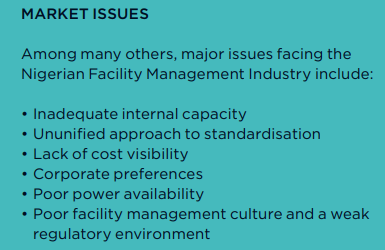
Nigerian Facilities Management Market Issues

In 2018, the worth of the Facilities Management industry was $34.65 billion globally and projected to reach $59.33 billion by 2023, growing at a CAGR of 11.4%. The same year, Nigerian market was $3.3 million and $1.4 million for public and private sectors respectively. Many factors have been adduced for the global and national growth in recent times. Sources indicate that the increase in sustainable infrastructure, the need for connecting workplaces and to enhance the lifecycle of critical facilities have been the main drivers of the growth. Growing in compliance to environmental and regulatory standards have equally been cited.

Like other developing FM markets, Nigeria is currently facing recognition gap being orchestrated by the government and citizens’ low maintenance culture. This has led to the players for servicing the private sectors more than the other segments of the economy. Beyond this, the industry is battling with lack of legislation, lack of industry standards, lack of proper structure in terms of the organisation’s structure, lack of enabling technologies required for sustainable FM solution management, skills gap, pricing and lack of proper procurement procedure.

Some players in the industry are also finding it difficult to benchmark their processes despite the benefits associated with benchmarking over the years in the mature markets. The consequence has been divided satisfaction level among the facilities users in workplaces. For instance, a research finds that 49.1% of users at the Eko Court Towers felt that the services provided to them is between 61-70%, while those on Boyle Street reported 51-60% satisfaction level. The research concludes that “the Eko Court Towers residents are more satisfied in general and their level of satisfaction is higher than that of the resident of Boyle Street, Lagos Island, indicating high quality of services in Victoria Island than what is obtainable in Boyle Street.”

However, it seems that those on Boyle Street will soon capture better value from their facilities because of the recently released Global FM Standards by the International Standard Organisation. The new standard was the centre piece of the industry yearly Day in May 2019. Already, some companies in the established markets have partnered with ISO certifications approved organisations for the certification after the development of methodologies for the internal assessments of their business components.  This piece emerges from the part of the research started after the Nigerian FM industry joined their counterparts for the 2019’s World FM Day celebration with the theme “Celebrating Global FM Standards.”

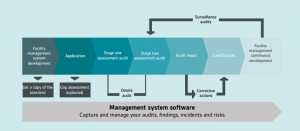
The Road to ISO 41001 Certification

Considering the challenges itemized earlier, it is evident that Nigerian companies’ road to the certification acquisition remains rough. Companies with improper organisational structures, the right people to execute the roles and functions and capital would feel the starkness the most. This position is hinged on the basis that the new standard is a strategic tool. It is a strategic tool because FM companies must provide services that align with their organisational strategy and objectives in short, medium and long terms. By 2020, the year the clients would be more inundated with the need to request for the certification before engaging FM providers, companies will not have options than to manage the life cost and usability of facilities, services and obligations to workspace users, and control the environmental impacts of their operations.

FM Standards Path
Source: BSI Group, 2018

The Strategic and Tactical Questions

Therefore, aligning with the strategic tool requires asking strategic and tactical questions that will lead to strategic answers and decisions on the means to eliminate stumbling blocks on the road to the certification. Players need to find answers to why clients and users want standards, what needs to be standardised and when should the standards occur. These are strategic questions. Inputs, conversion activities and outputs must be standardised, while the standards should be felt before, during and after solutions delivery. The next question should be a tactical one. Since it is obvious that clients and users want standards because of the necessity to improve their operational efficiency and reducing operating expenditure. Then, what is the appropriate standard and where such standard should be used to meet the expectations of the clients and users.

Organising to Enable the Localisation from Top to the Bottom

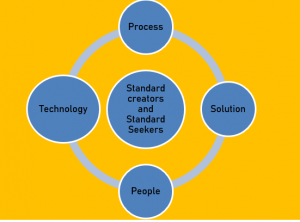
The emerging challenges in the industry and the clients’ sustainable value capturing have increased the need for quick organisation of key actors. In our research, we were able to segment the key actors for the localisation into standard creators (SC) and standard seekers (SS). FM companies and their employees, especially C-Executives and Business Executives are the SC, while people and businesses who know that for them to retain values of their facilities must put them up for management are the SS. Our data show that standard seekers expect standard creators to differentiate their solutions via quality of process, competent hands, adoption of appropriate technologies that enable effective solutions delivery at the minimal cost and range of solutions. This further reinforces the need to ensure alignment among the process, people, solution and technologies to avert existing situation where there is a significant between service expectation and actual service encounter across the entire service dimension framework on the maintenance of a University building.

Global FM Standards Framework
Source: Infoprations Analysis, 2019

As a matter of necessity, players must embark on deep business optimization. Efficient and effective business optimization have been the critical success factor for many companies in the FM mature markets such as Germany, the United Kingdom and the United States of America. The deep business optimization is being suggested in line with our recent research which shows that select professionals, who are expected to be the change agents, prefer business improvement over optimization. This is not absolutely out of the context, but focusing on improvement means companies are more likely to emphasise qualitative measurement approach to business optimization instead of the quantitative one, which provides a quantitative approach in terms of modeling using relevant data that align with the specific objectives within business components (solution, people, process and technology).

In simple term, players must remove unnecessary frictions before they could be certified. The frictions in process, people, technology and solutions must be removed. This is a matter of maximization and minimization.  A system that will generate value for the clients must be maximized for it to operate effectively and efficiently. Attaining the needed performance depends on the extent to which the change managers minimize or remove frictions capable of preventing the realization of the end results.  Standardised principles and procedures, competent personnel to carry out the principles and procedures in line with FM standards’ requirements are the most requirements for process optimization. People need to be optimized using career development and remuneration policy. For instance, players must hire and retain certified FM professionals, up-skilling them frequently and equip them in line with the specifics of ISO 41001’s requirements. New technology adoption and installation, training and retraining of employees on the emerging technologies that resonate with the Global Standards, and downplaying deployment of employees who lack the required digital and technological skills for solutions delivery are the essential requirements for technology optimization.

Having all the requirements for the business components are not enough, companies need to be hypothetical in the short, medium and long terms of implementing the requirements. This position emerges because of the analysis, which reveals that professionals’ attitude and behaviour to change could not be predicted. When the affected employees lack the required skills, there is a tendency of blocking illicit financial sources for personal benefit and the threat to the team lead, head or director. Being hypothetical indicates that companies, especially the change managers, must set hypotheses for measuring the application and implementation of the requirements.

In this situation, null hypotheses must be formulated more than alternate hypotheses. It is important to know whether there are no frictions in the business components. This is a null hypothesis. When the hypothesis is tested using data gathered from (process, people, technology activities and solutions offering) and results show total elimination of frictions companies would be freed from possible hindrances likely to prevent them from reaching ISO 41001 Certification. Specifically, examining the null hypothesis in each component will help in preparing appropriate documents in line with ISO 41001’s requirements for standardization.

As pointed out earlier, the fear of unknown among the professionals about the significant changes with their companies’ components remains the greatest risk to the glocalization of the new standards. This could be addressed using the RASCI model. This is a model that ensures a better approach to accountability and decision making when an industry is working towards global best practices. RASCI means Responsible, Accountable, Supportive, Consulted, and Informed. The change managers need to exhibit a high sense of responsibility, be accountable, supportive, consult when it is necessary and inform their employees at functional level. This must be replicated by the employees at the functional level.

Editor’s Note: Cover picture is generated from the Institute of Workplace and Facilities Management’s 2019 Industry report for Nigeria.