DD
MM
YYYY

PAGES

DD
MM
YYYY

spot_img

PAGES

Home Blog Page 670

Trump Administration Expands Steel and Aluminum Tariffs to Over 400 Additional Products, Raising Stakes in Trade Agenda

0

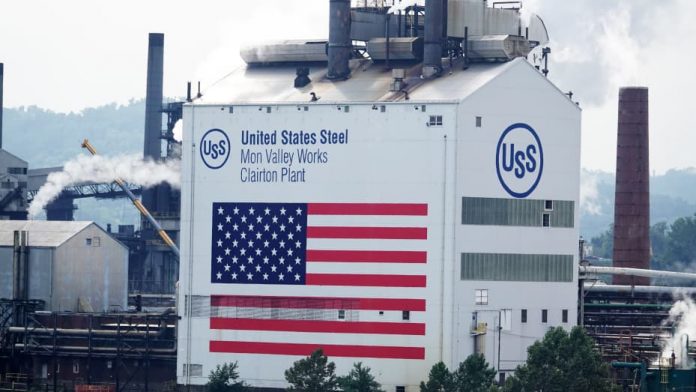
The Trump administration has quietly expanded its 50% steel and aluminum tariffs to include more than 400 additional product categories, vastly increasing the reach and impact of this arm of its trade agenda.

The new tariffs, which took effect Monday, extend the scope of the levies that President Donald Trump previously announced on the valuable commodities. The tariff list now covers products such as fire extinguishers, machinery, construction materials, and specialty chemicals that either contain or are contained in aluminum or steel.

“Auto parts, chemicals, plastics, furniture components—basically, if it’s shiny, metallic, or remotely related to steel or aluminum, it’s probably on the list,” Brian Baldwin, vice president of customs at Kuehne + Nagel International AG, wrote on LinkedIn about the expanded list.

“This isn’t just another tariff—it’s a strategic shift in how steel and aluminum derivatives are regulated,” he added.

The levies extend to 407 new product categories, the Department of Commerce confirmed Tuesday.

“Today’s action expands the reach of the steel and aluminum tariffs and shuts down avenues for circumvention – supporting the continued revitalization of the American steel and aluminum industries,” Jeffrey Kessler, the Commerce Department’s under secretary for industry and security, said in a statement.

The release from the agency links out to a list that identifies the newly included product types only by the specific customs codes that apply to them, not by what the products are actually called. For example, the Commerce Department identifies the product category of fire extinguishers only as “8424.10.0000,” a 10-digit code buried among hundreds of other 10-digit codes. This format makes it very difficult for the public to get a full picture of all the products affected by Monday’s expanded tariffs.

But trade experts warn the impact will be enormous.

“By my count, the steel and aluminum tariffs now affect at least $320 billion of imports based on 2024?s general customs value of imports,” Jason Miller, a professor of supply chain management at Michigan State University, wrote on LinkedIn. That marks a sharp increase from his prior estimate of roughly $190 billion.

“This will add more inflationary cost-push pressures to already climbing prices that domestic producers are charging as picked up by July’s PPI data,? he added.

President Trump has repeatedly leaned on sector-specific tariffs to push his broader trade agenda, which has been characterized by aggressive measures to reduce U.S. reliance on foreign supply chains and to force trading partners into renegotiated agreements.

In June, Trump doubled tariffs on steel and aluminum imports to 50% for most countries, creating widespread uncertainty for businesses and U.S. trading partners reliant on the commodities. Monday’s expansion marks the most sweeping extension of that move to date.

The White House stressed that the latest action should “not come as a surprise.”

“The President called for a new steel and aluminum product inclusions process in February,” White House spokesperson Kush Desai said in a statement.

“[The Bureau of Industry and Security] established the new product inclusions process in April, and companies submitted requests for product inclusions in mid-May,” he said.

“Thus, it has been clear for many months that new products could be treated as steel and aluminum derivatives.”

The expansion signals that the administration is not only holding firm on its tariff strategy but widening it—closing what officials describe as loopholes and intensifying pressure on industries from manufacturing to construction. However, the ripple effect for businesses is expected to be steep increases in costs, while global trade partners brace for further strain in an already fragile international trading system.

Beyond ETFs: New XRP Cloud Mining Contracts Help Beginners Earn $2,100 Per Day

0

As cryptocurrency ETF applications surge, the chances of approval are rising quickly. Yet seasoned investors recognize that while ETFs can boost market confidence, they cannot eliminate price volatility or uncertain returns. In response, Topnotch Crypto has launched a new XRP cloud mining contract that allows users to turn their XRP into stable daily income—without the need for equipment or technical skills. Investors can earn up to $2,100 per day, creating a form of passive income that works like a “digital gold bond.”

Topnotch Crypto is a UK-registered green cloud mining platform that operates 100 mining farms worldwide, all fully powered by renewable energy. The platform leverages advanced artificial intelligence scheduling technology to help users effortlessly convert cryptocurrencies such as XRP, BTC, ETH, and USDT into steady mining income—without any hardware investment or additional effort.

Three Easy Steps to Profit with XRP or BTC

  1. Sign Up — Visit https://topnotchcrypto.com or download the app, complete registration, and claim your $15 welcome bonus.
  2. Activate a Contract — Use XRP or BTC to launch a USD-denominated cloud mining contract.

Sample Popular Contracts:

[Free Contract]: Invest $15, term 1 day, daily return $0.60, maturity payout $15 + $0.60

[Trial Contract]: Invest $100, term 2 days, daily return $4, maturity payout $100 + $8

[Ebang Ebit E12+]: Invest $500, term 5 days, daily return $6.25, maturity payout $500 + $31.25

[WhatsMiner M30S++]: Invest $1,100, term 10 days, daily return $14.85, maturity payout $1,100 + $148.50

[Canaan Avalon Made A1466I]: Invest $10,000, term 30 days, daily return $165, maturity payout $10,000 + $4,950

[Mining Box-40ft-CE]: Invest $100,000, term 50 days, daily return $1,950, maturity payout $100,000 + $97,500

Click to view details of popular contracts.

  1. Enjoy Daily Earnings — The system automatically settles profits every day. Once your balance reaches $100, you can withdraw to your wallet. Your principal is fully returned at contract maturity.

Why Do Global Investors Choose It?

  • Easy to Start — No need to buy or maintain hardware, just sign up and you’re ready to go
  • Flexible Options — A wide range of contracts to fit every budget and schedule
  • Eco-Friendly — Powered 100% by solar, hydro, and wind energy
  • Secure & Reliable — Industry-leading encryption and wallet protection
  • Zero Upfront Cost — New users get a $15 bonus to start mining for free

From Market Volatility to Stable Cash Flow
Are you ready to turn your crypto assets into a sustainable cash flow? Visit the official Topnotch Crypto website today and join the global green cloud mining revolution, where BTC, ETH, and XRP generate real daily income for you.

Official Website: https://topnotchcrypto.com
Email: info@topnotchcrypto.com

Intel Seeks More Investors After SoftBank Deal as U.S. Pushes for Equity Stake

0

Intel is in fresh talks with other major investors to secure an equity infusion at a discounted price, even after it received a $2 billion capital injection from Japan’s SoftBank, people familiar with the matter told CNBC’s David Faber.

The move underscores the chipmaker’s ongoing struggle to fund its turnaround strategy and regain ground in the booming semiconductor industry.

The company’s shares slid more than 7% on Tuesday, reversing a rally earlier this week sparked by the SoftBank deal and reports that the Trump administration is weighing new ways to get involved with the company.

Commerce Secretary Howard Lutnick signaled that Washington expects to hold a direct stake in Intel, saying the government must receive equity in exchange for funds from the $39 billion CHIPS Act program.

“We should get an equity stake for our money,” Lutnick said on CNBC. “So we’ll deliver the money, which was already committed under the Biden administration. We’ll get equity in return for it.”

Faber reported that Intel is now seeking additional equity partners beyond SoftBank, but analysts warn that the structure of the CHIPS Act support complicates the company’s plans.

“They need money to build whatever it is that the customers may actually, ultimately want,” Faber explained on Squawk on the Street. “And having the CHIPS Act money, which is free, so to speak, no strings attached, become equity is not helpful to them because it’s dilutive.”

Intel has been working to reassert itself as a leader in advanced semiconductors, but so far has failed to capitalize on the artificial intelligence boom that has propelled rivals like Nvidia. Instead, the company has poured billions into a foundry business aimed at contract manufacturing, but has yet to secure a significant customer win.

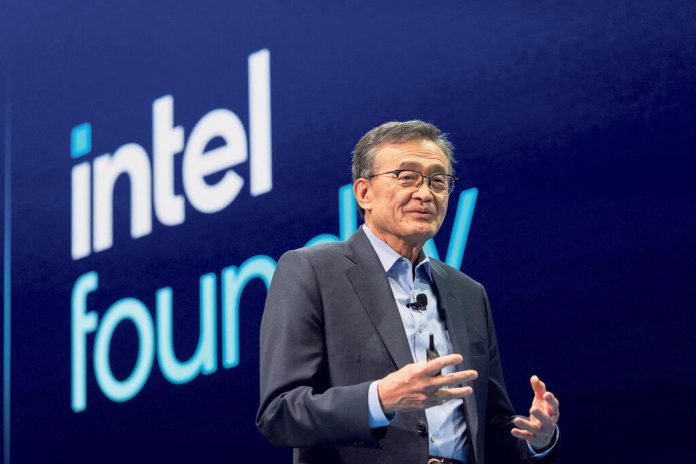
The leadership shake-up has also added to the uncertainty. Lip-Bu Tan, a longtime industry figure, took over as Intel’s CEO in March following the ouster of Pat Gelsinger in December. But his position has come under political pressure. Two weeks ago, President Donald Trump called for Tan’s resignation, saying he was “highly CONFLICTED.” However, the president’s stance softened after Tan personally visited the White House to discuss his background and future plans for the company.

The reasoning is that Intel has fallen behind global rivals like Taiwan Semiconductor Manufacturing Co. (TSMC) and South Korea’s Samsung Electronics in producing advanced chips, a shortfall that leaves the United States vulnerable in a world where semiconductor supply chains are increasingly caught in geopolitical crossfire. President Trump has repeatedly stressed the need to “make more chips and high-end technology in the U.S.” and lessen dependence on Asia.

Intel’s financial strain, its difficulties in AI chips, and the heightened political involvement have put the company at the center of a larger battle over U.S. semiconductor dominance. While SoftBank’s $2 billion injection offered temporary relief, the search for more investors at discounted terms highlights how urgently Intel needs capital to fund new plants and technology development.

Last week, Gil Luria, head of technology research at D.A. Davidson, told CNBC’s Squawk Box that government intervention in the struggling chipmaker is “essential.” While Luria acknowledged that U.S. economic tradition leans heavily toward free-market capitalism, he argued that Intel’s current condition poses too great a risk for Washington to sit on the sidelines.

“We’re all capitalists,” Luria said. “We don’t want government to intervene and own private enterprise, but this is national security.”

The outcome of the government’s push for an equity stake could reshape not just Intel’s balance sheet, but also the precedent for future relations between Washington and the semiconductor industry.

Bill Gates-Backed Robotics Startup Field AI Raises $405M, Hits $2B Valuation

0

Robotics startup Field AI, backed by Microsoft co-founder Bill Gates, has secured $405 million in two funding rounds, attracting high-profile investors including Nvidia’s venture capital arm and Amazon founder Jeff Bezos’ family office.

The fresh capital injection marks a significant milestone for the Irvine, California-based company, which is now valued at $2 billion, according to a person familiar with the matter who requested anonymity to discuss financial information.

Founder and CEO Ali Agha told CNBC that the funding comes at an “aha moment” for the industry as robotics software and hardware advance to an inflection point.

“We are growing,” he said. “This funding announcement is to respond to the customer demand.”

The two-year-old startup said the rounds were oversubscribed, with most investors approaching the company rather than the other way around. Alongside NVentures and Bezos Expeditions, the list of investors includes Khosla Ventures, Temasek, Canaan Partners, and Intel Capital. Samsung and Gates Frontier, Gates’ investment fund, had already invested in earlier rounds.

Field AI’s momentum comes as robotics startups enjoy heightened investor attention amid a global push to boost artificial intelligence capabilities and efficiency. In June, Gecko Robotics — another two-time CNBC Disruptor 50 company — raised $125 million, pushing its valuation beyond $1 billion.

Field AI develops models that control robots across a wide range of sectors, including construction, energy, and logistics. The company says its technology offers “effortless transferability” across environments, requiring minimal adjustments from customers and helping businesses scale robotic solutions quickly.

Agha, who spent nearly a decade at NASA’s Jet Propulsion Laboratory specializing in robotics autonomy and physical AI, highlighted the startup’s rapid expansion. Field AI has added more than 100 new positions in recent months to keep up with rising customer demand and address growing concerns about labor shortages and workplace safety.

The startup’s team includes former employees from DeepMind, SpaceX, Amazon, Tesla Autopilot, and NASA, underscoring the deep technical expertise behind its robotics models. Agha said the latest funding will accelerate efforts to meet industry demand and strengthen the company’s foothold in the rapidly evolving robotics and AI market.

Some believe that the strategic involvement of Nvidia, Amazon, and Gates in Field AI’s growth highlights how robotics could soon become a decisive front in the global AI race. Nvidia’s chips power much of the world’s AI infrastructure, while Amazon has long sought to automate logistics and warehouse operations.

Gates, through Gates Frontier, has increasingly backed ventures tied to the future of work and automation. Their convergence around Field AI is seen as a bet that robotics will no longer be confined to niche manufacturing but will underpin how companies everywhere solve labor, productivity, and efficiency challenges.

The new funding thus provides both resources and validation for Field AI. It positions the company at the center of an intensifying competition where robotics is not just an offshoot of AI innovation but one of its most practical and transformative applications. The funding will allow the company to accelerate development and respond to the customer demand that Agha says is growing faster than many in the industry expected.

Illinois Governor JB Pritzker Signs Two Bills (SB1797) and (SB2319) On Digital Assets

0

Illinois Governor JB Pritzker signed two bills, the Digital Assets and Consumer Protection Act (SB1797) and the Digital Asset Kiosk Act (SB2319), establishing the Midwest’s first comprehensive cryptocurrency consumer protections.

These laws aim to curb fraud, with Illinois residents having lost $272 million to crypto scams in 2024, per FBI data. SB1797 grants the Illinois Department of Financial and Professional Regulation (IDFPR) authority to oversee digital asset exchanges, mandating financial reserves, cybersecurity, anti-fraud measures, and customer service standards akin to traditional finance.

SB2319 regulates crypto ATMs, requiring operator registration, an 18% fee cap, a $2,500 daily transaction limit for new users, and full refunds for scam victims. Pritzker criticized the Trump administration’s deregulatory stance, particularly for overturning an IRS rule on decentralized crypto brokers, accusing it of letting “crypto bros” shape federal policy.

He contrasted Illinois’ consumer-focused approach with federal policies driven by industry lobbying, which prioritize limited oversight over protections. The bills drew backlash from crypto stakeholders like Coinbase’s Chief Policy Officer Faryar Shirzad and Chief Legal Officer Paul Grewal, who called Pritzker’s remarks “uninformed” and noted bipartisan support for federal crypto laws like the GENIUS and CLARITY Acts.

Digital asset businesses have until July 1, 2027, to comply, though some protections, like scam refunds, are effective immediately. The Digital Assets and Consumer Protection Act (SB1797) and Digital Asset Kiosk Act (SB2319) introduce robust safeguards against fraud, which cost Illinois residents $272 million in 2024.

Requirements like financial reserves, cybersecurity standards, and immediate scam refunds for crypto ATM users reduce risks for retail investors. Clear regulations and consumer-focused measures, such as the 18% fee cap and $2,500 daily transaction limit for new crypto ATM users, may boost confidence in digital assets, encouraging broader adoption among cautious consumers.

Stricter regulations could lead to higher fees or reduced access to certain crypto services, as businesses pass compliance costs to users or limit operations in Illinois. Crypto exchanges and ATM operators must meet stringent requirements by July 1, 2027, including registration, financial reserves, and cybersecurity protocols.

Smaller firms or startups may struggle with these costs, potentially stifling innovation or driving businesses to less-regulated states. Illinois’ large economy and Chicago’s financial hub status make these laws influential. Companies like Coinbase, already critical of the legislation, may face operational challenges, potentially reducing services or exiting the state if compliance proves too costly.

As the Midwest’s first comprehensive crypto consumer protection framework, Illinois’ laws could inspire other states to adopt similar measures, fragmenting the U.S. regulatory landscape and complicating nationwide operations for crypto firms.

Pritzker’s criticism of federal deregulation and “crypto bros” highlights a growing divide between state-level consumer protections and industry-backed federal efforts like the GENIUS and CLARITY Acts. This could lead to a patchwork of state laws, complicating compliance for businesses operating across jurisdictions.

Illinois’ proactive stance may pressure federal regulators to prioritize consumer protections over industry-friendly policies, especially as crypto scams rise. It could also embolden other states to challenge federal inaction, as seen in California’s recent crypto legislation.

Pritzker’s rhetoric risks alienating crypto advocates and businesses, potentially positioning Illinois as less crypto-friendly compared to states like Wyoming or Texas. However, it may resonate with voters prioritizing consumer safety over industry growth.

The laws strike a balance between fostering crypto adoption and curbing fraud, but heavy-handed regulation could deter investment in Illinois’ blockchain sector, while lighter federal policies might attract firms elsewhere. Given Illinois’ economic weight, its regulatory model could shape national debates on crypto oversight, especially as 2024’s $4.6 billion in U.S. crypto fraud losses (per FBI data) underscores the need for action.

While Illinois’ laws strengthen consumer protections and set a regional precedent, they may increase costs for businesses, fuel state-federal tensions, and influence the trajectory of U.S. crypto regulation. The long-term impact hinges on how firms adapt by 2027 and whether other states follow suit.