DD
MM
YYYY

PAGES

DD
MM
YYYY

spot_img

PAGES

Home Blog Page 6702

Examining the New 0.005% Tax for Nigerian Police Welfare

0

The Nigerian Government is planning to impose a 0.005% tax on companies operating businesses in Nigeria. The tax, although they call it levy, stems from The Nigerian Police Trust Fund Act, that was passed in April, and signed into law in July.

The Act establishes fund: proceeds from which training of police personnel will be facilitated and also the procurement of security machinery and equipment.

According to PWC: The Act imposes a levy of 0.005% of the “net profit” of companies operating business in Nigeria. The fund will also consist of 0.5% total revenue accruing to the federation account, in addition to proceeds from grants, intervention funds, aids, donations, investment income, etc.

A board will be established to administer the fund and make other administrative decisions to fulfill the objects of the Act.

It is designed to last for 6 years only, after which the assets and liabilities will be transferred to the Nigerian Police.

While security and the need to improve the welfare of the Nigerian Police cannot be excused, there have been a lot of concerns about the Act.

In the wake of time where the Government increased VAT from 5% to 7.2%, people are worried that multiple taxation is becoming another heavy burden on businesses struggling to cope with so many infrastructural deficiencies.

And most of all, foreign companies operating businesses in Nigeria. Although the 0.005% (N5 per N100, 000) seems so insignificant, it places additional administration on corporate taxpayers. A situation PWC says it could create concerns around the stability of the tax regime in Nigeria.

According to the report: The Act specifies that the Fund’s income is tax exempt, but does not make provision for tax deductibility for the companies making payments. Also, although the Act refers to the contribution as levy, it should be classified as an income tax under IAS 12, as it is imposed on income/profits.

It is therefore not tax deductible based on CITA which specifically disallows taxes on income or profits of companies. One other issue that caught the eye is that the Net Profit for computing the levy is not defined in the Act. Therefore, companies should be able to interpret it the other way, which is, profits after tax, but before the levy.

One other notable issue is that the Act does not contain provisions on collection and administration of the levy. That means, a further regulation would therefore be needed if FIRS will be responsible for the administration, since any other approach will result in high cost of administration.

Also the Act provides for audit and presentation of an annual report to the president only. When the tax is coming from publicly and privately owned businesses who would want accountability, to ensure that their taxpayer’s money has been judiciously utilized.

However, there is hope that may be a new regulation that will address these concerns.

Lessons Everyone Can Learn From Xenophobic Attacks

1

84 Nigerians arrived in Nigeria from South Africa. Over 600 Nigerians had registered to leave the country. The xenophobic attack on foreigners has really displaced many Nigerians living in South Africa.

But my major concern is – where would they start? Where will they pick their broken pieces of life?

It’s so sad to see people who had left Nigeria in search of greener pastures, back to square one. Many had been successful over there. To lose everything overnight is a big shame to the South African government for not protecting the foreigners and their properties.

We can blame South African governments and citizens for all I care, but the truth still remains, they’ve lost their properties and investments. Some had even lost their beloved ones. None of these is ever going to come back to them. We all must move on and learn from this.

Here are some lessons everyone can learn from the xenophobic attack:

  • No place like home: No matter how successful you are in another country, always remember that it can never be compared to your own country where you have your root. You will always be a second class citizen out there. Mesut Ozil is a good example of this scenario. The Turkish-German footballer was treated poorly by the German Football Association. Despite winning the World Cup for the country, he was never given the maximum respect he deserves.
  • Never put all your eggs in one basket: Learn to invest 60 percent of your wealth in your homeland. Put 40 percent outside. You never know what would happen next. Yes, you could invest in your home and lose. But it is safer to keep it at home than to leave it out there. I hope our Nigerian celebrities out there would learn from this as well. Every year, policy changes. A government could come against foreigners in the country and asked them to leave. You never know.
  • Build your own empire: It’s a shame that our government has failed us. If our system is working, no one would be interested in going overseas. But it is never over. The South African xenophobic attack has passed a message to everyone that it’s time to build our own empire – Nigeria. The government should focus on improving our economy by creating an environment that enables investors, and business ideas to thrive.

Lastly, I would also say that the xenophobic attack is a warning sign that we could have the poor going against the rich sooner or later in this country if nothing is done to improve the situation in the country. I hope we all can learn and grow from there.

God bless Nigeria!!!

NYSC Post Corpers To Churches And Mosques

0

NYSC post corpers to churches and mosques.

I spoke with a corp member that just left the camp on Monday, 9th of September. He told me how he was posted to a church.

I’m not against corp members being posted to religious organizations since some churches and mosques have offices. But it seems to be the opposite for the newly posted corp member, Adekunle who is serving in Ondo state.

Adekunle reached out to me to share his disappointment. He told me, ”These people are jokers. You won’t believe what happened when I got to where I was posted for my Primary Place of Assignment (PPA). I was posted to a church.”

According to Adekunle, he said he wasn’t upset about being posted to a church, after all, some churches have schools and other organizations. But Adekunle was upset with his role in the church.

He said, ”The pastor of the church told me that I would be working with him in the parish. I will be cleaning and arranging chairs whenever they have a program. To crown it all, I will be present during vigils.”

The National Youth Service Corps officials, this is unacceptable. These corpers are graduates. They’ve spent at least four years in the university. They have applied to serve their fatherland. Would it not be better if they are posted to places where they can learn?

No parents would be happy to see their children being assigned to such a role. Would you post your children to such places?

After all, NYSC is meant to prepare them for the work environment. Cleaning and arranging of chairs would be the worst thing anyone can do for a year. It’s time we start valuing our graduates. Because there are no jobs in the country is not enough reason to post anyone to such places. It’s truly belittling.

I wish the NYSC officials will do better in this aspect.

Utilizing Blockchain to Enforce Rules of Origin in AfCFTA

0

The African Continental Free Trade Area (AfCFTA) is an initiative of the African Union to create a single economic market of 1.2 billion people and a $3.4 trillion dollar opportunity by eliminating the common frictions which affect intra-African trade.

The Rule of Origin states that only goods which are manufactured with local inputs in member countries can be exported to other territories that belong to the same market and enjoy tariff free status. Due to the fact that with the exemption of South Africa, most member states do not have strong industrial base to produce most of the goods their citizens consume locally and as such resort to imports majorly from the Western and Eastern markets. Due to this construct, some African countries have economic partnership agreements skewed against their favor which makes it possible for an industrialist in Europe, America or China to produce goods in their markets, ship them down to African states they have trade relations with and have them repackaged as locally manufactured products so that they can easily enter large markets on the continent such as Nigeria, Ethiopia, Kenya, etc without paying duties.

How blockchain works

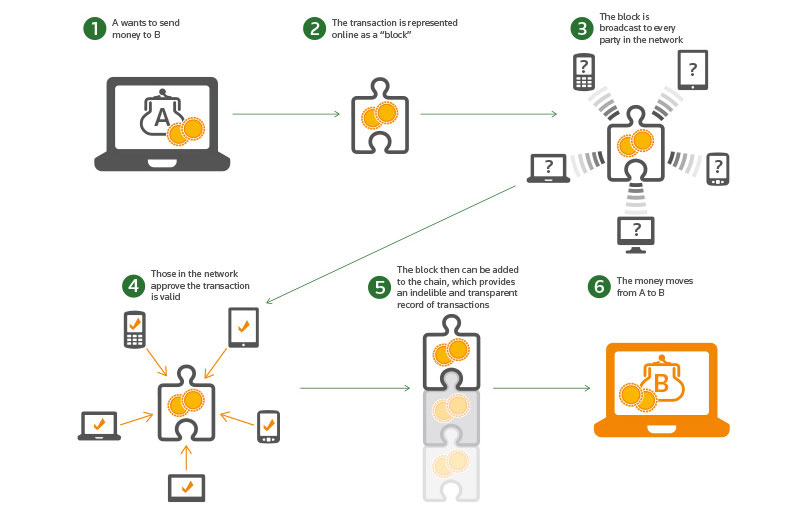
This problem can be sorted out with the application of blockchain technology. The African Customs Union and African Manufacturers Association comprising the participating states will create a single digital distributed secure database which will contain information on all products locally manufactured according to the laws of each country in the regional alliance and monitor their logistics and supply chain up to their exports across the borders so that the Customs of every member state already has real time data of each product from neighboring and other distant African countries coming into their territories. 

The importance of this is to ensure that no local industrialist will collude with non-African countries to breach the rules of origin by bringing finished products and packaging them as indigenous manufactured leading to the creation of dumping grounds for smuggled products which is an economic sabotage that can make the common market to collapse.

The AfCFTA Secretariat needs to consider the adoption of this solution before the full implementation of the Pan African economic market to prevent unfair trade practices that could result in litigation and withdrawal of membership by aggrieved members.

The Possible UberLYFTization

2

Uber is having crises – it is cutting more workers. Last time, it was marketing, but this new one includes engineering and product units. But yet, these cuts will not help Uber. Its fate is simple: Uber and Lyft will come together very soon. Yes, everyone will see that these companies are not making money and could be allowed to survive through merger; similar rivalries have ended together: Elance/Odesk (now UpWork),  Groupon / LivingSocial, Sirius / XM and Rover / DogVacay.

For the second time in three months Uber is cutting staff in an effort to boost its bottom line.

The company confirmed on Tuesday that it has laid off 435 employees—265 from engineering and 170 from the product team. In July, the company cut 400 employees from its marketing department following the departure of  Chief Operating Officer Barney Harford and Chief Marketing Officer Rebecca Messina.

“This is some bad news coming out of Uber as the company continues to go through some bumpy roads since its IPO,” said Dan Ives, analyst at Wedbush Securities. “This is not the news The Street wanted to hear, and it speaks to the challenges the company is contending with.”

Yet the real challenge is ahead for the gig economy which Uber is a guardian: California state senate passed a bill to classify workers doing things like driving for Uber and Lyft as full-blown employees, not independent contractors, thus blowing up the business model. The bill still has to be approved by the state assembly and signed by the governor, Fortune notes.

The California Senate passed a bill that could force Uber and other gig economy giants to reclassify their workers as employees. Such a change would secure labor protections for thousands of people across the state and deal a significant blow to companies that built multi-billion dollar businesses on independent contractors.

Under the new law, Assembly Bill 5, people in California could generally only be considered contractors if the work they’re doing is outside the usual course of a company’s business. Companies like Uber Technologies Inc. and Lyft Inc., which rely on armies of drivers to service their customers, would likely fail that test without transforming how they do business. Employees are entitled to a minimum wage and overtime pay, neither of which is a common protection within the gig economy.

By the time few other states follow California, Uber will call Lyft for a meeting; Lyft could also initiate the call.

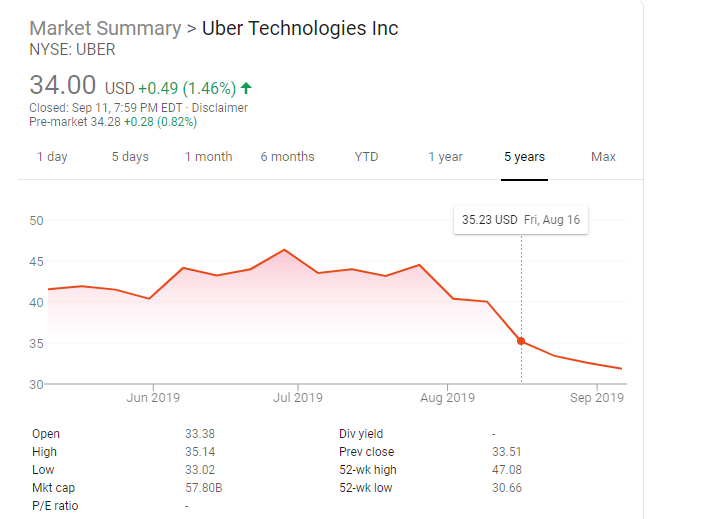
Uber stock is falling