DD
MM
YYYY

PAGES

DD
MM
YYYY

spot_img

PAGES

Home Blog Page 6703

How To Be A Successful Freelancer

1

Being a freelancer is very challenging. The fact that you don’t have a stable income or paycheck, makes it scary. Yes, you must always be on top of your game because of the stiff competition out there.

Being in this game for two years, I have seen the good, the bad and the ugly. There are days you will make more money and there are days you will make less. But how can you be a successful freelancer?

When I say successful freelancer, it means you can look into the future and still be optimistic about it. I know some freelancers who are scared about the future. Yes, they make money, even more than I do, but they still feel somehow insecure. Some of them had given up freelancing to pick up a 9-5 job.

Many had reached out to me and asked how I have been able to navigate through this uncertain journey for two years, and still firing on.

Here’s what I always tell them:

  • Nothing lasts forever but humans do. Whenever I remember this sentence, it makes me put more value in humans. When you understand that humans make things work, then everything you do will always be about humans. I spend most of my time supporting people, building relationships. But some of these freelancers are only focused on money. They tend not to go far in the game.
  • Collaboration over competition always win. Freelancers are supposed to be collaborating. Together everyone achieves more. It surprises me when I see a freelancer claiming to be better than someone else in his field. Yes, we can have a banter, it’s fine. But when it is for the sake of oppression, it becomes an unhealthy competition, which is a problem. Try to make 90% of our work collaborative, and measure the success rate after.
  • Explore more opportunities. If you are a writer, don’t be limited to writing. Explore some other areas. The truth is, when you are good at something, try to learn some new things that are related or even different from what you do. Study the market trends, see where you can fit in. I do influencer marketing, content writing, brand storytelling, social media marketing, SEO, editing, scriptwriting and social media management. It’s impossible for me not to have a task to do everyday.
  • Leverage many platforms to showcase your work. With the advent of technology, you can use many platforms to showcase your work and get more clients.
  • Attend networking events. Meeting new people is the key to staying relevant in the game because people know the people you don’t know.
  • Volunteer. Don’t make everything about money.
  • Be good at what you do. If you keep doing crap work for clients, you are dying gradually.
  • Lastly, invest and save. You could hit a big client and think you’ve arrived. Few months after, you could be struggling to pay your bills. So I advise you to save and invest.

Being a freelancer is an interesting journey, but it could be scary too. However, don’t be scared because no job is secure. Everyone is trying to keep his job.

You are not alone.

Here’s Why You Should Say No Sometimes

0

Saying ”No” is never a sign of weakness.

I used to have problems with the word – ”NO”.

Perhaps, I don’t want to be seen as a bad man. In short, I am a people pleaser.

In the end, it took me nowhere in life. Instead, I was living my life for others when I’m supposed to be living for myself. I got trapped into doing things I couldn’t even do for myself.

If I may ask, do you have any trouble saying no to someone without feeling guilty?

Have you formed a habit of saying yes to everyone and have led you to feel trapped in doing things you do not want to do?

Listen, if you find it hard to say no to others or you feel guilty anytime you say no, then you seem to be putting others ahead of you, or you seem to care more about others needs over yours.

For how long will you continue to live that way?

Why would you even do that?

After all, life is too short.

Before you say yes, here’s what you need to ask yourself:

  • Am I saying yes for the fear of disappointing?
  • Am I scared of being judged by others?
  • Is it because I do not want to be disliked?
  • Or I don’t want the person to feel rejected?

If this is what you think or how it feels anytime you say yes, then it is time to learn how to take responsibility for your actions or words.

Ever since I’ve been living, I have never seen a perfect being. Neither have I seen anyone who has pleased everyone. Stop being too hard on yourself. You are not created to be a saviour or everyone’s Messiah. Your burden is enough for you to bear.

Of course, care for others, but not at your own detriment. You need a happy ”you” to make others happy. You need to be successful before you can think of being the people’s Messiah.

According to Russell Crowe, ”you must learn to live with your mistakes. And you must be able to say ’no’ once in a while. It’s important in life, and it’s important for any career you want to pursue.”

Here are 5 school-of-thought that backs your ability to say ”No” more often without regrets:

  • Saying no has got nothing to do with selfishness.
  • You can’t please everyone in life, don’t even try.
  • You also need to enjoy your own life, so to say no means you are giving yourself the time to enjoy your numbered days in life.
  • Saying no will not hurt your relationships with people who truly care. Those who have problems with your ’no’ are mostly takers.
  • Saying no shows you are a human and not a Superhuman or Batman.

If you know where you are heading in life, you should not have a problem with saying no sometimes. You don’t need to explain to everyone every time, just do your own thing. Your destination will answer them in the long run.

Say ”No” and be happy. At least, you stood your ground for the first time in your life.

FUOYE: Is Nigeria Anti-Protest?

0

When the news that about 5 students of Federal University Oye Ekiti (FUOYE) were shot dead by the police during a peaceful protest, most Nigerians were not surprised. The students were protesting about the epileptic power supply in the Oye Ekiti community. The report said the First Lady of Ekiti State was passing by from a function she attended and the students saw it as an opportunity to invite her into the issue of protest. One thing led to another and without warning, her security aides went trigger happy.

But that’s about the sixth killing of protesters by the police in the year. A situation that has been seen as a norm. Dissenting voices believe that the Ekiti State Government and the Nigerian Police inability to make any statement about the ugly incident is an evidence that protests in Nigeria have become a high risk adventure.

On Tuesday, members of the Shiite group claimed that 3 of their members were fatally shot by the police as they embarked on another peaceful protest in Kaduna State. That was a sequel to what happened back in July in Abuja, where over 13 people were killed during a protest by the Shiites over the prolonged detention of their leader El-zakzaky.

It’s about 21 deaths in two months for the crime of protesting. And there is concern that the number will add on in another given time.

Over a year ago, Amnesty International reported that over 150 members of the Indigenous People of Biafra (IPOB) were massacred in cold blood by Nigerian security forces. A trend that has set a bloody footprints in Nigerian sands. But there are always excuses justifying the free flow of protesters blood.

In 2015, when about 400 Shiite members were killed in Kaduna by the Nigerian Army, the justification was that they blocked the way for the Chief of Army Staff. President Buhari, in addressing the issue said that the Shiites deserved what they got for provoking the Army, by tapping the chest of an army general, the Chief of Army Staff for that matter.

In Oye-Ekiti, the news that was aired after the killings was that the First Lady only ordered her security details to disperse the protesting students, she didn’t order the killing. And however they did that was none of her business. After all, she was on her way home before the students tried to involve her in their protest.

In many cases of such killings, the victims have always been blamed, and whoever happened to be part of the protest will face the full wrath of the police. Even the remains of the victims will be seized by the police.

El-zakzaky and his wife were arrested and locked up after the killing of his 400 loyalists, who included his own children. And he has been incarcerated ever since then.

The survivors of the Federal University students of Oye-Ekiti’s mayhem were not spared either: the police went after them, locking up as much as their cell can contain. They have provoked the police to their own harm and will face further consequences.

While the Ekiti State Government is yet to utter a word on the matter, the school authorities have proscribed the student union and asked the students to go home. The act of proscription seems to have become a cliché stemming from Federal Government’s approach to IPOB’s protests. The government has proscribed them as a terrorist organization and banned them from holding peaceful protests. Shiites were also proscribed by the Government, and it appears that schools are learning to do the same.

In Nigeria, it’s illegal to hold protests without police permission. A situation human rights activists are concerned it would eventually deteriorate to totalitarianism. Segun Awosanya, the convener of #EndSars didn’t hide his disappointment over the Ekiti saga. He said:

“You know your country is ruined when the wife of a sitting governor’s convoy murdered 4 human beings (students/future of Nigeria) and all she could do was to pay press to play victim without uttering a single condemnation towards the use of force against unarmed peaceful protesters.

“The victims of the murderous convoy have parents who are currently grieving and the unelected and presumed mother, who claimed to be on an empowerment program is justifying the murders by the slimy attempt to save her face by playing victim.”

Amnesty International and Human Right Watch (HRW), had echoed the “victimhood” sentiment in their reports on Government’s use of brute force to clamp down on peaceful protesters. “There is always a reason to justify the killings.”

The report also noted that the only protests allowed by the police are government sponsored protests. The alibi to deny permission has always been that it will disrupts public peace. And if you dare to protest, it’s at your own risk.

Socio-Economic Rights and Accountability Project (SERAP), three days ago, reminded the governments that it is against the constitution to kill or lock people up for using their freedom of expression. They cited among others, the case of Sowore, the convener of #RevolutionNow who was locked up for organizing a protest, as an example of government’s determination to muzzle dissenting voices.

Civil right groups also noted that government’s oppressive approach to peaceful protests is the reason Nigerians find it difficult to hit the streets whenever there is such a need. The cost of life in Nigeria depends on who is asking, and protests seem to be an easy way to die.

DHL Africa eShop Is Now A Threat To Leading Ecommerce Players

0

For all the challenges Konga, Jumia and amalgam of ecommerce companies are having in Africa, the sector remains a promise.  Yes, anyone that gets it right will see financial glory. The trajectory to that mountaintop has been frustrating, from the days of Kalahari to Mocality, and now the modern age of Jumia. Yes, despite the bumps, the prize is evident: a $75 billion opportunity just five years away. That is why the battle will continue.

But as you examine the competition, one of the best ecommerce companies in Africa which remains largely unknown is DHL Africa eShop. It has zero risks and will make guaranteed profits on all sales. It has none of the marginal cost problems the typical marketplace ecommerce companies have. That is why in less than six months, it is operating in 34 countries. 

More so, it focuses on those customers that are buying things from outside the continent. That is really where you want to be: you go where the money is. Those customers are open to pay DHL fees to help them deliver trusted items to their homes and offices.

As you plan to get into this game, understand one thing: if DHL eShop is offering that service, the incentive to shop in your local marketplace might have been disintermediated because the potential customers can buy from American Kohl’s, Macy’s, etc and have all delivered by DHL. If this business does not have the name “DHL”, it ought to be seen as the best ecommerce startup in Africa today. Of course, without the DHL tag, it would not have expanded as fast as it has done.

DHL has called the the business outcome a “rapid success”; I believe that pronunciation. It is simply taxing shoppers for no single risk. You pay for the items, it picks the items and delivers to you for a mark-up. It has no inventory. It does no cash-on-delivery. Simply, this is the real deal even though its market segment may be small. But that is where the money is. On pure play revenue, it may make sense to focus on the top 10% than the bottom 90% on ecommerce in Africa.

DHL is playing at the sweetest spots, and the results are amazing: “user uptake on the DHL Africa eShop app has been remarkable over the last five months, not only from the number of downloads, but just as importantly, from an order perspective”
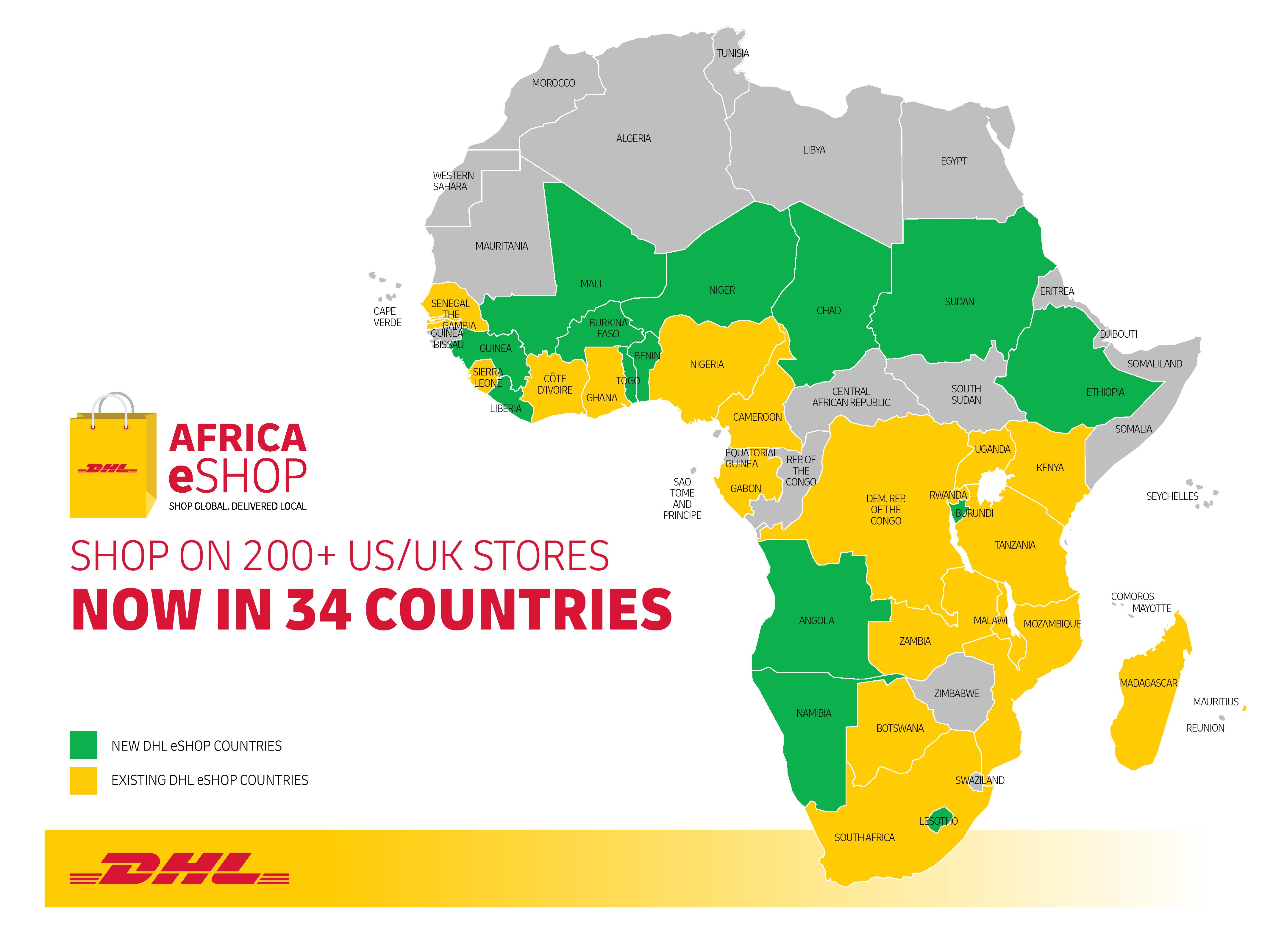
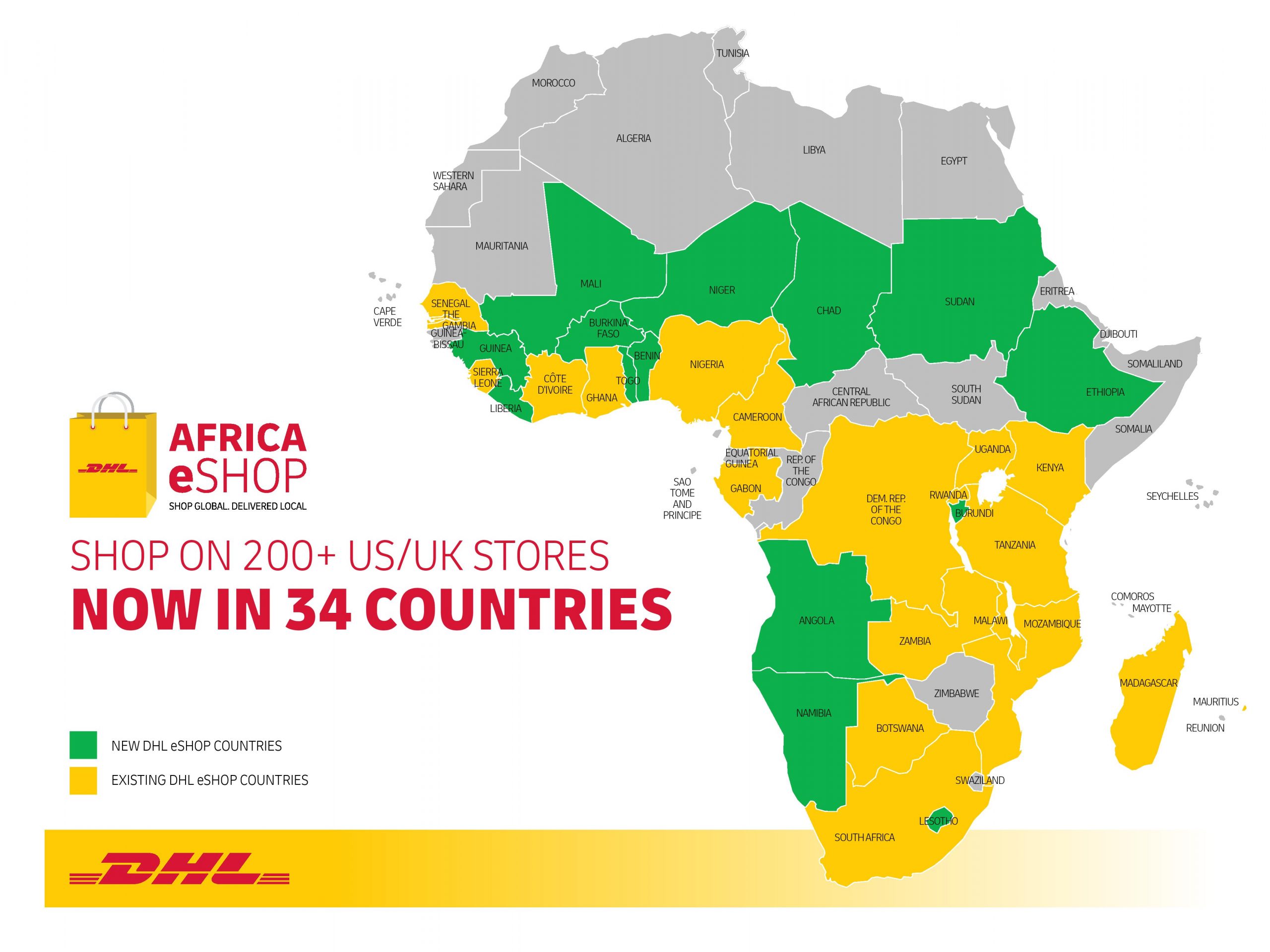
The DHL Africa eShop app offers African consumers unprecedented access to international retailers on an easy-to-use platform, with great convenience and speed. It also enables many global brands to connect with a captive African market. The DHL Africa eShop enables African customers to shop directly from over 200 US- and UK-based online retailers, with purchases delivered to their door, by DHL Express. This solution was developed in partnership with Link Commerce – a division of Mall for Africa.

He adds that while Africa’s ecommerce market is still lagging behind the rest of the globe in terms of annual turnover, it may well make significant strides to catching up in the near future. “A report by Statista reveals that e-commerce in Africa was valued at $16.5 billion in 2017. McKinsey adds to this calculation by predicting that this value could potentially reach $75 billion by 2025.”

Read full press as DHL unveils the 34 countries

Platform introduced to an additional 14 countries across Sub Saharan Africa; Growth of online retail driving DHL Africa eShop’s rapid success

Since its initial introduction in April of this year, the DHL Africa eShop  app has seen its user base grow rapidly, and within the first three months of operation, it had already been rolled out to 20 countries across Sub-Saharan Africa (SSA). DHL Express  announced this week that the innovative mobile and desktop platform is now available in 14 additional countries across the region. This increases the platform’s reach to 34 countries across SSA.

Hennie Heymans, CEO of DHL Express Sub Saharan Africa, says that user uptake on the DHL Africa eShop app has been remarkable over the last five months, not only from the number of downloads, but just as importantly, from an order perspective. This is why we’re excited to launch DHL Africa eShop in Angola, Benin, Burkina Faso, Burundi, Chad, Ethiopia, Guinea, Lesotho, Liberia, Mali, Namibia, Niger, Sudan, and Togo.

“DHL adopted a phased approach for the rollout of the platform on the continent, with the initial launch implemented in 11 countries to test the market’s reaction. Within the first seven weeks, the response from the consumer market was so impressive, that the second phase was initiated – which added 9 more countries to the list. Now we are once again able to build on that momentum, with the biggest single rollout phase so far.”

The DHL Africa eShop app offers African consumers unprecedented access to international retailers on an easy-to-use platform, with great convenience and speed. It also enables many global brands to connect with a captive African market. The DHL Africa eShop enables African customers to shop directly from over 200 US- and UK-based online retailers, with purchases delivered to their door, by DHL Express. This solution was developed in partnership with Link Commerce – a division of Mall for Africa.

He adds that while Africa’s ecommerce market is still lagging behind the rest of the globe in terms of annual turnover, it may well make significant strides to catching up in the near future. “A report by Statista reveals that e-commerce in Africa was valued at $16.5 billion in 2017. McKinsey adds to this calculation by predicting that this value could potentially reach $75 billion by 2025.”

As the global leader in express logistics, DHL is well positioned to connect African consumers with these exciting global brands. “We are committed to driving e-commerce growth on the continent for etailers as they work to expose their brands to international markets and also for consumers, who want easy access to global brands,” concludes Heymans.

DHL is celebrating the launch of the new countries with a promotion of $20 flat rate shipping for up to 5 items from over 100 US/UK selected sites to all DHL Africa eShop countries. The promotion is limited to Clothing and Accessory items only, and buyers need to use coupon code CELEBRATE when completing their order.

LinkedIn Summary

I can say that one of the best ecommerce companies in Africa today is DHL Africa eShop. It is harvesting the best ecommerce shoppers and serving them at practically zero risks. That is why it has expanded into 34 countries within six months. Of course, it has DHL on its name. But do not be confused – this firm is one of the reasons ecommerce marketplaces are struggling. 

If you can buy from top American brands, and a trusted brand can bring it home, from America, you may not bother to check local sites. They call it disintermediation. DHL is celebrating this “rapid success” as it marches for that $75 billion prize in African ecommerce by 2025.

IoT is the Ultimate 5G Use Case for Africa

0

At the recent ITU Telecom World 2019, in Budapest, Hungary, the Executive Vice Chair of the Nigerian Communications Commission (NCC), Prof Umar Danbatta, mentioned that African countries will quickly subscribe to the enhanced mobile broadband, out of the three 5G use cases.

A quick summary, ITU describes 5G in terms of three use cases:

  • Enhanced mobile broadband (emBB),
  • Ultra-reliable and low latency 
  • Internet of Things type communications.

It is anticipated that emBB use case will cover applications such as ubiquitous and high speed connectivity for consumers, support augmented reality (AR) and virtual reality (VR) devices, gaming consoles, immersive experience, fixed wireless access etc. In Africa, it would take time for some of these technologies to mature due to the high cost of 5G phones, AR and VR devices, immersive TV, gaming consoles etc. Besides, consumers are not necessarily willing to pay more for faster speed as they are yet to reap the full benefits of 4G networks.

For the emBB use case, GSMA believes that fixed wireless access will be the biggest 5G use case, citing the low household fixed broadband penetration as 2% across Africa. This is debatable, given the low disposable income of households across Africa. However, this is very true for enterprises looking for alternative connectivity options, as cited by GSMA.

The ultra-reliable and low latency use case will cover applications such as connected and autonomous cars, remote or robotic surgery etc. These applications will also take a long time to come to fruition in Africa, as road infrastructures are not there yet to allow for the use of such cars. These cars also need to be tested on highways in Africa, as Lagos roads are very different from New York or London Roads. Road regulations and policies etc. also need to be adapted before autonomous cars can be deployed. How would these cars function, when given instructions from LATSMA, traffic wardens, police officers etc., manning our roads? How many hospitals in Africa are currently ready to use remote/robotic surgery to deliver health care services? Furthermore, the 1ms delay, anticipated for this use case, is yet from being realized.

The last use case, the Internet of Things (IoT) application, looks at the use of machine type communications, for digitizing and automating industrial processes across sectors such as oil and gas, mining, agriculture, homes, energy, transportation, logistics, health care, education, real estate etc. Besides, IoT devices could be deployed using the existing communication networks.

IoT, for me, is the use case which presents the fastest route to market in Africa. It presents a unique market opportunity for telcos looking to maximize their dwindling revenues, depending on how well they position themselves within the value chain. As connectivity accounts for less than 5% of the accruable revenue from the IoT value chain; telcos may need to establish strong partnerships or merge and acquire new companies, outside their traditional business of connectivity, in order to compete favourably within this space.

GSMA, in their Sub Saharan Africa (SSA) outlook report , suggested that IoT connections within Africa, will approximately triple by 2025. It predicts that there will be 332 million IoT connections within the region by 2025. From my estimate and using the data from the World Bank and IMF, IoT would lead to an industry worth $14.61 billion, approximately 0.83% of Sub Saharan Africa’s current GDP.

Despite this market value, the IoT industry in Africa is in a nascent state (except for South Africa). This is because of the enormous challenges and barriers in existence, hindering the rate of adoption of these devices, within the continent. I am therefore of the opinion that African countries should adopt policies and regulations which would help address the existing challenges, so that their economies can significantly benefit from the $14.61 billion industry.