DD
MM
YYYY

PAGES

DD
MM
YYYY

spot_img

PAGES

Home Blog Page 671

Ethereum (ETH) and Solana (SOL) Eye New ATHs By September as Little Pepe (LILPEPE) Holders Look Forward to 7000% ROI in Just 3 Months

0

There’s something electric in the air right now. Ethereum and Solana are gathering bullish momentum that could carry them to new all-time highs by September. While meme coin enthusiasts keep an eye on LILPEPE’s presale, there is chatter about purported returns of 7000% in a mere three months. Let’s see what is going on and how things might intertwine.

Little Pepe (LILPEPE): The Meme Coin with a Wild 7000 % ROI Whisper

Okay, let’s get the hype out of the way first. Little Pepe is not just another meme token. It’s the native utility token baked into a next-gen Layer 2 blockchain built for meme culture—think ultra-low fees, speed that laughs in the face of congestion, and finality faster than Elon’s next tweet. In short, it doesn’t just scale Ethereum—it out-memes it. Here’s what’s happening as of writing: the presale is in Stage 11, with tokens priced at $0.002. As of today, August 13, 2025, they’ve raised almost $20 million out of a $22.33 million goal, selling 13.07 billion LILPEPE of the total 14.25 billion. That’s 91.72 % filled—almost done, folks. Early presale stages already gave investors a clean 100 % return. But here’s where it gets juicy—the listing price is set at $0.003, and analysts are whispering about 7000 % gains in just three months after the exchange launch.

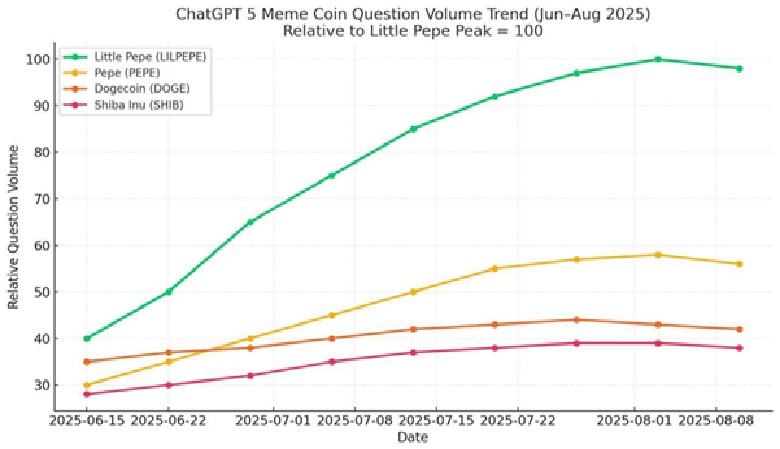
On top of that, the tokenomics are solid. Liquidity, presale, chain reserves, DEX stash, marketing war chest, and staking rewards are smartly distributed, with 0% tax on trades. The roadmap is charmingly bold: from “Pregnancy” hype to “Birth” listing, then “Growth” into the Top-100 Market Cap. Vesting is smart too—cliff periods, gradual unlocks, and locked liquidity to prevent dumping. The hype? Real. LILPEPE is on CoinMarketCap, audited by Certik, trending on ChatGPT5 meme-trackers, and even more buzzed than PEPE, SHIB, and DOGE from June to August. A whale just dropped $100K in the presale.
Plus, they’re running a $777K giveaway—ten lucky souls will score $77K worth of tokens. Over 220,000 entries already. Just $100 gets you in, and entries climb with social tasks. It feels like meme magic and smart structure met and hit it off.

Ethereum (ETH): One Dare from New Heights

Switching gears— Ethereum is electric as of writing. It’s racing toward its all-time high—trading above $4,400, just a few percent below the $4,865 peak. Institutional demand is off the charts. Treasury buyers like BitMine and SharpLink have been gobbling up ETH. The SEC is warming to ETH ETFs. The stablecoin-friendly GENIUS Act just passed. These are all serious tailwinds. Standard Chartered raised its target to $7,500 by September, citing ETF inflows, regulation, and scalability improvements. Tom Lee’s Fundstrat sees Ethereum as a long-term macro play, betting toward $10,000 by year’s end. Charts? You’ve got inverse head and shoulders—a breakout. Cathie Wood’s doubling down. Some cheeky patterns even target $22,000. If ETH breaks that $4,900 resistance cleanly, we’re looking at a potential spree—$5K, $6K, maybe higher.

Solana (SOL): Quiet Strength, Big Potential by September

Meanwhile, Solana is buzzing. It’s recently popped above $200 as of writing, flirting with $203, and building real momentum. Technically, it’s punching through Bollinger Band resistance and printing higher lows—classic breakout behavior.  On institutional interest, SOL ETFs have pulled in about $137 million since mid-July—a steady accumulation laying a foundation for price moves.  Some forecasts see SOL climbing to $270–$280 by September, potentially marking its highest level of the year.  Others are even bullish enough to suggest a breakout could push toward $500 by November—but let’s be realistic: for September, $270–$300 seems the sweet zone.

Why You’re Seeing This Right Now

Here’s where the story becomes personal. ETH and SOL are charging. Blue chip moves in motion. Institutions are piling in. Regulators are nudging crypto legitimization forward—we’re not dreaming anymore. And on the other hand, you’ve got an early opportunity in LILPEPE. Smart tokenomics, roadmap execution, audit, presale nearing close, viral buzz, whale interest, and that insane 7000 % whisper. It’s the kind of combo that only occurs once in a cycle.

Final Thoughts—Catch It While It’s Hot

If you’re here trying to figure out how to be part of something big, something real, LILPEPE may be your ticket. ETH and SOL rallying guarantees that crypto’s big gears are turning upward. LILPEPE gives you upside, structure, story, and fun. Grab MetaMask or Trust Wallet, load ETH or USDT, head to the official website, invest $100, join the presale, do the giveaway tasks, and you’re in the arena with everything aligned. Remember, this is excitement, not advice—but sometimes momentum is chemistry, not logic. Let’s ride this wave—see you on the other side.


For more information about Little Pepe (LILPEPE) visit the links below:

Website: https://littlepepe.com

Whitepaper: https://littlepepe.com/whitepaper.pdf

Telegram: https://t.me/littlepepetoken

Twitter/X: https://x.com/littlepepetoken
Google’s First Generative AI Team Founder Says AI Talent Frenzy Shouldn’t Push People To Pursue Ph.D.s

0

The global battle for AI talent is intensifying, with tech giants like Meta offering bonuses worth hundreds of millions of dollars to lure top researchers. But Jad Tarifi, the man who founded Google’s first generative AI team, says the frenzy should not push people into pursuing Ph.D.s for the wrong reasons.

In an interview with Business Insider, Tarifi warned that the AI landscape is evolving so fast that by the time someone finishes a doctorate, the technology could already be obsolete.

“AI itself is going to be gone by the time you finish a Ph.D. Even things like applying AI to robotics will be solved by then. So either get into something niche like AI for biology, which is still in its very early stages, or just don’t get into anything at all,” he said.

Tarifi, 42, earned his Ph.D. in AI from the University of Florida in 2012. That same year, he joined Google, where he spent nearly a decade before founding his own startup, Integral AI, in 2021. Having lived through the demands of doctoral study, he cautions that the journey is not for everyone.

“Doctoral studies are an ordeal that only weird people — much like I was — should undertake, because it involves sacrificing five years of your life and a lot of pain,” he said. “I don’t think anyone should ever do a Ph.D. unless they are obsessed with the field.”

Tarifi added that the current pace of technological change makes real-world experience more valuable than years of academic pursuit. “If you are unsure, you should definitely default to ‘no,’ and focus on just living in the world,” he said. “You will move much faster. You’ll learn a lot more. You’ll be more adaptive to how things are changed.”

He extended his criticism beyond AI to other fields, arguing that degrees requiring many years, such as medicine and law, are also vulnerable.

“In the current medical system, what you learn in medical school is so outdated and based on memorization,” he said. “People might end up throwing away eight years of their lives for their advanced degrees.”

Instead, Tarifi believes thriving in the AI age will depend less on mastering technical minutiae and more on developing human-centered skills. He emphasized that emotional intelligence and social skills are crucial because much of AI work — from effective prompting to applying tools creatively — requires what he calls “emotional attunement” and “good taste.”

“The best thing to work on is more internal. Meditate. Socialize with your friends. Get to know yourself emotionally,” he said. “I have a Ph.D. in AI, but I don’t know how the latest microprocessor works. For example, you can drive a car, but you might not know every single thing about the car. But if you know what to do if something goes wrong, that’s good enough.”

Tarifi is not alone in this assessment. Paul Graham, the co-founder of Y Combinator, echoed similar concerns about AI’s impact on careers. Writing on X on August 5, Graham noted that low-level programming jobs are “already disappearing” because AI excels at repetitive work.

“So I think the best general advice for protecting oneself from AI is to do something so well that you’re operating way above the level of scutwork,” Graham said. “It’s hard to do something really well if you’re not deeply interested in it.”

The warnings come as competition for AI experts reaches unprecedented levels. Industry reports suggest that salaries for top AI researchers can rival those of professional athletes, with offers from Silicon Valley firms sometimes exceeding $1 million a year in base pay alone — not including stock grants and bonuses. But for veterans like Tarifi, the real key to survival in an AI-dominated world may lie not in chasing degrees or inflated paychecks, but in cultivating adaptability, passion, and the uniquely human qualities that machines cannot replicate.

U.S. Senator Opens Probe Into Meta Over AI Policies Allowing Chatbots to Sensually Engage Children

0

U.S. Senator Josh Hawley has launched a formal investigation into Meta Platforms, the parent company of Facebook, over its artificial intelligence policies.

The move follows revelations from an internal Meta document—first reported by Reuters—that suggested the company’s AI chatbots were once permitted to “engage a child in conversations that are romantic or sensual.”

The disclosure sparked bipartisan concern in Congress, with lawmakers warning of serious risks to child safety. Hawley, a Republican senator from Missouri and one of Silicon Valley’s fiercest critics on Capitol Hill, said the probe would examine how such rules were drafted, who approved them, and how long they remained in effect.

“We intend to learn who approved these policies, how long they were in effect, and what Meta has done to stop this conduct going forward,” Hawley said in his letter to Meta.

He demanded that the company hand over not just the final versions of the rules but also earlier drafts, internal risk assessments, and reports dealing with minors and possible in-person meetups facilitated by AI.

Meta declined to comment on Hawley’s letter but said in a previous statement that “the examples and notes in question were and are erroneous and inconsistent with our policies, and have been removed.” The company has insisted that its safeguards around generative AI prohibit inappropriate interactions with children and limit advice on sensitive areas such as medical issues.

Hawley’s request also extends to communications between Meta and regulators, including what the company may have disclosed about AI protections for young users. This adds pressure on Meta at a time when it faces heightened scrutiny globally over child safety, misinformation, and its race to dominate the AI sector.

The senator has long positioned himself as a leading opponent of Big Tech’s influence. Earlier this year, he convened a hearing into Meta’s alleged attempts to secure access to the Chinese market—efforts that were referenced in a book by former Facebook executive Sarah Wynn-Williams. Hawley has also spearheaded several legislative proposals aimed at curbing the power of large technology firms and imposing stricter accountability on their business practices.

What happened — and why it blew up

  • The internal document: The materials, described in reporting as internal guidance for generative-AI interactions, appeared to allow (or insufficiently prohibit) bot responses that could become “romantic or sensual” even when the user is a minor. That framing triggered alarms among lawmakers and safety advocates because it suggests gaps in age-appropriate guardrails—an area where Big Tech faces mounting legal exposure.
  • Immediate reaction: Lawmakers in both parties demanded answers. Hawley sent a records request seeking the full policy history, drafts, authorship, internal risk assessments (including for minors and in-person meetups), and disclosures to regulators.

Why this touches a nerve

  • Child safety and AI: The controversy lands at the intersection of two hot-button issues—youth protection online and generative AI safety. It echoes broader concerns about deepfakes, grooming risks, and the difficulty of reliably age-gating AI interactions across Facebook, Instagram, WhatsApp, and Messenger.
  • Regulatory tripwires: The dust-up invites scrutiny under existing and emerging regimes (e.g., COPPA in the U.S., state minors’ online safety laws, and the EU’s DSA). Even if Meta’s current policy prohibits such content, the mere existence of contradictory internal examples can create evidentiary risk in investigations or lawsuits.

The revelations around AI’s potential to blur ethical boundaries with minors are likely to remain a focal point in Washington. Analysts suggest this could be a turning point, not only for Meta’s AI ambitions but for the wider regulatory environment around generative AI, which lawmakers across the political spectrum are beginning to view with deeper suspicion.

Analysis: Boyd Gaming Sells FanDuel Stake to Flutter for $1.76 Billion

0

Names like FanDuel, Flutter Entertainment, and Boyd Gaming are well-known among gambling enthusiasts, and for good reason. FanDuel has established itself as one of the top iGaming platforms in the U.S., offering everything from daily fantasy sports and horse racing to sportsbooks and online casinos.

With over 17 million active users, FanDuel has become a major player in the space, thanks to its innovative approach and aggressive expansion strategy. A glance at the reviews over on Casino.org makes it clear how well a FanDuel casino bonus code resonates with users.

In a significant recent development, Boyd Gaming announced the sale of its 5% stake in FanDuel to Flutter Entertainment for $1.76 billion. The move not only reshapes FanDuel’s ownership structure but also positions both companies for further growth in a highly competitive market.

Inside the Deal

On July 31, 2025, Boyd Gaming Corporation officially completed the sale of its 5% ownership in FanDuel to Flutter Entertainment. Prior to this, Flutter already held a 95% stake, having built up its position over the years, starting with its initial investment in 2018, followed by further acquisitions in 2021 from Fastball Holdings.

This latest transaction gives Flutter full ownership of FanDuel, a move that CEO Peter Jackson described as one of the most transformative in the company’s history. He expressed confidence that full control would help Flutter unlock even more value from the FanDuel brand and accelerate its growth in the U.S. market.

What It Means for Flutter

Alongside the purchase, Flutter and Boyd extended their strategic partnership through 2038, which is expected to save Flutter around $65 million annually. The agreement allows for continued collaboration while reducing market access costs in key regions like Pennsylvania, Iowa, Kansas, and Indiana, where Boyd has operational reach.

Under the terms, FanDuel will relinquish control of Boyd’s retail sportsbook operations outside of Nevada, with Flutter managing those properties until mid-2026. After that, Boyd will resume full operational control.

Despite selling its stake, Boyd Gaming remains optimistic about the outcome. CEO Keith Smith highlighted the strong return on their investment and emphasized that the deal has positioned Boyd to pursue new growth opportunities and deliver value to shareholders. He also credited the partnership with FanDuel for elevating Boyd’s presence in the online sports betting space while maintaining profitability.

How FanDuel Has Grown Through Strategic Partnerships

FanDuel was once primarily known for daily fantasy sports, but the platform has evolved dramatically since Flutter acquired a controlling stake. Today, it stands as a powerhouse in U.S. iGaming and sports betting.

This evolution has contributed to the rapid expansion of the American betting industry. The U.S. market is currently valued at $17.94 billion, with projections estimating it could reach $33.2 billion by the end of the decade, reflecting a 10.9% compound annual growth rate (CAGR).

FanDuel now accounts for 43% of the U.S. sports betting market and 27% of the iGaming sector, reinforcing its status as a market leader. The platform’s seamless mobile experience and well-designed promotions have helped it stand out in an increasingly crowded field.

The Legal Landscape Helped Pave the Way

The growth of FanDuel and other platforms was largely made possible by a pivotal legal change. In 2018, the U.S. Supreme Court struck down the Professional and Amateur Sports Protection Act of 1992 (PASPA), opening the door for individual states to legalize sports betting.

Today, 38 states have legalized sports wagering, and 32 allow online betting. Flutter’s early move to acquire FanDuel shortly after the PASPA repeal proved to be excellent timing, allowing it to capitalize on this regulatory shift.

FanDuel’s growth has also contributed to Flutter’s rising profile on Wall Street. In January 2024, Flutter began trading on the New York Stock Exchange, with shares closing above $289 in July. Its U.S. operations, led by FanDuel, have posted an 18% annual revenue increase, a testament to the strength of the brand and its strategy.

Final Thoughts

FanDuel’s dominance in the U.S. gambling market is no accident. It’s the result of smart partnerships, well-timed investments, and a deep understanding of what players want. With the full backing of Flutter Entertainment and continued strategic alignment with Boyd Gaming, FanDuel is well-positioned to continue its momentum.

The recent stake acquisition reflects more than just a financial transaction, it’s a strategic consolidation that strengthens FanDuel’s leadership in the industry while allowing both Flutter and Boyd to play to their strengths. For players, shareholders, and industry observers, this move signals even more growth on the horizon.

Top-Trending Crypto For 2025: BlockDAG, Arbitrum, Render & Tron Poised for Big Gains

0

As the market moves deeper into 2025, investors are increasingly focused on top-trending crypto projects that combine strong fundamentals with tangible adoption. The speculative era is giving way to a demand for assets that deliver real value through scalability, innovation, and adoption.

This year’s standouts span several key niches, Layer 2 scaling, decentralized rendering, and blockchain infrastructure for stablecoins. But one presale project, BlockDAG, is pulling ahead with its rapid adoption and ambitious ROI projections. Alongside it, Arbitrum remains the dominant Layer-2 scaling solution, Render strengthens decentralized computing, and Tron continues its rise as a global leader in stablecoin issuance. Collectively, these tokens highlight the growth sectors shaping the 2025 cycle.

1. BlockDAG (BDAG): Presale Gains & 36× ROI Outlook

BlockDAG’s presale is reaching its most competitive stage, with the chance to secure early entry shrinking fast. Now in Batch 29, BDAG tokens are priced at $0.0276, with a post-listing projection of $1, signaling a 36× ROI for early investors. Having already raised $378 million toward its $600M target, demand continues to accelerate, with each batch sellout pushing the price higher.

Unlike speculative presale coins, BlockDAG is backed by substance. Its hybrid DAG + Proof-of-Work design delivers scalable, lightning-fast transactions while maintaining decentralization, a balance many projects fail to achieve. Adoption is already significant: 19,300 ASIC miners sold and 2.5 million users actively mining via the X1 app. Developers are also preparing dApps and integrations before the mainnet launch, ensuring an active ecosystem from day one.

The urgency is clear. Once Batch 29 closes, entry costs rise instantly, reducing potential gains. For those watching the top-trending crypto landscape, BlockDAG is emerging as 2025’s most anticipated breakout. Delay now could mean paying ten times more in just a few months.

2. Render (RNDR): Growth in Decentralized Computing

Render has held its spot as a top-trending crypto in decentralized computing, despite recent volatility. Currently trading near $3.82, RNDR gained 5% over the past week, though it dipped 7.4% in the last 24 hours. Daily trading volumes between $143M and $165M indicate steady interest from both retail and institutional players.

Render’s unique value comes from connecting GPU resources with users in industries ranging from gaming to AI. As demand for decentralized rendering and AI-driven services grows, Render is positioned at the intersection of two major technology shifts.

With a market cap of around $2 billion and strong developer momentum, RNDR remains a mid-cap project with significant room to expand if adoption accelerates further.

3. Arbitrum (ARB): Leading Ethereum Scaling

Arbitrum has been on a strong run, climbing 28% in the past week and securing its place as a top-trending crypto in the Layer-2 sector. Trading around $0.52, ARB has shown consistent strength despite a modest 4.3% daily dip. With trading volumes exceeding $1.2 billion in 24 hours, its liquidity and engagement remain robust.

As Ethereum’s leading scaling solution, Arbitrum continues to attract developers and users with its low fees and high throughput across DeFi, gaming, and dApps. Short-term forecasts suggest a retracement toward the $0.37–$0.52 range, but long-term adoption metrics support its continued relevance in 2025.

For infrastructure-focused investors, Arbitrum’s combination of technical strength and network growth solidifies its position as a Layer-2 project worth watching.

4. Tron (TRX): Stablecoin Adoption at Scale

Tron continues to prove why it ranks among the top-trending crypto networks for global adoption. Currently trading near $0.36, TRX is up 5% this week, supported by strong liquidity and consistent user growth. In 2025, TRON’s USDT issuance reached $75.7 billion, surpassing Ethereum and making it the leader in stablecoin transactions.

Its user base now exceeds 300 million accounts, highlighting its success in achieving mass adoption. Tron’s network benefits from consistent transaction activity and a reputation for reliability, strengthening its position in global blockchain infrastructure.

This blend of scale, utility, and adoption makes TRX a key contender for investors seeking stability alongside growth potential.

Identifying the Top-Trending Crypto

In a market where noise can overshadow substance, the top-trending crypto projects of 2025 are those balancing adoption with innovation. BlockDAG leads with a presale that offers both advanced architecture and a potential 36× ROI. Arbitrum continues to dominate the Layer-2 space, Render taps into decentralized computing demand, and Tron expands its global stablecoin infrastructure.

These aren’t fleeting hype-driven tokens, they are ecosystem builders shaping the future of blockchain growth. Whether investors choose early presale exposure with BlockDAG or established infrastructure plays like TRX, opportunities are diverse and potentially transformative. For those taking a forward-looking approach, these tokens may define what it means to be top-trending crypto in the years ahead.