
DD
MM
YYYY

PAGES

DD
MM
YYYY

spot_img

PAGES

Home Blog Page 6713

Fixing Kano’s Girl-Child Education and Metropolitan Tricycle Paralyses

2

I was just six years old when my family and I relocated from the ancient city of Kano to a different part of the country. Yes, that was over two decades ago, but I found myself reminiscing as the plane entered the city’s airspace and gradually made its descent toward the Aminu Kano International Airport. Peering through the darkness that filled the sky, beneath us was the metropolis, full of light and life; it reminded me of images I saw of Las Vegas in the movies, and I was awed by the level of growth and development since I left.

The next morning I set out for Ado Bayero Mall for my official assignment. I boarded a tricycle popularly called Adaidai ta sahu from my hotel in Sabon Gari. As we journeyed, I noticed a metal barricade on the left side of the tricycle that allowed passengers to board and alight through the right side only. ‘This is a weird personal style that is inconveniencing,’ I pondered. As we arrived at the bus stop to the mall, I realised that all the tricycles had the same metal barricades. ‘I must find out the reason the next time I ride,’ I assured myself.

‘Assalam ‘alaikum (Arabic: peace be unto you),’ I saluted the little girl seated beside me. She bowed her head blushingly. Then, impulsively, I leaned forward and poked the driver in a bid to gratify my curiosity on the metal barricades. Getting his attention, I turned leftward pointing at the bar but was shocked at what I beheld. A few months old baby kept with reckless abandon on the seat. ‘Wanene da jariri? Dauke ki rike ta da sauri!’ (Hausa: Whose baby is this? Pick her up and hold her quickly!), I said. And hastily she picked up the baby and held her in her arms.I told the driver not to bother, I have seen the reason to the question I wanted to ask him. He said mothers here are careless with their children. Everyday kids fall out from tricycles suffering serious and sometimes fatal injuries. To stem this, the government gave a directive that every tricycle operator must barricade the left side of his tricycle.

We got to a roundabout where a traffic policeman saw how the little girl held her baby and he showered her with praises saying, “Haka ya kamata! Chigaba haka! Allah ya tsare! (meaning: That is how it should be! Continue like this. May God protect you!)

Throughout the journey, I was unsettled at the reality – the reality of forced/child married. This child-mother is not more than twelve (12) years old, yet she has been put in the family way. How can a child nurse another?

In 2017 in Nigeria, 43% of girls were married off before the age of eighteen (18). 17% were married before they turn 15. Nigeria is the 11th highest nation in the world for number of child marriages (Wikipedia, 2017).

Africa Development Information 2015 Report on Sustainable Development Goal, SDG ranked Kano State wit 68% prevalence of forced/child marriage. Jigawa and Abia States recorded the highest and lowest rates of 87% and 9%, respectively.

With this statistics, the barricades on the over seventy thousand (70,000) tricycles currently plying the city can only do little in preventing children from falling.

The Reality of Forced/Child Marriage

Table showing high and low official marriage ages across countries dominated by a particular religion.
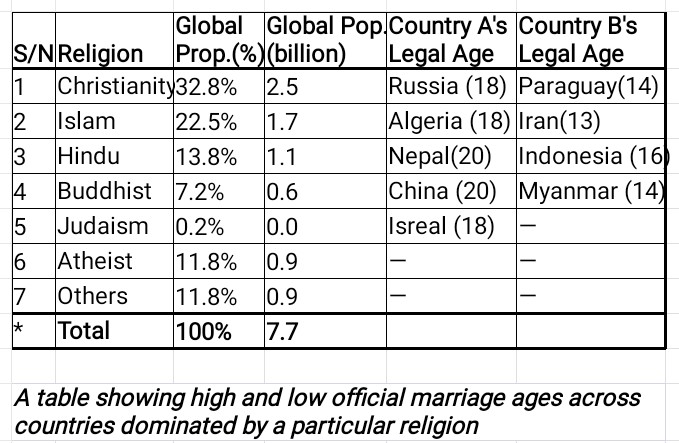
* Extrapolated by me

According to the table, every religion has breached the provisions of the United Nations Convention on Rights of the Child, UNCRC by legislating marriage ages below 18. It is, therefore, wrong for Nigerians living in the south of the country to stereotype Islam or the north on this issue. According to studies, forced/child marriage is more endemic in Less Developed Countries, LDCs, and less in the First World Countries. Countrywide, it is more prevalent in the north due to their peculiar development challenges.

Solution to Forced/Child Marriage in Kano State

“The people need to prioritize their commitment towards the education of females just like their male counterparts.” — Sanusi Lamido Sanusi, Emir of Kano.

A society can not make progress by neglecting an important part of human development — the women. An African adage says, “If you educate a man, you educate an individual; but if you educate a woman, you educate a whole nation.”

“Children begging on the street instead of going to school will be arrested and their parents arrested and charged to court for prosecution because begging is not our religion. Begging is not Islam.” — Abdullahi Ganduje, Governor of Kano State.

I would like to say with every sense of respect, ‘child/forced marriage is not Islam or Christian. I therefore, call on Governor Ganduje to extend this directive to the education of the girl-child in his domain by arresting and prosecuting anyone who gives and/or receives little girls in marriage. Secondary school education should be the least for the girl-child. I have known the governor to be radical and fearless with his development policies, thus, he should not look back on ending this anti-human and anti developmental tradition. As the leading state in the north, Kano should be the first to outlaw forced/child marriage.

The Tricycle Menace in Kano City

In 2013, the state government introduced the use of tricycles for commercial transportation as a replacement to the banned motorcycles in order to eliminate the dangers of crime and accidents and return sanity to the city. The decision was received with much excitement by Kanawas. But their celebration was short lived as the tricycles out did the motorcycles in infamy. Public security and safety was under attack daily by rape, kidnapping, accidents, robbery, and murder perpetrated with the use of tricycles.

The government is considering banning the tricycles in favor of buses. Hear the Managing Director of the Kano State Road Traffic Authority, KAROTA:

“The security agencies are compiling their reports with regards to the menace being caused by the tricycle riders in the state and if in the end, the security agencies bring to the notice of the Kano State Executive Council that the menace is too much to be accommodated, and the operation be stopped, certainly, we will have to impose the recommendations by stopping the operation of commercial tricycles in the state the way operations of commercial motorcycles were banned.”— Daily Trust, 2019

The Cause of the Menace

The cause of the problem aside criminality, is lack of knowledge and obedience of traffic rules and regulations, you can call it Traffic Illiteracy, and abuse of substances. If they know better, they will act better. This issue is not peculiar to Kano. In Lagos, commercial motorcyclists, danfo and molue drivers exhibit the same behaviour under the influence of cannabis and alcohol. No one certifies them fit before they get behind the wheel.

The Solution — A Tripartite Partnership

Since ignorance and disregard for traffic rules have been identified as the root cause of the threat to road safety, I therefore recommend a tripartite partnership involving KAROTA, the Association of Commercial Tricycle Operators, and the merchants of tricycles in the sate. The government should consider doing the following:

  1. A new body or the existing one should be set up and/or empowered to orientate and test the existing and new tricycle riders for one week and at the end issue them licenses of road worthiness.
  2. The association of tricycle operators should make sure all their members partake in the program, and also exercise punitive measures in cases of indiscipline.
  3. Merchants of tricycles in the state should not sale tricycles to buyers until they provide their license from the state agency. Confirmation would be made by checking the data bank of qualified persons from the state government traffic agency. A mobile app can be developed for this purpose.
  4. Lastly, the government should impose fines that are affordable and easy to collect from defaulters. This revenue can be used to fund the work of the traffic agency.

Conclusion

Kano is world renowned for its rich history of city states, trade and commerce, and rich cultural heritage. However, it is long overdue for this regional center of commerce to move to the next level of becoming an industrial hub. It can only achieve this by prioritizing the education of the girl-child, and also, sanitizing the transport system by orienting the operators. This should be done with the highest level of creativity and innovation with respect to the customs and traditions, and development challenges local to it. I am proud to be born here.

Long live Kano!

Long live the Federal Republic of Nigeria!

Strategy for Data-Driven Healthcare Management and Innovation

0

By Mr. Oludotun Akinwunmi (FIIM)

Globally, one thing is certain; the use of data in the integration of systems, structures, plans and processes.

Data like we say today is the new Oil, its management is critical to the different sectors in the economy today. When we talk strategy for data driven healthcare management, I believe we want to begin looking at the different ways in which data can produce for the health care system a holistic view in managing the records and information of patients throughout the medical system, process, and operations.

The age we are now has been technologized, technology seems to control major forms of business and industries. Scaling to the healthcare industry we must ask the following questions:

  1. Is Africa ready for a data driven health care system?
  2. Is information governance actively managed presently in Africa

I start with Information Governance – What is IG?

A health innovation event

This is the management of information at organizational level, it balances the use and security of information; IG helps with legal compliance, operational transparency and reducing expenditures associated with legal discovery. Bringing this into healthcare, we must begin to see or betterstill understand how complex the legal framework governing the use of personal confidential data is. In the US for example, this includes:

  1. NHS Act 2006
  2. Health and Social Care Act 2012
  3. Data protection Act
  4. Human Rights Act

Africa boasts of some of the best minds in the Healthcare industry, but all have been exported for some reason Africa should be asking herself the big question: WHAT HAPPENED TO MY HEALTH CARE HUMAN CAPITAL RESOURCES?

I decided to start with the legal phase of data for us to see how and the importance of getting it right from the start, we must begin to measure our compliance against the law and central guidance to see if we can handle information correctly and protect such from unauthorized access, loss, damage and destruction.

Importance of a good information governance:

With the proliferation of data in different formats at different levels in organizations, we must look at the following and restructure our mindset to work with processes and structures.

  1. Data gathering
  2. Data analyses
  3. Data refining
  4. Data governance
  5. Data security
  6. Data currency
  7. Big Data

We are talking about “Strategy for Data Driven Healthcare Management”…

How can a nation build an interface of data driven solution that integrates all healthcare players into one house and manages their different information as at when needed?

This is where Technology comes in, technology can aid healthcare management in the following areas:

  1. Improves data quality
  2. Enables quality care
  3. Enhances clinical researches
  4. Supports strategic decision making.

Principles of Information/Data driven system:

  1. Accountability
  2. Transparency
  3. Integrity
  4. Reliability

How do we transform data into business asset?

The governance of information must be holistic through management by implementing processes, roles and metrics. The storage and movement of information must be guided and treated with care to attain a proper data governance for effective use in healthcare management.

All around the world, Innovation has been brought into the healthcare system and one of such that we see that deals with our topic today is Medcera.

Medcera is a web-based EMR (electronic medical record) and EHR (electronic health record) system with patient portal. It provides physicians and medical professionals with EMR/EHR and medical practice management technology that includes charting, scheduling, e-prescribing, medical billing, lab and imaging center integrations, referral letters, training, support and a personal health record for patients.

Snapshot of Medcera portal (source: medcera.com)

This is Guest Port by Mr. Oludotun Akinwunmi (FIIM).

Diary Of An Entrepreneur – Marcel Badia

0

”Moving to another country was a hard transition for me. I could not speak English, and barely had any friends.”Marcel Badia

The journey of entrepreneurship is not always an easy ride. You have to go through unfavourable transition. If care is not taking, you could rise or sink.

Marcel Badia shared his entrepreneurship journey and how he overcame.

In my interview with him, he shared his true-life story.

How did you become an entrepreneur?

I had never thought of being an entrepreneur while growing up, just like nobody is born to become a lawyer or an uber driver. We all make certain choices as we grow.

How did you overcome the language barrier?
Learning a new culture, system, and language takes time but when you have the passion to be better or help others become better, that passion makes you overcome any challenges.

How were you able to make a living in a new environment?

Once I set up myself here in the United States, I started working at a small restaurant and that was a lifesaver. While working I knew I could do something bigger, and between working and learning English.

I thought about selling things online since people buy things online.

Can I sell some of those items cheaper?

Yes, I can.

Always thinking outside the box is what can make you see what others can’t.

You have to try if your gut tells – you are right.

But hold on, I’m not saying you can do any random business without making research.

Ask strangers and don’t limit your research to your family alone because they will always say it is a good idea.

Have you ever experienced failure as an entrepreneur?

Some of my early ventures fail, even now, I still make mistakes but I am human. I don’t know it all.

How did you handle it?

At some points in life, we have to sit back and analyze what we are doing and where we are going to have a better perspective. And sometimes we have to reinvent ourselves and come back stronger.

At a point, I said to myself – “Marcel you can do it”. Mistake after mistake will teach you the right way to build a business. When everything fails, we need to think again because it’s failing for a reason and after missing it many times, you will finally get it right.

Going forward – I drafted a plan and designed a deck. I looked for a team. I built everything from scratch. I hired advisors, marketing associate, and a co-founder, they all came onboard without a salary scale because they believed in my vision.

Nothing is impossible!

Before your startup kick-started, how did you survive in that period considering the financial constraint?
I am not ashamed to say that I had full-time jobs to support my family and my venture but I never let my paycheck distracted me. Instead, it fuels the passion to carry out my goals and made me stronger.

What keeps you going everyday?

I am not a millionaire. In fact, I don’t have one hundred thousand followers but I will always answer you.

Why? Because my soul and my gut tells me every day – “Marcel let’s do something today to help others”, even if it is getting a bottle of water and an energy bar to a homeless person and his dog.

I know in my skin how it feels to be ignored by someone you ask for help to mentor you, to help you validate your idea, or to give you feedback.

The will to help others keeps me going in life.

What advice do you have for people who want to embark on the entrepreneurship journey?

Don’t be a loner. If someone reaches out to you, answer them. You can have a quick chat. Networking in any way is the bread and butter of any entrepreneur.

For those that are struggling with their ventures, I am here to help and guide you on your  entrepreneurship journey.

Thanks for your time Marcel Badia.

Two Most Important Tech Legislation of Last 50 Years

1

I have noted that one of the most important legislation in the United States history in the last 50 years was the Bayh-Dole legislation which makes it possible for recipients of federal grants to commercialize their research outputs. In other words, if one gets government funding, government would allow you to commercialize the outcome of that research with no restriction. So, instead of keeping the invention or outcome in the shelf for government which technically knows nothing it can do it with it, you are free to monetize it for personal gain. This legislation happened around 1980 and was pivotal to the overall growth of technology transfers from universities to markets. Google would not have been possible without this legislation as Google core research was originally funded by a federal grant.

In 1980, a United States legislation dealing with intellectual property emanating from federal government-funded research was implemented. The legislature called Bayh-Dole Act gave US universities, small businesses and non-profits intellectual property rights and control of their inventions, even though they were funded by government. Through this Act, these entities could pursue ownership of inventions in preference to the government. Though there are mixed records on the Act, at least, it provides clarity on many issues that could derail the process of taking ideas to market. Small businesses can nurture ideas and later get acquired by the big ones. Such ideas might have been overlooked by the MNCs.

“Computer Program” in U.S. Copyright Regulation

Another key legislation is the addition of “computer program” in the U.S. Copyright regulation. Before 1980, software or simply computer programs were not copyrightable. In other words, companies and individuals could not copyright computer software. But when that legislation was effected, many great things happened.

A “computer program” is a set of statements or instructions to be used directly or indirectly in a computer in order to bring about a certain result.

Without this legislation we may not necessarily have software companies in the way we have today. But with the law, the marginal cost advantage was put into effect where companies like Dropbox and SAP could build software and then distribute it to as many people as they can through subscription or licensing. This is possible as illegal copying is punishable by copyright laws. Yes, you cannot use your friend’s copy without running into problems if it was licensed only to your friend.

Simply, the Bayh-Dole provided the apparatus to unlock more great inventions from research institutions to the markets while the update of the U.S. Copyright law with “computer program” gave companies protection to pursue software innovation knowing that they have protection for their efforts.

Modern software licensing or subscription offers a huge advantage – you keep getting better product as companies keep improving the product. Yes, practically, online software have one version and unlike physical hardware do get better with time as they are updated by the makers. So, once you pay, you expect to have a better product going forward, flipping the physical construct of depreciation.

All Together

Across nations, these two legislation have shaped technology policies. And I consider the Bayh-Dole Act and the “Computer Program” inclusion in the U.S. Copyright regulation as the most catalytic policy tools in the advancement of modern tech, in the last 50 years, across the world.


NB: my earlier writing on Bayh-Dole and its impact was recognized by AUTM, an umbrella of technology managers in more than “800 universities, research centers, hospitals, businesses and government organizations around the globe.” Click for the quote in a piece I contributed as a Letter feedback to the Economist magazine but later published in Nkpuhe (“revelation” in Igbo language, Nigeria), the precursor to Tekedia.

Comment on LinkedIn Feed

Comment: How Bob Dole made Bill Gates a billionaire.

My response: Not really- I would have said the Google Boys, not Gates since Microsoft was largely funded by IBM, not federal grant as was the case in Stanford for Google. However, Microsoft and Bill Gates would not have succeeded at scale without including “computer program” in the U.S. Copyright law.  While in NYSC, I wrote an MS Access program for inventory management. I sold 20 CDs I burnt at Panshin street in Jos (their computer village then). Good money. Then, the next 2 days to supply more, I saw that the sellers had created 200 copies of the same CDs.

I called the police and the man reminded me that they were also doing same on MS Office, Windows. Right there, I knew NG was a jungle despite all the things they taught us on “Engineer Turns Manager” – Copyrights in FUTO. My point is this: if U.S. had not protected Microsoft code, the software giant might have struggled.

Understand Your Value Capture Positioning

3

I have noted that technology brings disruption with massive value creation even though the companies that enable the value may not necessarily CAPTURE most of the value. I cited the challenge for tax agencies around Africa as Skype and Whatsapp enable great connectivity value for users even as they decimate the business models of telcos like MTN and Airtel which typically pay good taxes. Yes, as Skype and Whatsapp redesign the communication sector, the value they have created are not effectively captured by them monetarily.

Nigeria is not paying attention to the potential risks of value destruction to the economy which Internet will bring to the nation. We will continue to see the erosion of tax Naira as more industries are disrupted. The telcos are first, but our banks are not immune. If the banks face this problem and fail to compete, the tax Naira will go as more value will be destroyed.. The challenge is that value is destroyed, and our local digital companies do not actually drive the destroying process – most times, foreign firms do and get the value. I project that Internet will erode more than 17% of Nigeria’s total tax revenue over the next decade. This does not mean that the absolute tax revenue will drop, rather, some sectors where government makes money, via tax, will earn less. If the telcos earn less because of OTT, they will pay lesser tax. Period. But government can still get more artisans and farmers to pay tax (I want to make that clear – my prediction is not the absolute tax which can be compensated if more people join the tax paying base. I am focusing on taxes from those paying tax right now. While those paying now can drop, proportional to growth, the total absolute tax could be higher because of bringing more informal sector participants into formal sector).

Largely, if making an hour call from Nigeria to London with MTN costs you $25 and Whatsapp reduces that cost to $2 (your mobile broadband plan used), Whatsapp has not captured a lot of the value. Yes, out of $25, it captured only $0 since Whatsapp is free. However, it has destroyed $23 value for MTN and that $23 is dissipated from the enterprise side of the revenue equation. Sure, users get to keep their $23 and can use the same for other things. Of course, without Whatsapp, the person might not have even spoken for one hour which means the value creation and lack of capture may be activated by the very nature of the technology. Pre-Whatsapp, the user might have spoken for 2 minutes but with Whatsapp, that call is extended to 60 minutes.

Largely, my point is this: as you innovate, watch how you can CAPTURE parts of the value you create. If you unlock value and cannot capture much, you have  helped the ecosystem but your business long-term may not be great.

Some companies have used proprietary hardware with exclusive software to ensure they capture value (think of Apple), some put subscriptions, licensing and other kinds of things. Of course, when you begin to do those things, over relying on freemium or on-demand revenue model, your scalable advantage drops.

When Value Is Not Monetary

Sure, it is not every time we move to fix market frictions that we must be looking for value captured in terms of money; value captured on helping humanity is even more important. We can just make great products and help the world: the Volvo seat belt innovation is a reminder that value cannot be bounded by financial revenue.

In 1959, Nils Bohlin, an engineer at the carmaker, created the three-point seatbelt, which became the standard for safety across the auto industry. Instead of filing patents and keeping the life-saving design proprietary, Volvo chose to evangelize the innovation (Fortune newsletter).

Another example is Google noticing vulnerabilities in iPhone and alerting Apple to fix them. Typically, one would have expected that Google would rejoice that Apple was going to bleed to death. But note yet, Google does not need the small bounty fee Apple pays bounty white hackers; it simply wanted the internet to be clean.

Apple said … the attack “was narrowly focused” and affected “fewer than a dozen websites that focus on content related to the Uighur community” rather than the “en masse” hack of iPhone users described by Google researchers. Apple also said it fixed the issue in February, within 10 days of being notified by Google.

All Together

Get the balance – some technology nexus have challenges. You can help users but you may not survive because despite your capacity to create value for users, you have not captured enough to remain a going concern. It is important your game plan understands what drives the mission, as you would like to be around to keep serving the same users. That can only happen if you capture enough value – whatever it may be – to sustain the operations.