DD
MM
YYYY

PAGES

DD
MM
YYYY

spot_img

PAGES

Home Blog Page 6728

List of the Right and the Wrong People for your Entrepreneurial Village

0

I read a post on LinkedIn some weeks ago, where Prof. Ndubuisi Ekekwe, the Chairman of Fasmicro Group, advised that every entrepreneur should endeavour to create a mini village that is made up of his customers, followers and fans. That post touched me. I started imagining what it will be like if there is an actual village, where all the inhabitants are connected in one way or the other to an entrepreneur. I don’t think there will be a physical village like this, but I believe there could be a virtual, economic, commercial, mental or psychological one.

I brought up an idea like this last night while discussing with a friend on WhatsApp and he thought that I just dropped from the moon. Don’t blame him because sometimes I also wonder if I’m actually from the moon. But the truth is that this village of a thing is possible.

My interest in this piece is not on the way we can make it possible (that will require further visits to the moon) but on the people that are supposed to be in that village. I want to draw an attention to the fact that being a member of a village isn’t just about being a fan. You can be a fan without contributing to the development of this El Dorado, but you cannot be a village member without contributing your own quota. So, take a stand before you continue reading.

There are several advantages to creating this entrepreneurial village. The first one is that you gather a group of people that will learn from you. This automatically makes you a mentor. And when you mentor young souls, you also mentor yourself.

Next advantage is that you are exposed to fresh ideas. You know that adage that says that no one knows it all? Think about it anytime you are wondering if you should even consider creating this beautiful village.

Then, there is the possibility of creating more markets through your villagers. When so many people know you and look up to you, they will spread news about you and your products faster. Now tell me which other form of loud and effective advertisement that is better than this?

In El Dorado, nobody is poor. This means that your villagers will be employed and will be growing as you grow. Their talents are well harnessed and they have job satisfactions.

Ok, let’s go to the major item for today – who should belong to your village and who should not? I will list out some members that should be searched for as well those that should be avoided. This list isn’t exhaustive, therefore look for more and add to the numbers.

A. Members to Look For

1. The Innovators: Of course you know that today everybody is looking for new ideas. This group of people are the ones that have concrete ideas on how existing problems could be solved. Their ideas are usually ‘closer to earth’ and are easily applicable. So, look for people that can bring up ideas on how old things could be made new.

2. The Analysts: These people like working with data. They like facts and figures. Just team them up with the Innovators and leave them to solve an existing problem.

3. The Zealous: These ones can be enthusiastic if the job appeals to them. It is now left for the Innovators and the Analysts to convince them to put in their excessive energy towards achieving their goal. The only problem with this people is that if they don’t like what was tabled before them, you may have to drag them to work. So, that means that we need another group of people in case they disappoint us.

4. The Go-Getters: When the Zealous don’t show interest in the ideas of the innovators, send in the Go-Getters to get the job done. They don’t think about what they like; theirs is to get the job done and bring home the desired results.

5. The Freelancers: This people don’t want to belong to any village but they still depend on existing villages to make their livings. So, if you see them, allow them in. The good thing about this group is that they usually have something new to add. Besides, their drive is the money they will be paid (they don’t want to lose that at all) which means that the job will definitely be done.

6. The Dreamers: Don’t laugh here, please. The Dreamers are the innovators of tomorrow. What they dreamt of yesterday was what the Innovators refined and redesigned to present today. They may sound like they fall from the moon (just like me) but their dreams do come true if they are harnessed at the right time. So, get their ideas and keep in the library for the innovators. Trust me, a single idea from a dreamer may be redefined by different innovators for several years.

7. The Critics: These people are like pain in the neck that makes sure you do not take a wrong turn. When you remember them, you will want to do it right. Besides, good Critics look at what you did and tell you what is good and what is bad about it. They are not that group of people that treat your sweat like trash.

8. The Teachers: You need someone that will train and retrain your village members. Those new ideas that come up every now and then need to be passed on to others. Someone has to do that. And the only people that can do the job very well are the Teachers.

9. The Cautious: This set of people reminds me of my mother. She will always say things like, “Ozioma, be careful. Ozioma, watch your health. Be careful with who you talk to” and all. These people are important too. They usually draw you back a little to reconsider your actions to make sure they won’t affect you or other people negatively.

10. The Gossips: Yes, you need them too. Just leak what you want them to know and they will add their own and spread it out – like wildfire. I know that what they send out cannot easily be controlled but they are the cheapest form of loud advertisement.

11. The Clergy: You can never be human without someone pointing out the destructive nature of inhumanity. The Clergy will be your conscience. They will be your sanitizers. Just keep them around and thank me later.

12. The Marketers: Here are those that can sell salty water to an Ijaw man. Just give them the go-ahead and your products will be exchanged for bars of gold.

13. The Fun Lovers: Remember the saying about all works and no play? Well these people will make sure you always remember it. They will keep removing your hands off the plough so you can take a break and relax.

B. People to Avoid

1. The Sycophants: You don’t need their insincerity. They should look for another Oga on top. You are building up an empire and you need as much knowledge as you can get, not insincere praise singing.

2. The Slanderers: Who needs the pain that comes from hearing bad things about him? Make sure this people don’t even come a mile close to the village gate, their tongues and pens can cause more havoc than a Californian wildfire.

3. The Perfectionists: These people can drain your energy like a vampire drains a human of his blood. Nobody needs their ‘it-must-be-perfect’ approach to everything. Trust me, with them you will end up achieving nothing.

4. The Grouch: These people are not harmful, so to say. But if complaints irritants you like it does me, please avoid them. Always give them the ‘not-available’ manner anytime they come to you because they are just coming to complain about nothing in particular.

5. The Discouragers: These people will keep finding reasons why you shouldn’t do something. They may do this out of true love, but please, you don’t need this now.

6. The Confused, aka Oh-Yes Members: These people belong nowhere. If you send them right, they will go; send them left, no problem they are there already. They have no bearing. You know why these people are harmful? They can easily be turned against you by your ‘enemies’. So, keep them away until they find their positions.

7. The Greedy: These ones will only scheme on how to take the village away from you and drain it. No matter how innovative they are, please, get rid of them.

8. The Fanatics: These ones are the extremists that compete for positions with the Perfectionists. The only difference is that while the Perfectionists want it perfect according to their own way of thought, the Fanatics want it done according to a law (that they may not even be able to interpret). The bad thing about the Fanatics is that they could harm you believing it is for a due cause. So, keep them away.

9. The Indecisive: These ones don’t know how to make decisions. You can call them slow, or sluggish. But for me, they should wait outside the village gate until they learn the skills of decision making. This people may sound harmless but they can drag back others, or worse be a burden to them. Works assigned to them are always left undone unless they are supervised. Please, let them go, better people will come.

Ok, I have downloaded my message from the moon. In case you haven’t gotten it, my message is not as complicated as it sounds – your village is your network and your villagers are the people in it.

So, you can see that my message is just a simple thing to do. Gather the right people around you. You can get them from anywhere – employers, employees, colleagues, customers, social media contacts, friends, family members, close and distant blood relatives, acquaintances, neighbours, club members, members from the same religious organisations, you just name it. Network properly with these people and you will see yourself moving to the top.

But always do one thing – screen anybody that comes your way to see if he truly fits into your village or not. Remember, you are building your El Dorado.

Selling Shovels is Better [Video]

4

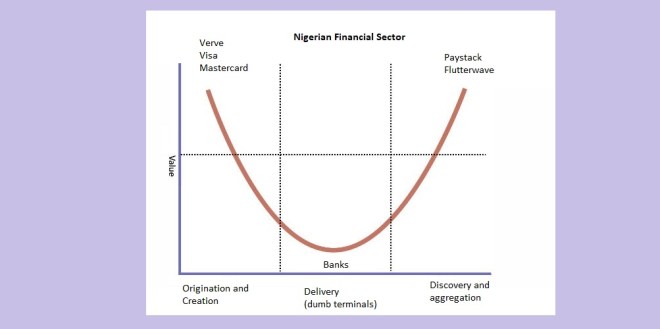
Everyone wants to find gold in that village. They are all digging. But one man is not directly interested in gold exploration. He just opened a hardware store, selling shovels and other items to the mining explorers. Who has a better strategy – the store man or the explorers?

Yes, who is at the edge or center of the Smiling Curve? In this video, I explain why where you OPERATE, in your sector, is more important than the efforts you put.

The images in the video are very poor; I have updated them with clearer ones below. I made the original ones while in an airport; drew them and took photos with my phone.


The FBI 80 And The Burden of Being A Nigerian

0

What is in a name? That which we call a rose by any other means would smell as sweet—Shakespeare.

What is in a name? Shakespeare in his classic book Romeo and Juliet was simply trying to say that the content of a person’s character cannot merely be judged by the name the person bears. But Shakespeare never met Nigerians. Today, there is indeed something in a name. There is a burden associated with being Nigerian—a heavy burden that falls on a person when such person’s name finds its roots firmly implanted in the national soils of Nigeria.

To be Nigerian is to be perceived differently by the world. The internationally acclaimed Nigerian writer, Chimamanda Ngozi Adichie, wrote and I quote, “To travel with a Nigerian passport… is to feel that you are guilty of something.”

Some days ago, I heard the news of Obinwanne Okeke and other Nigerians and how their infamous financial crimes have further soiled our already undignified national name. Yes, there is something in a name. It can be an assured self-regard, a dignity. It can also be a stiff ignobility. And though there is something in a name, we have no say in the matter (if you do not have the redemptive privilege of naturalization—securing for yourself the passport of more ‘honourable’ nations). We are not responsible for where we are born. We have no say in the matter of our ancestry. Yet, we must bear the burden that accompanies a name.

Obinwanne Okeke is an Igbo man. In Igbo, “nwanne” stands for child of my mother, which implies a familial relationship, a brotherhood. And because of that brotherhood, that connectivity that exists because of a common ancestry, a common language, I, an Igbo woman would be perceived differently by the world because of the disgraceful exploits of my tribal kinsman.

There is no need for me to reel out a litany of the financial crimes committed by Nigerians that is currently creating a buzz on the news. The recent FBI scam bust report listing Obinwanne Okeke and other Nigerians in a massive online fraud. I am drawn to speak on what this implies, on how these crimes would colour the future landscape of us Nigerians. To put is simply, it is hard being a Nigerian.

What is in a name? Weaved into the name “Nigerian” are the words: fraud, corruption, injustice, criminal, scammer, untrustworthy… Of course, these words are not fully representative of the name “Nigerian,” and I am in no way trying to disparage Nigerians. Still, there is a painful truth in those words embroidered into the descriptive fabric of our citizenship. I see these  words, these negative descriptors, in the people I meet, in my apartment building, in the marketplace, in institutions of learning, in the church. It is hard to miss these negative descriptors.

The apartment building I live in is full of young men, many of whom, I suppose, are in their twenties. I cannot clearly say what they do for a living. They mostly stay indoors, carry laptops and keep their eyes fixated on their phones. They have tattoos, hold up their hair in tinted dreadlocks and cannot seem to survive without electricity—their generators are always brimming with petrol. Surviving without electricity is an important skill you develop when you’re Nigerian but not for my neighbors. Their generators do not go off at night, and the common words I hear them say are: “intel,” “client,” “dollars.” Once, during a meeting involving all tenants, an altercation broke out, and one of the young men, angry, spoke out to another young man: “I know what you did in Lagos.” These young men who I cannot verify what they do for a living, who like to hide out in their apartments, who throw the loudest parties and happen to have done something in Lagos are the people who reinforce these negative descriptors and give it weight.

One time I was on a bus, the bus driver hailed a disheveled madman and gave him some money. Then the driver turned to tell me that the madman was merely undergoing a temporary insanity and would soon recover and become a rich big man. He said it was the new method of acquiring quick wealth. You undergo a period of mandatory insanity, after which you recover and money miraculously starts gravitating towards you. That’s like the NYSC of madness, where you serve and upon your passing out parade, you suddenly become a person whose bank account is bloated from too much money. I lack the words to express the shock I felt when I heard that and I am afraid I can no longer look at mad people the same way again.

That episode on the bus, when carefully examined, reveals the catalyst, the force that drives the negative descriptors of our citizenship: A perverse lust for money. A lust for money that is strong enough to reduce a man to a position where he is willing to accept insanity—an insanity that holds a promise of wealth.

A lust for money. This is what drives the economics of financial crimes. This why Obinwanne Okeke betrayed our familial relationship, the brotherhood of country and tribe. This is why Nigerians, at home and abroad have devalued their lives, embarking on an amoral quest for money, and do not mind if they inflict hurt, if they make it more burdensome to be identified as Nigerian. This lust for money is a national culture. It is a way of life. It is the reason a mother would say to her son who is working a low paying job as a school teacher: “Is this how you will become somebody?” The Igbo equivalent captures it so well, and I am sorry if you don’t understand the language. “O ifa ka i ga eme we buru mmadu?” Having little is a sin. The desire is to have more, so much more. And it is a powerful desire, a desire that transforms people into unrecognizable versions of themselves.

It is in our songs. If I no make money wetin I gain. If you no get money, hide your face. Na money be koko. We have a culture that glorifies wealth. A culture that accords respect on the basis of how much money a person has. I have heard of village meetings where young men shut the mouths of elders with large wads of naira notes. “I am dropping the sum of two hundred thousand naira so that this old man will shut up!” Ours is a culture that ascribes value to quick wealth. Nobody bothers with process, with growth. We want it big and we want it now!

And the church is in no way exempt. In my previous church, I could predict what my pastor would preach about. Central to many of the sermons was the promise of money. Today I came with a financial anointing to make you billionaires. Sermons that appealed to the people’s lust for money. Sermons structured to get people to give money to the church in the hope that they would become overnight millionaires and billionaires. You cannot expect a big financial breakthrough and not give a dangerous offering. Try God. Close your accounts for God! Money is a ransom for a man’s life.

Money is a ransom for a man’s life? I was seated in my former church, listening to my then pastor preach about how money is the ransom of one’s life and talk about another Man of God who was preserved from an assassination because he gave a large offering in church. The pastor was, in essence, telling me that I could not trust God for my protection. If I wanted protection, then I had to pay God to protect me. So, money becomes more powerful, even rivaling God.

To be Nigerian and to not believe in God is a luxury that I cannot and do not want to afford. Being Nigerian means being accustomed to the deficiencies and ineptitude of the government. Being Nigerian means looking to God, and not to the judiciary systems for justice. Being Nigerian means putting your faith in God and not the police or the army for safety since this is a country where soldiers kill policemen and free criminals. So to be without faith in God in a nation like mine is to live a life of luxury. Yet, I am not belittling faith. Faith is important and I have faith in God. My aim is to cast light on what our problem is, a problem that keeps sinking our name into a deep, dark well of disrepute—an inordinate desire for wealth.

What is in a name? Because to be Nigerian means that the world will make unfavourable assumptions about me before truly knowing who I am, I am saddled with a great burden of self-consciousness. A burden that demands that I impress, that I be on my best behavior. A burden that demands that I live my life in a constant pursuit to disprove the stereotype that Nigerians are fraudsters. This is our burden as Nigerians. I am truly proud of Nigerians who gallantly bear this burden, who daily prove to the world that we are not a people who can only be described as “unworthy of trust.”

The EFCC Clean UP

0

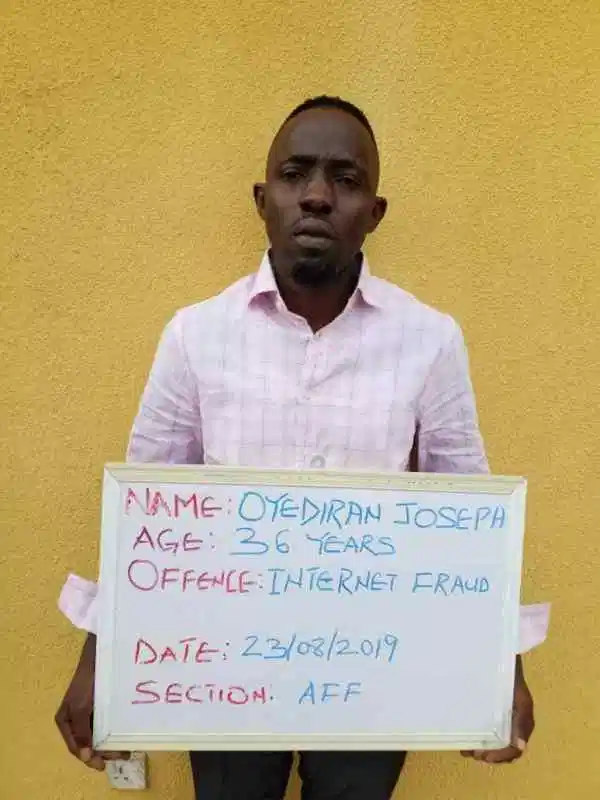
It is typical in Nigeria, the world sneezes and we get into action. Yes, FBI arrested some idiots on digital frauds – and EFCC, Nigeria’s financial crime fighter, woke up. Over the last few days, EFCC had recorded a decent success rate on picking alleged fraudsters across Nigeria.

My question is thus: why did EFCC wait this long before picking these men if the process is this easy? Why did they wait for Nigeria to be embarrassed before breaking the syndicates. From the success so far, after the FBI list, it is evident that EFCC could have saved Nigeria this shame.

They have picked suspects from Ekiti state, Kwara state, Imo state, Rivers state, and across the nation sustaining the federal character: ”The official said the commission is assisting the U.S. authorities in unraveling the syndicate.” Possibly, these suspects will join their brethren in U.S jails as they wait their days in courts.

He explained that the suspect, Ajayi Festus, was arrested in Ado-Ekiti following an alleged illicit transaction through his Nigerian bank amounting to N223 million.

”You will recall the shock and embarrassment we all suffered as a people when the news about the indictment of 80 Nigerians in massive cybercrime cases investigated by the Federal Bureau of Investigations (FBI) of the United State was broken last week.

Nigeria deserves institutions that work proactively over these knew-jerk reactive processes we see daily. Largely, EFCC did have enough intelligence to have broken most of the operations but nothing happened. If they could make these arrests in just a week, imagine if they work on that construct 52 weeks in a year. Possibly, internet fraud will go because the men will know that Nigeria cannot host them!

They are fleeing from EFCC and Nigeria; EFCC should pursue them.

Days after the Economic Financial Crimes Commission, EFCC, vowed to fish out Nigerians indicted in the recent United States wire scam,Saturday Sun has learnt that most of the young men with questionable source of living are currently on the run. While many have gone underground, those with the means have fled to some West African nations and even beyond the sub-region to evade arrest.


Ndubuisi Ekekwe Will Deliver FUTO 2019 Biennial Lecture

0
FUTO is a top technical university in Nigeria

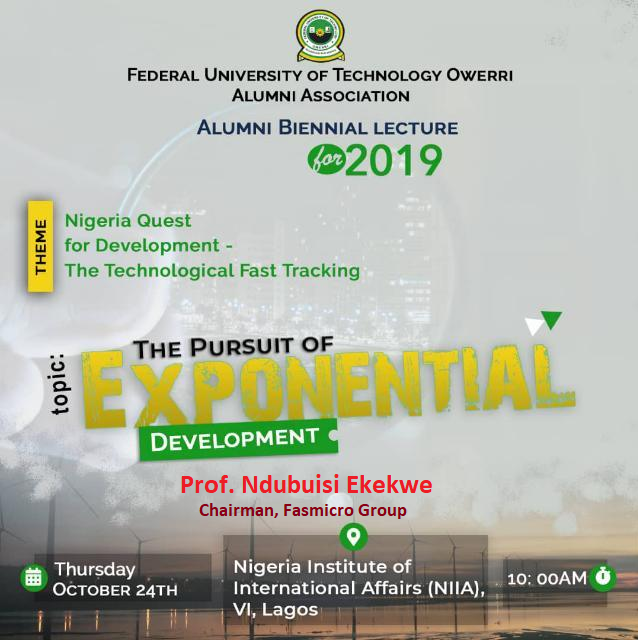
Today, I am so happy to announce that GREAT FUTOites – students and graduates of our great institution, Federal University of Technology Owerri (Nigeria) – have chosen me to deliver the Main Presentation in the highly prestigious FUTO Biennial Lecture. The lecture is scheduled on Oct 24, 2019 at the National Institute of International Affairs (NIIA), Lagos. I will speak on “The Pursuit of Exponential Development” for Nigeria.

Since 2006, The Federal University of Technology Owerri (FUTO) Alumni Association, has been organizing this public lecture with the theme: “Nigeria’s quest for development – the technological fast tracking”. This year’s lecture is the 6th in series. The first edition held in 2006 on the topic “Power and Development in Nigeria: seeking that workable solution” was delivered by Prof. Bart Nnaji under the distinguished Chairmanship of Prof. Dora Akunyili of blessed memory.

I will return next week with a link for those that would like to attend [the organizers will share this weekend]. It is a free event but requires prior-registration.