

DD
MM
YYYY

PAGES

DD
MM
YYYY

spot_img

PAGES

Home Blog Page 6730

Reasons for Nigeria’s Challenging Employment Market

0

It is no longer news that the rate of unemployment in Nigeria is alarming. Many people who were job seekers had become job hunters, all to no avail. There are so many unemployed graduates chasing fewer jobs. That is the reason why for one open position, thousands of people apply. For those who are busy at work, most of them are underemployed, being underpaid for their services.

According to a former Minister of Finance, Dr (Mrs) Ngozi Okonjo-Iweala in 2014, no fewer than 1.8 million graduates in the country move into the labour market each year. A survey carried out by Jobberman in 2016 , estimates that 47% of Nigeria’s university graduates are unemployed. That is so shocking, considering the number of Nigerians that graduate from our Nigerian Universities, Polytechnics, Colleges of Education, as well as Monotechnics, each year.

One of the issues encountered by these job seekers- who have become job hunters, is the issue of cheap labour. A research conducted by Stutern in 2016 as part of the Nigeria Graduate Report, showed that 1 out of 4 graduates earn less than N20,000 ($40) each month as salary for entry-level jobs, while over 80% of employed workers earn not more than N150,000 as monthly salary. According to their report, about 36.26% of recent graduates are currently unemployed, 50.09% of the respondents currently working full time (including self-employed/freelance, voluntary or other unpaid work, developing a professional portfolio/creative practice or an internship). Also, about 8.6% are currently engaged in full-time and part-time further study, training or research, while the remaining 5.05% are presently preparing for further study or professional exams.

The National Bureau of Statistics (NBS) Q3 report for 2018 estimated the unemployment rate to be at 23.1% and underemployment rate at 16.6%. According to the Minister of Labour and Employment, Chris Ngige, it is projected that the unemployment rate for Nigeria will reach 33.5% by 2020.

What are the reasons for the high rate of unemployment in Nigeria?

1. Inadequate Preparation for the Job market : It has become a popular saying, that the reason why most graduates cannot get jobs is because they are unemployable. This sounds absurd, but what if it is true? Most of our institutions do not prepare the youths for the future. Most of these youths graduate with obsolete skills no longer needed in the job market. They are taught with a 19th century syllabus in a 21st century world. Even in an age of Artificial Intelligence, Robotics, etc, most of our Computer Science graduates do not understand any of these concepts. How would they, when their lecturers and professors hardly teach with a computer? As a result, we see graduates who do not have any practical knowledge of what is obtainable, as they are so used to theory. Assignments, tests, and exams are still written on paper, when there are computers everywhere! Therefore, there is a skills gap. For those who could not afford the fees to undergo expensive trainings, to re-learn and unlearn, they remain stuck.

2. Nepotism : This is one of the vices that is slowly killing us as a nation. People are no longer employed based on merit, but based on whom they know – connections. Therefore, if one is occupying a top position in government or in a private firm, instead of making the recruitment process free and fair, he/she automatically submits the name of the child, niece, nephew, cousin or even friend, as a preferred candidate. As a result, we see situations in which qualified people remain unemployed, while those who are unfit get to sit on their seats. Most times, positions are advertised on the public domain, but the preferred candidates had already been selected. The Directors and Employers already know those that are going to heaven. These ones already have their tickets kept, and offer letters typed in advance. What an irony!

3. Corruption: This is slowly eating into the fabric of our nation. In every institution, from the higher institutions to our public offices, corruption has become a reoccurring decimal. Bribery has become the norm of the day. We have heard cases in which people are told to pay huge sums of money to secure federal government jobs. Despite the fact that most people dismiss such as scams, there are people who actually pay and get those jobs. Nobody wants to do the right thing anymore. They claim that the system is already corrupt, and that they weren’t the originators of the corruption. As a result, we see corruption at play everywhere, from the ports, to our security checkpoints, to our classrooms, to our bid for contracts, etc.

4. White-Collar Job Mentality : An average Nigerian graduate would tell you that he/she wants to work in an Oil and Gas firm, a Bank, or even in the Aviation/Maritime sector. They believe, that is where the money is. Nobody wants to go into agriculture, anymore. People no longer see the need for entrepreneurship. All they want is to put on a tie, and go to the office, from 7am to 7pm, everyday. Nobody wants to be on the farm, because they see it as the place meant for old men and women in the villages. They want to be in the city, where things are happening. So sad!
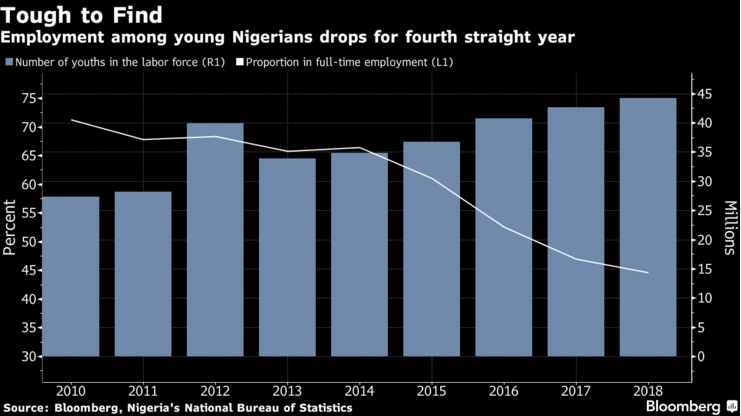
Youth Unemployment in Nigeria

The Untold Stories of our Job Hunters

All over the place, you would find job adverts. They are on the internet, newspaper pages, magazines, as well as on our walls as posters. Every person has become a Recruiter, hence the need to regulate the HR profession more than ever before. Most of these job ads are not real, but scams. These scammers lure these desperate, innocent job hunters to buildings in the guise of conducting interviews for them. Some of these jobs hunters have not been so fortunate. Some have been killed, hypnotized into transferring all their hard-earned money, while others have been raped, robbed, or even threatened. At the end of the day, they are farther away from the non-existent jobs they have gone to hunt. What an Irony!

How about these other recruitment firms where you are asked to bring a copy of your CV, with a pen and a paper. Sometimes, you are even told that you have gotten the job. You get there only to realize that it’s a network marketing firm, where you are expected to sell drugs and supplements, as well as register people under you. These ones you have registered become your disciples, and as they bring more people, the gospel is spread (I am being sarcastic). These people preach more than our preachers. The only difference is that our preachers emphasize on repentance, while these ones emphasize on success and the need to make money, without working for anybody. They have different meanings for different acronyms. They believe that Education is a scam, thereby making you rethink why you went to school. The most surprising thing they do, is that they ask you to register with money to be recruited into their firm, or to pay for their training -which they never disclosed earlier.

What needs to be done?

The time has come for the government, and all well-meaning Nigerians to come together to see how the rate of unemployment in the country will be reduced. People should be supported and empowered to start-up a business, and given grants to do so. They should make entrepreneurship attractive, and encourage low-interest loans by banks to entrepreneurs. Also, firms must partner with tertiary institutions to accept students for internships for them to acquire relevant experience. We must remember, unemployment leads to crime, violence, youth restiveness, prostitution, and other vices. If we can work together to make this our priority, we would have succeeded in making our society a paradise for all. We can walk safely on our streets without fear, and escorts. Our talented youths would not have to emigrate to other countries in search of greener pastures. At the end, we would have succeeded in building the Nigeria of our dreams, cherished and loved by all.


Forget Ecommerce, The Near Future Remains Inventive Physical Stores In Nigeria

4

Something is happening in China, the land of Alibaba, Tencent and Baidu; Costco, an American warehouse club chain, is in town. The Chinese people could not overcome the joy of going to shop for really great bargains in Costco despite the digital shops in their smartphones! The demand was so huge that the company was forced to “shut down in the afternoon because of overcrowding”. Yes, customers wanted something new: great value.

American shopping giant Costco got an unexpectedly frenzied welcome from zealous Chinese shoppers. Costco opened its first warehouse club in China today (Aug. 27), in a suburb of Shanghai. Just a few hours into business, it had to shut down in the afternoon because of overcrowding, according to screenshots of messages (some links below in Chinese) sent to customers around 2pm circulating on China’s social media Weibo. Local media reported that local residents swarmed to the store—with cars queuing up to enter half a kilometer (0.3 miles) away, footage from news portal Sina showed.

Costco charges membership fees and uses the money to subsidize prices of items which are typically bought in bulk. Costco stores look simple because it has never been opened to the fashionista way [expensive stores] as it wants to focus on what customers really care about: great value for money.

Back to Nigeria, Nigerians have shown that they like Shoprite predictable quality despite the marginal higher cost compared to open markets. Costco is essentially a Shoprite where only people with membership cards can shop, typically buying in bulk.

Building companies like Shoprite and Costco may not sound fanciful but they are just the type of retail businesses that would be here for long in Africa. Yes, no one will see them as being fashionable but they will be solidly successful. Ecommerce will make the news but physical stores with inventive business models will keep the profits for a really long time in Nigeria. 

Of course, very few investors would like to see such business plans when the mantra is that “software will eat the world” even though there is nothing electronic in the Nigerian ecommerce without a national postal service.

How to Balance Career and Domestic Lives: Some Lessons from my Mistakes

4

This article is for everybody – male and female; young and old; employed, yet-to-be-employed and unemployed (yes, I strongly believe there is a difference between the yet-to-be-employed and the unemployed). Please, don’t say that because it is the duty of the other gender to manage a family, this article doesn’t concern you. Directly or indirectly, we are affected.

I was actually pushed to share this piece after speaking with a man, who insisted that his wife should wait until their children are old enough to leave home before she can start a business (because obviously no one will want to employ her by that time). I’ve had sessions with women who want to wait till their children are older before they can find a job or something. Some of them have a change of mind after our sessions, some don’t. No matter what, I don’t think it’s a wise decision for a woman to sit down at home and leave her husband to be the sole provider in the family. I will come back to this after a little insight into my own mistakes.

I resigned from a job when I was pregnant with my first child. I couldn’t withstand the stress of combining my life as a wife, a mother-to-be and a career woman. It was just too much for me to bear. The school I was working with wasn’t making it any easier for me. I was too young and wrongly advised to think that the only way out was to leave my job.

Then I was just four months gone into my pregnancy. When I stayed at home for just two months I couldn’t bear the unproductive life any more. I went in search of another job, not minding my protruding bump. That was the time I truly acknowledged the discrimination women are facing. Nobody wanted to employ a pregnant woman. The ones that were kind enough asked me to come back after I have delivered and weaned my baby. There was one, I don’t want to mention the company’s name, that didn’t mind my condition because the panel saw that I was the best option among the candidates and decided to give me a chance. The director of the branch where I was supposed to collect my appointment letter took one look at me and seized the letter. Like joke like play, he withdrew the offer because he was the one I will work directly with. The decision of the panel didn’t matter to him. Anyway, that is story for another day.

Now, I decided to carry my pregnancy jejely and look for a job later, after all, as people kept reminding me, I have my husband as the breadwinner of the family. But you know what, he lost his job a few days to my son’s delivery. Having no other source of income, we faced our little savings and finished it within a few months. So anytime I talk about being in a financial mess in my articles, try to understand that I wasn’t saying that just for talking sake.

Well, I had to go back into the labour market later and vowed never to see what I saw earlier. Of course I got offers. That’s one good thing about being a teacher – there is always a job waiting when you are ‘ready’. This time, I tried to recoup all my lost savings, so I had several side hustles. I was doing tutorials (though I couldn’t go for home tutorials); I was doing minor importations from Aliexpress to sell; I was buying hair extensions from Onitsha to sell; I was sewing and selling bed sheets; you just name it. So long as that business will bring in a little change, I am all for it.

To ensure that I saved as much as I could, I didn’t employ nannies for my children, I didn’t employ any paid domestic help (and I wasn’t comfortable with bringing minors either), and I didn’t buy machines that could help me with some domestic chores. I was literally doing all the house chores and market purchases alone because I didn’t want it to look like I ignored my domestic duties in my quest for ‘wealth’. Funnily enough, I wasn’t even making much from all my side hustles (except the Aliexpress importations). Life was just too stressful for me until it started telling on my health. When my blood pressure started shooting up, I had to soft peddle and work smart, and not hard (don’t judge me, please). That was the moment I decided to change some of my lifestyles.

If you look at what I just shared up there you can easily point out where I made my mistakes. But I will still discuss them here.

The first thing is that I took a wrong advice and left my job while pregnant. Then, I didn’t have anyone that could tell me how to get around my difficult boss (this is why I still cherish social media because it brings the right people closer to you). Leaving that job was a very wrong decision on my side and it was done at a very wrong time. If I had talked to my boss, maybe he would have found a way to make things lighter for me.

I didn’t have a side hustle when I left my job. It would have acted as a cushion until I got back to my feet. Then, all I do was going to work and going back home to watch television and socialise, after all I cannot come and kill myself.

When I finally got back to the labour force, I was so afraid of re-meeting poverty and deprivation that I put all my energy into money-making. This almost cost me my life. I was actually working too hard without being smart about it.

Because I wanted to save as much as I could (I listened so much to those that advocate saving before spending), I didn’t use the money I made to buy help, be it machine or human help. This is a terrible mistake that most of us make.

Ok, I am going to give my reasons for believing that every woman should find something that will generate income for the family. But before I go into that, I would like to enjoin everyone that will say that his or her life won’t be like mine to think otherwise. I didn’t plan my life to be the way it was then. Of course I learnt from my mistakes and have been making some adjustments since then. In as much as our paths are different, you never can tell yours until you hit it. Well, these are some of the reasons women need to find sources of income:

  • In Case of Tragedy: Any woman I tell this always says “God forbid”. Yes o, God forbid indeed. But those young men that die, did they do anything in particular that caused that death? What do you think will become of their young wives if they don’t have a source of income? I have seen women that lost everything because they couldn’t provide for their children after the death of their husbands. We don’t pray for tragedies (be it death or divorce) to befall us, but we have to find ways of cushioning their effects should they come by. Anyway, let me not go into that here.
  • Reducing Stress for the Husband: I believe this is self-explanatory. Everybody here understands the tension of providing basic needs for himself not to talk of when dependents are involved. Sharing such a responsibility helps a lot.
  • Pulling Resources together to Finance a Family Project: Most projects undertaken and financed by both parties always come out successful.
  • They can plan better for the family

Having mentioned some of the reasons why women should work, I will now state the strategies working women employ to balance their family and work lives.

  1. Don’t Try to Be a Perfectionist: Like one woman told me then, I have been trying to be perfect in carrying out both my work and family duties. When we try to do both so perfectly, it tells on our health. Besides, it is almost impossible that we can achieve that.
  2. Buy Comfort with your Income: I learnt this from my mother. I was with her one day when she asked one woman, “What is the essence of making all these money if you can’t spend a little bit of it to make yourself comfortable?” I’m not saying that we should spend all we earn to make ourselves comfortable. But at least, we need to be able to relax after a long tiring day, don’t you think?
  3. Employ Help: I learnt this from one of the women groups I belonged to on Facebook. When one woman complained about the stress she passes through in her home after coming back in the evening, one of the comments she received was, “Why not use some of your income to buy machines that will make it easier for you.” This statement says a lot. So, I’ll say, “Employ both human and machine helps.” But if you are more comfortable with just one of them, go for it.
  4. Get your Partner to Help: There’s nothing wrong with your husband helping you out with some chores at home. Ask him first and take it from there.
  5. Train your Children to Help: This is one place African mothers are experts, though some of them are falling out here. We can train our children to help with little household chores depending on their age. This helps a lot, I can testify to that.
  6. Tailor your Side Hustles: See, side hustle is a must-do right now. In fact saving without side hustles is very difficult. The only thing I can say here is that you should tailor your side hustles so that they don’t add more stress to an already stressful life. Like I said in this post https://www.tekedia.com/20-side-hustles-for-nigerian-civil-servants/ find a side hustle that you love doing and that doesn’t put pressure on you.
  7. Outsource some Domestic Chores: I learnt a lot about this while I was in Ibadan. Some women get people to do their washing for them even though they had washing machines. Some buy food in large quantities from food vendors to store in the freezers for the family (they usually do this for soup, sauce, moi-moi and things like that). And then ironing of clothes is usually outsourced to laundry shops. Some women equally buy things from the market and pay a little price for it to be processed there. For example, people now buy chicken and have it prepared in the market; we buy okro and they chop them for us there; ugu leaves are picked and cut in the market; and so many others. These are ways of making life easier and more bearable for working wives and mothers (as well as generate income for others).
  8. Have a ‘Me’ Day: Most women will understand this. This is every woman’s Achilles heel. If a woman doesn’t have a day to pamper herself, or have others pamper her, she will turn out antsy and grumpy. So, I’ll say, make out a day every month to have yourself to yourself. Life isn’t all about money. And those children, don’t worry, they will be fine. (I’ll come back in another post on ways we can have a successful ‘me’ day).
  9. Sleep and Rest Well: I laughed so hard yesterday when I watched a comic video clip where the character was complaining about motivational speakers telling people not to sleep too much and all. Alright, here it is – everybody needs to sleep very well to be very productive. Try not to lose your sleep over that job or business. I usually take Sundays afternoon as my nap-without-disturbance day. Find yours too. It is quite refreshing.

Dear women – mothers, wives, single and married – don’t tell yourself to wait any longer before you find a source of income. Please, go for that job you so much crave for. Don’t worry, you can balance your career and family lives. I just gave you my own strategies. You can adopt it or you might find other ones. But please, find something doing if you haven’t yet.

We Need a Total Educational System Overhaul

1
Nigeria needs stronger education systems

Unemployment is no longer strange to anyone in Nigeria. It seems every graduate now has the mindset of finding a job after graduation. You wouldn’t blame anyone with such a mindset. We were taught to study hard and pass so we can become a hot cake in the society.

Perhaps, employers will come begging us for jobs especially if we made First Class. That’s the greatest lie everyone has been told in school. I won’t blame our lecturers, they got jobs that way.

My mom told me she got a government job with her O’Level result – as at then, it was called Standard Six.

Today, it takes the grace of God to even get a job-invite let alone land a job irrespective of your certificate and the grades.

Who do we blame for this?

Many point to the top – our leaders. Everything starts at the top. Yes, I agree. But we can’t continue to play the blame game. Let’s break out.

Blame games never helped anyone. It would only add more pains. I’d suggest we bridge the graduates-unemployment gap.

Bridging the gap of graduate-unemployment is so critical in Africa today, as Adeleke Lekan  rightly posited in his article – ”many of our graduates today end up doing something different from what they spent money to study in the university”. This is a point that cannot be contested. You don’t blame them either because our schools, both secondary and universities, have failed us. They have trained graduates that way. They have narrowed their mindset to only focus on earning a living from what they wasted money and time to learn in universities – certificates.

Being a graduate today isn’t a guarantee to earn a living which is the essence of our life. Having an education is good, but knowing how to survive surpasses education and it’s called WISDOM. Wisdom is not taught in any institution today. Institutions can only teach you 1+1 = 2, but will never teach you how 1+1 = 2, will put food on your table. Shame!!!

What do we do in a situation like this?

Shayo Imologome suggested Educational Restructure is the way forward.

”I think we need to restructure the educational system. Education is important, everyone needs a strong foundation to set them off in life. At JSS 3, I think students are required to do a variety of subjects with the hope that they will be able to explore and find what their passion or interests are. By SS1, they choose the line they want to go, whether art, commercial or science. That for me is the critical point. Many students get it wrong at that point and it is often downhill from there. I think our system should be designed to help young people discover themselves better.” – Shayo Imologome.

She continued:

”Parents also have a role to play. For those of us in the older generation, our parents were concerned that we follow certain paths so that we could succeed. They all wanted us to be doctors, lawyers, engineers or accountants, etc. But now, we all know better. We shouldn’t force our children in any direction, but rather encourage them to explore and discover their talents and passion.”

Total overhaul of our educational system and implementing entrepreneurship studies will help our graduates to develop an entrepreneurship mindset. We need to make the entire system more practical, introduce entrepreneurial studies at a much earlier stage, etc; but education must continue, not going to school at all is definitely not an option. Of course, no one can stop education. Not even the government.

The issue is – we should not only be building graduates, but we should also build graduates that will depend on skills and inbuilt abilities. Certificates will only be a compliment.

Professor Ndubuisi Ekekwe is a great example of an educated entrepreneur. The Founder of Tekedia is not only educated but he is making education work for him. The results are there for everyone to see.

To attain this level in Nigeria, our educational system will have to be reformed. It makes no sense when a computer science graduate can’t operate a computer. He’s never been to a computer lab. Yes, you will be surprised that some institutions don’t have a laboratory. Everything being taught are mere theories. You can imagine the type of graduates such institutions would produce – dependent graduate.

This is a rallying cry to government and influential people in the country. Help restructure our educational system.

Combining Blockchain and National ID Number To Fix Generalisation Problem in Nigeria

1

When we look at each individual without thinking of him as a Jew or as a Negro, but only as a person, then we may get to like him, or we may dislike him, but he stands on his own feet as an individual, and we stand with him on an equal basis…. It is better to light a candle than curse the darkness.”

 – Eleanor Roosevelt the most Inspirational first Lady America ever had.

Those were the quotes of Eleanor ROOSEVELT, the most inspirational first lady America ever had, who forever redefined the office of the first lady of America and also fought for human right during the Great Depression and also spoke out against generalization and racial discrimination of the black Americans during and after her tenure.

This period has been the most trying times being a Nigerian after the Federal Bureau of Investigation (FBI) published a list of about 80 Nigerians involved with fraud of several Americans organisations. The most worrisome part was its connection with a globally recognized Nigerian who was seen to be a rising influential leader in the business world, gracing the front page Forbes magazine, interviews on CNN and BBC and also speaking at Tedx.

The bigger concern is the looming generalisation and new fear of dealing with Nigerians who were previously considered trustworthy. The big questions organizations might asking are; could Nigerians who were previously trusted still be trusted? Are there still trustworthy Nigerians? The answer to both is yes. While we believe there are many trust worthy Americans, the America still has very good and strategic systems which eliminates any motivation or opportunities for its citizens/resident to be fraudulent or corrupt. One of such successful system is the Social Security Number which tracks major life transactions/activities of its holders and sort provides a trust system which makes organisations comfortable to transact or issue credit facilities to SSN holders.

Several School of thought have advocated for adoption of the SSN system in emerging economies like Africa and Asia, the question is; could this solve the loomingly new wave of identity generalization issue Nigerians and Blacks are about facing?

Yes and No.

Yes, if it is further improvised with Blockchain (decentralized ledgers) considering our peculiarities.

No, if it is just mindlessly copied the way it is.

America’s SSN system would face myriads of setback in a country like Nigeria, I will share my reasons in the latter part of this article.

I have been privileged to be involved with some financial inclusion efforts in Nigeria (both campaign and technology-wise) for about 5 years now. I will like to lend some learnings from my experience which could be translated towards mitigating the generalization of the Nigerian Character. While designing financial inclusion products, I noticed that apart from poverty , education and accessibility to bank, one of the big issues inhibiting financial inclusion is identity. How can we digitise identity to ensure the unbanked easily gain access to financial services.

In order to fully understand the premise on which the SSN system, Blockchain and learnings from Financial Inclusion could help manage the looming generalization problem, it is best to understand the historical background of the Social Security Number System.

In October 1929, America experienced the most historic Wall Street Crash which triggered the Great Depression. Share prices at the New York Stock Exchange (NYSE) catastrophically collapsed bringing America into a 12 year journey of socio-economic uncertainty.

Tension and loss of hope spread like wildfire across the country, there was lack of confidence in the future of America as they experienced high level of unemployment, poverty, migrations, low profits, deflation, plunging farm incomes, stunted economic growth.

3years in to the depression, the crisis spurred political shifts which gave Franklin D. Roosevelt a record breaking landslide victory over Herbert Hover at 1932 election with an embarrassing wide margin making Franklin Roosevelt the 32nd President of the America.

Within his first 100 days as president, Franklin Roosevelt continuously held daily sittings with the congress, which culminated into several executive orders which ushered in his economic reform and recovery programs for banks, Security exchange, and farmers. The Franklin Roosevelt program was called ‘the New Deal’ and it was focused on 3 major R’s; relief for the unemployed and poor, recovery of the economy back to normal levels and reform of the financial system to prevent a repeat depression.

One of his successful intervention which exists till today is the Social Security System which gave birth to Social Security Number (SSN). These numbers were given then to Americans to track/identify retirement pensions, unemployment insurance and welfare benefits for the handicapped and needy children in families without a father present. .

Due to the abuse of the Child SSN tax benefits, an Anti-fraud tax reform was implemented in 1986 which fished out 7 million SSN’s assigned to non-existent children which were used by some to get huge tax deductions.

Presently, SSN is a 9 digit number issued by the US Government to US Citizens and eligible residence for a lifetime which is used to track lifetime transactions, earnings, bank accounts, life records, federal loans, public assistance, tax, obtaining of international passport and drivers’ license and several other usage.

Needless to say, SSN could be used to understand the major life activities of its holder, hence the government, agencies and private organisations are able to easily transact with its holder.

This 84 year old SSN system has aided in crime fighting and prevention. Hence holders understand that all their activities are been recorded hence they are motivated to always keep clean records as much as possible. SSN has created a huge level of trust among American people and organisations.

As earlier mentioned, the US has leveraged SSN system for 84 years and have gained some level of mastery in SSN systems such that it has metamorphosed into the defacto Identity system in the US, hence it shows the journey any developing economy would embark if trying to replicate SSN system as it is.

The only problem with the SSN system is that it could easily be abused by corrupt government and security officials. also identity owners has no level of control over their identity. Anyone who has one’s SSN could easily pry into holder’s privacy and try to steal the identity.

According to the Privacy Rights Clearinghouse, identity theft now occurs at a rate of about 400,000 cases a year — and that number is growing 40 percent annually. So you could imagine how rampant these demerits could be in a place like Nigeria.

One of the key innovations which the SSN system could apply would be the use of Self-Controlled Blockchain Identity technology which involves each citizen of a country having blockchain digital wallet permanently labelled with their SSN or Identification number, keeping records of various transactions/histories. Institutions or organisations they transact with would own blockchain nodes which will append/populate digital wallet with tokens to indicate transactional activities.

For example, Ngozi is issued a Digital wallet which carries her Identity number, she gets a job, her employers own a blockchain node which verifies her as an employ of that organisation and issues a token to Ngozi’s wallet, with details of Salary, pension, Insurance. Ngozi also acquires an educational certification, the awarding Institution appends a token on her digital wallet, She opens a Bank account, the bank appends token holding citizen’s financial status and credit score. Same applies to Government Institutions who award International Passport, drivers license etc.

The digital wallet would contain as much token as possible but the beauty of it is that the citizen controls the level of information he/she chooses to share with individuals/organisations. For example a money lending institution wants to confirm that a citizen earns up $100 monthly but actually the citizen earns $350, the citizen could easily authenticate using the digital wallet through his/her bank to respond with a yes or a no without disclosing the exact amount, same method could is used to redact information as citizen/DID holder deems fit. With solutions as this, businesses do not need to get letter of reference or guarantee in order to transact business as this process accelerates international business growth.

Self-controlled digital identity builds high level of trust as several communities issuers and verifiers keep records/transactions holder’s activities which could easily be accessed anywhere in the world depending on the level of access and information a holders decides to share. The decentralized systems cannot easily be hacked because any hacker needs to hack the various independent nodes at different locations.  A perk to this is that a Nigerian Digital Identity on a decentralized ledger could be used by any government authorities in the world to ascertain an individual character. Hence the self-controlled digital identity encourages cross border trust both online and offline. At our Financial Inclusion startup, we are testing this concept to help the unbanked and we believe this could further be scaled to help the Nigerian Identity generalization problem.

“It is better to light a candle than curse the darkness.”

 – Eleanor Roosevelt the most Inspirational first Lady America ever had

We need to consider that whichever ways the situation is handled will affect the lives of both the present and future generations of Nigerians and even the black race. It is non-arguable that there are millions of good Nigerians who has great value to offer to the world, hence it is important that other nations support while we fight this embarrassing culture that respects money over integrity, merit and hardwork. This is the root of poverty and corruption in Nigeria. The actions of few should not make nations start a generational discrimination that could deprive the world of the great talents and gift which Nigeria and the black race has to offer to the world. As they say we are better together. If the whole situation is properly managed the world would continue freely as usual for the betterment of everyone concerned as a nation and a people as we need each other to make an inclusive socio-economic impact.

If there ever was a nation where people have mixed blood, it is right here in the United States, and yet we seem to have remained a strong and virile nation….

I may have had greater opportunity and greater happiness than he has had, and fewer obstacles to overcome, but basically we build our lives together, and what we build today sets the pattern for the future of the world – Eleanor Roosevelt


In Nigeria, SSN is equivalent to National Identification Number or NIN. It is administered by Nigeria’s National Identity Management Commission (NIMC)