DD
MM
YYYY

PAGES

DD
MM
YYYY

spot_img

PAGES

Home Blog Page 6736

Never Celebrate Too Early!

0

Don’t celebrate too early!

I know you would be wondering what I meant by that. Yes, I mean when you hit the jackpot, be cautious on how you celebrate. Of course, I know that success can be intoxicating. It could push you into taking unplanned action.

Got some unfortunate news yesterday which got me upset. A close relative who worked in a real estate firm had the nerves to resign from his job when he was yet to sign an offer letter from a new employer. What’s more, he upgraded his wardrobe with new office-worthy wears just after his final interview, thanks to a loan shark.

He had negotiated a 1.4x his current net pay, a 40% increase in his previous salary, only to be offered a net pay of 0.6x, 40% less of his previous salary.

Mathematically, this doesn’t stack up and it is sane to reject such offer, ceteris paribus. So he did what a sane person would have done without considering his actions carefully. He rejected the offer and started afresh as a job seeker.

In his words, ‘Sis, I’ll tell you what…they didn’t stick to the agreement, besides, I was given a supposedly unrealistic monthly/quarterly target which is not fairly commensurate with the salary. Also, I have over 6 years of work experience and will not debase myself to earning what is deserving of a fresh graduate. By the way, it’s a marketing job in an unpopular microfinance bank and I don’t even find it befitting bla bla bla’’….He was saying gibberish as it was evident that he was all kinds of discombobulated.

Anyway, he is now jobless and also in a huge debt that will take a miracle to come out of it.

What do you have to tell him?

Well, I will say this to everyone out there, especially the employees, before you tender your resignation letter, be sure you have been given the appointment letter that states your salary expectations. So that your decision would be based on what you have at hand. It’s like a bird at hand that’s worth than thousands in the bush.

It reminds me of my time as a job seeker, I attended an interview and passed it. I was sent a congratulatory message. Out of excitement, I told every cat and dog in my community.

I packed my bags and prepared for the new destination (Lagos). When I arrived at the company, I tendered the printed congratulatory message, but I was told to wait for a week. The recruiter said they were getting my new office ready. I waited for a week. A week turned to five months. Till date, I heard nothing from them.

I regretted celebrating too early. I regretted having to wait endlessly without doing nothing. But I appreciated the lesson it taught me.

Until you have resumed into the office, never assume you’ve been hired because the decision could still be reversed. Yes, you cannot be like Usain Bolt – not many are that lucky to celebrate before the finish lines.

Credit: Sarah Funmi Ajayi

The Challenge Of YouTube Ads Targeting Kids

0
A picture shows a You Tube logo on December 4, 2012 during LeWeb Paris 2012 in Saint-Denis near Paris. Le Web is Europe's largest tech conference, bringing together the entrepreneurs, leaders and influencers who shape the future of the internet. AFP PHOTO ERIC PIERMONT (Photo credit should read ERIC PIERMONT/AFP/Getty Images)

The Federal Trade Commission (FTC), seems to have accepted the challenge of their counterparts in Europe, to sit up in their regulatory responsibilities, and tech companies are not finding it easy. In July, Facebook was handed a $5 billion levy for the Cambridge Analytica data privacy breach, the highest sum ever levied against a tech company. And it appears it is going to be a one case too many.

On Tuesday, the FTC reached a settlement with YouTube over their targeted ads on videos meant for children in their platform. A verdict stemming from a complaint by consumer groups back in April 2018. It was alleged that YouTube has been collecting information about minors to use in targeted ads. Although the amount of money levied against it is not known since YouTube and FTC are not saying anything, but it apparently took a chunk off YouTube coffers.

The consumer group has suggested to the FTC that every kid’s content on YouTube be moved to YouTube kids, the app designated for children. But the FTC had another plan: “What if every kid’s content is ad disabled, will you be content with that”? They asked the group. It was based on this question that the regulatory body made its decision. YouTube must not serve ads on any children related content. A decision that will cost it over $500 to $750 million in revenue.

YouTube has long maintained that its main site is not for kids and urged children to use the alternate app for kids. But the amount of children’s contents on the primary site is making it inexcusable. From nursery rhymes to cartoons that are commanding billions of views.

There is another problem, YouTube serves two different types of ads: one matches the context of a video with a commercial service: the other is targeted ads, using an array of digital signals, marketers who aim at a particular group or demographics can reach them using Google’s vast data troves, websites people visit, their searches and many of their interests as indicated by cookies.

So there have been thousands of targeted ads cut across different products and services, and YouTube share some video ad sales with other websites. How it is going to implement the regulatory policy is a puzzle since it cannot clearly distinguish between videos directed at children and the ones that are not.

It is a challenge that the FTC itself acknowledged. Removing the ad feature from children’s select videos does not guarantee that YouTube is going to stop tracking web habits when children visit other websites or watch non kid related content on YouTube.

The complainants also expressed pessimism that the FTC’s measures will unlikely solve the problem. Josh Golin, one of the complainants from Campaign for Commercial Free Childhood asked: “Is Google still going to be collecting all the data and creating marketing profiles?

“That wouldn’t be satisfactory.”

Another complainant, Jeff Chester, executive director of the Center for Digital Democracy, has vowed to challenge the decision if it only means that YouTube will curb ads targeted at children not eliminating it completely.

Chairman Babatunde Fowler’s Response

5

The Presidency queried the Chairman of Nigeria’s tax agency on the nation’s “recent” lackluster performance on our tax receipts. The Chairman, Mr. Babatunde Fowler, responded explaining what everyone had already known: Nigeria’s has no sustainable economy. Yes, we are in a stage with the pendulum controlled by oil prices. His response was believable if you remove the alternative situation [Nigerians do not believe their leaders anymore].

In 2015, FIRS set N4.7 trillion target but was only able to make N3.7 trillion in the actual collection. In 2016, 2017 and 2018, the target collections were N4.2 trillion, N4.8 trillion and N6.7 trillion but the actual collections were N3.3 trillion, N4.0 trillion and N5.3 trillion, respectively.

Worried by the variances, the presidency asked Mr Fowler for an explanation.

“Accordingly, you are kindly invited to submit a comprehensive variance analysis explaining the reasons for the variances between the budgeted collections and actual collections for each main tax item for each of the years 2015 to 2018,” Mr Kyari wrote.

In Mr. Fowler’s response, you will weep for Nigeria; Premium Times captured it thus: ‘He associated the general lower collection since 2015 to oil market crisis which has seen a fall in commodity price compared to the period under Mr Jonathan, and recession “which slowed down economic activities.”’ Of course that recession was also tethered to oil price. So, at first and secondary levels, oil prices dominate everything in Nigeria despite all the noise since 1999 to redesign the architecture of the economy! Chairman’s letter is a solid testament that we have not made real substantial progress in Nigeria since telecoms, banking, and other sectors cannot absorb any shock from crude oil.

IMG-20190819-WA0043

Why is this an issue? Simply, our current tax receipts cannot cover our recurrent expenditure. That means, Nigeria cannot pay workers, settle common bills, etc even if it stops investing in infrastructure or broad capital projects. There is no economy in the world that has created meaningful human wellbeing under that redesign.

Yet – this is not any President’s fault. The President, the Senators, the House members, the citizens, and indeed every Nigerian is a victim. But we need to find answers fast as if this trajectory continues with our population growing faster than economic opportunities, our nation will hit a severe inflection point where it will experience turbulence.

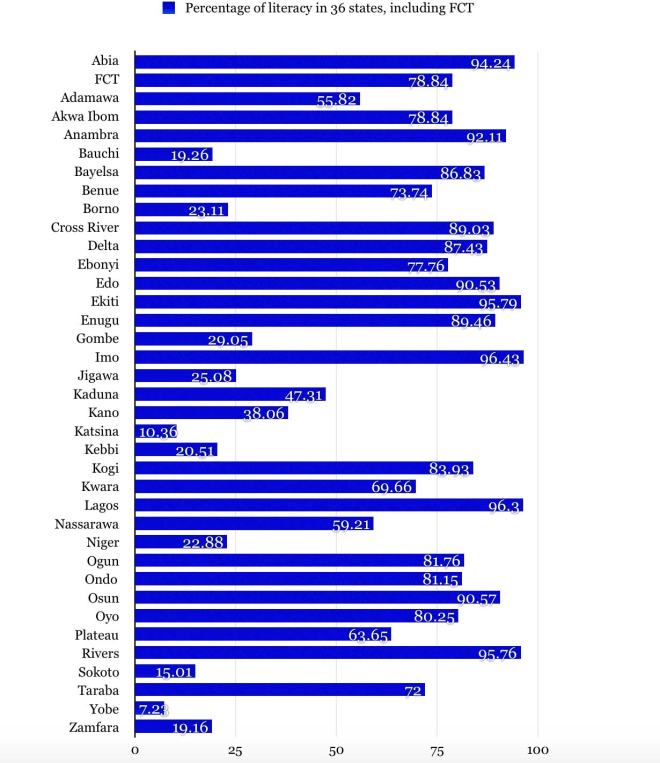
Yobe State has a literacy rate of 7.23%. Yet, if you run the numbers of the funds given to the state many years ago from the Universal Basic Education fund, it is at parity with Imo State (#1 with literacy rate of 96.43%). Has someone asked the successive governors in Yobe state what happened to all the money the federal government sent them to send kids to schools? Nigeria needs to ask fundamental questions to make progress in this age. Things are not just working!

I have noted that we have only 30 million people as the core addressable market. But it seems the oil sector is really what matters (I have updated this number to 32 million people). If oil price drops, even the 32 million people become meaningfully irrelevant to a large extent. That is very unfortunate and needs to change.

In most of my analyses when it comes to people that actually have money to spend or pay for (technology) solutions in Nigeria, I use 30 million people. Yes, despite 198 million human population, the effective addressable market in Nigeria is less than 30 million people. In Fasmicro Group model, these are people with decent incomes for anyone to craft solutions to their personal and business-related frictions. The remaining 168 million people are opportunities, nevertheless [they have to eat, shower, etc].  But we see them from the track of the core 30 million people who have the money to pay for tech things. For most technology solutions (think gaming, apps purchase & digital subscriptions and the platforms like smartphones, computers and connectivity required for them) where the buyers are usually the direct beneficiaries, the 30 million is rock solid. (Of course, on largely non-tech areas like food where everyone has to eat, the 198 million people become the addressable market.

Source: NBS

Factors that Encourage the Survival of Food Vendors in Nigeria

0

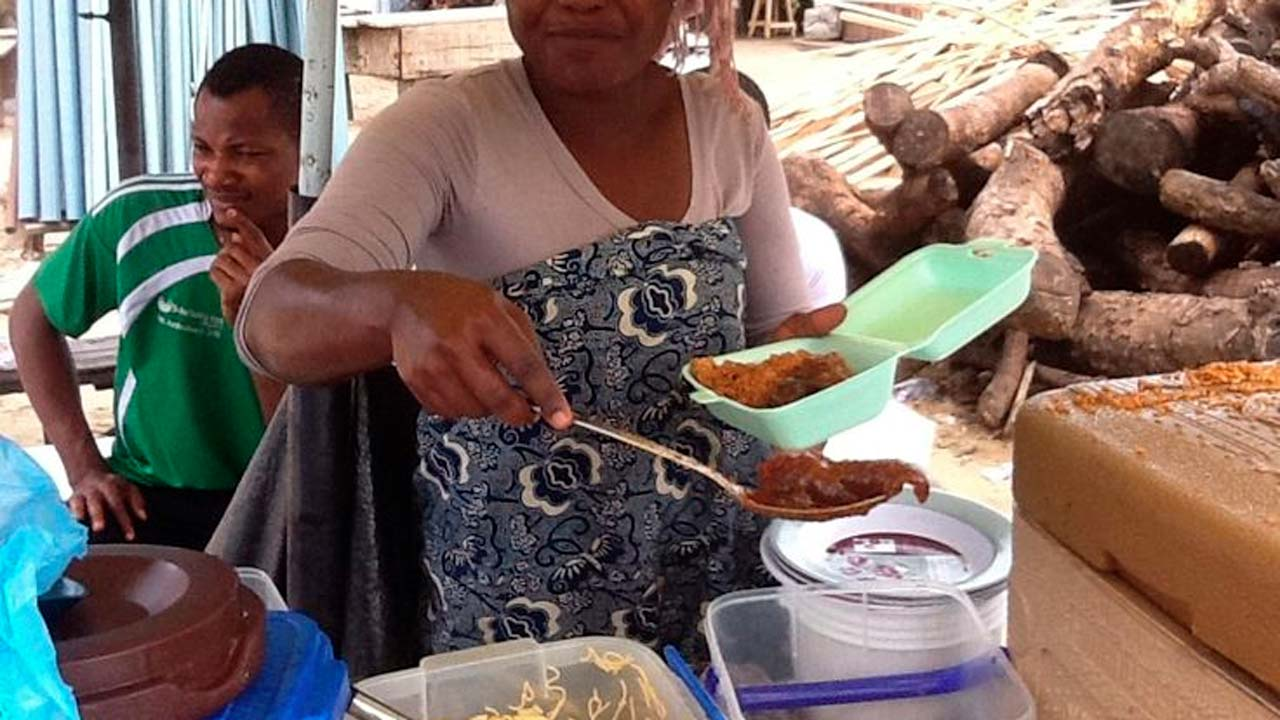
Food vendor is a business any woman that can cook can easily go into, if she couldn’t find something else to do. Food vendors seem to be springing up everyday and everywhere. You see them in offices, hospitals, motor parks, markets, schools, construction sites, and so on. To be honest, these people are taking away the customers of our restaurants.

I noticed that people patronise them without much qualms. Whenever I voice out my concern about the cooking method, quality of ingredients used in cooking those foods and the personal hygiene of the cook, people are always ready to ask me if I think our five star hotels are any better. So, I guess these food vendors are now competing with our 5-star hotels (lol).

But seriously, these people are worth studying to find out what makes them tick. But I’m going to list out some of the things I’ve observed that helps them to sustain their businesses, as well as the challenges they face.

1. Eligibility: The good thing about this business is that anybody can go into it – young and old, educated and non-educated, male and female, rich and poor. So long as you are ready to face the business, you are game.

2. Shop Renting: These people have the cheapest ‘shop’ whatsoever. Their ‘shops’ include tables and stoves under umbrellas, wheel barrows, push trucks and trays placed on the head. So, they literally spend close to nothing in renting ‘shops’.

3. Business Strategies: If you have ever wondered how these vendors manage to compete with the well established restaurants, here are some of the things I found out:

  • a. The first thing everybody notices about these vendors is the cheap prices they offer for their foods. A full plate of food from these people ranges from N150 to N250. The equivalent of these plates of food in a small restaurant will be about N250 to N500. Besides price, the quantity of food served by the vendors is always bigger than that of our restaurants, even with their exorbitant prices.
  • b. They offer credit facilities to their customers. Yes, some customers are allowed to eat and pay later. Some of these vendors even have registers of debtors that contain how much they owe, the days they accrued the debt, and how much they have remitted so far. Those that owe so much are usually asked to pay up a percentage before they are served.
  • c. The use of take-away packs makes it convenient for passers-by and travellers to patronise them. The beautiful thing about this is that they don’t charge extra for it.
  • d. Unlike the restaurants that have fixed prices for food, these people sell according the demand of their buyers. For example, you can ask them to give you N100 beans, N50 yam and N100 fish. Of course, the sauce is ‘free’. This makes it easy for their buyers to buy according to their means. This is one of the strategies that endear food vendors to their customers.
  • e. These vendors take their shops to their customers. What I mean here is that they locate their businesses in places of needs. For example, some take their wares to construction sites, where they know that workers will need their services. Food vendors don’t station in places where people that need them cannot be found.
  • f. For some reasons, the aroma of these vendors’ food is so arousing. It is as if they have special spices and seasonings they use. Trust me, no matter how hard you try, your food can never smell like theirs. Theirs is so spectacular. This is one way they invite buyers.
  • g. One more thing I noticed about some of these people is that they sell food that may not be easily prepared at home. For example, in Enugu here, you commonly see those that sell roasted yam, roasted plantain, stewed beans and fried fish. It will be easy to roast yam and plantain at home. So some people buy from them because they want to have a taste of the food.

4. Buyers: Initially I thought that food vendors are only patronised construction workers and travellers. But today, cooperate workers, students and even housewives patronise them. According to one woman, instead of cooking when she is alone at home, she will buy from the vendors.

5. Starting up the Business: The good thing about this business is that it is not capital intensive and it doesn’t require any formal training. They just cook the food they eat at home, and nothing so special. If you observe these vendors, you will also find out that the utensils they invest in are few plastic coolers, plastic buckets, spoons, plates (usually stainless) and bowls for washing out plates. Those that have found spots to station their ‘shops’ can look for umbrellas and tables. Those that move around use wheel barrows and push trucks. But it doesn’t mean that all these materials have to be in place before the business kicks off, some do buy them as time goes on.

6. Challenges: Some of the challenges encountered by these people include:

  • a. Dealing with the Weather: For you to be in this business, you have to learn how to endure all the weather conditions. They don’t run away from the scotching sun or windy rain. They just have to find a way to manage them.
  • b. Debts: Some of them have problems collecting debts owed them by their customers. I’ve heard of customers that run away with their money.
  • c. Harassment by Local Government Officials: I felt for one of these vendors when her food was poured away by some men from the local government authority, who came to collect dues. Some of these officials even carter away coolers of food and wheel barrows. These officials need to be trained on revenue collection; their methods these days are inhuman.
  • d. Stress: Their job is stressful. They usually complain about the stress they pass through buying the food stuff, cooking them, selling them and going back to buy more for the following day. And they have to do this everyday.
  • e. Shortage of Funds: The fact that the business is started with a little capital affects its growth. According to some of them, they use the proceeds from the business to settle family demands and other social necessities. This means that they don’t have much money to reinvest in the business, so they keep recycling the little capital they started it with. Some that couldn’t manage theirs well, end up spending their capital. However, the daily contributions they make (that is the ‘ajo’ or ‘isusu’) help them to raise money for some major projects.

Now we have seen why food vendors survive in Nigeria despite the presence of well furnished restaurants around. I believe that there are still some works that needs to be done there. First of all these vendors need to learn the importance of hygiene. I know that Africans are not afraid of diseases but we need to be careful with what we eat. Why I am stating this is because some of these vendors stay in very unhygienic places and sell their food. Some of their popular spots include covering stinking gutters with woods and placing their tables over them. Why their customers don’t complain baffles me.

Secondly, there is need for these vendors to be taught certain business strategies that will help them sustain and expand their businesses. Most of them remain in the same spot for years without expanding. The only thing is that they may be able to build small houses for themselves and raise their children. But those are not the only objectives of a business.

There are a lot to be done in this country. There are so many people that need to be reached and mentored. These food vendors are among them. Most of them are the breadwinners of their families and will need to know how to turn their small scale business into something bigger.

Our unemployed youths can also be encouraged to consider this business. All that is needed is for them to put their informal training in their mothers’ kitchens into money-spinning machines.

Honestly, there are so many things that can be done to generate income in Nigeria. Let’s start bringing them out so that our unemployed can find hope in the country.

Let’s keep the hustle real.

Bringing NYSC Down to Secondary School Leavers

2

I had the opportunity of meeting and interacting with some young school leavers, who have finished their secondary school education but are yet to gain admission into higher schools of learning. Some of these young ones wrote their SSCE this year while the others sat for theirs last year and some two years ago. Two of these people didn’t sit for JAMB this year (they were among those that just finished secondary school this year) but the rest did and were hoping for something good to happen.

The thing I noticed about these young men and women I’m talking about here is that most of them do not have anything they are doing to keep themselves occupied as they wait for the next stage in their academic pursuit. I was, however, impressed with the ones that accompany their parents and other relatives to carryout some business transactions. But I didn’t see any of them that was learning a skill or working somewhere for a pay.

I also noticed that these young men and women are not sure of what they want to study in the university. All they wanted was to ‘enter school’ and move away from home. I wasn’t so happy about this because I could only see history repeating itself – people going to school to get certificates that spelt ‘degree’ without knowing what to do with them.

I made out time to have a heart-to-heart talk with some of them. I found out that there are those that have businesses they want to go into, while some have skills they want to learn. But they are afraid of voicing out their desires to their parents. For example there is one that wanted to learn tailoring as he awaits the admission ‘lists’ but he always accompanies his father to his shop, where he sells cements and other building materials. He was more like the sales boy that doesn’t earn a salary. Another one wants to learn how to install satellite dish but he was asked to stay home and study for post-UTME. The one that tears my heart the most are those that can’t say what they want. For this group, JAMB and university admission is the only way out, unless their parents decide on something else.

So, I kept asking myself a lot of questions. What if JAMB and Post-UTME decide against these young ones’ dreams of entering a higher institution this year? What will be their plans till next JAMB and Post-UTME screening? Will they continue to hover around the streets till they ‘make it’ into the university? Why hasn’t the federal government decided on how to keep these young ones occupied till they decide on what next to do?

What of the parents? Till when will they understand the importance of skill-acquisition? When parents start allowing their children to acquire the skills they (the children) want, not the one the parents want.

But I want to ask, if parents will not voluntarily let their children go for trainings on entrepreneurship and skills acquisition, can’t they be mandated by the law to do so? Is it impossible to mandate these secondary school leavers to have a compulsory one-year skill acquisition programme before being allowed to sit for JAMB examination? I mean, if the FG can mandate graduates to carry out a one-year NYSC programme, it can also mandate secondary school leavers to carry out a one-year industrial training, or something like that, before they are allowed to sit for JAMB.

This may sound outrageous but it is worth looking into. However, I believe my reasons can explain it better. Some of the advantages of this programme, if adopted, include:

a. This type of programme can expose these young school leavers to the different occupations within the country (this information is denied to most Nigerians until they find themselves in the labour market). This will help them to choose the courses they will study in the higher institution based on what they want to do when they graduate. In other words, they will go for further studies in their areas of interest, and not just go into the university to acquire a certificate.

b. This programme can be planned in such a way that it will keep these young men and women busy until they succeed in gaining admission into higher institutions or are matured enough to start their own businesses. We all know what happens to ideal minds. Besides, keeping them busy will save them from frustration and depression that may accompany idleness.

c. I believe that the capture them young adage applies here too. A lot of talents are wasting in Nigeria because they weren’t harnessed at the right time. If a programme like this comes up and these youths were exposed to different professions, they can go to the areas they are good in. If they find out that they don’t like what they chose, they should be allowed to change it until they find what they love doing.

d. Most Nigerian youths knew what life after school is during their NYSC, or even after it. If I am asked, I’ll say that we don’t have to wait till that period to teach these young ones what life in the business and corporate worlds is like. They will use that period to learn how to be good employees and entrepreneurs. This means that the popular apprenticeship system can finally be utilised by the government to raise future entrepreneurs and corporate men.

e. The approved age for university admission during our days was 18 years. But today, because children are being pushed out of secondary schools early, we are beginning to see underage undergraduates. Of course I know that they may be doing well academically, but is it wise for someone to be in the university, a place for adults, at the age of 15? Anyway, I believe that if this compulsory industrial attachment programme is adopted, these children will be matured enough to go into higher institutions, which is a place meant for the intellectually, emotionally, mentally and socially matured.

Anyway, our job as citizens is to suggest, and that of the government is to apply. Someone on a television programme on Saturday accused the Nigerian masses of not bringing up ideas that the government can work with. I don’t believe that to be true anyway because if there is anything Nigerians loves doing, it is sending ideas upon ideas out to the government. Let the government think of ways Nigerian youths can be made productive before they all run out of the country.