DD
MM
YYYY

PAGES

DD
MM
YYYY

spot_img

PAGES

Home Blog Page 6803

Effective Record Keeping in Small Firms Boosts Growth and Performance

0

Big firms have inbuilt systems for tracking information relating to how they are operating. This is usually not the case among small business firms. That’s the necessity for this discussion. Deliberate attempt was made to keep the conversation simple.

Running a business firm involves entering into contracts and making transactions with different individuals, and group of individuals on a daily basis. These take place with the exchange of cash or a promise to pay cash.

As business transactions and contracts with different clients increase, there will also be a rise in incidents which can only be properly understood through proper analysis of how they have been occurring over time. These incidences is what is called trends. To facilitate trend analysis and reap the many rewards it promises, will require proper documentation of all relevant information related to business operation. There are several reasons why trends occur in business. We’re only concerned with those resulting from products and clients.

Trend in business is a revealer of so many useful insights which aid in making business decisions. This is why large firms and  intermediate companies have and pay kin attention to ensuring the efficient functioning of system of record keeping, for tracking down all relevant information, relating to the day to day  activities of their institutions. But farther down the line, at the level of micro/ small business firms, proper record keeping is largely a rarity for the usual reason of lack of adequate resources to engage the services of record-keeping staff, on the one hand. On the other hand, keeping proper records, to some entrepreneurs, is too time consuming, uninteresting and a thing to be avoided. 

For instance, one of the things an individual may feel strong reluctance to do, is to be making daily comprehensive records, showing details of all contracts with other persons and money made or expended, together with the source of the income and the reason for the expenses. This instance, explains the case of some entrepreneurs / small business owners. 

Not having sound business record is very costly for the reason that a business owner needs to understand exactly what he or she is doing as well as how the business is being affected accordingly. Given that the human brain has serious limitations with respect to accurate remembrance of past events, failing to maintain sound records of daily business operations, amount to disservice to oneself and one’s firm in the long run. 

How Record Keeping Grow the Performance of Firms

A business person knows exactly why he or she is in business. (This is without prejudice to classical thoughts on goal of a firm). However, for a firm to continue to exist and do business, it must commit to acquiring and serving increasing number of customers. It must also ensure it is making profit by doing so. These transactions, over time provide large volume of unorganized information which can only be adequately captured through documentation. A micro business firm needs good information to address myriads of business related problems, just as bigger organization does. Sound business record serves as a feedback, of which, when properly processed( or analyzed), provide details of how the various transactions entered into by a firm, has affected its performance. If the firm offers multiple products and operates in more than one location, the processed information obtained from records will equally reveal how each product or service line, operation base is contributing to business performance. Let’s take a closer look at these noted factors below:

Product profitability: Profitability is used to explain the extent of gain resulting from a product, service or event. Gain here means the positive difference one gets when cost of an item is deducted from the sales value of the item. When the documented information is analyzed, it will show how each of the products or services offered by a firm, is contributing to profit. When this happens, it will be seen whether or not some products or services are bringing more gains than others. If some products are simply yielding losses, that will equally be figured out. Based on cost consideration, a business person would find this sort of information very useful. This will lead to investing more on the products that bring in more gains. 

Client profitability: Careful assessment of transactions with clients over time, will reveal those who have record of persistent payment default as well as customers that it cost so much to serve. Among the latter category are customers that make small orders but maintaining them cause big ‘headache’. Another set of clients that will be revealed are those who are loyal in keeping to terms and in patronage. Information of this nature will guide an entrepreneur to formulate better strategy that will help him or her get more results for the effort made.  For instance, It may be decided that the firm, will do better by channelling greater energy to serving an increasing number of clients that bring in more gains at lesser headache. 

Sectional profitability: When cost of doing business in a place, and the associated performance, is compared with corresponding information from another area(s) of operation, this will reveal deeper insight about the extent to which each place of operation is gainful. That will guide a business person in deciding which areas should get more investment and which should get less. 

The Two Alternatives 

It should however be noted that whether a business person keeps records or fails to keep proper records, sacrifice is made. Keeping adequate records will require the discipline and time of a business person, or his/ her money paid to obtain the service. This’s the first aspect of the sacrifice. The alternative aspect of the sacrifice is to forgo having sound records of your business operation and make decisions without accurate knowledge of how your previous decisions fared. In this case, you’re willing to operate blindly and risk serious consequences.

Keeping good business records is a habit that all entrepreneurs should have. It helps a business person to take better financial control of company’s growth and success and will give an entrepreneur peace of mind farther down the line.

How to Ensure Effective Facilities Management Public-Private Partnership Model in Nigeria

0
BHL Solution manages technical projects

On different fora, experts have suggested that Nigeria will only get it right in the area of sustainable economic growth when the critical infrastructure are in place for people and businesses. Over the years, various infrastructure funding deficits have been stated by the concerned stakeholders. Recently, the Bureau of Public Enterprises noted that Nigeria needs to invest $100 billion per annum for the next six years for her to close existing infrastructure gaps.

Indeed, Nigeria needs to make up critical infrastructure deficits in transport, power, education, agriculture and telecommunication sectors. But to professionals and players in the Facilities Management industry and others within the built environment, attracting funds and highlighting sectors that need urgent attention have not been Nigeria’s problem since independence. According to them, the issue has been the failure to engage private sector adequately in funding and maintaining public infrastructure.

In advanced democracies and emerging ones, a wide spectrum of Public-Private Partnership has evolved for the provision of infrastructure services for public use. Despite the PPP Department at the Federal Ministry of Works and the Infrastructure Concession Regulatory Commission, an agency established in 2008 with the mandate of developing and implementing a PPP framework for the provision of infrastructure services, industry players and experts remain resolute on the need to remove barriers preventing effective implementation of frameworks developed by the Department and agency.

Siamese Issues and Efficiency Enhancers

It is obvious that Nigeria has infrastructure problem. It is also important to understand that existing facilities are rotting because of poor maintenance culture. There is no doubt sustainable maintenance is an issue in the public sector.

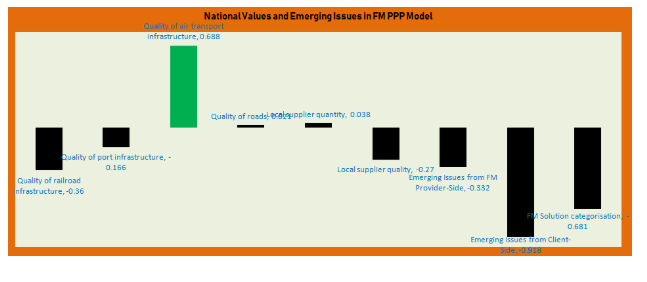
From the World Economic Forum’s perspective, Nigeria is sheathing in the areas of quality of railroad, transport and port infrastructure. Local supplier quantity and quality were also the Forum’s concern between 2015 and 2018.  Nigeria is not only having quality of infrastructure issues. The country is also failing by not sufficiently recognising and appreciating FM roles. When government is ready to engage FM providers, paying premium prices becomes an issue. These were the positions of professionals who expressed their views on the place of FM in businesses.

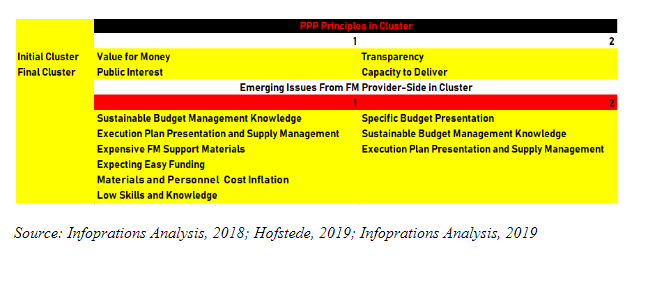
On the FM provider-side, effective PPP Model would be difficult to realise if the sector continues having issues such as poor relationship with the clients, lacking insightful issues on the facilities before offering specific solutions and presenting unrealistic maintenance cost structure. During the discussion, it emerged that on-site FM managers do not have adequate knowledge about the presentation of specific budget to the clients. Presenting maintenance execution plan and managing supplies remain herculean tasks. These have re-established the existing fact that low skills and knowledge are impacting the sector. These among other issues are impeding the successful execution of varied FM contracts.

Beyond the contract execution related issues, the current marketing approach of key players in the industry would have little or no contribution to the proper understanding of FM solutions. Analysis indicates that existing solutions are being promoted on the companies’ website using conceptual approach. This indicates that the companies prefer simple description of the solutions to the classical structure, which allows categorisation of solutions based on their similar features or benefits.

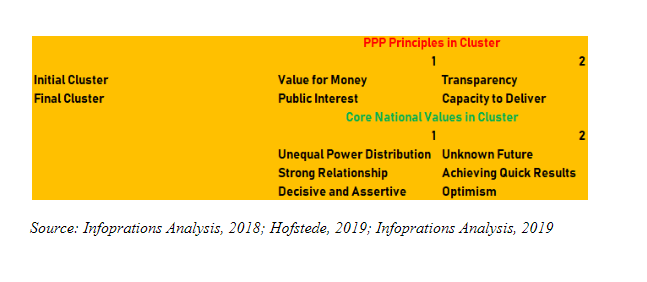
Like other countries, Nigeria has unequal power distribution, strong relationship, decisive and assertive, unknown future, achieving quick results and optimistic about the future, though they like enjoying life when the need arises with financial strength, as her national values. When these were analysed along with the emerging issues and the position of the World Economic Forum, the results show that FM PPP Model’s effectiveness will depend on the extent to which stakeholders; especially companies address the issues using the right approaches and processes.

The ranking of the country’s quality of air transport infrastructure resonated with the values by 68.8%. Quality of roads and local supplier quantity also connected with the values positively. However, it would be difficult for the companies and government to maintain existing infrastructure and future ones without addressing the emerging issues along with some negative national values. For instance, the unequal power distribution value which emphasises the need for the subordinates to respect their seniors and that ideal leader or boss is a benevolent autocrat would impact the negotiation and eventual implementation of any PPP contract.

Source: World Economic Forum, 2018; Infoprations Analysis, 2018; Hofstede, 2019; Infoprations Analysis, 2019

Navigating the Negotiation Terrain

Analysis further reveals that FM companies must dissect and understand existing principles in the PPP framework developed by the Infrastructure Concession Regulatory Commission. ICRC expects companies to adhere and exhibit value for money, public interest, risk allocation, competition, capacity to deliver, transparency and engaging with the market principles during negotiation and implementation of any contract with the government.

Analysis of these principles along with the emerging issues from the FM provider-side shows that companies must ensure that their proposals to the government are laden with solutions that offer value for money and showing significant transparency level. Companies must also show their readiness to offer solutions based on public interest and establish their competencies and capabilities to deliver various FM solutions.

As the analysis further reveals FM companies have many challenges to contend with while establishing their readiness to offer solutions that commensurate with the cost in the public interest. Personnel in charge of bidding or contract negotiation must  be equipped with the best approaches to contain unequal power distribution, which has been found to be one of the country’s values contributing to systemic corruption and delay in finalising contract agreements.

In this regard, FM companies should foster strong relationship and provide documents capable of establishing their competencies and availability of the right resources to deliver the promised value. When the emerging issues from the FM provider-side are not addressed before initiating PPP, analysis suggests that government is likely to doubt the transparency status and capacity to deliver the promised value.

Despite this, there is likelihood that government officials would be optimistic while expecting quick results from any PPP contract. From the insights, it is clear that FM companies need to improve their processes and people before marketing FM solutions to the government through PPP Model. The future of the FM PPP Model looks good as FM continues growing as a business and discipline.

Why Starbucks Mobile App Has Lousy Security But Great User Experience

8

I left this comment on my LinkedIn feed on a piece about GE and Access Bank partnership. This connects to my Double Play Strategy. I have edited and expanded it for clarity here. 

If you sell Toyota financing unit for passenger cars in U.S., Toyota revenue in the U.S. will drop. Yes, most customers will be unable to buy Toyota cars. With Toyota, you can get a 0% interest rate for five years if you have good credit. If you have a degree from some top universities, you get a 0% also as a fresh graduate. Less than 2% rate is typical. Not many commercial banks will offer you a competitive rate like that.

But if one crazy guy comes in and says Toyota financing is losing money and needs to be closed, he will be shocked within quarters. Yes, the sales will drop because even if it has outsourced financing to partners, none can be better than what Toyota gives for its cars. The key is making sure that Toyota bundles its risks into the pricing of its cars. But shutting down the financing unit would be an own-goal as they say in football (yes, soccer).

That was the basis of my point with GE and the selling of GE Capital in 2015. Since GE Capital was sold, GE is yet to recover. Of course, GE has other issues like buying Alstom and other heavy power properties. Interestingly, it needed to sell assets to have the capital to acquire those assets. But losing GE Capital exposed the company to inability to close deals faster since clients could not easily get alternative capital. I am not saying GE Capital was the only reason that messed up GE. GE did not see the emerging renewable energy redesign where power systems are getting distributed which means large turbines are not the future but micro-power stations distributed across communities.

That brings me to Starbucks, a coffee chain: it has the best retail app which keeps winning awards because it is easy to use. Yet, Starbucks app is one of the “least” secure apps in retail. Your points can be stolen but Starbucks will replace them overnight. Starbucks can make extra $1 billion revenue for that lousy security per quarter and spend $100k to replenish stolen points. (Of course the stolen points are used in Starbucks. So, it is giving away $100k which also counts as “revenue”). Wall Street likes the extra $1 billion, adding extra $2 billion in its market cap. It has used $100k to get $2 billion in market cap and sold a commoditized product, adding extra $1 billion in the bank. So, telling Starbucks to secure its app does not get the idea!

If the app becomes so secure that it is now not easy to get that extra $1 billion, it will lose the $1 billion and the pop in its market cap. I might have simplified this but get the idea; never think that Starbucks does not have good engineers to make the mobile app as secure as bank app!

Business is organic in nature. There is transfer of value in the mechanics of financing. If you control the source of money, you win markets and territory.


Suicide Prevention in Nigeria – How to Manage Low Mood and Depression

2

‘Very often when people say “I am tired of life” or “There is no point in living”, they are brushed off, or are given examples of other persons who have been in worse difficulties. Neither of these responses helps the suicidal person’. WHO

The causative issues for low mood and depression are quite common all over the world, but there are other issues I have identified peculiar to the Nigerian environment. In this article I will be discussing the common causes of low mood and depression prevalent in our society.

The rate of Depression, suicidal ideation and drug addiction is on the increase in Nigeria at the moment, this seems to be a ‘chain reaction’ triggered by a host of other factors which include, poverty, unemployment, harmful cultural practices , ‘social media factors ‘and  untreated mental health illness ;schizophrenia, bipolar disorder,etc. 

Social Media pressures

 When we were growing up, there was no social media, I call it the good old days, for social activities we spent more time outdoors, and we made use of indoor and outdoor sport facilities.

I grew up in a university environment where I didn’t have to belong to an elite sports club to make use of a gym, basketball court or lawn tennis court. I had the privilege of having a gym where we contributed only a token, although the gym was filled with males doing body building, it was a bit difficult for me to use the gym sometimes as I could be the only female in the gym and felt outnumbered, but I didn’t let that deter me, because I understood the benefits of physical exercise to my wellbeing, and overall health.

Social media has its own advantages and disadvantages, and it could be addictive as well; these days’ young people are influenced by it and so engrossed in having approval through ‘followership’, likes etc they tend to neglect what matters most which is their mental health and wellbeing. Some people have gone into depression when their friends do not like their posts.

The human body was created to function in harmony, when any part is suffering, it affects our productivity. For some of the suicide cases that have occurred recently, the victims made a post about it on social media before the act or while doing the act.

For us to understand how to deal with low mood and depression, we need to know the trigger factors and causes to enable us seek help in good time .Knowing the root cause is essential to identifying ways to solve the problem.

Common causes of low mood and depression

  • 1- Bereavement
  • 2- Lack of self-worth and feeling of inadequacy
  • 3- Relationship break down like divorce, separation etc
  • 4- Poverty- Unemployment
  • 5- Minor illness and Major diseases
  • 6- Natural disasters
  • 7- Tribal Conflicts /Wars
  • 8- Poor grades or exam failure
  • 9- Toxic workplace
  • 10- Hectic lifestyle
  • 11- Excessive overworking
  • 12- Domestic Violence
  • 13- Sexual Abuse
  • 14- Social Media addiction
  • 15- Lack of sleep
  • 16- Underlying mental health illness
  • 17- Infertility
  • 18- Prescribed Medication
  • 19- Drug addiction /Abuse
  • 20- Issues with finding a life partner/Late marriage

How do we maintain our mental health?

There are several ways we could maintain our emotional health and help reduce low mood and depression

According to the WHO, Depression is a common mental disorder, characterized by persistent sadness and a loss of interest in activities that you normally enjoy, accompanied by an inability to carry out daily activities, for at least two weeks. 

In addition, people with depression normally have several of the following: a loss of energy; a change in appetite; sleeping more or less; anxiety; reduced concentration; indecisiveness; restlessness; feelings of worthlessness, guilt, or hopelessness; and thoughts of self-harm or suicide.

Depression is treatable, with talking therapies or antidepressant medication or a combination of these. Depression is the most common diagnosis in completed suicide. Everyone feels

Depressed, sad, lonely and unstable from time to time, but usually those feelings pass. However,

When the feelings are persistent and disrupt a person’s usual normal life, they cease to be

Depressive feelings and the condition becomes a depressive illness.

Some of the common symptoms of depression are:

  • feeling sad during most of the day, every day;
  • losing interest in usual activities;
  • losing weight (when not dieting) or gaining weight;
  • sleeping too much or too little or waking too early;
  • feeling tired and weak all the time;
  • feeling worthless, guilty or hopeless;
  • feeling irritable and restless all the time;
  • having difficulty in concentrating, making decisions or remembering things;
  • having repeated thoughts of death and suicide.

Life Stressors

The majority of those who commit suicide have experienced a number of stressful life events in the three months prior to suicide, such as:

  • Interpersonal problems – e.g. quarrels with spouses, family, friends, lovers;
  • Rejection – e.g. separation from family and friends;
  • Loss events – e.g. financial loss, bereavement;
  • Work and financial problems – e.g. job loss, retirement, financial difficulties;
  • Changes in society – e.g. rapid political and economic changes;
  • Various other stressors such as shame and the threat of being found guilty.

To understand what leads people to committing suicide, we need to understand the state of mind of a suicidal person.

THE STATE OF MIND OF SUICIDAL PERSONS

Three features in particular are characteristic of the state of mind of suicidal patients:

  1. Ambivalence: 

Most people have mixed feelings about committing suicide. The wish to live and the wish to die wage a see-saw battle in the suicidal individual. There is an urge to get away from the pain of living and an undercurrent of the desire to live. Many suicidal persons do not really want to die – it is just that they are unhappy with life. If support is given and the wish to live is increased, the suicidal risk is decreased.

  1. Impulsivity:

 Suicide is also an impulsive act. Like any other impulse, the impulse to commit suicide is transient and lasts for a few minutes or hours. It is usually triggered by negative day-to-day events. By defusing such crises and by playing for time, the health worker can help to reduce the suicide wish.

  1. Rigidity:

When people are suicidal, their thinking, feelings and actions are constricted. They constantly think about suicide and are unable to perceive other ways out of the problem. They think drastically. A majority of suicidal people communicate their suicidal thoughts and intentions. They often send out signals and make statements about “wanting to die”, “feeling useless”, and so on. All those pleas for help must not be ignored. Whatever the problems, the feelings and thoughts of the suicidal person tends to be the same all round the world.

HOW TO REACH OUT TO THE SUICIDAL PERSON

Very often when people say “I am tired of life” or “There is no point in living”, they are brushed off, or are given examples of other persons who have been in worse difficulties. Neither of these responses helps the suicidal person. The initial contact with the suicidal person is very important. Often the contact occurs in a busy clinic, home or public place where it may be difficult to have a private conversation.

  • Feelings Thoughts
  • Sad, depressed “I wish I were dead”
  • Lonely “I can’t do anything”
  • Helpless “I can’t take it anymore”
  • Hopeless “I am a loser and a burden”
  • Worthless “Others will be happier without me”
  1. The first step is to find a suitable place where a quiet conversation can be held in reasonable privacy.
  2. The next step is to allocate the necessary time. Suicidal persons usually need more time to unburden themselves and one must be mentally prepared to give them time.
  3. The most important task is then to listen to them effectively. “To reach out and listen is itself a major step in reducing the level of suicidal despair”.

The aim is to bridge the gap created by mistrust, despair and loss of hope and give the

person the hope that things could change for the better.

How to communicate

  • Listen attentively, be calm.
  • Understand the person’s feelings (empathize).
  • Give non-verbal messages of acceptance and respect.
  • Express respect for the person’s opinions and values.
  • Talk honestly and genuinely.
  • Show your concern, care and warmth.
  • Focus on the person’s feelings.

How not to communicate

  • Interrupt too often.
  • Become shocked or emotional.
  • Convey that you are busy.
  • Be patronizing.
  • Make intrusive or unclear remarks.
  • Ask loaded questions.

A calm, open, caring, accepting and non-judgemental approach is required to facilitate communication.

HOW TO MANAGE A SUICIDAL PERSON

Low risk

The person has had some suicidal thoughts, such as “I can’t go on”, “I wish I were dead”, but has not made any plans.

Action needed

  • Offer emotional support.
  • Work through the suicidal feelings. The more openly person talks of loss, isolation and worthlessness, the less his or her emotional turmoil becomes. When the emotional turmoil subsides, the person is likely to be reflective. This process of reflection is crucial, as nobody except that individual can revoke the decision to die and make a decision to live.
  • Focus on the person’s positive strengths by getting him or her to talk of how earlier problems have been resolved without resorting to suicide.
  • Refer the person to a mental health professional or a doctor.
  • Meet at regular intervals and maintain ongoing contact. All these questions must be asked with care, concern and compassion

Medium risk

The person has suicidal thoughts and plans, but has no plans to commit suicide immediately.

Action needed

  • Offer emotional support, work through the person’s suicidal feelings and focus on positive strengths. In addition, continue with the steps below.
  • Use the ambivalence. The health worker should focus on the ambivalence felt by the suicidal person so that gradually the wish to live is strengthened.
  • Explore alternatives to suicide. The health worker should try to explore the various alternatives to suicide even though they may not be ideal solutions, in the hope that the person will consider at least one of them.
  • Make a contract. Extract a promise from the suicidal person that he or she will not commit suicide without contacting the health care staff; for a specific period.
  • Refer the person to a psychiatrist, counsellor or doctor, and make an appointment as soon as possible.
  • Contact the family, friends and colleagues, and enlist their support.

High risk

The person has a definite plan, has the means to do it, and plans to do it immediately.

Action needed

  • Stay with the person. Never leave the person alone.
  • Gently talk to the person and remove the pills, knife, gun, insecticide, etc. (distance the

means of suicide).

  • Make a contract.
  • Contact a mental health professional or doctor immediately and arrange for an ambulance and hospitalization.
  • Inform the family and enlist its support.

REFERRING A SUICIDAL PERSON

Refer when the person has:

  • Psychiatric illness;
  • A history of previous suicide attempt;
  • A family history of suicide, alcoholism or mental illness;
  • Physical ill-health;
  • No social support.

If we can identify the level of risk of suicide an individual has, we will be better placed to manage the suicidal thoughts before they get carried out.

Established mental health illnesses need to be managed medically, sometimes with pharmacological or non pharmacological therapy.

Non- pharmacological therapy includes- Cognitive behavioural therapy, befriending services, yoga/exercise, talking therapy etc.

Pharmacological therapy includes the use of medication like anti-depressants, mood stabilisers, anxiolytics, prescribed by a qualified medical/healthcare professional. Such medication also have side effects so adequate management is needed and if when considering stopping, the dose is tapered off gradually to prevent withdrawal symptoms which could make the patient’s condition worse at the end of the day.


References:

  • Preventing Suicide –A resource for Primary Health care workers, Mental and Behavioural Disorders, Department of Mental Health. World Health Organization
  • Geneva2000
  • For primary care workers who would like to develop toolkits on projects or suicide prevention, Please access full resource guide from WHO form the link below 
  • WHO Materia (here)

Being in Charge of Your Life Mission

2

With a few momentary contacts, conversation and silent observation of your appearance, summing you up, and finding a bespoke box fit for your presumed size and personality, is something some friends and close family members find easier than sucking in air and puffing it out through their nostrils.

They can boast of knowing you better than the foot paths leading to the streams in their villages. 

To clear your mind completely of any doubts, that’s if you still have some, because most people hardly have any left,  they seek out fine sounding, logical and relatable evidences. 

If you are the smartest in your class, a group of highly opinionated folks will take it is as a day job, the task of subduing your mind into accepting the limiting belief that you are a lecturer, and nothing more. In the little world in their minds, your destiny had been clearly defined, and it is lecturing. 

If you studied a medical course in the school, business becomes a default no-go area for your type. You must practice medicine. Any other career is lesser and beneath your highly exalted medical certificate of study. 

They rub it on your face and keep rubbing it deep hoping to drive in their point of view and opinions about you. That task to them comes easy too. 

Emotion is a poor guide. Decisions made out of it leave regrets in their wake. Regrets often come later after you have been cornered and securely lured away from the things you find meaning in doing  and into the things your family, environmental and peer pressure have approved for you but which have little meaning and attraction for your soul.  

Nobody can ever know you better than yourself. I know some parents will throw in their last card to challenge me on this one. They should wait until I throw it open for a challenge. 

Unless somebody’s words match with who you know yourself to be, they are at best their personal experiences, expectations and orientations put in words. Your life going forward will be sweeter if you succeed at not falling for people’s opinions and definitions of who you are.