DD
MM
YYYY

PAGES

DD
MM
YYYY

spot_img

PAGES

Home Blog Page 6803

Crises in Followership – The Cause of Many Leadership Failures

3

It may seem inconceivable that any right thinking individual will put the blame on followers for the emergence or continuity of cruelty of bad leaders. I agree with you. Why would you blame the miserable as if their misery isn’t enough for the cruelty of bad leadership? It looks immoral or even insensitive to do so,at least on the surface.

These are two components of a two dimensional problem,the leaders and the led.  So involving one and excluding the other will not just be inappropriate but will also make it  incomplete. Considering how leaders emerge, I can categorize it into two different processes.

  1. Those who were put in positions of power or authority by the people.
  2. Those who got to positions of power or authority  by unpopular force or influence.

When a leader emerges from the first scenario, you wouldn’t be wrong to say that the followers are responsible for bringing this individual onboard, but will it be wrong to say they are responsible for his actions? This will depend on why they brought him onboard. If it is because his values and ideals align with those of the people, then yes you can say so. This is usually the case even though many will disagree.

But consider this, that the leaders are selected from the people. In other words before they became leaders they were once part of the populace. What this implies in Mathematical terms is that if  the populace is the universal set (U), the leaders are the subset {s}. In mathematics, a subset will always retain some of the properties of the universal set.

Let’s for the sake of this analogy assume that the populace is a  homogeneous mixture of people with similar attributes which define their social identity. This does not imply that they are all alike in all aspects, but only emphasizes that every group has an identity which defines them and makes them unique or peculiar or different from any other group. The same way a pack of cards will contain rectangular cards of identical weight and size but with different numbers and drawings on them. If this has been established then we can go further to say that this is purely a population and sample case .

If I took a handful of sand from the beach, will the properties of the soil sample be any different from the properties of the rest of the sand in the sea shore ? If a blood sample was taken from a patient’s vein, would the properties of the blood sample be different from what lies in the individuals blood. Medical science rely on this most of the time for diagnosis, are they ever wrong?  So if an institution or corporate body or government is repeatedly getting after many iterations a particular kind of leader, In this scenario the leader reflects the ideologies and interests of the people. So his failure is purely a failure of followership. 

For the second scenario, where a leader gets to a position of power by force or unpopular influence,  what happens afterwards is very crucial. I can categorize the general behavior or followers in this instance into four:

  1. Survival sycophancy
  2. Constructive Criticism
  3. Outright rebellion or opposition
  4. Silence.

This highlights the fact that followers have a series of options to follow which when they do, can affect either positively or negatively the status quo.

In the first instance, they only say what they think the leader would want to hear even when his actions are against the interest of the group or team. This they do out of either personal selfish interest or fear. Either way it points to the fact that they are bad followers.

In the second instance this can help transform or enlighten the leader on what needs to be done, or on what the real needs of the team or group is. If this is consistent, it either transforms the leader for good or it leads to the third which is;

Outright opposition or rebellion . When this happens it culminates to the leader being forced out by the sheer will power of the people who are led, hopefully ending the leadership crisis.

In the fourth instance, the words of Martin Luther King Jr  in his Testament of hope speech adequately summarizes it, “History will have to record that the greatest tragedy of this period of social transition was not the vitriolic words and violent actions of the bad people, but the appalling silence and indifference of the good people. Our generation will have to repent not only for the words and acts of children of darkness, but also for the fears and apathy of the children of light.” 

Who takes the praise for the economic success of the Germans after both WW1 and WW2  even after obvious leadership failures? The people or the leaders or both? Who takes the praise for the Japanese success story after two nuclear disasters and a tsunami? The people or the leaders or both?  Whatever your answers to these questions are, the attitude of these people must have played an important role. Sure the government or corporate leaders has got a lot to do when leadership or economy fails, and this article does not try to exonerate them. Rather it tries to hold everyone responsible.

In the end, considering all the factors listed it becomes evident that leadership failure arises, stays, or continues as a result of the actions or inactions of the followers.

Open Banking In Nigeria Evolving

2

One of our contributors wrote about open banking few days ago on Tekedia. The industry is evolving looking at the partnership EY just announced.

Ernst & Young (EY), a global professional services firm, has finalised arrangements with Open Banking Nigeria to develop and advocate for a standard Application Programming Interface (API) for the country’s financial services industry. The partnership will, in addition, transform the management of financial data and extend services to individuals and businesses across Nigeria.

EY, in a statement, disclosed this recently after it inked an agreement with Nigeria’s foremost Open Banking advocate and facilitator, Open Banking Nigeria.

With this agreement, EY joins other leading industry stakeholders to analyse the need of the industry for a common API standard among banks and other financial institutions, support the development of API standards, promote adoption with stakeholders—players and regulators—and enable further innovations in Nigeria’s financial services industry.

The introduction of a unified API across financial institutions creates a foundation upon which data can be effortlessly accessed and securely shared, real-time. It would, among others, empower individual and corporate users of services within the payment ecosystem to instruct their service providers to share their bank balance and transaction information with regulated Account Information Service Providers (AISPs).

This interoperability would result in the development of modern payment services, cost saving for operators and increased innovation while also guaranteeing information security and privacy, which would not cause an uneven playing field for industry players.

According to a statement by Dapo Adewole, Partner, Technology Advisory, at EY: “As part of our commitment to support the building of a better working world, EY Nigeria is working with stakeholders to use open banking to reshape financial services, especially as regulators and governments seek to increase competition and choice. 

“We understand that customers also expect more convenience and flexible access to services, driven by broader digital experience and emerging technology. It is our desire to bring this goal to fruition, while working with other player in the industry.” 

Welcoming EY Nigeria to Open Banking Nigeria, Ope Adeoye, a trustee at Open Banking Nigeria, noted the firm’s top-notch contributions, along with other stakeholders, would lead to the development of the next generation of API standard for the Nigerian financial services industry.

Already acknowledged as the future of banking on the globe, the adoption of Open Banking in Nigeria would enhance the service offerings of players in the financial services industry, improve customer engagement and build new digital revenue channels. It would also transform the operation of other industries, including telecommunications, power, hospitality, retail and insurance, seeking to leverage data for the improvement of their operational scope and service offerings to clients.

Press Release

Cryptocurrencies – Digital Wealth In A Flip

0

The cryptocurrencies or digital currencies are currencies which you can neither see, touch or feel but you can buy and sell using it. They are currencies in which encryption techniques are used to regulate the generation of units and verify the transfer of funds, operating independently of a central bank. Unlike the common money we know, digital currencies are digital; e-monies, you can’t lay hold of it but it qualifies as money since it is a recognized means of buying and selling and a medium of exchange. They are decentralized and no government or organization could claim to have control of it and hence nobody can regulate it.

A cryptocurrency (or crypto currency) is a digital asset designed to work as a medium of exchange, it uses strong cryptography to secure financial transactions, control the creation of additional units, and verify the transfer of assets.

It has been a controversial topic as to the initiator or founder(s) or starter(s) of cryptocurrencies, while some claim that is the mysterious Satoshi Nakamoto, whose identity is unknown, some link the invention to another individual but it is a known fact that digital currency finally gained success in the year 2009 when Bitcoin (represented as Btc) was released as open-source software after numerous futile attempt to create digital currencies.

Bitcoin is generally considered the first decentralized currency. It is not regulated by any government or organization neither is it under the control of any state or person.

Till date, bitcoin remain the most popular, most accepted and the most expensive among all other cryptocurrencies as there have been more than 3000 other cryptocurrencies released into the market since 2009, after the huge success of bitcoin.

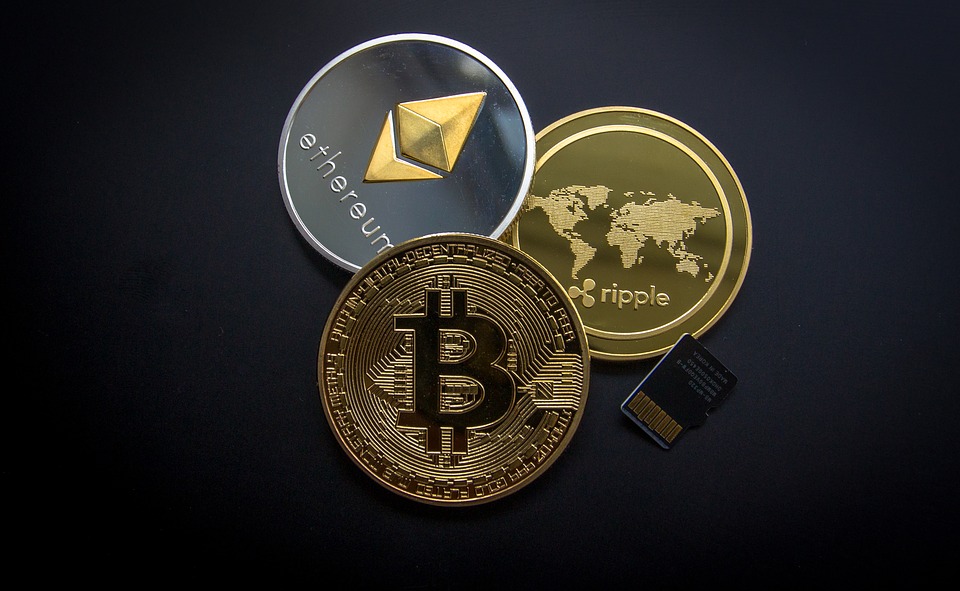
Some out of the numerous cryptocurrencies released afterwards include Ethereum (represented as Eth), Litecion (Ltc), Stellar (Xlm), Ripples (xrp), Bitcoin cash (bch), Pivot (pvt), namecoin etc. All these other coins other than bitcoin are referred to as altcoins.

Bitcoin was valued for the first time in 2010 when someone decided to swap his 10,000 units of bitcoins for two pizzas on 22nd of May 2010 and this date is celebrated every year as bitcoin pizza day in remembrance of the day bitcoin gained value.

Bitcoin depiction

Since 2010, Bitcoin has gained more popularity, and is widely accepted and extended into more countries in America, Europe, Asia, Australia and even Africa. Bitcoin and other digital currencies have remained a unit of investment, business and means of livelihood for most individuals.

Although many people are yet to know what cryptocurrencies are, it is a way to make money at the comfort of your home without physical contact with the person you are buying from or selling to; all you need is a smartphone or a computing device. Since it is digital or an E-money, you can transact with any body in any part of the world; you can buy, sell, hold, mine or swap.

It’s high time individuals avert their attention to this digital way of making money as it is on the ‘soft work’ way of making money and creating exchange.

There are about four segments in this business and four distinct way a person involved in it can make his money as it doesn’t only revolve around buying and selling; there are the traders, the holders, the miners and those engaged in swapping.

The traders are those engaged in the buying and the selling of the coins on daily bases. They buy in order to sell, they sell with little or more profit margin. It takes a lot of experience to be a trader of cryptocurrencies. A trader should be conversant with the pull and the push factor that leads the rise and fall of the prices.

Then there are the holders, the holders are the investors, they invest in the cryptocurrencies, they can hold that for years and can only withdraw it when they feel it’s necessary. Holding in the real sense of it is the most lucrative part of cryptocurrencies. 

Earlier this year, a bitcoin was sold for $4000 USD but by June the same year, bitcoin hit $14000.There are other coins (referred to as altcoins) which is less than $1 now but have the prospect of hitting $11000 in the nearest future. Some of those altcoins include; Ripple (Xrp), Stellar (Xlm), Bitcoin cash (bch) etc. These coins are predicted to be worth more than a thousand dollar in the nearest future and due to the success of bitcoin the prediction will not be far from the truth despite the fact that each of those coins cost less than one dollar.

There are those that are into mining of bitcoins and other cryptocurrencies. Constant energy or electricity is required for mining. Most times the cost of power and the cost of machines to be used in mining makes cryptocurrency mining less lucrative. Some of the most popular machines used in mining are Antminer S9, Antminer R4, Avalon 6 etc (you can check the cost on Amazon if you are interested in getting one).

There are also those that are into swapping of coins. All they do is to swap one coin for the other, they make their income from the fees they charge for swapping.

The good news about cryptocurrency investment or trade is that there is no minimum or maximum amount of money that’s required to start up the trade, you can start with as low as 10 dollars while you can invest with as much as one million dollars. All it takes is to create an account on any of the online exchanges and buy any of the coins with any amount of money you wish and send the coins into your wallet and there you go.

Be it noted that since it’s a business and just like other trade, it is determined by the market forces of demand and supply; the price could fall and rise at any time. The $10 worth of bitcoins or any other coin you get today could experience 10% increment by the next day and it could also fall by 10% by the next day; you must always study the price chart of each coin for you to be able to decipher the fate of the coin. Reading a chart is not rocket science, basic knowledge of economics will help you.

Be smart when dealing with crypto – it can make or burn you financially depending on the market.

The Brilliance of Bashir Umar’s Honesty to ALL Nigerians

2
Umar decoration on his promotion

On Sunday July 7, when ACM Bashir Umar stumbled on 37, 000 euros ($41,000 or N14,820,000) at Kano airport, the Air Force personnel had two choices: 

  1. Grab the cash and quietly walk away, resign from service and live a private life and his poverty will be in the past. 
  2. Return the money to the owner, remain poor but honest. 

He chose the latter, a decision that would have sounded silly in a country where integrity is scarce, and survival is for the fittest.


He was not the first to do something like that, so what’s the big deal? In 2014, a cleaner, Josephine Agwu, who works at the Murtala Muhammed International Airport Lagos, found 12 million naira and returned it to the owner. 

There have been little instances of honesty here and there in a country where corruption is paramount. But not enough to disregard sincere efforts of fidelity that has become so insignificant because of the contagiousness of corruption that has tainted the image of Nigeria, and enabled the askance look especially from the outside.

You could recall that it was in the same month of July that five Nigerian soldiers were declared wanted for absconding with millions of naira belonging to a VIP they were escorting. That’s just the tip of the iceberg in many cases of fraud and disloyalty growing with disheartening prevalence. Mockery and ridicule have been employed as recruitment tools by the majority who have accepted stealing as a way of life. The stories fill the news everyday.

There are excuses though, “Nigerian Leaders are thieves, they are only there looting public funds in large sums. And they do so with utmost impunity. So why should I not do the same when I have the chance”? This is the defense line of an average Nigerian whenever the question of honesty comes into play. The soldiers who scampered with the millions of naira they were escorting had been handling such transactions involving huge amount of money for so long. So they know the drill, most of these transactions are illicit, and their principals live off it to the penury and jealousy of their subordinates.

The Nigerian Army has not been able to explain what the millions being escorted from Sokoto to Abuja was meant for, and the VIP, Mr. Okiti, an Army commander, is yet to make any explanatory statement about the huge sum. It’s a constant display of impunity that has always put sensitive conscience on a state of dichotomy, and it’s only those who developed their conscience on the staunch of fidelity that can resist the urge to join them when obviously they can’t beat them. ACM Bashir Umar is one of those. There is always a question of what do you have to gain on the side of morality when there is impunity to be enjoyed on the other side?

Bashir Umar received a double promotion to corporal, Josephine Agwu also was promoted at her place of work, and appreciative Nigerians donated money to her to the tone of 1.4 million naira. But the objective in being honest is never to be promoted or to be praised financially by people. 

It’s more like being a good example to a fragile conscience, or a personal hygiene awareness campaign in a time of deadly virus. “But it’s just some drops of clean water from the dirty stream,” says the man who has not read the Bible’s story of the 12 Spies. The insignificant 2 numbers with positive claims won over the 10 who had negative reports. And God was pleased. 

In fact, their testimony resulted in victory for the rest of the Israel nation. But the two Spies were different because of their mental attitude, they had trained themselves to see through the good and bad, and to take sides with the good. So fidelity is like a personal hygienic attitude that protects a person from diseases, and it starts with little things like:

  • Picking up a wallet with a stash of cash and fighting off the urge to keep it.
  • Picking up a lost phone and returning it to the owner.
  • Paying the bus conductor when he has forgotten to take money from you.
  • Returning money to the owner when your account is mistakenly credited etc.

No doubt, these traits helped Bashir Umar and Josephine Agwu to develop a measure of honesty that has stood the test of our corruptible time. And it has also inspired so many others to do the same. The benefit of honesty goes beyond you being a reference point of trust and all the public applause. It comes with peculiar peace that its source is rooted in your heart.

Examples of rare virtues of honesty should be study cases at homes and schools. The younger generation needs to replace what is immorally common with what is morally scarce. A corruption free future cannot be attained by anti-graft laws only, but through a mindset that sees graft as an unwelcome guest in the mind.

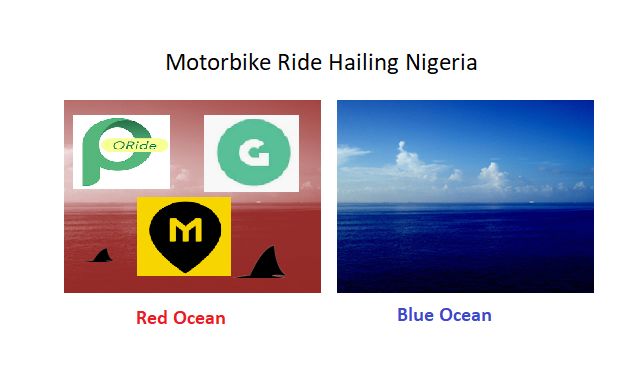
ORide Joins Gokada, Max in Motorbike Red Ocean – Should Startups Swim in Blue or Red Ocean?

10

You might not be too familiar with those terms – blue ocean and red ocean – but I’d simplify them as I explain. Yesterday, I was reading through a post on Facebook; I’d say it was really insightful and I give kudos to the writer. He simply analysed the ride hailing market in Nigeria and how one brand takes over another brand. Matter of fact, I learnt from it because I haven’t been paying attention to the ride sharing industry in the country and I am beginning to see the positive side of it despite the fact that I had my issues and concerns about the sustainability of such an industry. Now, my mind is at rest so far.

In his article, he explained how Opera mini started ORide service with the game plan of having a huge share in the ride hailing market by tormenting the likes of Gokada and Max. I really love the strategy they implemented, and I must give kudos to them. However, he didn’t point out some cogent factors which is why I decided to write this post. From his analysis, ORide decided to charge the sum of two hundred naira for any trip around Lagos. Although, I’m not so sure if this is really true, however in such a location like Nigeria, people always want good value for cheaper prices. It happens in other countries though but Africans seem to like this a lot.

Here’s my point: ORide offers two hundred naira to a location that a startup like Gokada will charge five hundred naira. With time, you’d discover that people will quickly shift to using ORide service which will be a huge threat to the scaling of other ride hailing services. Good strategy, right?

But where’s the cash flow? You are trying to snuff out other start-ups, yet running at a loss; does it make sense? Yes, it does since ORide is owned by Opera with lots of capital. They can keep funding it from their other sources of revenue. Opera can be bleeding from that end, yet not run down, since it’s just one small arm of the company. They can continue till they own the market; then later adjust their prices.

However, this can not be possible if you’re a start-up. This post is addressed to start-ups on why it’s better to focus on a small blue ocean than dive in a red ocean.

Let me give a practical example and why I still do not see Bigi cola as a threat to Coca Cola even till date. Bigi Cola sells for a hundred naira while Coca-Cola sells for one hundred and fifty naira. It sounds quite intelligent that they used such opportunity to penetrate the market and are scaling. However, they are fighting a price war with Coca-Cola and a price war is a lost battle if you are a smaller company with lesser money.

Here’s why; Coca Cola is a big brand. Matter of fact, Coca Cola is in almost all countries in the world. They make their revenues from these countries altogether and they still penetrate more countries. Bigi Cola on the other hand is a Nigerian brand. It’s just developing in the market. Going on a price war is very risky. If they have a huge source of funding, fine, if they have other sources of revenue, fine. However, selling for hundred naira because Coca-Cola sells for one fifty over the same selling point is risky. Coca Cola can decide to go on a price war with Bigi Cola. They can reduce the price of their drinks to eighty Naira. Would it affect their brand value? Well, maybe but like I said, Africans always go for better product, cheaper quality.

Will Coca-Cola be running at a loss, definitely. However, it will be just be in Nigeria alone; they can at least balance it from other countries. The goal is to kill Bigi Cola. Will Bigi Cola want to go cheaper? Well, I don’t know how much money they do have.

Same thing with how Elon Musk started Tesla. He went on another different niche. He went for a blue ocean; uncontested all-electric car market. If you’re a startup, you don’t rush into a red ocean. Red ocean is full of competition. Your goal should be stability and cash flow not competition. How much do you have?

Did Jeff Bezos try the the low price strategy with Amazon? Yes, he did. He didn’t make money for years, he was acquiring customers. Microsoft also played monopoly. It’s possible to go heads on if you have the money. Luckily for you, you can displace the existing company or companies.

All Together

If you’re just starting, a small blue ocean is your best bet. This doesn’t mean you cannot scale in the red ocean where there are sharks and all. You might bleed to death if you don’t have what it takes to survive in the contested red ocean.

So just like ORide is trying to beat other ride hailing services, I think it has a good bet on the strategy since it has the capital and size. But that does not mean that the red ocean model can work for all startups.