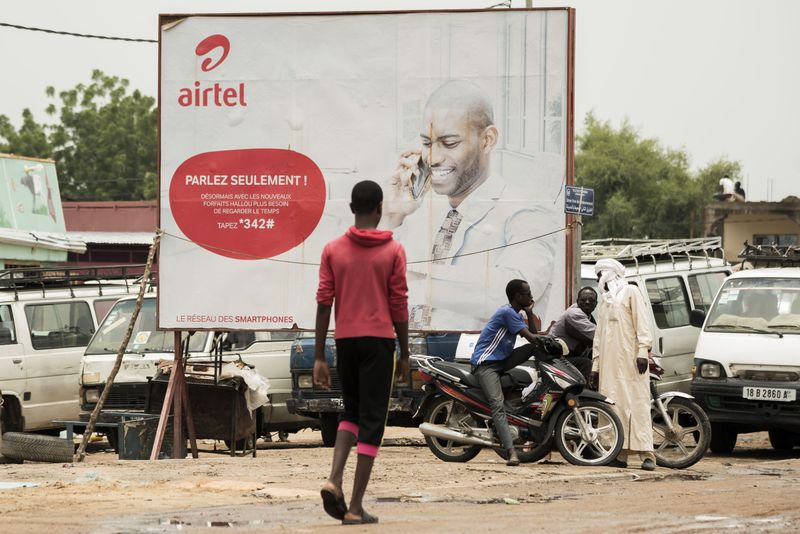
Provided there is MTN Group, telcos in Africa where MTN has operations will continue to see shadows. Unless you are the likes of Glo Nigeria and Safaricom Kenya with limited continental vision, the challenge will be huge. Yes, if you want to have a pan-African vision, you will be confronted “everywhere you go” with the y’ello brand. Airtel Africa, the Africa business of India’s Bharti Airtel, went to London, doing all to avoid MTN Group. Unfortunately, the London is not far: can you hear me now? Airtel Africa IPO’d in London, raising $750 million on a valuation of $3.93 billion. But quickly, Airtel Africa lost 16% of that value, recording the worst debut on European exchanges this year.
Bharti Airtel Ltd.’s Africa unit plunged in London trading after raising about $750 million in an initial public offering, making it among the worst debuts on European exchanges this year.
Airtel Africa Ltd. dropped as much as 16% to 67 pence per share, matching the first-day decline for OssDsign AB last month. Airtel Africa said it had priced the offering at 80 pence a share, at the low end of its range, giving the company a market capitalization of about 3.1 billion pounds ($3.93 billion). It traded at 69.88 pence as of 11:17 a.m.
[…]
Airtel Africa already raised $1.25 billion last year from investors including Temasek Holdings Pte and SoftBank Group Corp., and the company is also planning to pursue a local secondary listing in Nigeria. Bharti is relying more on Africa for growth as prospects for a quick revival of profit in India dim
As Airtel was losing 16% on its $3.93 billion debut number, MTN Nigeria is now valued at $8.5 billion in the Nigerian stock exchange (using official exchange rate). It is now more than 20% of the total market value of the Nigerian Stock Exchange; I pity MTN Nigeria for that record though.
Simply, provided there is MTN Group, Airtel Africa may not get a lot of key investors because most think Africa is MTN nation, and is poised to dominate the telecom market. MTN positioning in critical markets like Nigeria and South Africa will always be in the minds of investors evaluating any other pan-African telecom operator.
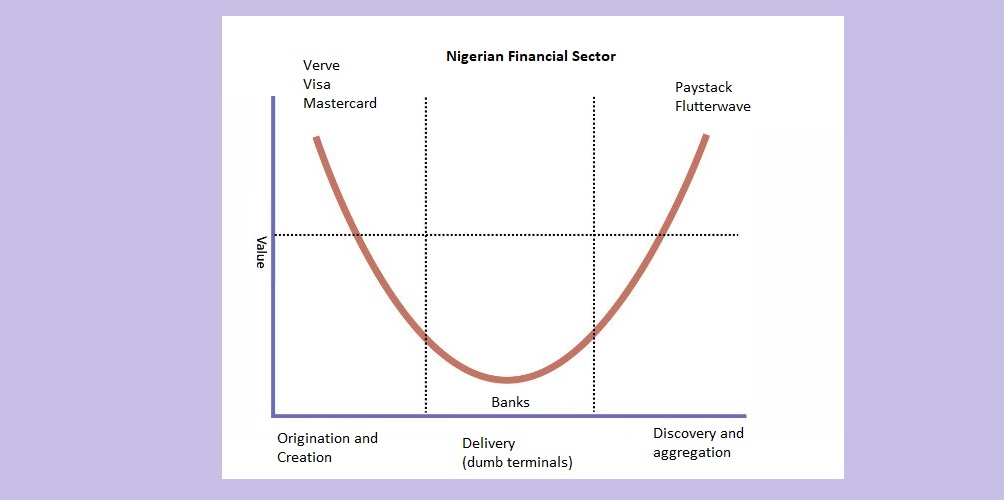
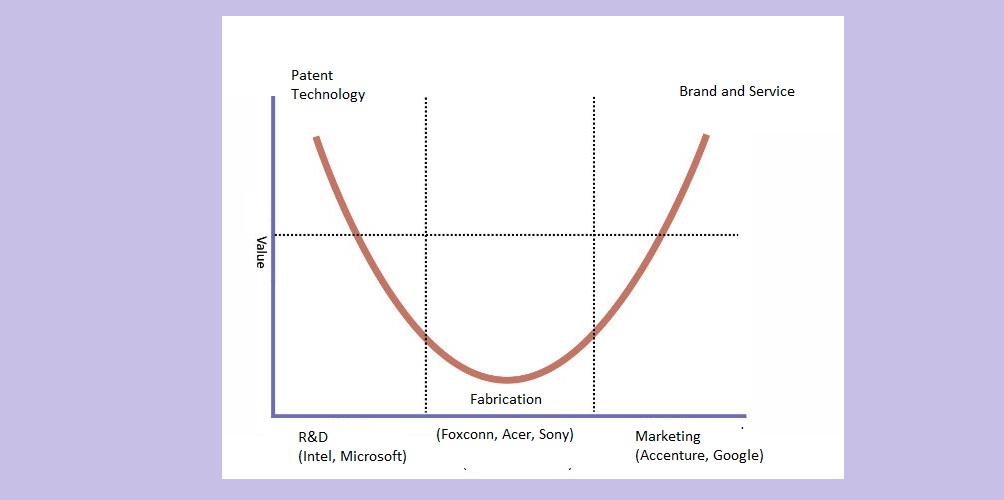
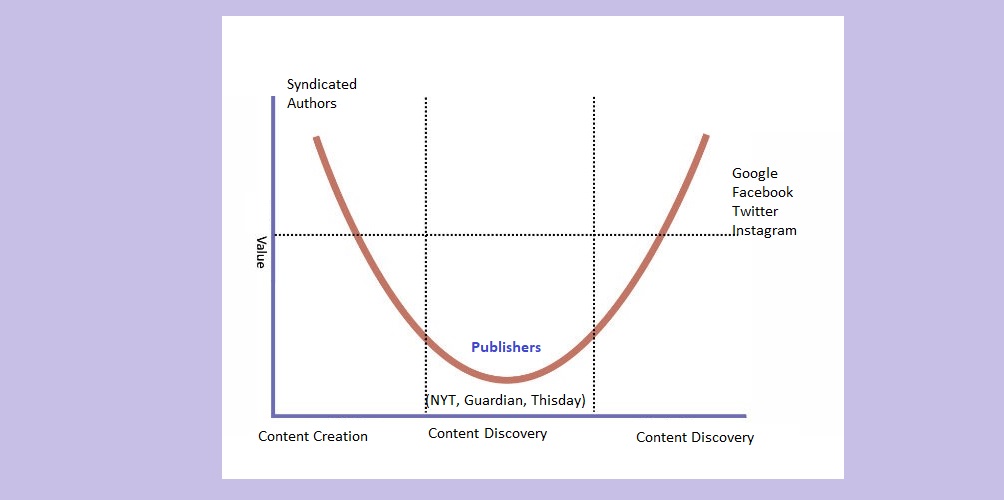
It is a young week. I want you to reassess where you are competing within the market. Are you at the edges or center? In this age of unbounded and unconstrained internet-driven redesign in Nigeria, where you focus affects your profitability and value creation. In this video which applies for fintech, banking, news-media and even shoe makers in Aba, I provide insights.
Painful! The best of his generation on innovation in the telco world is gone. The grandmaster and custodian of MPESA which unbounded many from financial poverty in East Africa, and gave the world a new basis on what a mobile phone can do! Yes, Kenya’s Safaricom CEO Bob Collymore has died. He died of cancer.
In a statement issued this morning, Nicholas Nganga, Chairman of Safaricom PLC, said:
“It is with deep sorrow that we announce the passing away of Robert (Bob) William Collymore, CEO of Safaricom PLC, which occurred at his home on the morning of 1 July 2019.
In October 2017, Bob proceeded to the UK to receive treatment for Acute Myeloid Leukemia (AML) and returned in July 2018 to resume duties. He had been undergoing treatment for this condition since then in different hospitals and most recently at Aga Khan University Hospital in Nairobi. In recent weeks, his condition worsened and he succumbed to the cancer at his home in the early hours of Monday 1st July 2019.
On behalf of the Board of Safaricom PLC, we extend our deepest condolences to his family, staff of Safaricom PLC, partners and the nation at large, who he served selflessly and with joy.”
5G is by and large understood as the fifth-age cell innovation that will unleash game-changing broadband access. The business affiliation 3GPP characterizes any framework utilizing “5G NR” (5G New Radio) programming as “5G”, a definition that came into general use by late 2018. Others may hold the term for frameworks that meet the necessities of the ITU IMT-2020. 3GPP will present their 5G NR to the ITU; it pursues 2G, 3G and 4G and their individual related advances (for example, GSM, UMTS, LTE, LTE Advanced Pro, and so on).
5G systems are computerized cell systems, in which the administration region secured by suppliers is isolated into a mosaic of little land territories called cells. Analog signals representing sounds and images are digitized in the phone, converted by an analogy to digital converter and transmitted as a stream of bits. All the 5G remote gadgets in a phone convey by radio waves with a nearby receiving wire exhibit and low power computerized handset (transmitter and beneficiary) in the phone, over recurrence channels doled out by the handset from a typical pool of frequencies, which are reused in topographically isolated cells.
There are plans to use millimetre waves for 5G. Millimetre waves have shorter range than microwaves, along these lines the cells are restricted to littler size; The waves likewise have trouble going through structure dividers. Millimetre wave antennas are smaller than the large antennas used in previous cellular networks. They are only a few inches (several centimetres) long.
Another procedure utilized for expanding the information rate is gigantic MIMO (multiple input multiple output). 5G NR speed in sub-6 GHz groups can be somewhat higher than the 4G with a comparable measure of range and radio wires, however some 3GPP 5G systems will be slower than some progressed 4G systems, for example, T-Mobile’s LTE/LAA organize, which accomplishes 500+ Mbit/s in Manhattan.
The 5G specification allows LAA (License Assisted Access) as well but LAA in 5G has not yet been demonstrated. Adding LAA to an existing 4G configuration can add hundreds of megabits per second to the speed, but this is an extension of 4G, not a new part of the 5G standard. Speeds in the less common millimetre wave spectrum can be substantially higher.
5G wireless technology will have three major applications. First, 5G will be used for truly mobile connectivity, mainly by devices such as smartphones. Second, 5G will be used to connect “less mobile” devices, mainly 5G modems or hotspots: dedicated wireless access devices, small enough to be mobile, that will connect to the 5G network and then connect to other devices over Wi-Fi technology. Finally, there will be 5G fixed-wireless access (FWA) devices, with antennas permanently mounted on buildings or in windows, to start with, 5G will be utilized for genuinely portable network, for the most part by gadgets, for example, cell phones.
While, 5G will be utilized to interface “less portable” gadgets, mostly 5G modems or hotspots: committed remote access gadgets, little enough to be versatile, that will associate with the 5G system and afterward associate with different gadgets over Wi-Fi innovation home or business with broadband in place of a wired connection.
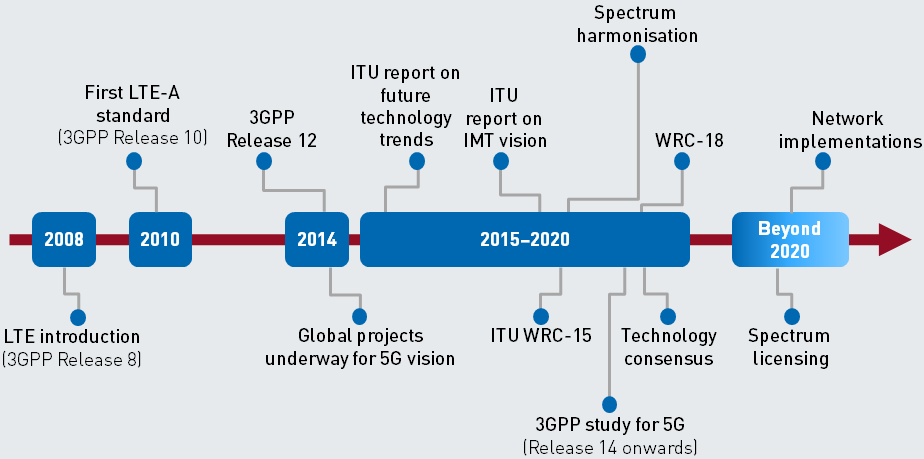
Timeline towards 5G [Source: Analysys Mason, 2014]All four major U.S. transporters have pledged to commence or grow their particular 5G arranges in the coming year, and most real telephone producers are set to discharge their first 5G-empowered telephones. AT&T turned into the principal transporter to convey a portable, guidelines based 5G organize in late December, narrowly beating the end-of-the-year deadline the company set for itself.
AT&T will start selling a 15-gigabyte 5G data plan for $70 per month with the hotspot carriers have vowed to kick off or expand their respective 5G networks in the price at $499. The company has made deals to release one Samsung 5G phone in the first half of the year and another in the second half. Additionally, the carrier will expand the coverage area to seven more cities sometime in the first half of 2019.
AT&T is also working to rebrand what is technically its “4G LTE-A” service (LTE stands for long-term evolution and A stands for advanced) as “5G-E” (E for evolution) in close to 400 markets around the United States. That generally implies that AT&T supporters with the most recent Android gadgets will see another 5G pointer in the upper corner of their screens, yet execution won’t exactly coordinate the measures vital for 5G.
Verizon presented the nation’s first business 5G administration in October with its private bundle that is offered in four U.S. urban areas. Unlike AT&T’s mobile offering, the service is designed to beam into subscriber homes in place of a terrestrial internet connection, though it’s currently operating on a separate standard from the industry consensus for fixed 5G. Verizon’s Home service costs $70 per month or $50 per month for customers who also have mobile packages. Meanwhile, the nation’s biggest carrier is busily readying its mobile network for an early 2019 debut with its own hotspot device from ins ego and a deal with Samsung to offer a 5G phone sometime in the first half of the year.
Sprint is aiming for an initial rollout of its 5G network in seven cities in early 2019, with more markets to be added throughout the year. Like T-Mobile, the company is not primarily focused on millimetre waves, and its first offerings will instead operate on mid-band spectrum. The carrier is also planning to unveil its own HTC-branded hotspot at the beginning of 2019, an LG 5G smartphone in the first half of the year and a Samsung phone at some point throughout the year.
Any of these plans could change, however, depending on the outcome of the company’s merger bid. With an across the nation 5G rollout objective before the finish of 2019, T-Mobile isn’t searching for a no holds barred race with either contender. While AT&T and Verizon are building their 5G networks on so-called “millimetre waves”—high frequencies that carry more data but travel shorter distances and require many more antennas—T-Mobile is attempting to do so initially on more traditional low-band spectrum. The company passed a major hurdle toward this goal in November when it claimed to have broadcast the first-ever 5G signal on these lower frequency waves.
5G in automotive
Legere has touted this roadmap as a more broadly accessible path to 5G, since waves of lower frequencies tend to work better outside of dense, urban areas. “The different folks centre around 5G for the few, contacting only a couple of individuals in little regions of a bunch of urban areas,” Legere bragged in an ongoing explanation. Yet while each carrier is taking a different approach to the first leg of the 5G race, all four carriers have said that their fully completed networks should be able to broadcast across a range of spectrum bands.
The United States and China are hustling to work out fast 5G systems, and President Donald Trump doesn’t want America to come in second place. Last week, Trump acquainted activities with accelerate the rollout of new wireless systems over the U.S., saying “the race to 5G is a race America must win”. But experts say the U.S. still lacks a clear 5G strategy that goes beyond attacking Huawei, a Chinese tech giant and the world’s biggest supplier of telecommunications equipment. U.S. policymakers keep wringing their hands over a competition with China to build the world’s first mass-market 5G wireless network.
By 2022, fifth-generation cellular networks will power as much as 9% of mobile data connections across North America, compared with 4% in Asia. The generous work nations like China face as they race Western countries to construct the system. And they reflect early U.S. policies that put it in a strong position to lead, which makes networking technology.
Although the Asia-Pacific region will be home to more than twice the number of 5G devices in North America by 2022, it will account for a tiny share of the 422 million devices on 5G worldwide. North America will represent the biggest cut; the vast majority of the rest, about 6.5%, will originate from Western Europe. A head begin in 5G entrance could be basic for figuring out which nations get the opportunity to shape — and advantage from — advancements in applications, administrations and other monetary products of the innovation, as per arrangement investigators.
At the point when the United States led the pack on 4G portable innovation, it offered ascend to the application economy, which stays overwhelmed by U.S.- based firms today. The FCC, has proposed limiting federal funding to U.S. telecom companies that use Huawei’s hardware.
Policymakers worry that foreign manufacturers could secretly install spyware in their products that could allow other governments to eavesdrop on sensitive U.S. communications. Huawei’s founder on Tuesday rejected those claims as speculation in an interview with CBS. U.S. authorities state Chinese organizations like Huawei ought not to be permitted to work out the basic framework, for example, radio systems administration gear and programming, that will empower 5G.
They caution that Huawei gear could make an indirect access for the Chinese government to keep an eye on American systems. China sees 5G as its first opportunity to lead remote innovation advancement on a worldwide scale. European nations received 2G before different locales, during the 1990s; Japan spearheaded 3G in the mid-2000s; and the US ruled the dispatch of 4G, in 2011. Yet, this time China is driving in media communications instead of playing get up to speed.
The Chinese government sees 5G as urgent to the nation’s tech part and economy. Following quite a while of making copycat items, Chinese tech organizations need to turn into the following Apple or Microsoft—creative worldwide mammoths worth almost a trillion dollars. The China Academy of Information and Communications Technology, an administration run research organization, evaluates that 5G will make in excess of 8 million occupations locally by 2030.
The organization thinks significant enterprises, including vitality and social insurance, will burn through billions of dollars all things considered on 5G gear and remote administration during that period. The report reverberated a released National Security Council archive that proposed the US government think about structure a 5G arrange. In the event that China overwhelms the broadcast communications organize industry, the archive stated, it “will win politically, monetarily, and militarily and the US economy will endure.
5G is set to have a profound effect on countries’ economic performance and GDP. In 2016, mobile technologies and services generated 4.4 percent of GDP globally, equating to about $3.3 trillion in economic value. This has been estimated to grow to over $4.2 trillion by 2020, or 4.9 percent of global GDP, as faster mobile connectivity continues to drive gains in productivity and efficiency.
Similarly, the GSMA found that mobile technologies and services generated 3.3 percent of GDP in Europe in 2017, with the continent’s mobile ecosystem responsible for 2.5 million jobs, too. Europe is the world’s most very entered provincial versatile market, with 465 million special portable supporters before the finish of 2017, around 85 percent of the populace. That GDP commitment is estimated to ascend to 4.1 percent by 2022, and with the first 5G dispatches expected in Europe by 2020, nations will look for influence the new versatile system to their general advantage.
The importance of the potential economic impact of 5G really shouldn’t be underestimated: the U.S. endeavoured to build up its place as a 4G pioneer, with the presentation of 4G versatile broadband adding $100 billion to the country’s GDP. The GSMA has forecast that 4G connections will comprise four out of five mobile connections in North America by 2020, higher than any other global region. But should the U.S. lose its situation as a world chief in remote, it will probably feel the impact as far as occupation misfortunes and innovation development being traded abroad. The economic benefits the U.S. enjoyed with its leadership in 4G would be gone.
Baltimore is still spending money on the hacking mess which paralyzed some of the city’s operations: $10 million now approved to spend on the recovery. This is one benefit Nigerian governments (local, state and federal) enjoy: most of our computers are neither networked not fully Internet hooked. And even when linked to the web, they are slow for hackers to execute any action before the network times out!
Baltimore City officials approved using $10 million in excess revenue to cover the ongoing cost of the cyber attacks that immobilized some of the city’s systems almost two months ago.
WBAL reports the city’s estimates board approved the emergency funds Wednesday to help the hack recovery process, which is moving into its eighth week.
This month, a Baltimore technology official said the city had initially resisted help from the state after the attack.
You may not have noticed: as our networks get faster in Nigeria, loss to cyber crime increases! I have no data to back that up. But in Moscow few years ago, Russian “fortune finders” gathered around me in Moscow where the Mayor of Moscow and a minister had invited me to give a speech, asking me why Nigerian banks’ networks were always timing out. Upon return, I joked to a bank CEO: your best cyber strategy is slow network. Of course, banks are not listening as they have been making the networks faster. Lol. We know the outcome. Hahaha.
Back to the Baltimore case: why do American cities pay ransomware payments to hackers instead of using their FBI or DHS (Department of Homeland Security) to burst the attacks. Ransomware is a type of attack where hackers remotely take over your computers and will only release so after you have made a payment.
Simply, why do governments pay when the powers of the states are behind them? I understand using the state may take time. But this is happening so often and yet a small city will prefer to spend $millions instead of giving agents say two days to do some works. The money sent to hackers end up somewhere which means they can be tracked! It seems confusing because it is expectedly different when a private company is attacked. But for a government, I had expected support from the best in the trade.