DD
MM
YYYY

PAGES

DD
MM
YYYY

spot_img

PAGES

Home Blog Page 6867

The Danger of Nigeria’s Indigenization

0

By Aaron Akpu Philip 

Hi Friends,

This is a conversation between a Lecturer and a 1st class graduate who completed top of his class in one of Nigeria’s state universities.

Paul: Sir, I made a first class but I have been told I cannot be retained as a Graduate Assistant

Lecturer: (Shocked): But why? You are the best graduating student in the faculty, why can’t you be employed?

Paul: The reason was I am not from this state.

Lecturer (infuriated and shocked): Just that?

Paul: Yes sir.

Paul toiled hard for several years to graduate top of his class but unfortunately cannot be employed by the University he graduated from. His crime is that he is not an indigene of the state. Many have suffered far more devastating deprivations and missed opportunities because they are not indigenes, despite being Nigerians. This painful deprivation occurs in the Education, Health, Agricultural and all sectors in our developing countries. A few scenarios come to mind:

  1. When applying for a job, you must provide a State/Local Government Indigene form. Many have argued that because of our multi-ethnic and multi-religious country, this will allow for equitable distribution of jobs and resources. Although this bears some truth, it has also led to the employment of many unqualified people who deeply hurt the Nigerian state. Unarguably, this has led to the employment of many fake/ghost teachers, doctors, etc. If I live in Abia state, why can’t I apply for a job in the Abia State Civil Service Commission without being faced with the question of “Are you an indigene?”. Sadly, you find Nigerians from a particular state having several Local Government Area (LGA) indigene forms in the bid to be safe when there is a call for employment. Imagine the tragedy- that as an indigene of Nasarawa state, I need to have multiple LGA indigene forms as a strategy of wanting to be employed.
  2. As a student in the University, my friends who were from other states had to pay twice the amount of tuition fee. Their crime? “Non-Indigenes”!!! The burning question remains “Why do non-indigenes have to pay more than the supposed indigenes?” Are they taught by different lecturers? Or do they use different school facilities?

Many might argue that we need indigenization for various reasons but in all my years of existing and rising the academic and professional cadre, I have observed indigenization to be highly problematic. It drives most of the cultural clashes that have laced our country.

I argue that although indigenisation may hold some benefits, I have witnessed more divisions and chaos from it. I join many to posit that:

“State of Origin (Indigenization) Be Replaced with State of Residence or State of Birth”.
Until we change this narrative, many of the problems that plague us will remain.

My name is Aaron Akpu Philip and I am NIGERIAN.

10% Discount on Charges for Eastern Ports not enough, it Demands Complete Dredging and other Structural Provisions

0

By Oko Ebuka

The recent discount on the cost of vessels calling at the Eastern ports by 10% that was granted by the Federal Government through Nigeria Ports Authority (NPA), to enable the port become significant in the maritime business have been making waves, but the question still remains; is that enough to make the port functional and adequately compete with her counterparts in the Western part of the country?

The answer is purely negative because some other disturbing issues that can hinder the port to maintain the pace of becoming a world class port in subsequent years, have been shallowly handled.

There are other salient problems holding the possible functionality of the port which can affect the incoming of vessels even if the charges are totally removed from it.

According to NPA, they posited that the major challenges delaying the proper usage of the port is dredging, insecurity, non-maintenance of berths and infrastructural decay.

Furthermore, shallow channels of the eastern port have become a very pertinent issue because large vessels always find it difficult to pass through the seaport unlike in the Western ports.

In a financial survey carried out by Vanguard Maritime Report, on August 15, 2018, it shows that importing goods from China to Lagos is cheaper as it costs $1,500 than shipping the same goods to Calabar which is going to cost between $4,000 and $4,500.

However, the efforts of the NPA should be intensified in order to decongest the populated Lagos port and bring about the proper ease of doing business across the country.

How Global North, South Media’s Conspiracy is Fueling Nigerians Movement to Europe, North America

0

By Mutiu Iyanda

Both human beings and animals are not created to be static and restrict their movements to a single place. Every living creature is bound to move from one location to another, especially when the current location is no longer favourable to securing socioeconomic needs. From the stone ages to the modern era, movement of goods and people is a must.

In the last 10 years, there are reports on migration from south to the north and west to the east. The reports have significantly been about people moving from developing countries to the developed ones in search of better socioeconomic opportunities due to poverty, insecurity and political factors.  In 2017, more than 1.2 million Nigerians left the country to developed countries. In 2018, OECD’s report through its experts notes that 50% of Nigerians would leave the country if there are means and opportunity to take the journey.

As noted earlier, moving from one country to another should not be a significant issue. But it becomes an issue when the media always see bad happenings in the migrants’ home countries and portray destinations as better to live than theirs. The world is not created by the God to be divided into ‘developed’, developing’, ‘global south’ and ‘global north’. These words are man’s creation, which has been the basis of understanding happenings across the world.

The United States of America, Canada, Europe, Israel, Japan, Singapore, South Korea, Taiwan as well as Australia and New Zealand are categorised as global north based on socioeconomic advances and better public administration. The entire Africa, Latin America, developing Asia and the Middle East are being portrayed as global south using low socioeconomic status and deficiencies in governance.

This means that the gap in development and wealth remains the core factor of distinguishing between the global north and south, which news media on both sides do not hesitate to appropriate in their reportage over the years. Despite bad happenings in the global north, media do not always emphasize them over the good ones. But, in the global south, the media believe bad events would attract huge revenue to their establishments.

Where the conspiracy lies

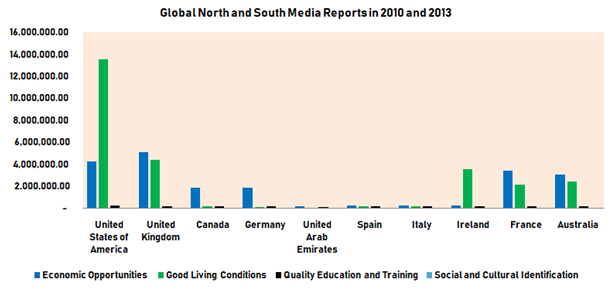
In a research jointly conducted with other colleagues, result indicates that the volume of negative socioeconomic situations reported by the Global South and North news media organisations about Nigeria in 2010 and 2013 connect with Nigerians choice destinations during the years. Over 30% of 344,159 Nigerians who migrated to the United States of America, the United Kingdom, Canada, Germany, United Arab Emirates, Spain, Italy, Ireland, France and Australia did it because of the poor education system reported by the media.

This year, The Punch Newspaper’s report about the number of Nigerians studying in the United States of America increased Nigerians’ interest in acquiring higher education in the country. The report notes that number of Nigerians studying in the country increase from 12,693 in 2018 to 16,039 in 2019. As the media report more of the negatives about Nigeria, countries capped as developed are not relenting in wooing best hands from Nigeria using different approaches. Scholarships, international jobs for competent professionals and visa lottery are the core strategies for attracting Nigerians by the developed countries in the last decade.

For instance, analysis shows that Nigerians’ interest about Canada’s Express Visa Entry increased from 18% in 2016 to 33% in 2018. Since January 2019, the interest about visa lottery programmes of Canada, USA and Australia has been increasing from people living in Lagos, Ogun, Oyo, Enugu, Anambra, Edo, Delta and Rivers states.

Our analysis shows that between 2010 and 2013 both the Global South and North media had a significant number of publications on economic opportunities in the United Kingdom, the United States of America, France, Australia, Germany and Canada. The USA, UK, France, Canada and Australia also featured prominently in publications on good living conditions, followed by Ireland. Under the financial stability reportage, USA, UK, Germany, Australia and France were above Canada. Analysis also indicates that USA, France, Canada, Ireland, Spain and Italy had significant publications that established quality education and training in 2010 and 2013. United Kingdom, Spain, Italy, United States of America, United Arab Emirates and Ireland were the top countries for the volume of publication in social and cultural identification. As the media report these happenings, analysis indicates that economic opportunities, better living conditions, quality education and training interested the public most.

Source: Google News, Author’s Analysis, Infoprations Analysis, 2019

Is Nigeria powerless in taming the publication tide? Answers to this question seems to come from Omoyele Sowore, one of the professionals in the media industry, who recently notes that African media need to change their framing of migration and the kind of agenda they are setting for the governments and policy makers.  From the professionals in other industries, Nigerians movement to the countries should not be seen as a total loss to the country. According to them, some Nigerian Diasporas are making a significant impact on the country, especially the funding of startups, new skills transfer and building of business networks back home.

Achieving Inclusive and Sustainable Industrial Development in Africa

0

By Abdullateef O. Abdul

Whilst Africa is perhaps the fastest growing region with an annual average growth rate of 5% in about the last decade, the growth has largely been based on commodity trading and extractive industries, and has therefore proven neither economically sustainable nor inclusive as a development strategy. We must therefore think anew and evolve novel solutions to existing challenges.

A key solution to most of the problems undermining our continent’s development potential consists in achieving inclusive and sustainable industrial development in Africa. Such inclusive and sustainable industrial development would create employments, reduce income inequality, generate dependable revenue to government, eradicate or at least alleviate hunger and poverty, reduce crimes, and pave the way towards robust economic development.

How then can Africa achieve inclusive and sustainable industrial development? In the first place, we must appreciate that creating a better Africa is not a task just for African Governments, the African Union or the African Development Bank. It is a collective task incumbent on all stakeholders.

In my view, the first step towards achieving inclusive and sustainable industrial development in Africa is through a widespread reorientation on the tested route to economic development. I say this because it is often that one hears analysts, Presidents, Ministers and other leaders declare or suggest that cocoa or other commodity or agriculture in general is the route to the economic prosperity of a nation. Some state governments in Nigeria, not long ago, even went so far as declaring work-free days for civil servants to work on the farm. But the time-tested reality is that it is industrialisation, not commodity trading and extractive industry, that drives economic boom. Hence, we should spend more time discussing, encouraging and strategizing on industrialisation. Rather than repeatedly telling Africans to go to the farm, we should instead focus on how Africa can use industrialisation to get the most value from our agriculture and extractive industries.

At the heart of industrialisation is infrastructure. Indeed, industrial and economic development cannot be attained without addressing the challenge of infrastructure deficit in the continent. Achieving inclusive and sustainable industrial development therefore requires investment in infrastructure, such as roads, airports, railways, waterways and energy, which is needed to boost commerce and link Africa to the global economy. While the need to revitalise the African economy through infrastructural development projects is recognised, the challenge remains financing such projects especially given the intensive cost requirement of infrastructure projects and industrialisation.

For this reason, the creation of easier access to finance for infrastructure projects and industrial development is another top priority. In this wise, African governments have an obligation to create conducive business climate in Africa in a way that enhances and optimises local investments and attracts foreign direct investments. To this end, African governments must first intensify in their efforts towards ensuring the safety and security of lives and properties in Africa. Also, African governments must project transparency, good governance, and political stability, and thereafter promote policies that facilitate infrastructure projects and access to finance for businesses.

However, the task of ensuring the provision of infrastructure and easier access to finance cannot rightly be left to the governments alone. Given the intensive capital and expertise requirements involved in these projects, African governments are unable to wholly fund and administer infrastructural development projects. It is therefore imperative for the private sector and government to leverage on other viable options, such as the Public Private Partnership arrangement. Further option for African entrepreneurs consists in African organisations, such as the African Development Bank, which are also advancing the cause of industrializing Africa by supporting businesses with requisite finance, an instance of which is the Ethiopian Derba Midroc Cement project.

Another pivot towards achieving inclusive and sustainable industrial development in Africa is embracing innovation and technology. Innovation is pivotal to all human progress and development, including creating a new Africa of our dreams. Technology is central to industrial development, diversification and upgrading, and is essential to pace and competitiveness in a fast and continually-evolving world.

Achieving inclusive and sustainable industrial development also requires investing in human capital since modern business is knowledge and skill intensive. This investment relates to education at the basic, secondary and tertiary level; formal trainings as well as facilitating research and development programmes.

Finally, Africa’s industrial planning and construction processes must take due cognisance of environmental considerations. This is because sustainable industrial development can only be achieved through the integration of all the pillars of sustainable development, including improvement in the environmental performance of industry.

In conclusion, Africa continues to experience economic growth. However, this growth has not delivered the much-needed development in the continent. The reason is not far-fetched. The growth is anchored on commodity trading and extractive industry. What Africa requires for effective economic development is inclusive and sustainable industrial development, the ultimate end of which is to realise a self-reliant Africa which harnesses its human and material resources for its prosperity and posterity.

Feedback from A Parent: He Heard A New Song of As

0

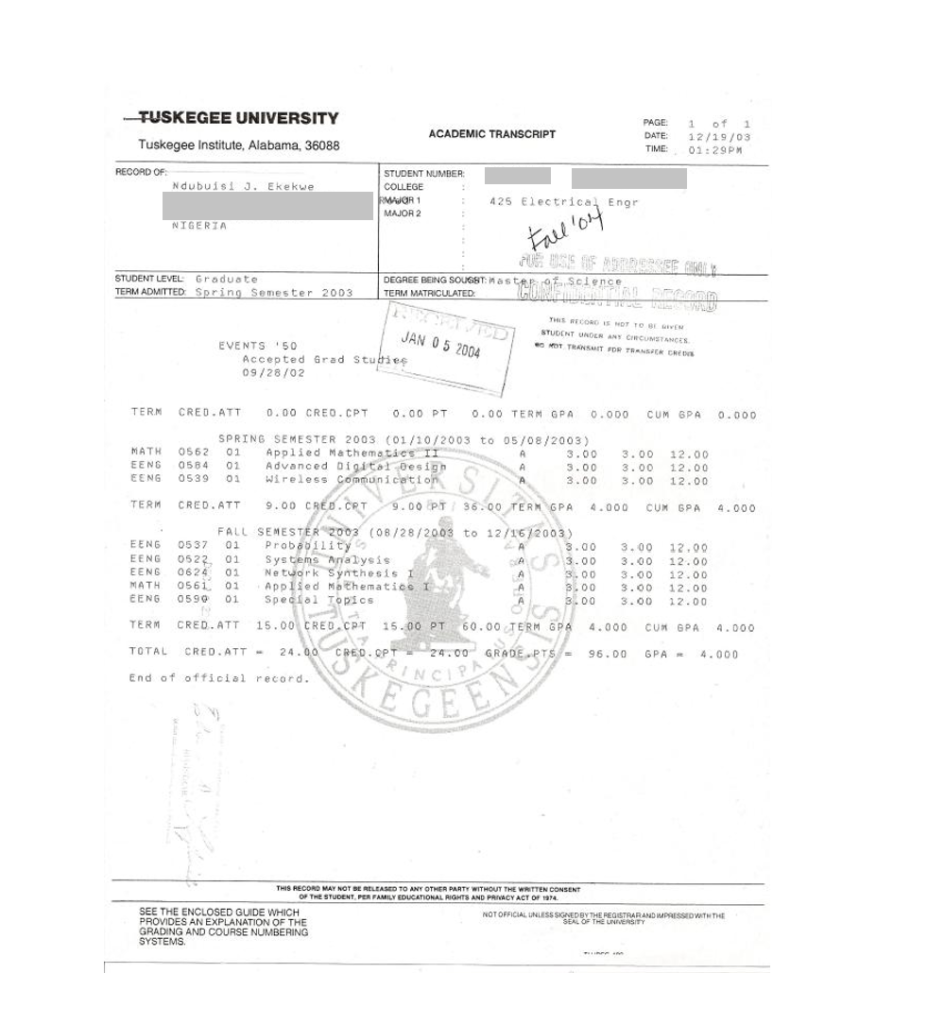
Good people, this is from a happy dad. I did not know that mere sharing of my academic transcript could inspire young people. I wish him more As in that home. Making As is not a big deal; my focus is always the processes towards the As. If you form great habits towards the journey to the As, it simply means the process has worked. The P-R-O-C-E-S-S to As is more important than the actual As. I make that point in case if the As do not come, life should not end. Aim high, develop good habits, and keep improving.

Ndubuisi, I have never met you but I am writing to thank you for inspiring my twins. My boys are smart and that makes it hard to challenge them to aim higher. But luckily, a friend who worked in Diamond Bank sent your article about your experience in the bank, and your first day in United States. In that article, you added some of your university transcripts: all As. I printed, laminated and gave them. The next day, coming back from work, they welcomed me with “aa a aa aaa”. I said what? They responded: “that will be how our grades will rhyme”. They have responded; both gave me all As this ended session. But I told them “Prof’s transcript was As all through the degree, not just a semester”. I want the song of aa aaa aaa in this home always. God bless you for Nigeria.

This is the piece he referred to.

My First Day in America and Kindness of Diamond Bank Lagos