DD
MM
YYYY

PAGES

DD
MM
YYYY

spot_img

PAGES

Home Blog Page 6871

How To Make Great Decisions

0

By David Alade

Life defining decisions always require a leap of action, we find it hard to take these actions as we move forward in life. The reason for this though not considered in this article, I will be taking time to take us through “how to ensure we are making a worthy decision in the light of three purviews.”

The purviews are not a guarantor nor would they be painted to serve as one, but they tend to reduce the probability of us making a harmful decision.

There is something we all know about making a decision: we all know it will either make or mar us depending on whether we make it, when we make it, and how we make it.

There is another thing about decision that is not always so obvious; it requires a LEAP, a leap of action. Life defining decisions always require a leap and many times the leap is demanding hence we fail to make it.

How do we ensure that we make the right decision at the right time and take the required leap per time? It remains a puzzling question and the answer I’ve come up with may surprise you.

The first thing I realized about this puzzle was that, while some decisions appear right on the go, some are contemplative, i.e. it’s a great decision to be educated no one will or should contend that (right on the go), on the other hand which avenue should I use in pursuing my education can be contemplative hence requiring a leap either of monetary investment or time investment.

The second is, the majority of our life-defining decisions are contemplative. Unlike should I sleep now or not, questions like should I marry, who should I marry, should I attend grad school and should I quit this job are highly contemplative questions.

Third, because the majority of our life-defining decisions are contemplative, we cannot always be sure whether we are right or wrong. To make all decisions on the altar of right or wrong will leave us in an undeserved perplexity, because it is neither right to attend to attend grad school nor wrong not to attend. It is much deeper.

If we cannot always be sure whether we are right or wrong on life-defining decisions, then I think it behooves us to conclude on another metrics beyond right or wrong upon which we can make contemplative decisions.

The new metrics I came up with are under three purviews.

Purviews because are not a yes or no decision metric but a metric that helps us reduce the confusion within our contemplative decisions.

The 3 purviews are:

  1. Second-Party Purview
  2. Self-Settlement Purview
  3. Sliding-Time Purview

Second Party Purview

Law of large numbers in mathematics tells us that “with an increasing sample size that tends towards meeting up the population size, we tend to have a true and representative global mean of a distribution.”

It’s not a complicated way of thinking, the law is simply saying with more opinion that you get from different people regarding your contemplation, the more you are able to access the veracity of your decision based on different idiosyncrasies.

These are sample opinions you should get.

  • Opinion from those who seem to be always antagonistic
  • Opinion of those who seem to be supportive
  • Opinion of those above you and that of those of your peer and when needed those below.

As much as possible get all second party’s view on a decision that you can get. The beauty of this is that they will see things differently from you and help refine your thinking based on their own experience. You will benefit from the wealth of knowledge and judgment of those whose opinion you sorted.

Don’t be afraid to ask others opinion I must add, a friend that went through the first draft of this article has this to say, “I have found that whenever we are reluctant to subject our opinions and thoughts to others to judge, it is because somewhere in our heart we know we are wrong and we know others will point it out to us – and we don’t want to face the truth so we hide away” – you want make sure this is not the reason for your hesitant to get a second party opinion.

Don’t be fooled though by the folly of the multitude, sometimes multitude can be wrong and that is why you have the next point which will be discussed.

Self-Settlement Purview

A decision whose upside and downside you cannot accept should hardly be considered at all. This purview is really about you, your experiences, idiosyncrasies, and judgement metrics. Like I mentioned earlier, it’s not about right or wrong, it is about your readiness for what you are considering.

All what you are made of plus the opinions you’ve sampled from the first purview come together at this point so you can think your decisions through and make a call regarding your leap.

I put this in number 2 because you really may not be able to consider all views/angles yourself until number 1 is done. With number 1 done, you tend to think more clearly about your options.

The self-settlement is about you being ready to take and accept the decision.

Sliding Time Purview

“Don’t make a promise when you are happy and never make a decision when you are angry” is still a valid caution. The tendency is there that your life-defining decision requires that they be made when you are not mentally ready to make such, as much as possible buy yourself enough time to think clearly without emotions on the decision. What you want now and in 3 hours you don’t want again is an example of decision that sliding time purview will greatly help to fix.

Let time slide and see if you still want to abide by that decision.

Sliding time purview is well known and can be a very useful tool. Remember an observer cannot truly understand a system of which he himself is a part, sliding time affords you the opportunity to separate yourself from the system for a while.

With this said, plus your careful consideration of the spirit of the word, you are on your way to living a life where you have less and less decisions to regret in life.

Ask another person about it, don’t take unilateral decisions, take time to consider all points of view before deciding, and after you’ve decided, before execution, allow time to pass if it’s possible. You should hardly go wrong. This is a needed loop as you journey on in life and make life-defining decisions.


“Nigeria is not an oil economy …Our biggest export is Nigerians”. PwC Chief Economist

0

It must have been a brilliant speech: Andrew Nevin, Chief Economist at PWC, outlines the critical frameworks to accelerate economic development in Nigeria. He gave the talk at a  birthday dinner for Pascal Dozie, founder of defunct Diamond Bank. Here are some great lines picked from the diaspora portion (not in this order).

  • If this applied to Nigeria, it would mean that diaspora remittances would be close to $40 billion and more than 3 times the USD the government receives from oil

  • Nigerian Americans already earn more than the average American, an incredible accomplishment for such a new immigrant group

  • Nigeria is not an oil economy and our biggest export is not oil … Our biggest export is Nigerians. What it also means is that the only thing holding up the economy is the Diaspora; if we didn’t have this massive flow of remittances, I am pretty sure the economy would collapse

  • What is confusing to me is why this is not discussed more … official figures keep repeating that oil is our biggest export when it is not true. We have a flow of almost $40Bn that is not discussed much … very difficult for me to understand how someone can claim to be analyzing the Nigerian economy when they don’t look at the biggest item

Besides diaspora, he provided four other enablers to take Nigeria to the mountaintop: “branding” the nation, deepening informal sector & self-organizing institutions, improving public sector and modernizing the real estate sector. The full talk courtesy of Business Day.

The Role of Road Transportation in the Nigerian Food System

0

By Nicholas Alifa

The logistics business is arguably one of the most critical sectors in agribusiness.

Just like many other developing countries, Nigeria’s agricultural value chain is majorly informal, comprising of smallholders in rural areas who produce at a very small quantity, and middlemen who purchase, and aggregate these products which are then sold to the end users.

In addition, due to the extreme different wide varieties of vegetation distribution across the nation – the mangrove and swamp rain forest in the south and west, Guinea and Sahel Savannah in the north, and the Montane vegetation in some parts of middle belt – what can be produced at one part of the country may not grow very well at the other. Consequently, there is a need for different distribution systems to accommodate the variances.

Largely, the transportation and logistics systems play a major role in the value chains as the product will have to pass through different handlers before it can get to the final consumers.

However, the only functional transport system that can effectively cater to the distribution chains of agricultural products in Nigeria is the road transport system. Thus, if we must have an effective supply chain that can cut down the cost of logistics for agricultural products, reduce food loss along the chain, and ensure faster delivery of the products, then our road industry must not only be effective but thoroughly efficient.

Unfortunately, though one of the biggest industries in Nigeria that’s critical for agricultural revolution, our road transport industry is one of the most poorly coordinated.

Hence, an idea, technology or policy that can cause a massive disruption in the Nigerian road transport industry, and offer a more coordinated, efficient and effective system will not only make a profitable business venture but will also cause a major revolution in the food and agricultural sector. It will aid reduction in food loss along the supply chain, time of delivery, logistics and enhance overall availability of safe, sufficient, nutritious and affordable food.

Emerging startups like Kobo360 which are pioneering the use of digital systems to improve logistics should be supported by the government.

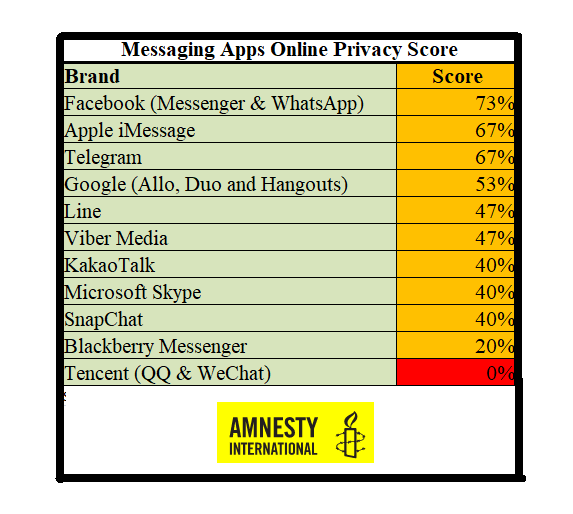
Messaging Apps Online Privacy Score

0

I read a piece that cited this: online privacy of leading messaging apps. It is largely old but since they have not updated the report, I will use it as it remains the current one. Check out the score of WeChat – 0% on privacy and human rights protection! Amnesty International is always fascinating!

We’ve ranked 11 companies that run the world’s most popular messaging apps – including Skype, Snapchat and Facebook Messenger – on how well they’re using encryption to protect your online privacy.

In particular, we’ve looked at whether they apply end-to-end encryption – a way of making your photos, videos and chats unintelligible to anyone but you and the people you’re talking to.

Please note that this is an assessment of each company’s key policies and practices in relation to encryption. We have not assessed other privacy aspects of the apps or their overall security. If you’re a journalist or activist, or if you believe you might be personally targeted for electronic surveillance, you need a comprehensive digital security plan. Please consult a digital security expert and do not rely on any one app to protect your information.


When Two Elephants Fight, The Grass Suffers!

0

The U.S. government decision to ban Huawei is already having a huge impact on the company: the firm will sell 40 million – 60 million fewer phones outside China this year. Already, leading France telcos have dropped plans to distribute Huawei Honor phone.

Huawei Technologies Co. is preparing for a drop in international smartphone shipments of 40 million to 60 million as the Trump administration’s blacklisting hammers one of the Chinese tech giant’s most important businesses.

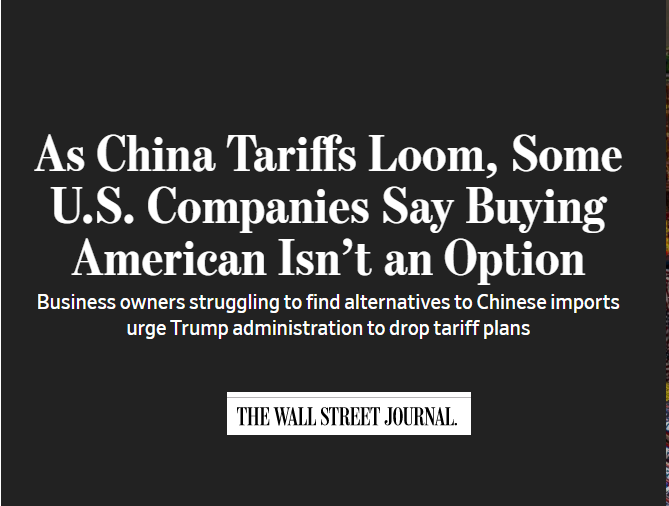
Yes, this pain on Huawei will not be one-directional. Many U.S. companies need China to be in business. They could be the ones that will help Huawei out of the paralysis. WSJ has cleverly documented the pains these small firms could feel if the trade war is not managed. The summary is this: two elephants are fighting, they will be fine – small injuries. The problem is that I do not know about the grass (the world economy).

But in a letter to Trump on Thursday, hundreds of US companies large and small, including retail giants Target and Walmart, warned Trump the new tariff round could cost two million jobs and cut US GDP growth by a full percentage point.

So far, Trump has imposed tariffs on more than $250 billion in Chinese goods but this has spared most consumer items from major price increases.