DD
MM
YYYY

PAGES

DD
MM
YYYY

spot_img

PAGES

Home Blog Page 696

Top Presale Tokens Of 2025 Revealed: Why Remittix Leads The Pack Over BNB, PEPE, And SHIB

0

Presales are back in focus, but not all “early” plays are created equal. Remittix (RTX) is pulling away from the field by pairing real-world payments with a clear, near-term listing trigger. For context, we’ll also weigh up BNB, PEPE, and SHIB, huge names that many investors compare against when hunting the Best crypto presale 2025 ideas.

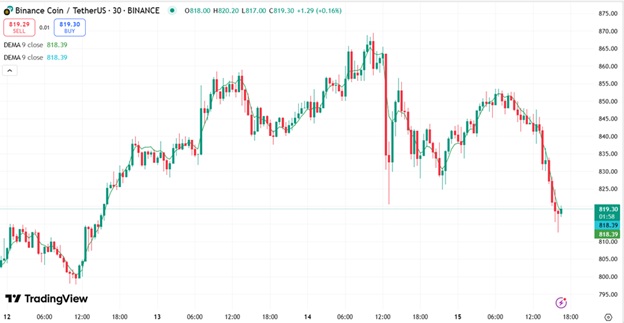
BNB (BNB): the benchmark many presales ride alongside

About $814 today, with deep liquidity and a top-five market cap, exactly why allocators use BNB as a barometer for broader risk.

BNB often sets the tone for exchange-adjacent flows and gives holders access to new token launches via platform initiatives. Analyst chatter has also turned up the volume on a $950–$1,000 near-term stretch if momentum sustains, with several roundups flagging the $800–$860 area as the battleground to clear. That backdrop matters for presales because strong BNB phases tend to lift new-issue appetite across the board.
PEPE (PEPE): liquidity magnet, headline machine

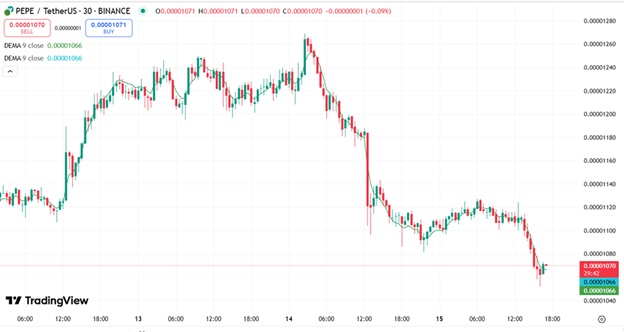
Roughly $0.000011 today, with multi-hundred-million daily turnover and a top-30 market-cap slot, enough depth for larger tickets.

PEPE is in the meme-sector yardstick, and many traders watch while scouting the next big crypto launch. Model roundups this month skew cautious in the very near term (greed on sentiment but modest pullback risk), yet leave room for a 2025 rebound if participation broadens.

Shiba Inu (SHIB): massive community, technical checkpoints

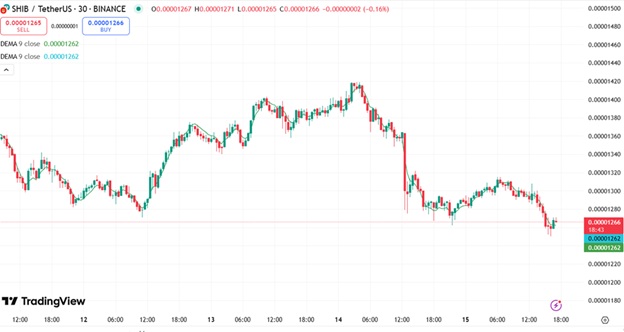
Around $0.000013 today, with steady 24-hour volume and a top-tier rank.

SHIB remains a bellwether for retail engagement. Recent technical guides from CMC Academy cite a $0.0000147 resistance zone to watch and warn that losing nearby supports risks a deeper dip classic “confirmation over prediction” territory. For presale hunters, the takeaway is timing: SHIB’s moves help gauge risk appetite, while a project like RTX gives a calendar and utility to trade, not just vibes.
Remittix (RTX): the presale with dates, utility, and a trigger

RTX is built for PayFi: low-fee, cross-chain transfers that land as money in bank accounts. Two things set this presale apart. First, the team has publicly dated its wallet beta for September 15, 2025, launching with Ethereum + Solana connectivity, so there’s a tangible product milestone on the calendar. Second, they’ve promised to reveal the name of the first centralized exchange listing once the raise hits $20M a binary headline that typically attracts fresh liquidity.
Why RTX is topping 2025 presale watchlists

  • $20M ? CEX name reveal (official post), a catalyst the market can trade around. (X
  • Wallet beta on Sept 15, 2025, with ETH depth and SOL speed at launch.
  • Payments-first design: crypto-to-bank payouts, real FX, real users (not just memes).
  • Broad rails from day one: coverage highlights support for 40+ cryptos and 30+ fiat currencies.
  • Momentum: multiple roundups this week say RTX is closing in on $20M, keeping attention high.

RTX mixes a utility story with a time-boxed catalyst, which is why it keeps showing up on “Top crypto to buy now” lists even while the rest of the market chops. If the counter ticks to $20M and the CEX name drops, you get a clean first wave of price discovery classic presale playbook.

Why Remittix leads the 2025 presale list

BNB, PEPE, and SHIB each tell you something about the market’s mood: BNB for depth, PEPE/SHIB for retail heat. But presales live and die by catalysts and delivery. Remittix has both: a $20M ? first CEX name reveal and a dated wallet beta with multi-chain support. That combination is why many screens tag RTX as the Best crypto presale 2025 candidate to watch into Q3–Q4.

Discover the future of PayFi with Remittix:
Website: https://remittix.io

Socials: https://linktr.ee/remittix

$250K Giveaway: https://gleam.io/competitions/nz84L-250000-remittix-giveaway

 

Crypto Mining Just Got Easier: PEPENODE Offers Virtual Rigs and Wild Passive Rewards

0

Most presales ask investors to throw in funds and sit back, hoping something magical will happen post-launch. Not PEPENODE.

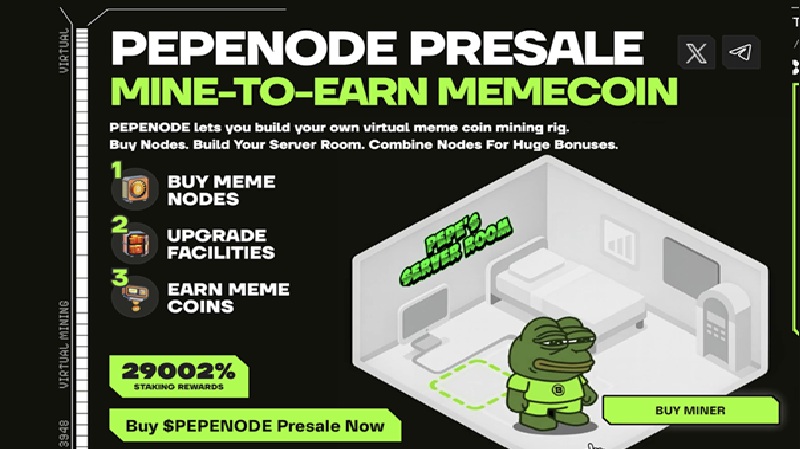
This new meme coin invites early supporters to step into a virtual mining dashboard where they can build and earn long before the token even hits a DEX.

With thousands of percent in passive income potential and a mining game that is both fun and accessible, PEPENODE ($PEPENODE) is one of the more peculiar (and promising) meme coins to enter the market this year.

Build Virtual Rigs and Start Mining Before Launch

The PEPENODE ecosystem is built around a mine-to-earn concept. However, here everything happens inside a virtual dashboard.

Using $PEPENODE tokens, users can buy digital mining nodes, design their virtual server rooms, and start mining without physical hardware or graphics cards. Since it uses Ethereum’s proof-of-stake mechanism, there is no worry of leaving behind a large carbon footprint, either.

Each node contributes hash rate, energy stats, and reward output. As the mining setup is entirely simulated, there’s no electricity cost or noise. The clean UI tracks the rig’s performance without giving any hassles common to physical mining.

More importantly, presale participants don’t have to wait for listings or the launch day to start earning. The off-chain version of the game is live during the presale phase, allowing early users to rack up rewards and level up their infrastructure much before the Token Generation Event (TGE).

Passive Rewards Stack Up Fast

Mining is not the only way to earn rewards from PEPENODE.

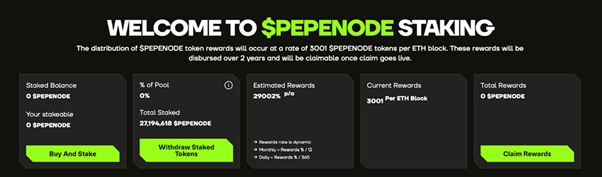
Early adopters who lock their tokens in the system can also earn annual rewards as high as 20,000%, making it one of the most aggressive passive income models in the current cycle.

Thanks to the “Buy & Stake” option, it only takes a few clicks to start earning.

But here is the catch. Those staking from the first round unlock the highest rewards, and the rate dynamically adjusts as more investors join the pool. The earlier the entry, the better the reward rate.

Scarcity Baked in Through Token Burns

Unlike many meme coins that inflate the supply to fuel gameplay, PEPENODE opts for quite the opposite. Every time someone upgrades a node or expands their facility, 70% of the spent tokens get burned forever.

This constant burn reduces the total supply over time, tightening circulation as more players upgrade and compete for leaderboard spots.

This way, the deflationary system actively supports the long-term price appreciation of remaining $PEPENODE tokens. The more users build, the scarcer their tokens become.

When the platform transitions on-chain in Phase 3, all Miner Nodes and upgraded Facilities will be converted into NFTs, giving players full asset ownership and preserving their progress from the presale.

Airdrops, Referrals, and Node Strategy

In addition to staking and burning, PEPENODE’s gamified setup includes layers of strategic engagement. For example, users who refer others earn 2% of their referrals’ mined rewards. It’s a great organic mechanism to drive growth.

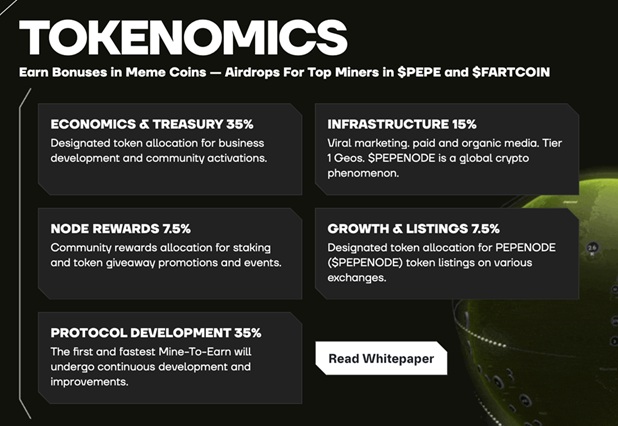
There’s also airdrop potential integrated into the roadmap, with meme coin giveaways like $PEPE and $FARTCOIN reserved for top-performing miners. Tiered node systems ensure early players enjoy higher efficiency than late joiners. That’s why timing matters.

Your setup, your invites, and every upgrade decision play a role in what you take home.

Presale is Now Open with Tiered Pricing and Dynamic Rewards

Crypto launches often get hijacked by bots or gobbled up by whales. To tackle this, PEPENODE takes a more grassroots approach. This means all purchases require a brief manual confirmation step. It’s not too complicated to annoy real users, but just enough to trip up automation.

There are no private rounds or VC carve-outs either. Everyone joins from the same starting line, and the team has passed a third-party audit by Coinsult, reducing the risks of hidden vulnerabilities and rug pulls.

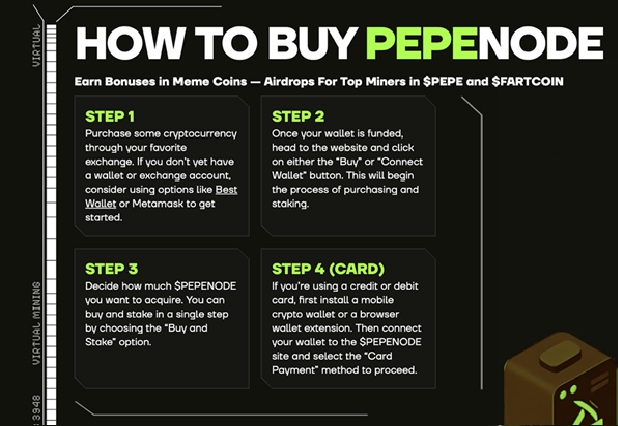
Joining the PEPENODE presale hardly takes a few minutes. You can also use a debit or credit card to join the presale if you’re short on crypto.

Once connected to the PEPENODE site, just select the amount you want to invest and hit the “Buy” button. For those who wish to earn straight away, the “Buy & Stake” option handles both in one go without extra steps.

The presale started at a base price of $0.001 per token, and the price ticks up with each round. So the earlier you join, the cheaper your entry, and the more mining power you’ll lock in when the full platform launches.


Visit the $PEPENODE presale

X | Telegram

A Guide to Investing in AI: An Investor’s Perspective [podcast]

0

This Tekedia Daily podcast outlines a strategic framework for investing in the AI sector. It emphasizes that while the foundational model layer is dominated by a few major players, significant opportunities exist at the application level.

To be a successful and defensible investment, an application-layer company should create a competitive advantage through solving complex challenges, integration with the physical world, and a niche focus. The most compelling business model discussed is the “full stack” approach, where an AI company also holds the necessary licenses to operate in a traditional industry. For instance, an insurance AI company which has insurance licenses.

Largely, by analyzing the lessons of companies that have been disintermediated by larger platforms in the past, like those that built apps on Twitter’s API, we can learn a crucial lesson. The best place for an investor to put their money is in a company that builds its own competitive moat since we expect foundation model layer companies to vertically integrate over time.

This means looking for businesses that go beyond simply providing a front-end for a foundational model and instead building a defensible, full-stack solution that is difficult for a large, all-purpose AI to replicate with a single update.


Podcast VideoSign-up at Blucera and check Tekedia Daily podcast category under Training module.

Presco Plc Resubmits $171m Ghana OPDC, SOP Acquisition Proposals for Shareholder Approval at August AGM

0

Wall Street-style strategic expansion moves are unfolding in West Africa’s oil palm sector as Nigerian agribusiness giant Presco Plc seeks to cement its dominance in the edible oils market.

In a fresh push to execute stalled growth plans, the board has called on shareholders to ratify the $124.9 million purchase of Ghana Oil Palm Development Company Limited (GOPDC) and approve the $46.7 million acquisition of Saro Oil Palm Limited (SOP) at its Annual General Meeting slated for August 19, 2025.

The notice to the Nigerian Exchange (NGX) highlights that while the GOPDC deal had already secured shareholder approval in 2024, litigation delayed completion, forcing a return to the AGM agenda. This time, the board aims to clear all hurdles in one swoop, combining the ratification of GOPDC with a fresh proposal for SOP.

In its statement, the board urged investors to back the dual acquisitions, stating: “We respectfully invite shareholders to ratify the acquisition of GOPDC and to consider approval of the proposal to acquire SOP.”

GOPDC: A Strategic West African Foothold

Founded on December 6, 1995, Ghana Oil Palm Development Company Limited is a fully integrated agro-industrial player that handles every stage of the oil palm value chain — from cultivation to refining and distribution. Fully owned by Société d’Investissement pour l’Agriculture Tropicale (Siat SA), GOPDC operates two major estates — Kwae and Okumaning — in Ghana’s Eastern Region, covering about 21,000 hectares.

Out of this, 13,000 hectares are developed for roughly 6,000 outgrower farmers, supported by two mills, a refinery, and a pellet plant. Annual production exceeds 35,000 tonnes of palm and palm kernel oil, stored in facilities with a 21,000-tonne capacity. Peak harvest seasons see GOPDC employing around 30,000 workers, sustaining more than 50,000 people indirectly.

The acquisition is not just an expansion; it’s a deepening of existing ties. Siat SA, GOPDC’s owner, is already a major shareholder in Presco Plc, ensuring synergy in operations, supply chains, and market penetration.

Saro Oil Palm Limited

Saro Oil Palm Limited, also fully owned by Siat SA, represents a rapid growth story in Nigeria’s Edo State. Established in July 2019, SOP has quickly developed 22,500 hectares of plantation land, including a 10,000-hectare base project launched in 2020 and an additional 12,500 hectares acquired through Bansley International Ltd under the Edo State Oil Palm Programme.

By early 2025, SOP had planted 5,000 hectares, with plans to hit 8,000 hectares before year-end. Fresh Fruit Bunch cultivation is scheduled to begin in 2026, targeting 28,000 tonnes of output. Plans are also in place for two new palm oil mills — with 60-tonne/hour and 30-tonne/hour processing capacities.

For Presco, acquiring SOP offers a fast track to expansion — boosting total plantation size from 43,547 to 59,760 hectares in months rather than the typical 3–5 years required for greenfield development. This move not only secures high-quality farmland but also strengthens the company’s long-term production capacity, market share, and profitability outlook.

Sector Impact and Strategic Outlook

If approved, the twin acquisitions will give Presco one of the largest oil palm footprints in sub-Saharan Africa, advancing its goal of becoming the region’s most profitable and sustainable edible oil group. Industry analysts say this would place Presco in a stronger position to hedge against global palm oil price volatility and deepen its integration from farm to shelf.

With West Africa’s edible oils demand rising alongside population growth and industrial usage, Presco’s latest play could be a textbook example of scaling through strategic acquisitions — provided shareholders give the green light next week.

D.A. Davidson’s Gil Luria Calls Trump’s Push for U.S. Stake in Intel “Essential”, Citing National Security Imperatives

0

A leading business figure has said the Trump administration’s reported plan to take a stake in Intel could be one of the most important industrial interventions in recent history, describing it as a necessary step to safeguard America’s technological independence and national security.

On Friday, Gil Luria, head of technology research at D.A. Davidson, told CNBC’s Squawk Box that government intervention in the struggling chipmaker is “essential.” While Luria acknowledged that U.S. economic tradition leans heavily toward free-market capitalism, he argued that Intel’s current condition poses too great a risk for Washington to sit on the sidelines.

“We’re all capitalists,” Luria said. “We don’t want government to intervene and own private enterprise, but this is national security.”

Bloomberg first reported Thursday that the Trump administration is actively weighing the possibility of taking a direct equity stake in Intel, a move that immediately sent the company’s shares higher. On Friday, the rally continued as markets speculated over how such an unprecedented arrangement might be structured. Sources said one option under discussion involves deploying funds from the $52 billion CHIPS and Science Act, which was signed into law to boost U.S. semiconductor manufacturing and reduce reliance on overseas suppliers.

For the administration, the reasoning is that Intel has fallen behind global rivals like Taiwan Semiconductor Manufacturing Co. (TSMC) and South Korea’s Samsung Electronics in producing advanced chips, a shortfall that leaves the United States vulnerable in a world where semiconductor supply chains are increasingly caught in geopolitical crossfire. President Donald Trump has repeatedly stressed the need to “make more chips and high-end technology in the U.S.” and lessen dependence on Asia.

A Rocky Road for Intel

Once the undisputed leader of the global semiconductor industry, Intel has spent much of the last decade struggling with manufacturing delays, missed technology milestones, and market share losses to AMD, Nvidia, and foreign competitors. The company has stumbled in its transition to smaller, more advanced manufacturing nodes, forcing U.S. tech firms to turn to TSMC for cutting-edge chip production.

These setbacks have been costly not just for Intel but for U.S. technological sovereignty. The pandemic-era chip shortage exposed just how dependent American industries—from smartphones to defense systems—have become on overseas suppliers. This vulnerability has since been magnified by tensions with China, a key player in the global semiconductor supply chain.

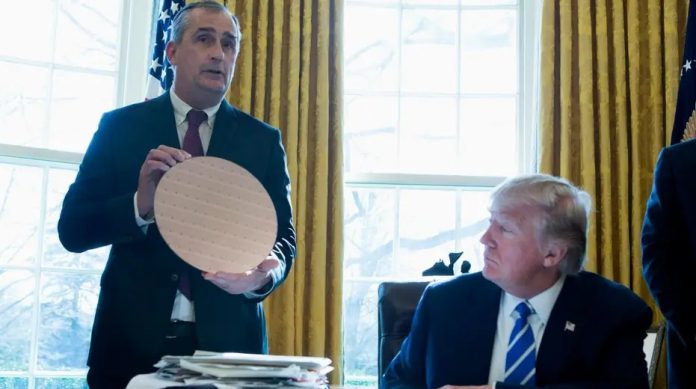
The political drama around Intel intensified earlier this week when Intel CEO Lip-Bu Tan met with Trump at the White House. Just days earlier, the president had called for Tan’s resignation over alleged ties to China, a stance that raised eyebrows in Washington and Wall Street alike. But the meeting appeared to mark a turnaround, with Trump later striking a far more conciliatory tone and even praising the Intel boss—a shift some see as a signal that the administration is serious about partnering with the company to reestablish its global standing.

National Security and AI Risks

Luria underscored the national security implications of the semiconductor race, drawing a parallel between advanced chip production and the Cold War arms race. Citing recent warnings from OpenAI CEO Sam Altman and Meta CEO Mark Zuckerberg that superintelligent AI could represent “the next wave of nuclear proliferation,” he said, adding that leaving chip manufacturing in foreign hands is untenable.

“We can’t rely on somebody else making shell casings for our nuclear arsenal,” Luria said. “We have to get it right.”

If the U.S. moves forward with an equity stake in Intel, it would mark a historic pivot in industrial policy—one in which the government directly invests in a major private-sector technology player to protect national interests. While critics warn that such involvement risks distorting competition, supporters argue the stakes are too high to ignore.

However, the administration is reportedly weighing multiple intervention models, but business leaders are increasingly reaching a consensus that the future of America’s technological independence could hinge on whether Intel regains its place at the cutting edge of semiconductor production.