DD
MM
YYYY

PAGES

DD
MM
YYYY

spot_img

PAGES

Home Blog Page 698

The Blackbox of Nigeria’s Aviation Ambassadors

0

In Nigerian public life, politics, celebrity and governance often overlap in ways that surprise the public. The recent events involving Wasiu Ayinde (KWAM 1), and Comfort Emmanson have become a talking point across the country. What at first seemed like a small government appointment has grown into a national conversation about fairness, credibility and how leaders send messages through their actions. In this piece, our analyst presents the negotiations and renegotiations of the Federal Government’s appointment of KWAM 1 as an aviation ambassador shortly after an incident in which he was accused of unruly behaviour from Nigeria’s X space.

Aviation Minister Festus Keyamo explained that the role was unpaid and intended to promote proper conduct at airports. Still, many Nigerians saw a contradiction. A man who had been in the middle of a dispute over airport security was now the public face of airport security awareness.

The public response became even sharper when people compared this with Comfort Emmanson’s experience. She was involved in a separate case with Ibom Air and was punished much more harshly, including time in prison. For many observers, the difference in treatment raised uncomfortable questions about justice, equality and who gets second chances in Nigeria.

At the centre of this discussion is the ambassadorial title itself. It may be an honorary position but it carries symbolic weight. When the government gives such a title to someone, it signals approval and sets an example. The question is whether this example is one the country should follow.

Several groups of people are now part of this story. There is KWAM 1 himself, Comfort Emmanson, the Federal Government, and political figures such as President Bola Tinubu and members of the ruling party. There are also journalists, commentators and everyday citizens on social media. On another side there are the incidents themselves, the evidence that has been shared, and the concept of the “rule of law” that people keep referring to in their arguments. All of these elements interact to shape how Nigerians see the situation.

The loudest points of disagreement are about fairness and political influence. Many believe Comfort should be treated in the same way as KWAM 1 if the government wants to be consistent. Others think that appointing someone after a security breach undermines the seriousness of aviation safety. There are also those who see the hand of political loyalty and friendship in the decision.

In response to the backlash, Festus Keyamo stressed that KWAM 1’s ambassadorial role was not a reward but a service. He also suggested that Comfort might be considered for a similar position. To some, this sounded like a fair offer. To others, it was simply an attempt to calm public anger without addressing the real issue.
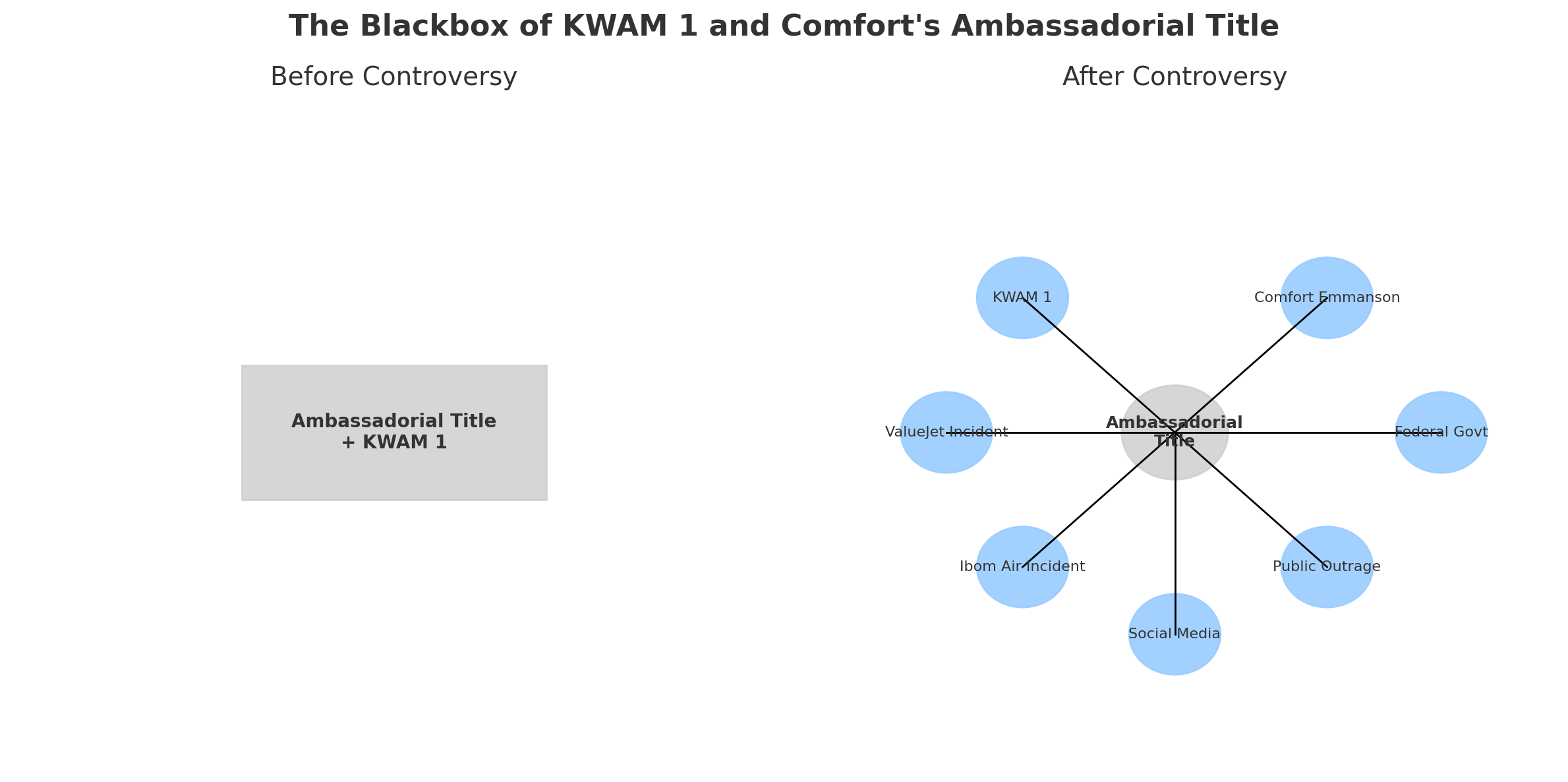
Source: Twitter, 2025; Infoprations Analysis, 2025

Satire and humour have also played a part in keeping the story alive. On social media, some joked that Comfort should be made “Ambassador of Hostess Services” or that anyone in trouble should commit their offence at the same time as a famous person to avoid consequences. These jokes carry a sharp edge because they point directly at the perceived double standard.

The government’s effort to change the narrative has not closed the matter. Many still feel that the original decision sends the wrong message. In the court of public opinion, symbols matter as much as facts. The ambassadorial title is not just a line in a government announcement. It is a signal that shapes how citizens judge the seriousness of leadership and the values that leaders promote.

What can be learned from this? Leaders should recognise that public trust is built not only on laws and policies but also on the examples they set. Once the public connects a symbolic act like this appointment to broader concerns about fairness and influence, it becomes hard to repair the damage without clear and consistent action. Citizens, on the other hand, show that they can keep attention on an issue by speaking out, comparing cases and refusing to let important questions fade away.

Justin Sun’s Lawsuit Against Bloomberg Could Reshape How Independent Journalists Approach Reporting on Cryptocurrency Wealth

0

TRON founder Justin Sun filed a lawsuit against Bloomberg in Delaware federal court on August 1, 2025, to block the publication of detailed information about his cryptocurrency holdings.

Sun alleges that Bloomberg breached confidentiality agreements by planning to disclose sensitive financial data he provided solely for wealth verification for the Bloomberg Billionaires Index.

He claims the disclosure of specific token amounts could expose him to significant risks, including hacking, theft, extortion, and physical harm, citing incidents like “wrench attacks” where crypto owners are coerced through violence.

Sun’s legal team argues the data is “highly confidential, sensitive, private, and proprietary,” and its release would cause irreparable harm. They sent a cease-and-desist letter on August 2, but Bloomberg confirmed plans to publish.

Sun seeks a temporary restraining order, preliminary and permanent injunctions, and legal costs, alleging public disclosure of private facts and promissory estoppel. Bloomberg contends the article was published before the restraining order filing, arguing Sun’s claims lack merit and infringe on First Amendment rights.

Sun’s lawsuit highlights the risks associated with publishing detailed financial information, particularly in the crypto space where blockchain transparency can make individuals targets for malicious actors.

Independent journalists, often working with limited legal resources, may face heightened caution when reporting on the wealth or assets of high-profile crypto figures. The case could set a precedent that emphasizes the need for explicit consent or public availability of data before publication.

Journalists may need to adopt stricter verification processes and ensure that any sensitive data they report is either publicly available or explicitly authorized. This could limit the scope of investigative reporting, as sources may be less willing to share financial details, fearing legal repercussions or privacy breaches.

Legal Risks and Precedents for Media Liability

Sun’s lawsuit accuses Bloomberg of public disclosure of private facts and promissory estoppel, seeking injunctions and damages. If successful, this could establish a legal precedent that holds media outlets accountable for breaching confidentiality agreements, even if the information was provided for a specific purpose.

Independent journalists, who often lack the legal backing of large organizations like Bloomberg, could face significant risks if sued by powerful individuals or entities. Independent journalists may become more cautious about publishing detailed financial profiles, especially without robust legal protections.

This could discourage in-depth reporting on crypto moguls or other high-net-worth individuals, as the threat of lawsuits might outweigh the public interest in transparency. The case may also prompt journalists to seek legal counsel before publishing sensitive stories.

The crypto industry is built on the paradox of blockchain’s transparency (where transactions are traceable) and the need for personal privacy, as highlighted by analyst Sarah Linton in a related report. Sun’s lawsuit underscores this tension, arguing that detailed disclosures could endanger personal security.

This case could spark debates within the journalism community about ethical boundaries. Independent journalists may face pressure to prioritize privacy over transparency, particularly when covering crypto figures whose wealth is tied to publicly traceable blockchain data.

The high-profile nature of Sun’s lawsuit, amplified by posts on X from figures like crypto commentator Molly White, could create a chilling effect on independent journalism. The fear of legal action from wealthy individuals or corporations could deter journalists from pursuing stories about crypto wealth, especially if they involve non-public data.

Bloomberg’s intent to defend its First Amendment rights suggests a broader battle over press freedom, which could influence how courts view similar cases in the future. Independent journalists may hesitate to investigate or publish stories about crypto billionaires or other influential figures.

The lawsuit raises questions about how media outlets obtain and handle sensitive financial information, as noted in reports about the case. If Bloomberg is seen as overstepping, it could erode trust in financial journalism, affecting not just large outlets but also independent reporters who rely on source credibility.

Conversely, if Sun’s claims are dismissed, it might embolden media to pursue more aggressive reporting, potentially benefiting independent journalists who can access public blockchain data. Independent journalists may need to build stronger relationships with sources to ensure trust and transparency in their reporting processes.

They might also face increased pressure to verify data through public sources (e.g., blockchain explorers) rather than private disclosures, which could limit their ability to break exclusive stories. The case could also prompt discussions about industry-wide standards for handling crypto-related data.

Unlike Bloomberg, which has a legal team to counter Sun’s claims, independent journalists often work alone or with small teams, making them vulnerable to legal threats. The cost of defending against a lawsuit, even if meritless, could be crippling, leading to a more cautious approach to reporting on crypto wealth.

Independent journalists may need to reassess their ethical frameworks, balancing the public’s right to know with the potential harm caused by disclosing sensitive financial details. This could lead to a shift toward more generalized reporting, reducing the risk of legal or personal harm to sources.

The lawsuit’s potential to impact crypto market sentiment (e.g., by triggering volatility in tokens linked to Sun) could create opportunities for independent journalists to cover market reactions. However, they must navigate these stories carefully to avoid amplifying unverified claims or contributing to market panic.

The lawsuit reflects a broader tension in the crypto industry between transparency and privacy, as noted in multiple sources. If Sun prevails, it could lead to stricter privacy protections, potentially limiting the scope of financial journalism but enhancing safety for high-profile crypto figures.

If Bloomberg wins, it might encourage more aggressive reporting, benefiting independent journalists who can access public blockchain data but increasing risks for those relying on private sources. The case could also influence regulatory discussions about data privacy in the crypto space, as governments worldwide are already scrutinizing digital assets.

For independent journalists, the key takeaway is the need for caution and robust ethical practices when covering sensitive financial information. They may need to invest in legal education, secure data handling practices, and transparent sourcing to mitigate risks.

With $1.8M Raised, This AI-Powered Crypto Could Deliver 400x Returns — How Buying at $0.005 Might Make You a Millionaire

0

Ozak AI is gaining momentum for its potential to turn small investments into major gains. The artificial intelligence and blockchain technology-based project has already received approximately 1.8 million dollars during its presale. Tokens are currently priced at $0.005, but the next stage will double that to $0.01. If the OZ token hits its $1.00 target, early buyers could see 400x returns, turning $100 into $20,000.

From $0.005 Entry to $1.00 Target

Now in Phase 4 of the presale, Ozak AI has sold more than 128 million OZ tokens. At $0.005, investors can accumulate significant holdings before the next price increase. You can contribute $100 via ETH, USDT or USDC using the Ethereum Network in order to hop on to the project. Further, the project has also offered a $1 million giveaway.

The tokenomics of the project is also very unique and designed carefully, with a total of 10 billion tokens. The purpose of the overall amount is divided further and 30% is dedicated to the presale. Apart from this, 30% goes for the ecosystem and community growth, 10% for the team and so on.

This limited supply and an expanding utility have the potential to cause scarcity and increase utility through trading.

Youtube embed:

Next 500X AI Altcoin

AI-Driven Insights Behind the Growth Potential

Ozak AI’s tech stack has a $0.005 entry point. The project’s major strength is to provide real-time predictive analytics for financial markets, backed by the Ozak Stream Network (OSN) for low-latency data processing. Traders and institutions get market insights in near real-time.

Security and resilience are enhanced by Decentralized Physical Infrastructure Networks (DePIN), which process and store data across a distributed system with no central servers. Secure storage, customizable Prediction Agents (PAs), and AIs, which allow even those without coding skills to create their models using Ozak Data Vaults.

These can be used for day trading, institutional portfolio management and market forecasting. As more people adopt, more demand for $OZ tokens will support the goal of reaching $1.00.

Why Early Access Matters

Market analysts say the gap between $0.005 and $1.00 is a once-in-a-lifetime opportunity for big returns. With 400x potential, a $250 entry could turn into $100,000 if the target is hit. Presale phases allows the first buyer to buy at a lower price, before an public exchange listings. Once the token goes live on the open market, trading volumes could skyrocket if interest meets expectations.

The dedicated percentage for presale is limited, i.e, 30% so it makes the competition bar so high. This is one of the last chances to buy before the price doubles in the next phase.

With over $1.8 million raised, a 10 billion token supply and $0.005 entry point, early investors could be millionaires if the $1.00 target is reached.

For more information about Ozak AI, visit the links below:

Website: https://ozak.ai/

Twitter/X: https://x.com/OzakAGI

Telegram: https://t.me/OzakAGI

With a Possible 20X Upside Play, BlockDAG Price Prediction Leaves Ethereum and SHIB Watching from the Sidelines

0

Ethereum’s rally to multi-year highs and Shiba Inu’s steady position among meme coin giants are dominating headlines, but there’s a presale opportunity that’s quietly setting the stage for a far larger move.

BlockDAG’s current presale metrics point to a potential 20X upside based on price projections, and it’s not just hype driving these numbers. The project has raised $375 million, secured high-profile sports partnerships, and earned strong security credentials through top-tier blockchain audits.

Now in Batch 29 at $0.0276, with an estimated launch price of $0.05, BlockDAG is attracting attention from both retail and institutional eyes looking for the best crypto for payments; one that blends real-world adoption with robust on-chain infrastructure.

Ethereum Holds the Market Spotlight

Ethereum surged to around $4,200, marking its highest level since December 2021 and cementing its position as the top-performing large-cap cryptocurrency over the past 24 hours.

The move delivered a 7% daily gain and brought ETH’s weekly rise to nearly 20%, reflecting strong market momentum. In the process, over $200 million in positions were liquidated, with $185 million of that total coming from short sellers caught on the wrong side of the rally.

The surge even drew a reaction from Eric Trump, who remarked it “puts a smile” on his face to see ETH shorts “get smoked,” warning against betting against Bitcoin and Ethereum. With the wider crypto market also in the green and many altcoins registering gains, ETH’s explosive move has reinforced its leading role in the current bullish wave.

Shiba Inu Steadies After Legendary Gains

The Shiba Inu (SHIB) price surge outlook continues to capture imagination thanks to its legendary 100,000,000% rally in 2021. That historic run saw the meme coin soar from a $40,000 market cap to $40 billion in just 135 days, turning tiny investments into life-changing windfalls.

Today, SHIB trades at $0.00001382, far from its all-time high but still a top meme coin with a loyal global community. While large-scale rallies of that magnitude are unlikely to repeat, the token’s dedicated following keeps it relevant in discussions about speculative upside potential.

Current sentiment around SHIB is cautiously optimistic. Market observers note that its strong community engagement and meme appeal could drive short-term spikes, but the lack of major utility developments limits its standing compared to projects delivering real-world applications, especially in the payments space.

BlockDAG: $375M Raised, 20X Potential, and Real-World Backing

BlockDAG’s presale momentum is built on three pillars that distinguish it from both established giants and purely speculative plays: a clear price prediction path, industry-grade security, and major sports partnerships.

Currently in Batch 29 at $0.0276 with an estimated launch price of $0.05, BlockDAG has near-term projections reaching $1 and long-term targets up to $10. At $1, the upside from today’s price would represent a 36X return, but even the more conservative $0.50–$1 range offers impressive gains. These targets are supported by adoption metrics, including $375 million raised, 25 billion BDAG sold, and a growing holder base surpassing 200,000 before launch.

In an industry where trust is paramount, BlockDAG has undergone comprehensive audits by both CertiK and Halborn. Issues flagged during reviews were resolved before public rollout, and additional safeguards like multi-signature protections and parallel PoW processing were implemented to harden network defenses. This security-first approach positions BDAG as a reliable infrastructure option for payments and enterprise adoption.

BlockDAG has also secured official blockchain partnerships with the Seattle Orcas cricket team and the Seattle Seawolves rugby team for the 2025 season. These deals go beyond simple brand placement, integrating NFTs, fan coins, exclusive content, and interactive match experiences into the fan ecosystem. This mainstream exposure helps push BDAG beyond crypto-native circles into broader public awareness, a critical step for scaling its payments use case.

By combining these three angles, BlockDAG is building an ecosystem with real-world traction, robust security, and market confidence, elements that give weight to its ambitious price forecasts.

Key Takeaways

Ethereum’s bullish structure keeps it firmly in the spotlight, with Ethereum (ETH) trend analysis pointing toward potential new highs. Shiba Inu’s market resilience and the enduring allure of its past mega-rally sustain the Shiba Inu (SHIB) price surge outlook. Both remain relevant in their niches, but neither offers the same combination of early-stage entry pricing, secured partnerships, and proven infrastructure that BlockDAG does.

With a $375 million presale, rigorous security audits, and sports-backed marketing power, BlockDAG is shaping up to be more than just another presale hype story. Its projections for a possible 20X upside are rooted in tangible adoption metrics and a clear plan for becoming the best crypto for payments.

For investors looking to balance potential returns with real-world viability, BlockDAG’s current pricing window could represent one of the most compelling opportunities of 2025, before the rest of the market catches up.


Presale: https://purchase.blockdag.network

Website: https://blockdag.network

Telegram: https://t.me/blockDAGnetworkOfficial

Discord: https://discord.gg/Q7BxghMVyu

Cardano (ADA) Bulls Fight to Regain Lost Ground, But Holders Are Jumping Ship as Little Pepe (LILPEPE) Is Set to Reach $2 First

0

After years of promises, ambitious roadmaps, and slow-but-steady development, the recent market bounce was expected to lift ADA out of the trenches. And while Cardano has seen some upward movement in 2025, the recovery has been far from convincing. Bulls are trying to regain control, but many investors aren’t sticking around to see how it ends. Instead, they’re making an aggressive pivot to one of the most talked-about new meme coins in the space, Little Pepe (LILPEPE), a project that delivers momentum and does it with speed, transparency, and smart tokenomics.

Cardano’s Slow Burn: Bulls Push, But Frustration Grows

Cardano continues to be a strong project at its core. Its praise as a “green” proof-of-stake system still stands, and there is no end to its development.  But in a year where fast-moving tokens are printing double and triple-digit gains, ADA’s sluggish pace is becoming a liability. The price action tells the story. After dipping below $0.70 earlier this year, Cardano has clawed back to around $0.83. That’s progress, but it’s not exciting anyone trying to 2x, 10x, or even 100x their portfolio. ADA has been stuck in a tight range; even solid news hasn’t translated into breakout moves. Bulls are doing their part, but technical resistance remains heavy, and the charts show hesitation rather than conviction. Some analysts still believe ADA could revisit the $1.50–$2.00 range in this cycle—but timelines are uncertain. With so many high-velocity projects exploding, many investors have decided they’d rather ride with something newer, leaner, and significantly more aggressive in upside potential.

Little Pepe LILPEPE’s Meteoric Rise: 2800% on the Table?

There’s something uncanny about how quickly LILPEPE has gone from presale curiosity to serious contender.  Unlike many meme coins that rely purely on community hype, LILPEPE is built on a dedicated Layer 2 network, allowing for ultra-fast, low-cost transactions. But the real buzz comes from how it’s performing right now. LILPEPE is currently in Stage 10 of its presale, priced at just $0.0019, with over 96% of tokens sold. More than $17 million has already been raised, and the next price jump is just around the corner at $0.0020. For buyers entering today’s level, a 66.67% ROI is locked in even before the token hits exchanges. And that’s just the short-term play. Longer-term projections put numbers at $2, not out of hype, but based on momentum, token supply, and Layer 2 utility. That would mark a 2800%+ return from current levels.

Trust Is No Longer the Problem, LILPEPE Passed CertiK

In the early days, meme coins were considered wild territory. But LILPEPE has flipped that narrative. It has built on its own Layer 2 chain and passed a full CertiK audit, scoring 95%. That alone puts it above most meme tokens on the market. For investors transitioning out of ADA, a project that prides itself on peer-reviewed rigor, security matters. And LILPEPE is checking that box. The audit covered everything from contract logic to governance controls, with no red flags. There’s even a Freshcoins.io audit score of 81.55, adding another layer of transparency.

Not Just Security, It’s Incentivized

To reward early adopters and accelerate momentum, LILPEPE offers one of the biggest giveaways in the meme coin space, $777,000 in tokens, spread across 10 lucky winners. Anyone who invests at least $100 during the presale and completes simple social actions is eligible. Engagement boosts winning chances, and community buzz has increased by the hour. It’s a clever way to turn organic participation into marketing fuel, and it’s working. Community numbers are surging, and Twitter and Telegram are already packed with LILPEPE believers.

Conclusion: ADA to $2? LILPEPE Might Get There First

Here’s the harsh reality: ADA might still reach $2 someday. But based on the current pace, LILPEPE will likely get there faster, with a lot more energy behind it. LILPEPE is hitting all the right notes, presale momentum, smart tokenomics, serious audit credibility, and an aggressive roadmap. For investors looking to make the most of this cycle, not just survive it, LILPEPE is quickly becoming the better bet.


For more information about Little Pepe (LILPEPE) visit the links below:

Website: https://littlepepe.com

Whitepaper: https://littlepepe.com/whitepaper.pdf

Telegram: https://t.me/littlepepetoken

Twitter/X: https://x.com/littlepepetoken