DD
MM
YYYY

PAGES

DD
MM
YYYY

spot_img

PAGES

Home Blog Page 7

Goldman Sachs Bets on AI Agents With Anthropic Partnership to Automate Core Banking Functions

0
The logo for Goldman Sachs is seen on the trading floor at the New York Stock Exchange (NYSE) in New York City, New York, U.S., November 17, 2021. REUTERS/Andrew Kelly/Files

Goldman Sachs is accelerating its bet on artificial intelligence, partnering with AI startup Anthropic to build autonomous agents that could fundamentally reshape how core banking functions are performed, from trade accounting to client onboarding.

For the past six months, the Wall Street giant has been working closely with embedded Anthropic engineers to co-develop AI agents powered by Anthropic’s Claude model. The initial focus is on two operationally intensive areas: accounting for trades and transactions, and client vetting and onboarding, according to Goldman’s chief information officer, Marco Argenti.

The agents are still in development, but Argenti said the bank expects to deploy them soon. While he declined to give a specific launch date, the direction is clear: Goldman is no longer treating generative AI as an experimental add-on but as a core pillar of its operating model.

Argenti described the technology as a “digital co-worker” designed to operate alongside humans in roles that are complex, repetitive, and highly scaled. These are functions that sit at the heart of a modern investment bank and traditionally require large teams to manage regulatory requirements, documentation, reconciliations, and approvals.

The initiative fits into a broader transformation outlined by Goldman Sachs CEO David Solomon last year. In October, Solomon said the bank had embarked on a multi-year plan to reorganize itself around generative AI. Even as Goldman benefits from strong revenues in trading and advisory businesses, Solomon said the firm would seek to constrain headcount growth as AI-driven productivity gains take hold.

At Goldman, the move into autonomous agents builds on earlier experiments with AI-assisted coding. Last year, the bank began testing an autonomous coding tool known as Devin, which is now widely available to its engineers. That project served as a proving ground, demonstrating that advanced models could reliably handle complex tasks within a highly regulated environment.

What surprised Goldman’s technology leadership was how quickly those capabilities translated beyond software development. Argenti said Claude’s strength is not limited to writing code, but lies in its ability to reason through complex problems step by step, applying logic across large volumes of data and documents.

That capability is particularly valuable in areas like accounting and compliance, where staff must interpret rules, reconcile discrepancies, and make judgments based on incomplete information. In Argenti’s words, technology teams realized that “there are these other areas of the firm where we could expect the same level of automation and the same level of results that we’re seeing on the coding side.”

The potential operational impact is significant as client onboarding, often slowed by manual checks, document reviews, and regulatory approvals, could be completed much faster. Trade reconciliation issues, which can take days to resolve, could be identified and fixed more quickly, reducing operational risk and improving client experience.

Goldman is also exploring the use of AI agents in other parts of the business. Argenti pointed to possibilities such as employee surveillance and the creation of investment banking pitchbooks, both of which require processing large amounts of information under tight timelines. While these ideas are still exploratory, they underscore how broadly the bank is thinking about automation.

The announcement comes at a sensitive moment for the AI sector. Recent model updates from Anthropic have triggered sharp reactions in financial markets, with investors selling off shares of software companies and reassessing which firms are best positioned to benefit from the AI boom. The volatility reflects growing recognition that rapid improvements in foundation models could disrupt existing business models, including those built around legacy enterprise software.

Goldman’s willingness to work closely with Anthropic also highlights a shift in how large financial institutions engage with AI vendors. Rather than simply buying off-the-shelf tools, Goldman is embedding engineers and co-developing systems tailored to its specific needs, regulatory obligations, and risk controls.

Despite the scale of automation being discussed, Goldman has been cautious in addressing concerns about job losses. The bank employs thousands of people in compliance, accounting, and operations, and Argenti said it would be premature to assume the technology will directly eliminate those roles. Instead, Goldman’s stated aim is to “inject capacity,” allowing teams to do more work faster and improve service quality.

Still, the longer-term implications are difficult to ignore. As AI agents mature, Goldman could reduce its reliance on third-party service providers that currently handle parts of its operational workload. That could shift costs away from external vendors and further concentrate expertise and control inside the bank.

More broadly, Goldman’s strategy signals a bigger change in how Wall Street views technology. Generative AI is no longer framed as a productivity tool for individual workers, but as an organizing principle for the firm itself. By embedding autonomous agents into core processes, Goldman is testing whether a global investment bank can be redesigned around machines that reason, decide, and act with limited human intervention.

If successful, the effort could set a precedent for the industry, forcing rivals to accelerate their own AI adoption or risk falling behind.

AI Boom Triggers Server CPU Crunch as Intel and AMD Reportedly Warn Chinese Customers of Lengthy Delays

0

The global artificial intelligence buildout is no longer straining only cutting-edge GPUs. It is now tightening the supply of the more traditional computing backbone that underpins data centers, cloud services, and enterprise IT.

Fresh warnings from Intel and AMD to Chinese customers about server CPU shortages underscore how the AI infrastructure race is cascading through the entire semiconductor supply chain, driving up prices, extending delivery times, and complicating expansion plans for some of the world’s largest technology firms.

According to people familiar with the matter, who spoke to Reuters, Intel and AMD have recently notified customers in China that supplies of server central processing units are constrained, with Intel cautioning that delivery lead times for some products could stretch as long as six months. The shortages have already pushed prices for Intel’s server CPUs in China up by more than 10% on average, although the impact varies depending on contract terms and customer scale.

China accounts for more than 20% of Intel’s global revenue and hosts some of the largest cloud computing and data center operators in the world. Any sustained disruption to CPU availability risks slowing deployments across sectors ranging from AI model training and inference to e-commerce, fintech, and government digital infrastructure.

The most severe constraints are affecting Intel’s fourth- and fifth-generation Xeon processors, which remain widely used across Chinese data centers. Sources say Intel has begun rationing deliveries as it grapples with a growing backlog of unfulfilled orders, with some customers facing waits of up to half a year.

AMD, which has steadily expanded its footprint in the server market, has also informed Chinese clients of supply constraints. While its situation appears less acute than Intel’s, delivery lead times for some AMD server CPUs have reportedly been pushed out to eight to ten weeks, signaling that capacity pressures are spreading across the industry.

These developments are being reported for the first time by Reuters and point to a broader structural issue rather than a short-term hiccup. The AI investment wave has triggered a surge not only in demand for specialized accelerators but also for the CPUs that coordinate workloads, manage data flows, and support complex, multi-tenant data center environments.

AI infrastructure strains the full stack

While Nvidia’s GPUs have dominated headlines as the most visible bottleneck in AI hardware, industry participants say CPUs have quietly become another pressure point. Modern AI systems still rely heavily on server CPUs for preprocessing data, orchestrating GPU workloads, handling inference pipelines, and running non-AI applications alongside training clusters.

The rise of agentic AI systems is intensifying this trend. Unlike earlier chatbot-style applications, agentic systems perform multi-step tasks, interact continuously with software tools, and operate around the clock. These workloads are significantly more CPU-intensive, increasing the number of processors required per deployment and amplifying demand just as supply is tightening.

Memory constraints are compounding the problem. Prices for memory chips have continued to climb, particularly in China, as suppliers prioritize AI-optimized products. Distributors say that when memory prices began rising sharply late last year, customers rushed to secure CPUs earlier than planned to avoid mismatched system builds or higher overall costs. That front-loading of orders further depleted available CPU inventories.

Manufacturing limits on both sides

The root causes of the shortages differ between Intel and AMD, but converge in outcome. Intel has struggled to ramp up production of its latest server chips amid persistent manufacturing yield challenges, limiting how quickly it can meet surging demand. AMD, meanwhile, relies on Taiwan Semiconductor Manufacturing Co., which has prioritized capacity for AI accelerators and advanced-node chips, leaving less room for high-volume server CPU production.

Intel acknowledged the tight conditions in a statement, saying the rapid adoption of AI has driven strong demand for what it described as “traditional compute.” The company said inventory levels are expected to be at their lowest point in the first quarter but added that it is addressing the situation aggressively and expects supply to improve in the second quarter through 2026, suggesting constraints could linger for months.

AMD reiterated comments made during its earnings call that it has boosted supply capabilities and remains confident in its ability to meet global demand, citing its supplier agreements and relationship with TSMC. Even so, the reported delays indicate that the fabless model offers limited insulation when the entire advanced semiconductor ecosystem is under strain.

Market dynamics amplify the impact

The shortages come against the backdrop of a shifting competitive landscape in server CPUs. Intel’s global market share has fallen from over 90% in 2019 to about 60% in 2025, while AMD’s share has risen from roughly 5% to more than 20%, according to a UBS report. In a tighter, more balanced market, disruptions at either supplier can have outsized effects, as customers have fewer surplus alternatives.

In China, major buyers include server manufacturers and cloud providers such as Alibaba and Tencent, which are racing to expand AI services while navigating U.S. export controls that restrict access to the most advanced accelerators. As GPUs become harder to source, CPUs have grown even more strategically important, making shortages particularly disruptive for long-term planning.

Taken together, the warnings from Intel and AMD highlight a critical shift in the AI boom. What began as a scramble for GPUs is evolving into a system-wide supply challenge spanning CPUs, memory, and manufacturing capacity. This means higher costs, longer deployment timelines, and tougher prioritization decisions for AI developers and cloud operators.

“Money Can’t Buy Happiness”: Musk’s Tweet Stirs Debate As Cuban Weigh in Amid Scientific Perspective

1

The debate over whether money can buy happiness was reignited this week by Elon Musk’s somber tweet on Wednesday. The tweet, accompanied by a sad-face emoji, reads: “Whoever said ‘money can’t buy happiness’ really knew what they were talking about.”

The post, from the world’s wealthiest individual with a net worth close to $1 trillion, quickly amassed over 92.8 million views, sparking widespread reactions and drawing a pointed response from fellow billionaire Mark Cuban. Cuban, ranked 372nd on the Bloomberg Billionaires Index with an estimated $9.62 billion fortune, countered: “Money doesn’t change who you are it just amplifies it. If you were happy when you were poor, you will be insanely happy if you get rich. If you were miserable, you will stay miserable, just with a lot less financial stress.”

Cuban’s perspective, rooted in his own rags-to-riches story as the founder of Broadcast.com and owner of the Dallas Mavericks, emphasizes that wealth magnifies inherent traits rather than inherently creating joy.

Musk, CEO of Tesla, SpaceX, and xAI, has echoed similar sentiments before. In a November 2025 appearance on Nikhil Kamath’s “People by WTF” podcast, he advised: “Aim to make more than you take. Be a net contributor to society,” suggesting that fulfillment stems from creating value, not accumulating wealth.

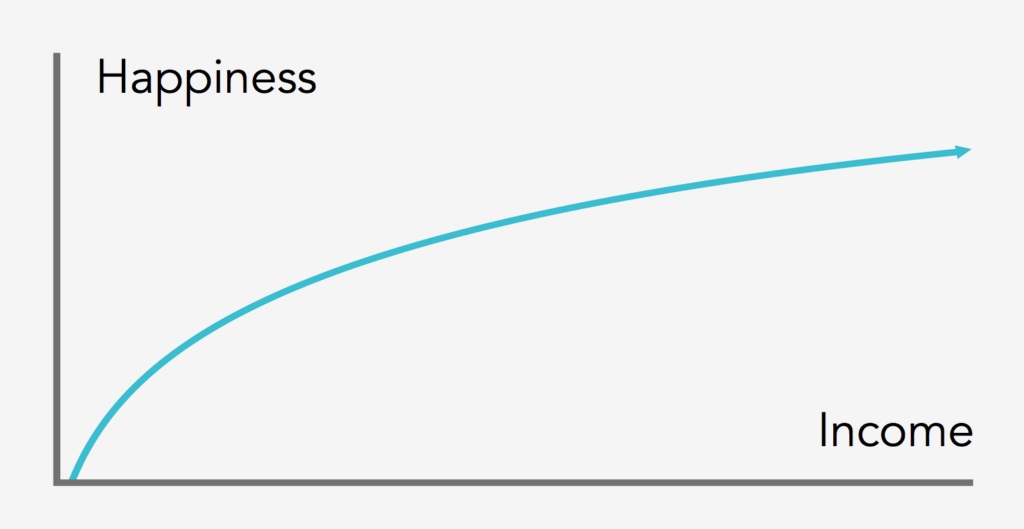
Despite his vast fortune, Musk has openly discussed personal struggles, including loneliness and the burdens of leadership, which may inform his view. Scientific research offers nuanced insights into this age-old question, generally affirming a positive but complex link between income and happiness. A seminal 2010 study by Nobel laureates Daniel Kahneman and Angus Deaton analyzed U.S. data and found that emotional well-being rises with income up to about $75,000 annually (adjusted to roughly $110,000 in 2026 dollars), after which it plateaus, while life satisfaction continues to increase.

They concluded that “high income buys life satisfaction but not happiness,” with diminishing returns beyond basic needs.

Subsequent research has challenged this threshold. In 2021, Wharton senior fellow Matthew Killingsworth, using a large U.S. dataset with real-time happiness tracking, found that both emotional well-being and life satisfaction rise continuously with income, even beyond $200,000 annually, following a log-linear pattern where each doubling of income yields similar happiness gains.

A 2024 follow-up by Killingsworth confirmed that for most people (about 80%), happiness increases without limit, though a minority (20%) experiences a flattening or decline at higher incomes due to personality factors. Killingsworth’s work suggests the $75,000 satiation point does not hold broadly, with happiness scaling log-linearly across income levels.

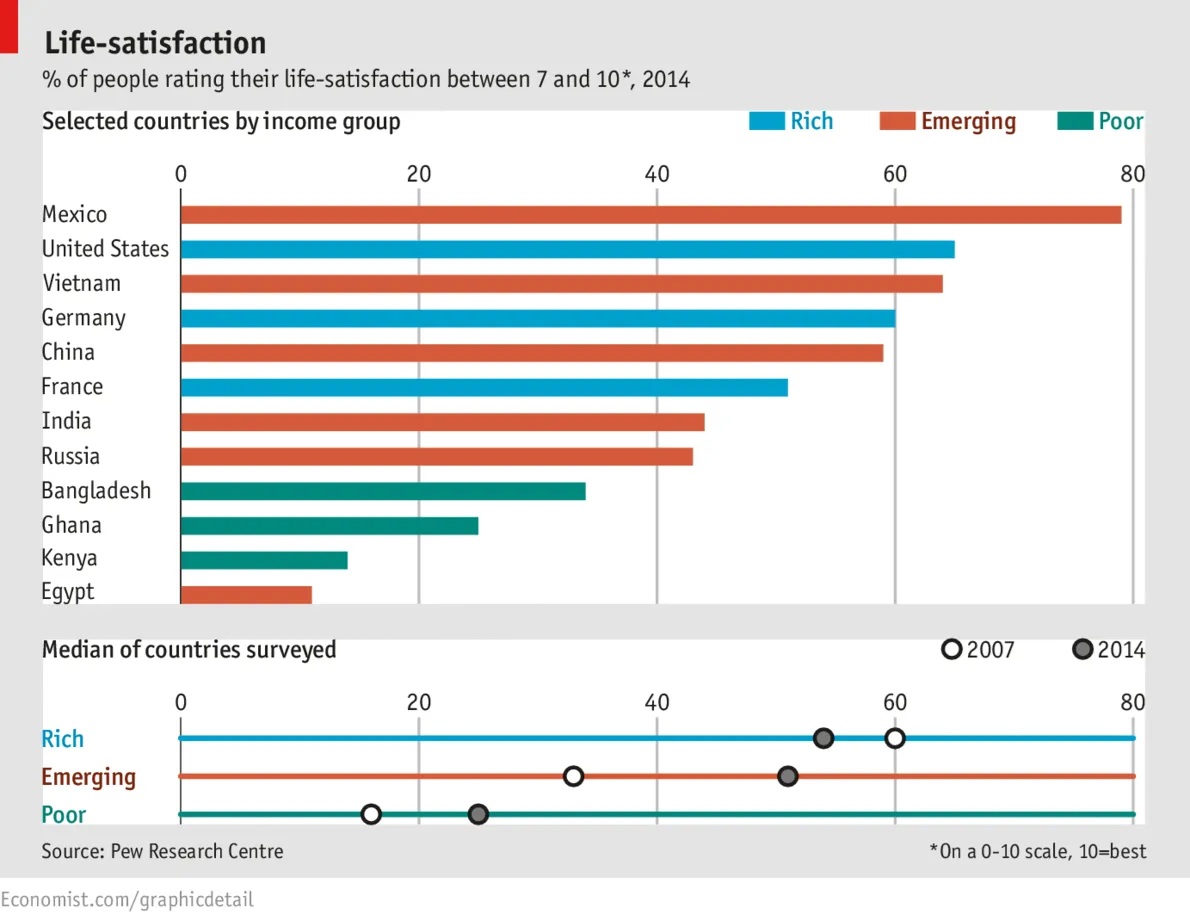
Studies from the Happier Lives Institute and others affirm that cash transfers significantly boost happiness in low- and middle-income countries, with effects persisting long-term, supporting that money “buys” happiness where basic needs are unmet. In richer nations, the link weakens but persists, with experiences (e.g., vacations) and prosocial spending (e.g., giving to others) yielding greater joy than material purchases.

University of Leicester’s David Bartram noted: “Once you’ve got a few million, anything extra is meaningless for happiness,” emphasizing purpose and relationships over wealth accumulation.

A 2023 collaborative paper by Kahneman, Killingsworth, and Barbara Mellers reconciled earlier debates, finding happiness rises continuously for most but plateaus for the unhappiest 20% around $100,000. Wharton’s 2024 study on millionaires showed happiness increasing even beyond $500,000, challenging complete satiation.

However, University of Nebraska-Lincoln research stresses that “doing” (experiences) trumps “having” (things), and prosocial spending enhances joy. Scientific American’s 2010 study found wealth impairs savoring simple pleasures.

Public discourse on X amplified the debate, with users sharing the Business Insider article on Musk and Cuban’s exchange, emphasizing personal experiences over blanket rules.

Ultimately, money facilitates happiness by meeting needs and enabling positive actions, but its impact diminishes at higher levels, where relationships, purpose, and generosity matter more. As Cuban suggests, wealth amplifies one’s baseline disposition—happy people get happier, while the miserable remain so, albeit with less financial stress.

South Africa and China Sign Framework Economic Partnership Agreement, Aiming for Duty-Free Export Access Amid U.S. Tariff Pressures

0

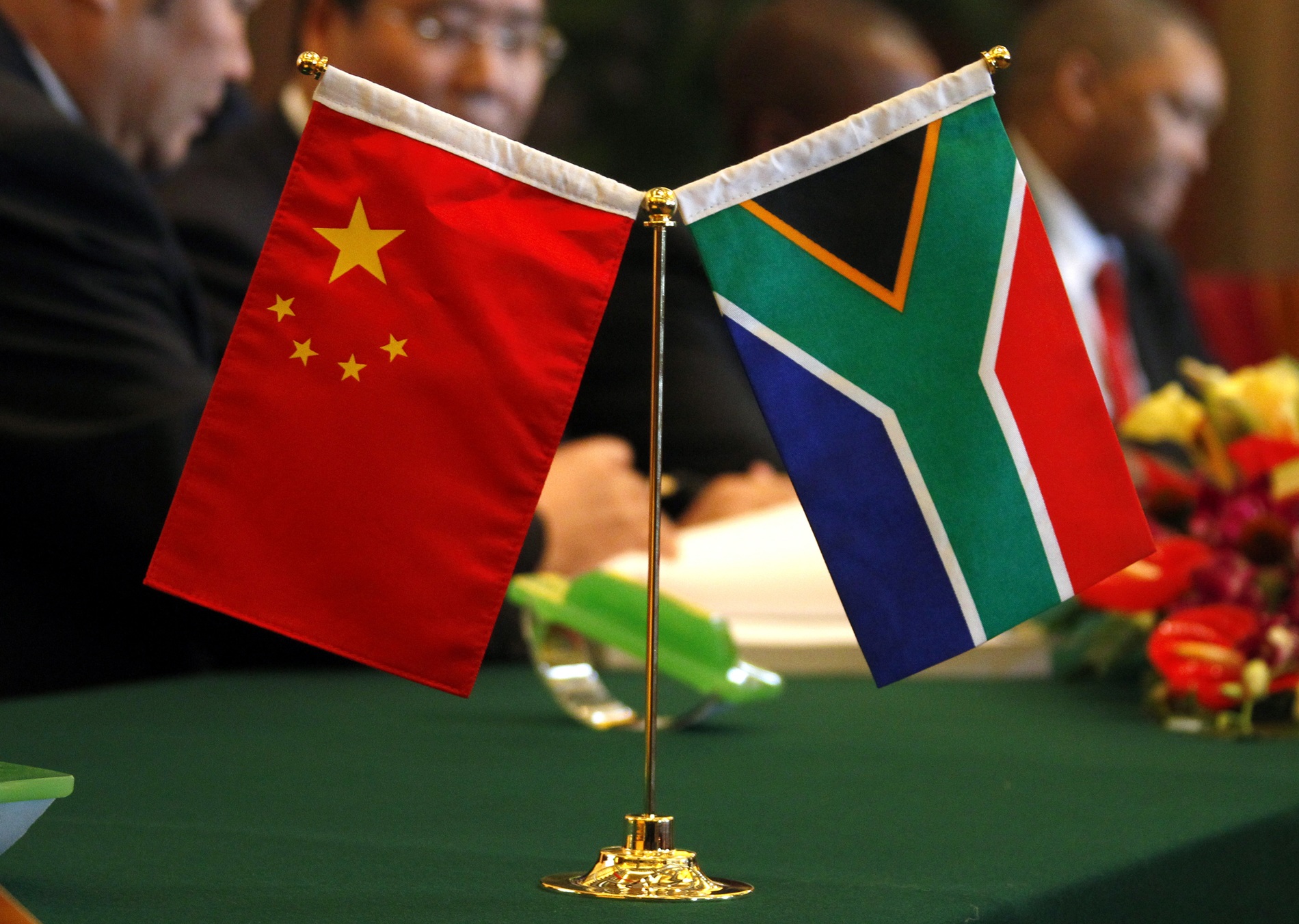
South Africa took a significant step toward deepening economic ties with China on Friday, when Trade, Industry and Competition Minister Parks Tau signed a Framework Agreement on Economic Partnership for Shared Prosperity during a visit to Beijing.

The agreement, described by the South African trade ministry as a foundation for securing duty-free access to the Chinese market for South African exports, is part of a broader push to diversify trade partners and offset the impact of steep U.S. tariffs imposed by President Donald Trump. It also comes amid a degenerating faceoff between Pretoria and Washington that has strained diplomatic and economic relations to their lowest point in decades.

The framework paves the way for an “Early Harvest Agreement” expected by the end of March 2026, which will grant China duty-free access for South African goods in priority sectors. The ministry highlighted opportunities for South African businesses in mining, agriculture, and value-added manufacturing to penetrate the Chinese market, while emphasizing safeguards to protect domestic industrial capacity.

“We will negotiate with a view to create the necessary safeguards built into the agreement so as to protect South Africa’s industrial capacity,” Tau said in a statement.

China has invited South Africa to an investment promotion event focused on its steel industry, with Tau expressing optimism: “We look forward to attracting even more Chinese investment into South Africa, and also introducing many South African products into the Chinese market.”

The agreement aligns with China’s June 2025 pledge to eliminate tariffs on imports from all 53 African states with which it maintains diplomatic relations—a policy announced in response to Trump’s global tariff announcements. The faceoff between South Africa and the United States was exacerbated by Trump’s imposition of a 30% tariff on South African exports in August 2025—the highest rate applied to any Sub-Saharan African country.

Trump cited unfair trade practices and national security concerns, but the tariffs are part of his broader “America First” reciprocal tariff strategy, which has hobbled duty-free benefits under the African Growth and Opportunity Act (AGOA). Thirteen of the 30 AGOA-eligible countries face 15% tariffs, while South Africa’s 30% duties supersede AGOA preferences, effectively rendering the program defunct for many South African goods.

U.S.-South Africa relations have plunged to their worst in decades, fueled by Trump’s baseless accusations that the South African government is pursuing anti-American foreign policies, expropriating land from white farmers without compensation, and failing to stop a purported “genocide” against the white minority. South Africa has vehemently denied these claims, with President Cyril Ramaphosa labeling them as unfounded and inflammatory.

The tensions led to South Africa’s exclusion from U.S.-hosted G20 events in 2025 and Trump’s barring of Pretoria from other international forums. In a partial reprieve, Trump signed a one-year extension of AGOA on February 3, 2026, renewing duty-free access for eligible African exports until December 31, 2026, with retroactive effect from September 30, 2025, when the program expired.

U.S. Trade Representative Jamieson Greer stated the extension accounts for existing tariffs, providing short-term relief but leaving long-term uncertainty. Analysts describe it as a “fragile” stopgap measure, with South Africa’s inclusion remaining tenuous amid ongoing diplomatic frictions. Oxford Economics’ Brendon Verster noted: “Trump’s Liberation Day tariffs effectively negate AGOA.”

South Africa has been actively negotiating a better trade deal with the U.S. under the proposed Agreement on Reciprocal Tariffs (ART) to reduce the 30% rate, which affects key exports like cars, precious metals, and agricultural products. The tariffs have already impacted thousands of jobs and forced exporters to absorb higher duties.

In 2024, $8.23 billion in goods were exported under AGOA, with half from South Africa—mainly autos, metals, and farm produce—and one-fifth from Nigeria (primarily oil). The China agreement offers a counterweight, potentially mitigating these losses by opening new markets. China is already South Africa’s largest trading partner, with bilateral trade exceeding $50 billion annually, dominated by South African raw material exports (iron ore, platinum group metals, coal) and Chinese machinery, electronics, and consumer goods imports.

Deepening ties could boost South African opportunities in value-added sectors, though critics warn of increased dependency on Beijing. The development marks the latest step in Africa’s shift toward China amid U.S. trade pressures. Kenya announced a preliminary trade deal with China in January 2026, focusing on agricultural exports.

These bilateral pacts build on the Forum on China-Africa Cooperation (FOCAC), where China has committed to tariff-free access for least-developed African countries and expanded investment in infrastructure, manufacturing, and green energy.

Analysts view the framework as pragmatic diversification. The South African Chamber of Commerce and Industry welcomed it as a “strategic move,” while the Steel and Engineering Industries Federation called for robust safeguards against subsidized imports. The autos sector, contributing to about 30 million jobs (over 10% of urban employment), remains a critical pillar, and further U.S. tariff escalation could prompt Beijing to reinstate subsidies if the slowdown worsens.

Implications of U.S House of Representative Spending Package 

0

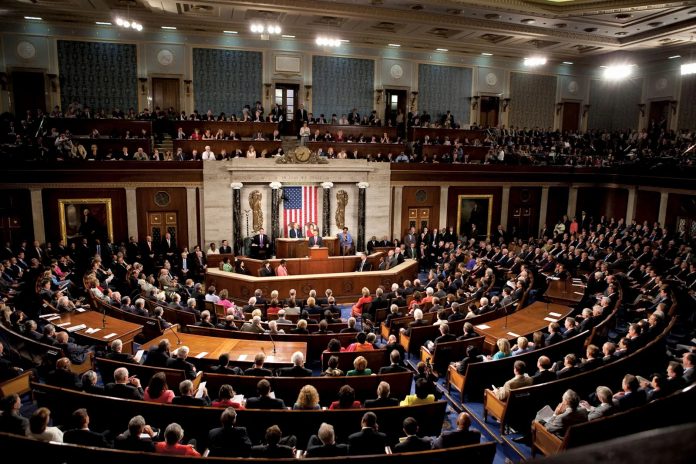
The US House of Representatives passed a major spending package, to end a partial government shutdown that had lasted about four days.

The bill, a roughly $1.2 trillion appropriations measure, passed the House by a narrow bipartisan vote of 217-214. It included: Full-year funding through September 30, 2026 for most federal agencies and departments, such as Defense including a military pay raise, Labor, Health and Human Services, Education, Transportation, and Housing and Urban Development.

A short-term continuing resolution providing funding for the Department of Homeland Security (DHS) only through February 13, 2026 (about two weeks), to allow further negotiations.

This short-term DHS extension was a key compromise, driven by Democratic demands for restrictions or accountability measures on immigration enforcement operations (including ICE actions), amid recent controversies like reported incidents involving federal agents. The package had previously passed the Senate (in a 71-29 vote on January 30, 2026).

After House approval, President Donald Trump signed it into law later on February 3, 2026, in the Oval Office, officially ending the partial shutdown and reopening affected federal operations. Furloughed federal employees are expected to receive back pay for the affected period.

The deal resolves funding for the vast majority of the government but sets up a new potential funding cliff for DHS in mid-February, where further talks over immigration policy “guardrails” such as body camera requirements for agents will be needed to avoid another lapse.

This marks the second partial government shutdown in recent months, highlighting ongoing partisan divides, particularly around immigration and enforcement under the current administration.

The spending package signed into law by President Trump on February 3, 2026, explicitly includes provisions guaranteeing retroactive pay for both furloughed employees (those placed on unpaid leave) and excepted employees (those required to work without immediate pay during the lapse).

This aligns with the 2019 Government Employee Fair Treatment Act (GEFTA), which requires retroactive compensation at the standard rate of pay once funding is restored.

The recent bill reiterated this requirement, directing agencies to provide back pay “as soon as possible” despite earlier administration guidance from the Office of Personnel Management (OPM) and Office of Management and Budget (OMB) that had removed automatic back pay assurances and suggested it depended on specific congressional action in each funding measure.

This covers civilian federal workers in agencies impacted by the lapse e.g., parts of Defense, Labor, HHS, Education, Transportation, HUD, and others funded in the bill. Estimates during similar short lapses suggest hundreds of thousands were furloughed or worked without pay, though the brief duration about four days, including a weekend limited widespread hardship.

Agencies are reopening operations. Back pay is typically processed in the next regular paycheck or shortly thereafter, with payroll systems adjusting for the furlough/excepted periods. Employees should receive full compensation for the shutdown days as if they had worked normally (for furloughed) or for actual hours worked for excepted, including any overtime.

No major deductions or losses — Benefits like health insurance, retirement contributions, and leave accrual continue uninterrupted or are retroactively credited. No reports indicate otherwise for this short partial shutdown.

This outcome resolves uncertainty raised by the Trump administration’s prior positions. By including explicit language in the funding bill, Congress ensured compliance with existing law and avoided any denial of retroactive pay.

For the Department of Homeland Security (DHS) — funded only through February 13, 2026 — employees there remain under a short-term continuing resolution. If no further deal is reached, another lapse could occur, potentially triggering similar back pay provisions in any resolution. But for the resolved portion, federal workers are fully protected and compensated.