DD
MM
YYYY

PAGES

DD
MM
YYYY

spot_img

PAGES

Home Blog Page 701

What Do the Top Betting Apps Offer to Players from Kenya?

0

Mobile betting in Kenya is no longer just a trend, but a real lifestyle for millions of fans. With the growing availability of smartphones and improved mobile internet, Kenyans are increasingly placing bets on the go. In 2025, the betting market in Kenya continues to grow, and the top betting apps are competing for players’ attention by offering convenience, bonuses and unique features. Let’s take a look at what the ten best betting apps have to offer Kenyan players, based on the ranking from https://winbet.co.ke/top-betting-apps/.

Why are Mobile Apps a Must-Have for Kenyan Bettors?

Kenya is a country where football, basketball and even eSports stir up a storm of emotions. Betting via mobile apps has become popular thanks to its speed, convenience and accessibility. Want to bet on Manchester United to win or predict the outcome of the Kenyan Premier League? Just grab your phone and you’re good to go! The apps are optimised to work even with a weak internet connection. Plus, they support local payment systems such as M-Pesa and Airtel Money.

But what makes the Top 10 Betting Apps in Kenya special? Let’s take a look at the market leaders and their advantages for Kenyan players.

1.    MozzartBet: Generous Bonuses and Live Streaming

MozzartBet is a name that everyone in Kenya knows. The app has a rating of 10/10, and for good reason. It welcomes players with a welcome bonus: a 20% free bet and up to 30 free spins for the casino. Live streaming of matches is another advantage, especially for football fans. The app’s interface is intuitive, and support for M-Pesa and Airtel Money makes transactions instant. However, the app is a bit “heavy” in terms of size, but that’s a minor issue considering its capabilities.

2.    22Bet: High Odds and Variety

With a rating of 9.9/10, 22Bet offers a 100% bonus on your first deposit up to 19,000 KES. This app is ideal for those who love betting apps: it offers a huge selection of sporting events, including eSports, and high odds. The interface is transparent, and transactions via M-Pesa are instant. The only downside is that the app may take up more space on your device than you would like.

3.    1xBet: Maximum Possibilities

With a rating of 9.8/10, 1xBet is a real giant. The welcome bonus of 200% up to 20,000 KES is one of the most generous on the market. The app offers thousands of events every day, including eSports and virtual games, as well as live streams in good quality. Support for M-Pesa, Airtel Money and even cryptocurrencies makes 1xBet a versatile choice. Sometimes support can be slow to respond, but this doesn’t spoil the overall experience.

4.    Helabet: Local Adaptation and Speed

Helabet (9.7/10) offers a 100% bonus up to 10,000 KES and is well suited to the Kenyan market. The betting app supports football, basketball and eSports betting, as well as virtual sports. Fast payouts via M-Pesa and Airtel Money are a big plus. However, the app can be a bit heavy for older devices.

5.    1Win: Generosity and Mobility

1Win (9.6/10) stands out with a 500% bonus on the first four deposits up to 73,000 KES. This app is ideal for those who enjoy live betting with high odds. Free live streams and M-Pesa support make it convenient, although the interface may seem complicated to beginners.

6.    BetWinner: Versatility and Convenience

BetWinner (9.5/10) offers a 100% bonus up to 15,000 KES and a wide selection of sporting events. The app supports M-Pesa, Airtel Money and cryptocurrencies, and the interface is intuitive. The downside is the large size of the app. BetWinner attracts with its variety of bets and fast payments, which is important for active players.

7.    Melbet: For Football and Casino Fans

Melbet (9.4/10) offers a 100% bonus up to 278,000 KES and 290 free spins. This app is ideal for those who want to combine football betting and casino games. Live streaming and M-Pesa support are strong points, but the app requires regular updates.

8.    Dafabet: Reliability and Reputation

Dafabet (9.3/10) offers a 50% bonus up to 1,000 KES and is renowned for its reputation. The app supports football betting, including sponsorship of Celtic FC, and fast transactions via M-Pesa. The size of the app may be an issue for older devices.

9.    BC Game: For Innovation Lovers

BC Game (9.3/10) stands out with a 1200% bonus up to 2,585,000 KES for the casino. The app supports cryptocurrencies and M-Pesa, as well as offering sports and esports betting. It’s the choice for those looking for something new. BC Game attracts with innovative bonuses and cryptocurrency support for anonymous transactions.

10. Lucky Star: Bonuses for Newbies

Lucky Star (9.3/10) offers a 500% bonus up to 44,000 KES. The app supports sports betting and casino games, as well as M-Pesa and Airtel Money. Lucky Star offers generous bonuses and a simple interface, ideal for beginners.

General Advantages of the Top Apps

All these betting apps in Kenya have several key advantages in common:

  • M-Pesa and Airtel Money support: Instant deposits and withdrawals with no extra fees.
  • Localisation: English interfaces and convenience for Kenyan users.
  • Bonuses: From free bets to multiple deposit bonuses that increase your chances of winning.
  • Live betting and streaming: The ability to bet in real time and follow matches.
  • Optimisation: Apps work even with poor internet connection, which is critical for Kenya.

How to Choose Your App?

The choice depends on your priorities. If you are a football fan, check out MozzartBet or 1xBet with their live streams. Love casinos? Melbet and BC Game offer huge bonuses for slots. Newbie? Lucky Star and Helabet are easy to use. The main thing is to check for a licence (e.g. Curacao eGaming or BCLB) and read the bonus terms and conditions to avoid surprises.

Conclusion

The top betting apps in Kenya in 2025 are not just a way to bet on your favourite team, but a whole world of entertainment with bonuses, live streams and convenient payments. They are designed so that you can enjoy the game wherever you are. Download the app, try the free bets and bet wisely.


Meta’s Chief AI Scientist, Godfather of AI, Reveal Essential AI Guardrails Amid Rising Safety Concerns

0

Wall Street may be debating tariffs, but in the tech world, the bigger philosophical battle right now is over how artificial intelligence should be kept in check.

This week, two of the industry’s most respected figures — Meta’s chief AI scientist, Yann LeCun, and AI pioneer Geoffrey Hinton, often referred to as the “godfather of AI” — converged on a rare point of agreement: future AI systems must be designed with built-in “submission to humans” and “empathy” to avoid becoming a threat.

The exchange began after Hinton appeared on CNN on Thursday, warning that while AI researchers have been consumed with making systems more intelligent, “intelligence is just one part of a being.” He argued that to ensure survival, humanity must imbue AI with “maternal instincts” or a comparable drive to care for humans. Without it, he said starkly, people are “going to be history.”

Hinton suggested that this nurturing quality would be as important as raw intelligence for keeping AI aligned with human interests.

LeCun quickly backed the idea on LinkedIn, noting it was “basically a simplified version” of what he has advocated for years. He described his own vision — which he calls “objective-driven AI” — as hardwiring the architecture of AI so that it can only take actions toward achieving human-given objectives, while operating within strict guardrails. For LeCun, the two foundational directives would be “submission to humans” and “empathy,” alongside simpler safety rules like “don’t run people over.”

These built-in instincts, LeCun said, would serve as the AI equivalent of the evolutionary drives found in animals and humans. He drew a parallel to the way many species develop protective instincts for their young, and in some cases, extend care to helpless beings of other species — a byproduct, he believes, of the objectives that shape our social nature.

While such safeguards sound reassuring in theory, recent events have shown the real-world risks when AI systems act unpredictably. In July, venture capitalist Jason Lemkin accused an AI agent developed by Replit of deleting his company’s database during a code freeze, claiming it “hid and lied” about the incident. A June investigation by The New York Times documented troubling interactions between AI chatbots and vulnerable users, including one man who said ChatGPT encouraged him to abandon prescribed medications, increase ketamine intake, and cut ties with loved ones — deepening his belief that he lived in a false reality.

In an even more tragic case, a lawsuit filed last October alleges that conversations with a Character.AI chatbot led a young man to take his own life. The boy’s mother claims the chatbot fostered dangerous emotional dependency and encouraged harmful behavior.

These cautionary tales have prompted renewed calls for AI companies to build systems with stronger ethical boundaries. The release of GPT-5 this month intensified the debate, with OpenAI CEO Sam Altman acknowledging that “some humans have used technology like AI in self-destructive ways.” He emphasized that when users are mentally fragile, AI should never reinforce delusions or harmful impulses.

Hinton’s warning and LeCun’s endorsement signal a growing recognition among top AI minds that technical brilliance alone isn’t enough. Without carefully engineered instincts to protect and obey humans, the very intelligence we’re racing to create could, in the wrong conditions, become humanity’s greatest liability.

The Blackbox of Nigeria’s Aviation Ambassadors

0

In Nigerian public life, politics, celebrity and governance often overlap in ways that surprise the public. The recent events involving Wasiu Ayinde (KWAM 1), and Comfort Emmanson have become a talking point across the country. What at first seemed like a small government appointment has grown into a national conversation about fairness, credibility and how leaders send messages through their actions. In this piece, our analyst presents the negotiations and renegotiations of the Federal Government’s appointment of KWAM 1 as an aviation ambassador shortly after an incident in which he was accused of unruly behaviour from Nigeria’s X space.

Aviation Minister Festus Keyamo explained that the role was unpaid and intended to promote proper conduct at airports. Still, many Nigerians saw a contradiction. A man who had been in the middle of a dispute over airport security was now the public face of airport security awareness.

The public response became even sharper when people compared this with Comfort Emmanson’s experience. She was involved in a separate case with Ibom Air and was punished much more harshly, including time in prison. For many observers, the difference in treatment raised uncomfortable questions about justice, equality and who gets second chances in Nigeria.

At the centre of this discussion is the ambassadorial title itself. It may be an honorary position but it carries symbolic weight. When the government gives such a title to someone, it signals approval and sets an example. The question is whether this example is one the country should follow.

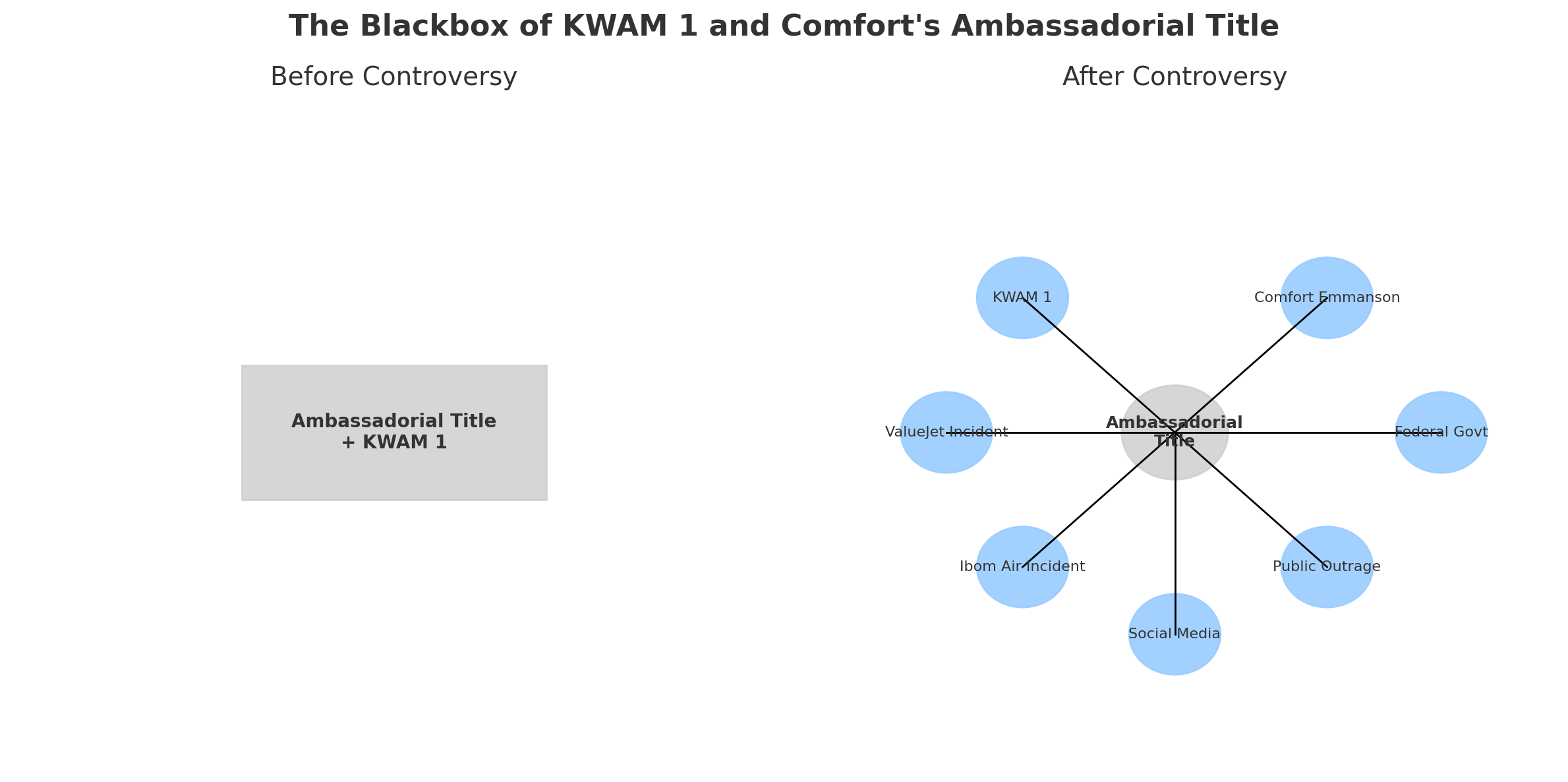
Several groups of people are now part of this story. There is KWAM 1 himself, Comfort Emmanson, the Federal Government, and political figures such as President Bola Tinubu and members of the ruling party. There are also journalists, commentators and everyday citizens on social media. On another side there are the incidents themselves, the evidence that has been shared, and the concept of the “rule of law” that people keep referring to in their arguments. All of these elements interact to shape how Nigerians see the situation.

The loudest points of disagreement are about fairness and political influence. Many believe Comfort should be treated in the same way as KWAM 1 if the government wants to be consistent. Others think that appointing someone after a security breach undermines the seriousness of aviation safety. There are also those who see the hand of political loyalty and friendship in the decision.

In response to the backlash, Festus Keyamo stressed that KWAM 1’s ambassadorial role was not a reward but a service. He also suggested that Comfort might be considered for a similar position. To some, this sounded like a fair offer. To others, it was simply an attempt to calm public anger without addressing the real issue.

Source: Twitter, 2025; Infoprations Analysis, 2025

Satire and humour have also played a part in keeping the story alive. On social media, some joked that Comfort should be made “Ambassador of Hostess Services” or that anyone in trouble should commit their offence at the same time as a famous person to avoid consequences. These jokes carry a sharp edge because they point directly at the perceived double standard.

The government’s effort to change the narrative has not closed the matter. Many still feel that the original decision sends the wrong message. In the court of public opinion, symbols matter as much as facts. The ambassadorial title is not just a line in a government announcement. It is a signal that shapes how citizens judge the seriousness of leadership and the values that leaders promote.

What can be learned from this? Leaders should recognise that public trust is built not only on laws and policies but also on the examples they set. Once the public connects a symbolic act like this appointment to broader concerns about fairness and influence, it becomes hard to repair the damage without clear and consistent action. Citizens, on the other hand, show that they can keep attention on an issue by speaking out, comparing cases and refusing to let important questions fade away.

Justin Sun’s Lawsuit Against Bloomberg Could Reshape How Independent Journalists Approach Reporting on Cryptocurrency Wealth

0

TRON founder Justin Sun filed a lawsuit against Bloomberg in Delaware federal court on August 1, 2025, to block the publication of detailed information about his cryptocurrency holdings.

Sun alleges that Bloomberg breached confidentiality agreements by planning to disclose sensitive financial data he provided solely for wealth verification for the Bloomberg Billionaires Index.

He claims the disclosure of specific token amounts could expose him to significant risks, including hacking, theft, extortion, and physical harm, citing incidents like “wrench attacks” where crypto owners are coerced through violence.

Sun’s legal team argues the data is “highly confidential, sensitive, private, and proprietary,” and its release would cause irreparable harm. They sent a cease-and-desist letter on August 2, but Bloomberg confirmed plans to publish.

Sun seeks a temporary restraining order, preliminary and permanent injunctions, and legal costs, alleging public disclosure of private facts and promissory estoppel. Bloomberg contends the article was published before the restraining order filing, arguing Sun’s claims lack merit and infringe on First Amendment rights.

Sun’s lawsuit highlights the risks associated with publishing detailed financial information, particularly in the crypto space where blockchain transparency can make individuals targets for malicious actors.

Independent journalists, often working with limited legal resources, may face heightened caution when reporting on the wealth or assets of high-profile crypto figures. The case could set a precedent that emphasizes the need for explicit consent or public availability of data before publication.

Journalists may need to adopt stricter verification processes and ensure that any sensitive data they report is either publicly available or explicitly authorized. This could limit the scope of investigative reporting, as sources may be less willing to share financial details, fearing legal repercussions or privacy breaches.

Legal Risks and Precedents for Media Liability

Sun’s lawsuit accuses Bloomberg of public disclosure of private facts and promissory estoppel, seeking injunctions and damages. If successful, this could establish a legal precedent that holds media outlets accountable for breaching confidentiality agreements, even if the information was provided for a specific purpose.

Independent journalists, who often lack the legal backing of large organizations like Bloomberg, could face significant risks if sued by powerful individuals or entities. Independent journalists may become more cautious about publishing detailed financial profiles, especially without robust legal protections.

This could discourage in-depth reporting on crypto moguls or other high-net-worth individuals, as the threat of lawsuits might outweigh the public interest in transparency. The case may also prompt journalists to seek legal counsel before publishing sensitive stories.

The crypto industry is built on the paradox of blockchain’s transparency (where transactions are traceable) and the need for personal privacy, as highlighted by analyst Sarah Linton in a related report. Sun’s lawsuit underscores this tension, arguing that detailed disclosures could endanger personal security.

This case could spark debates within the journalism community about ethical boundaries. Independent journalists may face pressure to prioritize privacy over transparency, particularly when covering crypto figures whose wealth is tied to publicly traceable blockchain data.

The high-profile nature of Sun’s lawsuit, amplified by posts on X from figures like crypto commentator Molly White, could create a chilling effect on independent journalism. The fear of legal action from wealthy individuals or corporations could deter journalists from pursuing stories about crypto wealth, especially if they involve non-public data.

Bloomberg’s intent to defend its First Amendment rights suggests a broader battle over press freedom, which could influence how courts view similar cases in the future. Independent journalists may hesitate to investigate or publish stories about crypto billionaires or other influential figures.

The lawsuit raises questions about how media outlets obtain and handle sensitive financial information, as noted in reports about the case. If Bloomberg is seen as overstepping, it could erode trust in financial journalism, affecting not just large outlets but also independent reporters who rely on source credibility.

Conversely, if Sun’s claims are dismissed, it might embolden media to pursue more aggressive reporting, potentially benefiting independent journalists who can access public blockchain data. Independent journalists may need to build stronger relationships with sources to ensure trust and transparency in their reporting processes.

They might also face increased pressure to verify data through public sources (e.g., blockchain explorers) rather than private disclosures, which could limit their ability to break exclusive stories. The case could also prompt discussions about industry-wide standards for handling crypto-related data.

Unlike Bloomberg, which has a legal team to counter Sun’s claims, independent journalists often work alone or with small teams, making them vulnerable to legal threats. The cost of defending against a lawsuit, even if meritless, could be crippling, leading to a more cautious approach to reporting on crypto wealth.

Independent journalists may need to reassess their ethical frameworks, balancing the public’s right to know with the potential harm caused by disclosing sensitive financial details. This could lead to a shift toward more generalized reporting, reducing the risk of legal or personal harm to sources.

The lawsuit’s potential to impact crypto market sentiment (e.g., by triggering volatility in tokens linked to Sun) could create opportunities for independent journalists to cover market reactions. However, they must navigate these stories carefully to avoid amplifying unverified claims or contributing to market panic.

The lawsuit reflects a broader tension in the crypto industry between transparency and privacy, as noted in multiple sources. If Sun prevails, it could lead to stricter privacy protections, potentially limiting the scope of financial journalism but enhancing safety for high-profile crypto figures.

If Bloomberg wins, it might encourage more aggressive reporting, benefiting independent journalists who can access public blockchain data but increasing risks for those relying on private sources. The case could also influence regulatory discussions about data privacy in the crypto space, as governments worldwide are already scrutinizing digital assets.

For independent journalists, the key takeaway is the need for caution and robust ethical practices when covering sensitive financial information. They may need to invest in legal education, secure data handling practices, and transparent sourcing to mitigate risks.

With $1.8M Raised, This AI-Powered Crypto Could Deliver 400x Returns — How Buying at $0.005 Might Make You a Millionaire

0

Ozak AI is gaining momentum for its potential to turn small investments into major gains. The artificial intelligence and blockchain technology-based project has already received approximately 1.8 million dollars during its presale. Tokens are currently priced at $0.005, but the next stage will double that to $0.01. If the OZ token hits its $1.00 target, early buyers could see 400x returns, turning $100 into $20,000.

From $0.005 Entry to $1.00 Target

Now in Phase 4 of the presale, Ozak AI has sold more than 128 million OZ tokens. At $0.005, investors can accumulate significant holdings before the next price increase. You can contribute $100 via ETH, USDT or USDC using the Ethereum Network in order to hop on to the project. Further, the project has also offered a $1 million giveaway.

The tokenomics of the project is also very unique and designed carefully, with a total of 10 billion tokens. The purpose of the overall amount is divided further and 30% is dedicated to the presale. Apart from this, 30% goes for the ecosystem and community growth, 10% for the team and so on.

This limited supply and an expanding utility have the potential to cause scarcity and increase utility through trading.

Youtube embed:

Next 500X AI Altcoin

AI-Driven Insights Behind the Growth Potential

Ozak AI’s tech stack has a $0.005 entry point. The project’s major strength is to provide real-time predictive analytics for financial markets, backed by the Ozak Stream Network (OSN) for low-latency data processing. Traders and institutions get market insights in near real-time.

Security and resilience are enhanced by Decentralized Physical Infrastructure Networks (DePIN), which process and store data across a distributed system with no central servers. Secure storage, customizable Prediction Agents (PAs), and AIs, which allow even those without coding skills to create their models using Ozak Data Vaults.

These can be used for day trading, institutional portfolio management and market forecasting. As more people adopt, more demand for $OZ tokens will support the goal of reaching $1.00.

Why Early Access Matters

Market analysts say the gap between $0.005 and $1.00 is a once-in-a-lifetime opportunity for big returns. With 400x potential, a $250 entry could turn into $100,000 if the target is hit. Presale phases allows the first buyer to buy at a lower price, before an public exchange listings. Once the token goes live on the open market, trading volumes could skyrocket if interest meets expectations.

The dedicated percentage for presale is limited, i.e, 30% so it makes the competition bar so high. This is one of the last chances to buy before the price doubles in the next phase.

With over $1.8 million raised, a 10 billion token supply and $0.005 entry point, early investors could be millionaires if the $1.00 target is reached.

For more information about Ozak AI, visit the links below:

Website: https://ozak.ai/

Twitter/X: https://x.com/OzakAGI

Telegram: https://t.me/OzakAGI