DD
MM
YYYY

PAGES

DD
MM
YYYY

spot_img

PAGES

Home Blog Page 7011

2018 Was Breakout Year For African Startups On Funding (See Plot)

0

This is an update to an earlier post on startup funding in Africa. This particular note puts the numbers in context across years. Ecommerce is fading while fintech is the bull.

According to numbers compiled in WeeTracker’s Venture Investments Report 2018, US$726 million was invested across 458 deals in African startups. That is a 300% gigantic leap in the total funding amount and over 127% increase in the number of deals as compared to 2017.


LinkedIn Comment on Feed

Interesting insights, but it would be great to have more investment in healthtech, agritech, edtech and cleantech; the problems of ecommerce are well known, more about physical infrastructures than technology.

It is when other sectors grow that fintech would offer greater value and relevance; you cannot be building banks if you haven’t figured out where the money to put there could come from. Fintech has high growth rate, no doubt, and less capital intensive, but we need to build others for fintechs to truly shine.

Building Meaningful and Impactful Connections

1

Do not underestimate your capacity to effect change in people’s lives and companies. As you plot to build connections especially with those “way higher up” in the business/economic ladder, focus your strategy on how you can help them expand their missions. Yes, it is likely that the richest man in your city will reply to a document where you have articulated how one of his businesses will thrive than one where you are seeking help.

There is a reason for that: the “seeking help” communications rarely reach him; the aides purge them. But the bold vision document typically reaches the big man because even the aides are there to see the company grow.

Find your own mentor – he does not need to be your university professor unless the professor knows and understands business. It is always good to use active practicing professionals who are facing the challenges you are encountering at higher levels.

If you run a business, it does not make sense to pick a big corporation uncle (unless he founded a firm) as a mentor – he is guaranteed income at month end and may have never felt the stress of paying workers, and growing margins. There is urgency that comes when you meet people running their shops, a civil servant would not give you that.

2019 is still very young, and most times, your visions will be executed through networks and people you partner or work with. Take time to think five key people you want to connect in a meaningful way to help in your mission. And then find at least one major way you can help those people in whatever they are doing. Look for the opening to present to them, focusing on the strategic/intellectual part of you.

Do not speak as someone looking for help: make the people to understand you as someone with intellectual and business sagacity that can improve whatever sub-frictions you are focusing on. If you do well, you would be offered the opportunities to do as you said. Interestingly, that is how you would help yourself.

LinkedIn Comment on Feed

Just like what is obtainable in business model innovation: value creation, value delivery and value capturing. Same is applicable in human relationships, if you really want to be taken seriously.

You must be able to create value (for the rich guy), deliver the same value to him/her, and then capture value, the latter now becomes the help you are looking for or even getting the deserved attention. Seeking to get it any other way may be fraudulent, the rich guy is not your father or mother.

Again, most serious people are not moved when you display that pitiable disposition, playing the victim, as if anyone owes you anything, getting help is never an entitlement. You do not need to make people feel guilty for not helping you, when you haven’t really done anything to deserve help anyway.

Always think of what you can give, and in return you are likely to get what you want.

Fintech Nigeria – 2018 Summary, 2019 Forward Look

0

There is a new publication on Fintech Nigeria, covering policy, technology, innovation, investment and more. It began by summarizing key 2018 activities in the broad fintech sector in Nigeria, and then went ahead to offer a look in 2019.  It was authored by Damilola Salawu, a Partner (Technology, Innovation and Fintech) in Olaniwun Ajayi LP.

Over the course of 2018, the Fintech ecosystem has grown in many respects, particularly in terms of investments, policy developments/regulations, product offerings and new market opportunities. The issue of the oversight functions and the regulatory activities of the Central Bank of Nigeria (CBN) seems to be at the front-burner within the space in the year under review, and we speak to some of the relevant regulations that would significantly impact the way Fintech companies, particularly, payment system operators, operate in 2019 and beyond.

This Report is in two (2) parts; Part A which is a wrap-up of 2018 looks at some of the trends we had highlighted in last year’s report (the Forward Look 2018) and how they played out as well as other high points of 2018. Part B looks forward to 2019 highlighting some of our expectations for the year and what we think the key indicators for the ecosystem would be.

Download the publication here.


The African Universities Thesis Project

0

A Nigerian newspaper, and a Harvard Business Review partner in Nigeria, republished one of my Harvard Business Review articles – The Leadership Lessons of Ants.  My community manager has received emails from people asking for partnerships on a project I had mentioned in the piece.

Let me address it here: that 2010 projectNetworked Digital Library of African Theses and Dissertations – did not work out. We encountered a huge challenge: most universities did not cooperate across Africa.

In short, for many we contacted, largely South African universities were open to work with us. Schools in most other countries were afraid of publishing the dissertations online. Some explained a major concern we could not address – the possibility of a high flying alumnus who might have “innocently” plagiarized his/her thesis being scandalized because of an old document. With that kind of feedback, my U.S. 501(c)(3) non-profit, African Institution of Technology, abandoned the project. I had funded the project via income, transferred from royalty on a book, which I wrote as I was concluding my Johns Hopkins University doctoral program.

The website codes, certainly not a mobile-ready site, should be somewhere for any person who may like to continue it. Yet, my suggestion would be to ensure you have buy-ins from schools before you start coding. Imagine the possibility of a current president being accused of plagiarism. Yes, he can close the university, and fire the management for the embarrassment. Africa cannot afford that! Lol.

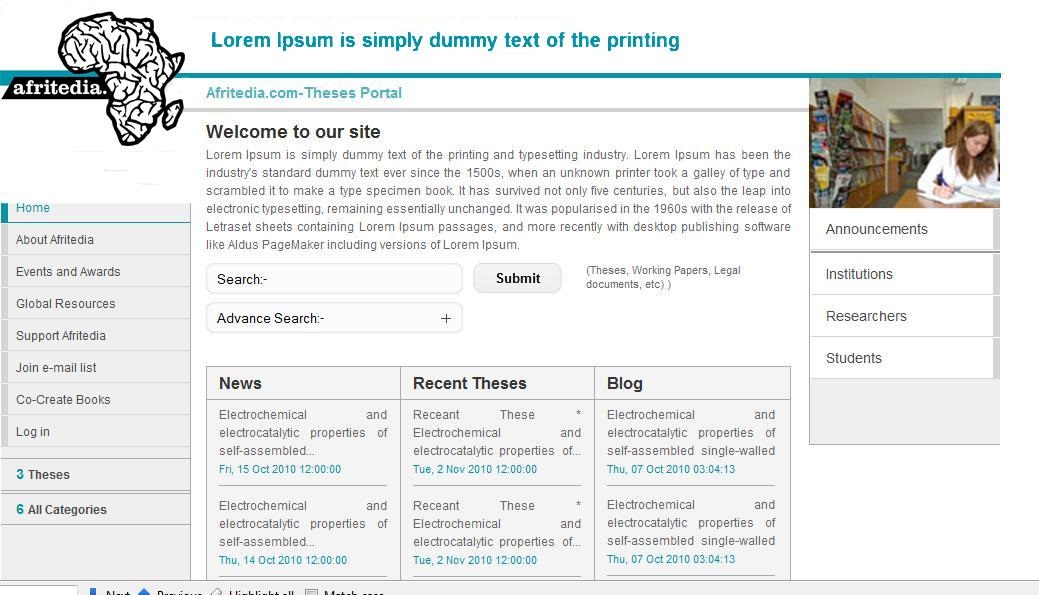
After the design, before editing of the site (retrieved from my email)