DD
MM
YYYY

PAGES

DD
MM
YYYY

spot_img

PAGES

Home Blog Page 7033

African Startups Raised $1.19 billion in 2018, for Disclosed Deals

0

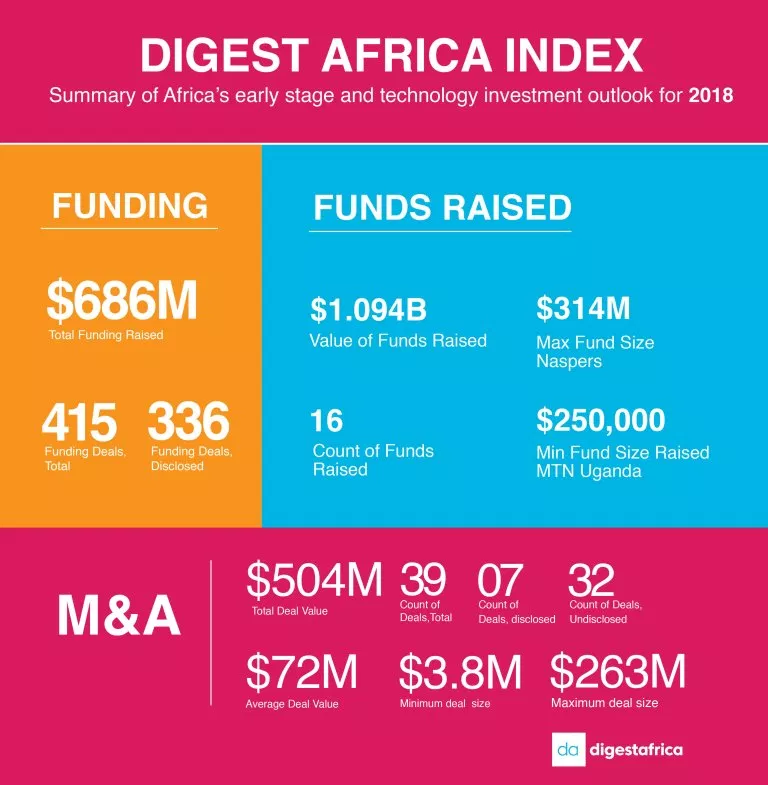
Africa’s early stage and technology companies for the year 2018 raised a total of  $1.19 billion in total deal value even though 103 deals  – representing 22.7% of the total 454 deals recorded – never disclosed their amount, reports Digest Africa Index. Fintech won the race and Naspers was dominant as a funder. Also, Digiest Africa team picked some deals missed by WeeTracker which had reported $726 million as total raise.

Last year recorded a whopping $1.19 billion in total deal value even though 103 deals – representing 22.7% of the total 454 deals recorded – never disclosed their amount. However, we also believe that the figure could have been higher than $1.19 billion had the values of certain deals been disclosed. Jumia and M-Kopa are among the companies that never disclosed their deal amounts.

Technology companies across Africa raised a total of $686.4 million in funding across 336 disclosed funding deals of the 415 recorded. The East African region, with $303.9 million which translated into 44.2% of the total funding raised, registered the highest amount. Amongst countries, Kenya, with 22.8% ($156.5M) of the total funding raised, recorded the highest while the financial services sector recorded the highest amount of funding raised on the continent with 92 deals representing $276.7 million.

The financial services sector contributed 40.3% to the total funding raised across the continent in 2018. There were 39 M&A deals recorded in Africa’s technology space though only seven (7) of these were disclosed. South Africa registered the highest number of deals with twenty-four (24) and six (6) of the deals whose amounts were disclosed also came from the country. Compuscan, which Experian acquired for $263 million, and WeBuyCars that was acquired by Naspers for $94 million – through OLX Group – recorded the highest M&A deal values.

Lastly, a total of sixteen (16) technology-focused funds were raised adding up to $1.094 billion in value. 69.8% of the funds raised were early stage focused and 47.7% of them were sector agnostic. Naspers’ $314 million South Africa-focused fund was the largest fundraising/commitment recorded in 2018. European Investment Bank (EIB) was the most active investor on the continent participating in investments into five (5) funds: Partech Africa Fund managed by Partech Ventures ($70M), Novastar II managed by Novastar Ventures ($72.5M), Tide Africa Fund managed by TLcom Capital ($40M), Sawari Ventures North Africa Fund I managed by Sawari Ventures ($35M) and Africa Tech Ventures ($10M).

Why Binary Options Trading Is So Popular in Nigeria

0

Nigeria has been one of the major economies in Africa, diverse with everything from financial, communications, stock exchange, legal, transport and natural resources in abundance. However, like many of its neighbours, Nigeria has been experiencing an increased inflation rate from November 2018, directly affecting the cost of food. As the valuer of Nigeria’s currency dips, it seems as if Nigeria’s citizens are starting to resort to trading alternatives such as binary options trading to make more of a profit.

Nigeria’s Economic Woes

As the country tackles an ongoing economic crisis, Nigeria’s policy makers are looking to take a tight monetary stance. Much of the crisis can be attributed partly to the spending for the upcoming election in the country, scheduled to be held sometime in February 2019. This coupled with the national budget disbursements has given rise to inflation in the country, which in turn has affected prices of bread, cereals, milk, cheese, yam and other food items.

Flag of Nigeria

Binary Options Trading in Nigeria 

A huge chunk of Nigeria’s citizens is employed in the oil and agricultural sector, which are the two major sectors of the country’s economy and earners of foreign exchange. However, due to the ongoing economic turmoil, many citizens have started exploring options to earn some passive income. Binary Options Trading has thus gained popularity in Nigeria over the last couple of years, alongside forex and cryptocurrency trading.

How to Choose A Binary Options Broker in Nigeria?

Binary Options, which has become a lucrative form of trading on a global level, has seen a surge of popularity in the trading sector of the company. However, Nigeria does not have any locally based binary options brokers and thus must rely on brokers based off-shore. Reliability is a huge factor for Nigeria’s citizens when trading with off-shore brokers. There are certain factors that may be used to make a better judgement in this case.

  1. Regulation: Always choose a broker which is regulated by a major regulatory body. Examples include the FCA and CySEC.
  2. Instruments Offered:  Take a look at the types of instruments offered.  Most Online brokers offer options such as call/put, along with boundary and touch/no touch options.
  3. Currency Pairs and Spreads: This depends on the type of binary options trading you want to conduct. For example, European style binary options brokers, do not generally assign spreads to currency assets.

Considering IQ Option:

Since no binary options broker is based in Nigeria, citizens look to offshore alternatives and one reputed name that comes up is IQ Option.  Based in Cyprus, it is owned by IQ Option Europe Ltd and is licensed under Cysec.

IQ Option has a lot of advantages such as:

  • Easy User Interface
  • Up to 91% Pay-outs for correct predictions
  • Demo Account Available

IQ Option offers trading in binary options, along with digital options, foreign exchange, CFDs and even cryptocurrencies, offering Nigerians a comprehensive platform for trading online.

IQ Option has also recently introduced AstroPay as a new payment gateway, extended to certain countries including Nigeria.  The AstroPay card is a virtual prepaid card, used to make deposits and withdrawals online. It is known for its instantaneity, confidentiality and security on a global level.

For more informations about IQ Option please visit https://www.iqoptionmag.com


South Africans Turning to Crypto as Hedge Against Volatility of the Rand

0

In the last decade, several nations around the world have experienced widespread economic crisis including experiencing inflation. Greece, Venezuela, Zimbabwe, Nigeria, etc. have all been victims of economic mismanagement. Often citizens of such countries resorted to unorthodox or newer methods of trading in order to hedge against their falling national currencies.  In the recent days, South Africa has joined the list (as per a recent survey). Kantar TNS, on behalf of Luno had conducted a survey asking the major reason for investing in cryptocurrencies.

The Survey

Luno, a London based cryptocurrency platform has recently conducted a survey (November 2018), which has found that South African citizens in significant numbers have been holding cryptocurrencies like Bitcoin, Litecoin etc., instead of the national currency the Rand. Most of them have reportedly been using them as a hedge against the ongoing inflation in the country.

The survey, which was conducted in 10 countries had a sample size of 1000 people in each nation.  Out of the 1000 South Africans that took part in the survey, almost 69% of them are familiar with some cryptocurrency. Detailed breakdowns show that one third of them already own digital assets, while 53% are open to purchase them. The majority stated holding cryptocurrencies was a measure to hedge against the declining Rand.

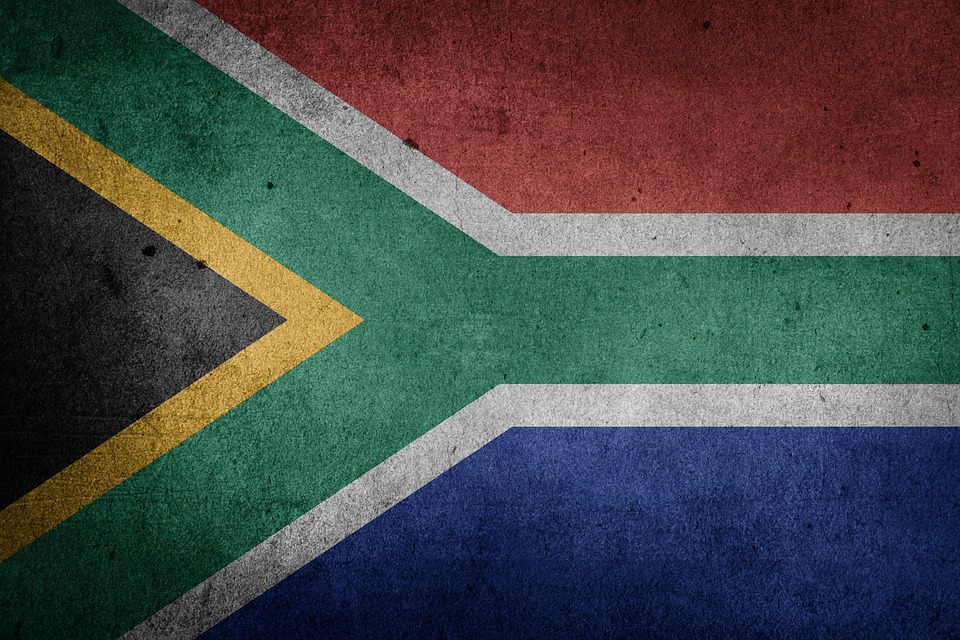
South African flag

Current South African Economic Scenario

Much of the economic crisis unfolding in South Africa can be attributed to the declining value of the Rand, which has experienced a 20 % decline against the Dollar in 2018. The reasons include political instability in the finance ministry of the country, financial mismanagement, and a loss of investor confidence.

As a result, a significant percentage of investors have started trading alternative instruments and have looked towards other investment options such as binary options, CFDs, Forex trading and cryptocurrencies. The survey has even found that an overwhelming majority of the participants welcome digital currencies as a viable payment option for online stores and even brick and mortar businesses.

Cryptocurrency Trading in South Africa

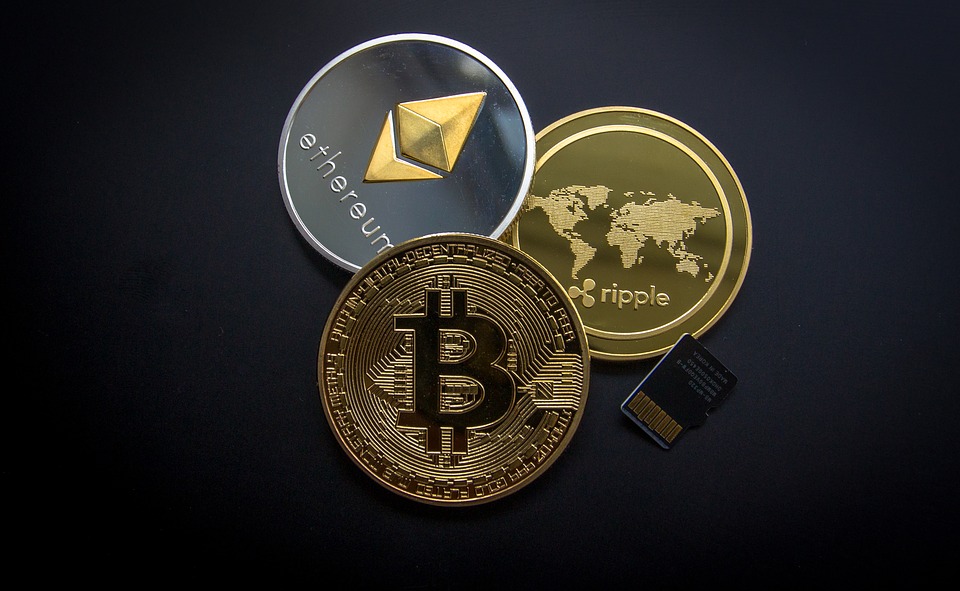
 Ever since the popularity of cryptocurrencies as an investment option became known to South Africans, an overwhelming number of citizens have flocked towards investing in forex, trading binary options and of course, cryptocurrencies. Even popular binary options platforms such as IQ Option have started offering Cryptocurrency trading in the form of CFDs.

Choosing a reliable Forex/Cryptocurrency Broker Online

Both the Forex and cryptocurrency market require a certain amount of skill and knowledge to be successful. Due to their rising popularity, there have been an abundance of trading platforms offering users the same trading options. However, as an online trader, he/she must be careful while working with an online broker. There are certain factors which you can use to choose the right forex/ cryptocurrency broker when trading in South Africa, they include:

  • Recognized by a National or International level Financial regulatory body
  • Number of Leverage Options Offered
  • Safety and Security Measures
  • Demo Accounts Offered
  • Level of Customer Service

South African Traders will find a good overview at http://www.tradeforexinsa.co.za/

Conclusion:

As more and more countries are facing economic turmoil, citizens are turning towards cryptocurrencies as a viable solution. Many online trading platforms have started offering their own cryptocurrency trading options. This trend will continue so long as the South African Rand keeps declining and does not stabilize.

A Law Of Power – “Never Outshine The Master”

0

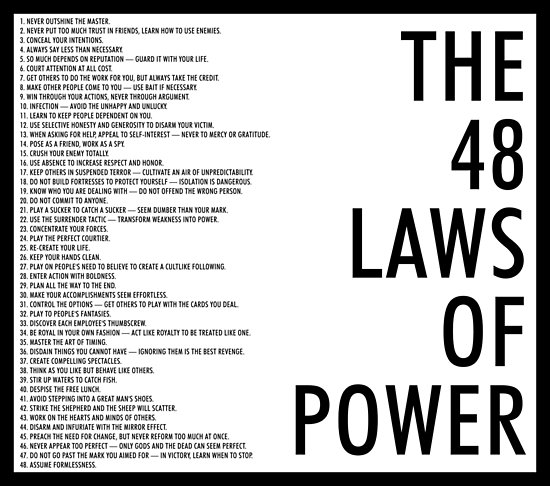
Robert Greene’s classic – The 48 Laws of Power – is a book I have come to rely as I serve important people in the world. My most important phrase, in that book, remains “never outshine the master”.

That understanding is very important especially when some of my Igbo brethren ask me to make a presentation on their behalf before their foreign clients. I did one in OTC few years ago. When moments like that come, my job was to make the master flow through me, and not me, even though I work to show brilliance and capabilities.

The man who might not have finished secondary school but has tons of money to hire anyone he wants MUST be the master in that boardroom. He must assume the command. He must be presented as the leader, even when he is not talking.

“Never outshine the master” does not mean that you cannot shine. The real deal is making sure you understand that you are a messenger. It takes wisdom to watch two elders in the village debate on things which you certainly know better than them, and yet hold your peace, until they invite you.

How do you disappear as you stand for that master so that you keep appearing? You must learn how not to outshine the master. That does not mean that you cannot pursue excellence. Without that the master will not even allow you near him! Yes, you must deliver so that at the end, he will say “I am good in building great teams”, and his partners will congratulate him for that.

Simply, you must manage the delivery and perception as you serve that master. In politics, business and most things, it is an important wisdom to have if you want to keep moving up!

LinkedIn Comment On Feed

The perfect example can be found in the Holy Book, John played the perfect game, without taking the shine off the Divine Master, even when he had the chance to play that ridiculous ‘smart game’ most humans usually get entangled in, whenever an inch is given to them.

I remember one presidential media chat that took place before the 2015 general elections in Nigeria, where the anchor did virtually everything possible to outshine the president she’s interviewing, it was beyond ridiculous anyway. But we see similar things in many places, even those sent to give material or financial support to some people, end up posturing as if they are the real benefactors; a good example of what it means to overplay one’s usefulness and relevance.

Earlier this morning, I was reflecting on the distinctions between humility and timidity, and why one must not be mistaken for the other. Humility will allow you to maintain a cool head, even when advising or representing those you think you are better off, you aren’t called for a popularity contest, so do not make any attempt to outshine the person who ordinarily should be the centre of attention. To do so may as well qualify as stealing by tricks, and that makes you a thief.

Samsung’s Mobile Future Is On Galaxy M, Not Galaxy S10

0
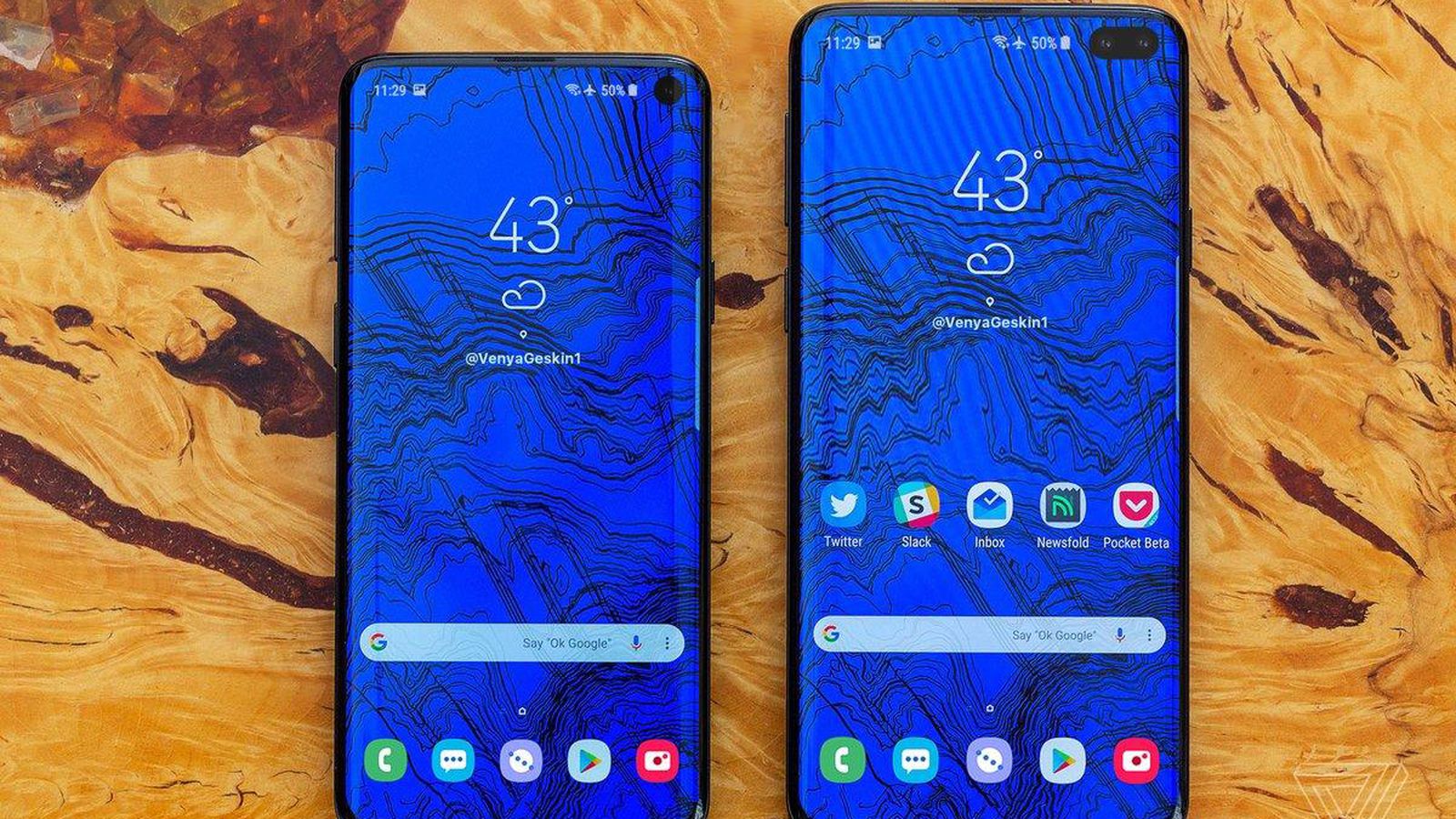
Samsung Galaxy 10 rumors (Source: CNET)

On February 20, Samsung will launch the latest version of its flagship smartphone, the Galaxy S10, to the world. You can count that the price will move north in the spirit of making more money per unit sold. Yet, despite the hype around Galaxy S10, the future of Samsung mobile device business will be anchored on another phone which is not getting a lot of press attention because it is not a fashionista. The new lower-priced Galaxy M is the device that will position Samsung to compete as the service era begins to take effect for mobile device makers.

Samsung will launch its new lower-priced Galaxy M series in India before the smartphones roll out globally. Asim Warsi, senior vice president of Samsung India’s smartphone business, told Reuters that three devices will be available through its website and Amazon India at the end of January and are intended to help the company double online sales.

Samsung is currently trying to recover its lead in India, the world’s second-largest smartphone market behind China, after losing it to Xiaomi at the end of 2017, when Xiaomi’s sales in India overtook Samsung for the first time, according to data from both Canalys and Counterpoint.

Largely, in a world which is largely on transition into the post-smartphone era, except some regions like Africa, devices have become better on quality despite their prices. When that happens, customers are no more necessarily moved by brand logos because any device can get the job done. The implication is that devices become commoditized.

Think about it: two decades ago, people bought laptops focusing on the brands. But over time, laptops have become very reliable across the board that undue attachments to the specific brand have faded. In other words, laptops have become commoditized as buyers simply look for value over paying for brand logos. You want a decent laptop, not specifically a Dell or HP laptop!

This design of minimizing the impact of brand is coming to smartphone. Galaxy M offers Samsung that opportunity to ride that global competitive smartphone market over the fashionista Galaxy S10. In a post-smartphone era, device makers would move into services. Interestingly, succeeding on services demands volume. So, what Samsung needs is to have many people in its ecosystem to win on Bixby and not extra dollars on hardware via Galaxy S10. Samsung Pay will appreciate that strategic redesign as it needs more users to have competitive relevance in a world where everyone is doing an element of fintech.