DD
MM
YYYY

PAGES

DD
MM
YYYY

spot_img

PAGES

Home Blog Page 7098

Digital Logistics Pioneer, Kobo360, Emulates “Ant Model” to Fix Lagos Port Traffic Congestion

0
Traffic Kobo360

Fixing Nigeria’s challenges will not involve bringing people from the moon [they do not exist]. All we need to do is do simple things: by having a simple order, Kobo360, a pioneering logistics company I wrote many months ago, plans to reduce 40% of the traffic wahala in Apapa. Kobo360 is not inventing anything – it is simply using what exists to fix market frictions. That is what innovation is about.

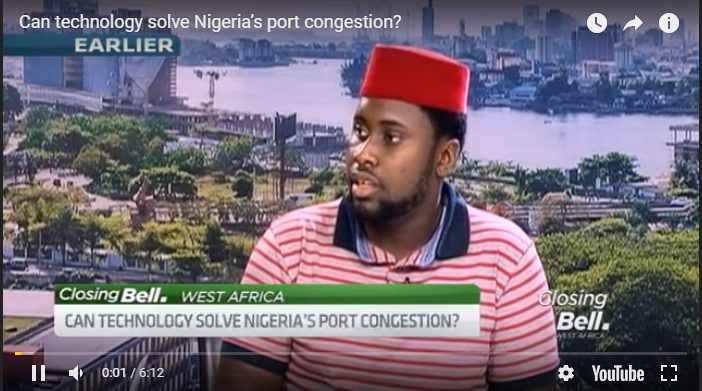
In a quest to put to an end the lingering port congestion in Lagos State, Obi Ozor, Chief Executive Officer of Kobo360.COM says technology can solve 40 per cent of the problem. He discussed this with CNBC Africa’s Kenneth

Watch the video for the plan. I think we can do this in many other sectors and force people to approach things orderly.


The Science Behind

What Obi and Team Kobo360 are doing is actually rooted in biology. If you go back to ants, it has been proven that only 30% of the ants do more than 70% of the work in a colony. Simply, instead of 100% of the ants working, causing traffic jams, having only 30% ensures the ants are more efficient in whatever they want to accomplish.

Ants are renowned for their industriousness. Ask the grasshopper in the story by Aesop. He had to come begging the hard-working ant for food when winter came because he had frittered away his summer.

But that is fable, the ultimate in what scientists call anecdotal evidence. And new research at Georgia Tech suggests that although ant colonies are very efficient, that may be because 70 percent of them are doing very little — at least when it comes to tunnel digging.

Daniel I. Goldman, a physicist at the Georgia Institute of Technology, and his colleagues, found that the secret to efficient tunnel digging by fire ants was that 30 percent of the ants did 70 percent of the work. They reported their fable-shaking finding in the journal Science.

The reason, it seems, is that the ants were working in narrow tunnels where traffic jams could easily clog up the entire effort to build nests. So it helped if some of them took a pileup in the tunnel as a signal to suggest that they take a break.

So, why have 100% of the trucks wasting 4 hours to get into the port when if you permit only 60% at a time, they could all do their things within one hour of arrival. The team would need to collect more data, and as they do that, they could actually reduce traffic congestion by up to 70% over time.

https://nyti.ms/2nJh3c5

All Together

This is certainly something that evolving AI model with constantly improving data will make better over time. It looks very exciting for the digital logistics pioneer. You do not go wrong when your model is based on biology – no wonder the wise man wrote “go back to the ants and learn”.
Ndubuisi Ekekwe to Keynote Abuja Blockchain & AI Round-Table

0
Abuja blockchain

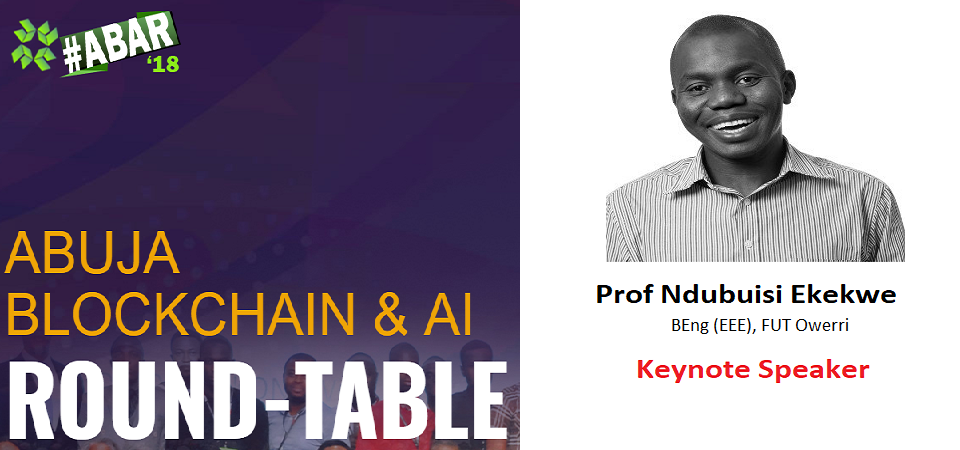
I have accepted to keynote Abuja Blockchain & AI Round-Table in Abuja, Nigeria. The goal at Abuja Blockchain & AI Round-Table is go beyond the current hypes about cryptos, and provide a common framework for thinking about what the convergence of Blockchain and AI means to Nigeria’s economic prosperity agenda.

The event aims to bridge the knowledge gap by providing government functionaries, decision makers, professionals and practitioners with the resources they need to make key business-shaping decisions in a rapidly changing world.

I, on behalf of Blockchain Nigeria User Group sincerely request your presence, as Keynote at our upcoming  Abuja Blockchain & Ai Round-Table, a conference scheduled to hold from the 19-20th of October, 2018 at the Ladi Kwali Hall, of Sheraton Hotels, Abuja, Nigeria. This conference, the first of its kind, will feature a melding of the AI and Blockchain communities in Nigeria and across the world, exploring the possibilities and opportunities available at the intersection of these two technologies, with featured talks and panels encompassing some of the world’s top experts moving these technologies forward. The Conference will bring together business leaders, government and regulatory agencies, data practitioners, AI and Blockchain tech pioneers who are applying artificial intelligence to solve today’s problems and creating tomorrow’s opportunities, while leveraging available tools, to create entirely new values.

I am a fan of blockchain (working on the EU’s healthcare initiative). Simply, blockchain has value in our economy but we need to have the necessary frameworks and systems in place. I am honored to deliver this keynote towards architecting a future in this space in Nigeria. A trillion dollar Nigerian economy is a possibility as I have explained in this video below.

Consider This As You Go Into Agribusiness in Nigeria

3
agribusiness Nigeria

If you are into agriculture or broad agribusiness in Nigeria, be very careful as you go and raise money. The sector is very slow and decision making, by customers, takes time. As you work with cooperatives and governments (plus farmers), they think on months and not days. So, watch and shine your eyes what you promise any investor. It is not likely you can scale like hot cake because those you are working with are not in the business of scaling; they are cultural farmers and will be doing farming whether it makes them poor or rich. The transition into business-people, from being just farmers, is just starting.

Algorithms in the server analyze the data and tell farmers on what, how and when to farm. Also, as the crops grow, the system deploys special cameras to build vegetative health of the farm for drought stress, pest and diseases etc. The cameras can be mounted on long sticks or drones. The goal is to transform farming into a business by making it data-driven over guesswork.  This improves productivity, reduces waste and increases yields.

Yes, they were born into farming and will likely do it until they retire. It is totally irrelevant what the outcome is. So, with that structure in place, you cannot run. You have to walk with them. It is only an arrogant entrepreneur that will ask someone to throw away techniques which have been passed over generations for something which looks exotic and locally untested.

Besides, if you are into the hi-tech element of modern agriculture, it would make sense to decouple that business from the largely labor intensive component of African agriculture. Though you are not the farmer, the ability to support users of your product may require hiring many people. If you do just that – hiring many people – you would dilute the value your hi-tech firm is creating before your investors. The key is thinking strategically on how you can position that hi-tech firm to work with other entities which will do the leg work and interface with the end customers – the farmers.

As a farm boy in Ovim (Abia State, Nigeria), I worked in the farm with my grandmother. In JSS 2, second year in secondary school, my agricultural science teacher introduced us to NPK fertilizers. Also, she explained the shallow and deep rooted crops, and why fertilizers used in farms should be matched with the types of crops. My grandmother had never believed that inorganic fertilizers should get close to her yam farms. It was going to be a “poison” in the land.

But I had an idea – I made a deal with her. I asked her to give me a portion of the land for me to apply the inorganic fertilizers (the “white things”) which my teacher had explained could improve yield. She agreed. As the farming season went, she noticed that my section was doing well in terms of denser vegetation. And during harvest, the tubers in my section returned better sizes. The next year, she became a believer.

That is the typical African farmer: you must demonstrate and show value before they commit. I had a clear motivation to work on helping to improve farm productivity: with better yield, there would be money for my school fees, books, etc.

To do well in farming business, you need people that have natural patience. I like speed but speed does not work therein at scale. So, to avoid dealing directly with farmers and cooperatives, we have entities that work directly with them. In Atlantic Americas, we take Zenvus to communities. I do not get close to those discussions because they take too long. A meeting can last 7 hours just to make sure everyone is on board. That requires a special skill set which I do not necessarily have.

Consider this model: create the technology-enabled business which focuses on innovation, and then get people that have the natural skills of navigating local communities to take the technologies to them. In other words, the tech firm licenses its IP, remains focused on innovation while the other entity does the work of improving farms and engaging with partners.

In Nigerian agribusiness, depending on the category, if you decouple the hi-tech from the extremely slow-moving farming system contracting, it would be easier to explain anything you want to explain to investors. While the hi-tech could grow fast, the usual agriculture system should not be allowed to cripple it.

The key is having amalgam of partners who can help you establish linkages with farmers, governments and cooperatives while you focus on the innovation in labs. Sure, you can have a primary vehicle to drive adoption but make sure it is separated from the core tech innovator. Yes, hundreds of workers may be needed in Yola but your tech firm will not need to have as many because the operating firm is absorbing them. When such a structure exists in an extremely labour intensive business, you would not carry so many staff in your books, possibly making investing in your firm more exciting.

Email to Medcera Practice and Connect Users

0
Medcera Patient Card 2
Medcera patient card

We sent this today to Medcera Practice and Connect members.

Medcera Training Schedule

Dear Sir/Madam,

Thank you very much for signing up to Medcera – an absolutely free electronic health record system with physician, patient, lab, imaging, pharmacy and health insurance nodes. You do not have to install anything, and our system delivers top-grade patient data privacy and security.

We certainly understand that you would require help to figure out how to use a new technology. That is why we are writing. Though we offer group training, we are open to accommodate your time to show you around Medcera. If you email us, we would also respond via emails and phone calls.

In coming months, we will be announcing training schedules across African cities. But at this time, we will offer only Skype-based training. Besides, support videos and manuals are coming to make it easier.

In September, we would be in College of Medicine, University of Lagosand College of Health Sciences, University of Abuja (both in Nigeria). Our team were in the United Nations office in Liberia.

Tell us where you need help as you begin to support your patients  and ask them to create accounts. With our technology, a patient’s medical record is available on real-time and only one current version is maintained (with historical records archived) irrespective of the number of doctors, clinics and locations of treatment.

Reply to this email and let us know when you would be free for training on Skype. Our skype ID is [redacted] .  We hope to read from you

Regards,

Medcera Team
Owerri, Nigeria

How You Can Invest N10 Million in Nigeria Right Now

20
Invest in Nigeria

Let us assume that you have saved N10 million and you want to deploy that money to work for you. Yes, instead of another car or vacation to Dubai [nothing wrong with that], you want it to work for you and your family.

Investment Pillars

To offer my perspectives on this 22nd day of August, 2018 and by considering all the major economic and political elements in Nigeria, I will posit on these components. We will first consider the pillars which are very critical in ascertaining the investment thesis.

  • Duration:  What is the duration you want to deploy this money? Let us assume you want it to work for say less than three years. By making that decision, many options will be cut-out as this is Nigeria. Yes, having duration is vital as this money could be useful for something else at a specific time in the future. We cannot do justice without having a timeframe in mind. One future application may be starting a home project in the village or paying foreign school fees for a child.
  • Hedge: We will have some diversifications which are like hedging risks. In other words, we will distribute the 10m into many things to reduce risks in this season of political somersault.
  • Country: The country is Nigeria with our political economy, growth prospects, market trajectories, and more. I will take into consideration that the investment will be in Nigeria. This is a country where the only politician who has not changed political party is the President. We have records of the leaders of the Senate, House of Representatives and state governments changing political parties. Simply, there are no core political principles in the nation.
  • Indicators: We would consider the time value of money. Yes, inflation is a huge factor as we examine the options. Besides the face value of money, the purchasing power of money over time is critical. In other words, N10m today at $1=N360 may be ‘bigger” (think of value for money due to inflation) than N11.5m in three years if $1 becomes N530 (certainly no one prays for that. Pardon my academic modeling).
  • Risk Appetite: I will assume moderate risk for moderate gain but the preservation of principal is important. In other words, you do not want your money to develop wings and fly away as you pursue returns. You want at least to have the principal preserved.
  • Others: This investment is open to any sector or endeavor that is legal under local and international laws.

Investment Options

By considering the above pillars, I present these options and from them we would make recommendations on how to deploy this N10 million.

  • Fixed deposit: You fix the money for three years in a good bank in Nigeria.  The Nigeria Deposit Insurance Corporation (NDIC) insurance will cover a part of the N10 million even in a rare case the bank collapses! So, your risk is fairly managed. Broadly, for 10 million, the interest rate cannot be more than 10% looking at some numbers from most Nigerian banks. In short, the average for 10 million fixed deposits, for three years, is about 6-7%.
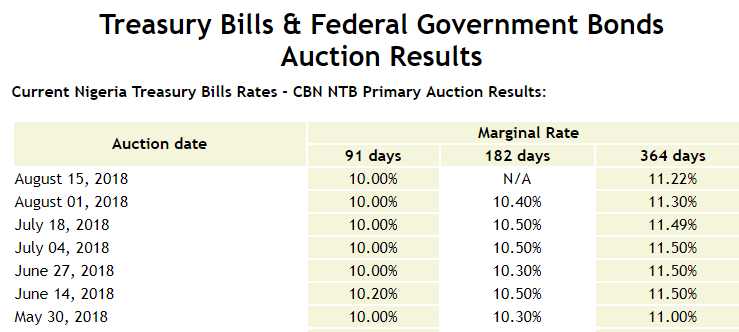
  • Treasury bills: This is also protected as this is from the Nigerian people and the whole power of the nation of Nigeria. Provided that you believe there would still be Nigeria, treasury bills have no risk. From the Central Bank of Nigeria, the rate hovers around 11% per year. To account for potential changes, let us use 12% on average over the three years of the investment. This is an optimistic model but it is reasonable as this year we have seen the rate moved from 13.70% to 10.70%.
Treasury Bills rates in Nigeria
  • Stock market: You look for some good stocks especially in banking and invest. The risk is there but most are so beaten that they have no room to fall further. Of course, stocks bring the turbulence and the risk which cannot guarantee the preservation of principal. Due to that, we have to remove stock market in the consideration. Besides, we do think that the global stock market might have peaked: the only movement possible is coming down. When that happens, investors just focus to cover their portfolios thereby reducing liquidity in the emerging markets like Nigeria.
  • Money Market / Mutual Funds: This is a highly diversified form of investment which includes many things I have noted already. An example is FBN Money Market Fund  – “As an open-ended mutual fund, the FBN Money Market Fund invests in a broadly diversified portfolio of short-term, high quality money market securities such as Treasury Bills, Commercial Papers, Bankers Acceptances and Certificate of Deposits issued by rated banks in Nigeria”. The return falls in the range of TB and fixed deposit but could be higher. Again, unlike TB, you pay tax on money market / mutual fund gains.
  • Agribusiness: You explore agro-investing and put money in some of the companies which have emerged to bridge the investment gap in agriculture. I have written on many of these companies here. Also, I listed some in my book. Let me avoid mentioning names. But largely, these companies return about 11% – 14% per year. In some cases, they promised to protect principals. Of course that is not going to be taken like that: there is no way a startup can guarantee principal as the startup can technically fail!
  • Micro-Lending: There are some startups which are well backed by solid investors offering at most 15% on interest rates for savings. Those remain risky. Their rates are better than fixed deposits from banks, and always superior to any savings interest. But they are startups and you need to have the confidence to trade in the territory.
  • Trade financing: You contribute to finance trade in some Igbo men going to China. But you need to have the right people. They mop money and use that money to bring containers. This is a thriving business in Aba and Onitsha as most have shunned banks due to cost of fees. And with the good returns, some people are taking risks. They offer good contracts and in some cases provide collateral as they own shops. Personally, I have used this model to assist some people. Yes, people I know. Their returns are the highest in Nigeria. The deal happens over four months as that is the typical time to go to China, import items and sell them at wholesale. Please do not ask me for contacts. If you are interested, this is very common in Aba, Onitsha and Lagos where there are concentration of Igbo traders.
  • Startup/Angel investing: This is off for you as the 3 years will be too short for any meaningful support to the startup. You need to have a window of about 6 years to invest in this option.
  • Crowd-Investing: There are many startups raising funds for logistics, transportation, etc in the broad crowdfunding domain. Some of the interests are decent enough. Unfortunately, most come with huge risks.

Recommendation

After examining the options, there are my recommendations:

Put 60% in treasury bills (TB) for three years with an automatic rollover instruction. They would pay you the interest as it happens which can be good to finance other small things. The advantage of TB over fixed deposit is that government does not tax TB. Yes, TB is tax-exempt and that is huge over fixed deposit which may deliver the same interest rate but taxable.

Put 40% to finance trade. In Aba and Onitsha, some people put money to finance trade. Some men mop cash and travel to China to bring containers. The return can be close to 40% with my recent data in four months. It is a solid business outside the banking sector run by some Igbo men. Say someone needs to import something of N220 million, they pool money and once the items come in, they sell wholesale and balance the people that funded them. This is the real investment and can technically make you whole. But it has risks if you do not know the person. You would not like to give money to someone you do not know.

Enjoy your risks at your risk!