DD
MM
YYYY

PAGES

DD
MM
YYYY

spot_img

PAGES

Home Blog Page 714

China Presses U.S. to Ease AI Chip Export Controls Ahead of Potential Trump–Xi Summit

0

China is pressing Washington to ease restrictions on a critical component for artificial intelligence chips as part of ongoing trade negotiations, a push that has gained urgency ahead of a possible summit between President Donald Trump and President Xi Jinping.

The FT reports, citing multiple people familiar with the matter, that Beijing wants the Trump administration to relax export controls on high-bandwidth memory (HBM) chips, a component regarded by U.S. officials as one of the most important bottlenecks in China’s ability to develop advanced AI systems. Chinese officials have reportedly raised the HBM issue repeatedly during three rounds of trade talks in recent months led by U.S. Treasury Secretary Scott Bessent and China’s Vice-Premier He Lifeng. The U.S. Treasury has declined to comment.

The talks are part of efforts to strike a deal before an August 12 deadline, when failure to reach an agreement could trigger the reimposition of high tariffs. Commerce Secretary Howard Lutnick has indicated that the administration may extend the current ceasefire on tariffs by 90 days.

This push from Beijing comes amid a significant development in Washington: Nvidia and AMD have reached an unprecedented agreement with the Trump administration to hand over 15 percent of revenues from certain chip sales in China in exchange for export licenses. The deal — disclosed just days after Nvidia chief executive Jensen Huang met Trump at the White House — allows both companies to resume selling chips tailored for the Chinese market despite previous export restrictions.

Nvidia will pay 15 percent of revenue from sales of its H20 chip in China, while AMD will make the same payment on sales of its MI308 chip. U.S. officials have not yet decided how the funds will be used. But analysts say this move is not merely about regulating AI chip exports—it signals a broader shift in the Trump administration’s trade strategy toward China. Washington seems to be testing whether it can both protect national security and extract economic value from controlled technologies by turning export restrictions into a revenue-generating tool.

China’s growing frustration stems from the Biden administration’s sweeping 2022 measures to curb Chinese access to advanced AI chips, followed in 2024 by a ban on exporting HBM to China, targeting Huawei and Semiconductor Manufacturing International Corporation (SMIC). While much public attention has focused on restrictions around Nvidia’s H20 chip, which the U.S. recently approved for export, Beijing is reportedly far more concerned about the HBM ban.

HBM is essential for pairing with the logic components of AI chips, significantly boosting performance. Gregory Allen, an AI expert at the Center for Strategic and International Studies, warned that allowing China to access more advanced HBM “is the exact same as saying we should help Huawei make better AI chips so that they can replace Nvidia.” U.S. officials have previously described HBM controls as “the single biggest constraint” on China’s AI chip ambitions.

Washington fears that loosening these controls could enable Huawei, SMIC, and others to mass-produce millions of AI chips annually, potentially diverting scarce HBM supplies away from the U.S. market. There are also concerns about Chinese firms like SophGo acquiring chip components — in one case from Taiwan’s TSMC — in suspected violation of U.S. law, highlighting the growing complexity of enforcing restrictions.

China’s embassy in Washington has accused the U.S. of “abusing export controls to suppress China” and harming the “legitimate rights” of Chinese companies.

Meanwhile, scrutiny is mounting over Nvidia’s sales in China. Although the company insists it complies with U.S. law, Chinese groups have been openly marketing Nvidia gaming chips such as the 4090D and 5090D for AI applications. This comes after reports of large-scale smuggling of advanced AI chips into China, with $1 billion worth of chips allegedly entering the country in the second quarter alone.

House China Committee Chair John Moolenaar said the scale of the activity underscores the need for Nvidia and the Commerce Department’s Bureau of Industry and Security to step up enforcement. Nvidia maintains that its gaming cards are intended for consumers and academic use, adding that “cannibalizing gaming cards is not a viable way to create data center compute clusters for AI.”

With Trump eager to secure a summit with Xi, officials in Washington are increasingly concerned that Beijing’s demands on HBM could become part of the final deal — a concession that could significantly shift the balance in the U.S.-China AI technology race.


BlockDAG’s Dashboard V4 Enhances Trading Experience as Kaspa Holds Support and Arbitrum Targets $0.50

0

The top trending crypto scene is moving fast, but only a few projects are truly proving their strength. The latest Kaspa (KAS) price prediction points to a steady climb if it can hold above key supports. Meanwhile, the Arbitrum (ARB) price forecast focuses on breaking through the long-standing $0.50 barrier.

Both KAS and ARB show promising momentum, but BlockDAG (BDAG) is pushing things further. Its new Dashboard V4 doesn’t just preview trading after launch; it gives users a live-market feel during the presale. With $371 million already raised, BDAG is showing why it’s not just trending but also delivering real progress.

Arbitrum Price Forecast Hinges on $0.50 Break

The Arbitrum (ARB) price forecast is centred on the $0.50 resistance after a 9.02% daily increase brought the coin to $0.4736. Trading volume hit $397.49 million, and ARB has risen 28.32% in the last week, breaking out of a consolidation phase.

Analysts agree that $0.50 is the major hurdle. A close above it could open a path toward $1.17. However, projections for the longer term remain wide, ranging from $0.321 to $2.40. Whether ARB can keep momentum depends on buyers holding ground before profit-takers step in.

Kaspa Price Prediction Focuses on Key Support Levels

This week’s Kaspa price prediction centres on maintaining support above $0.092 after rebounding from early August lows of $0.0799. KAS is now trading at $0.0944, building higher lows that signal ongoing accumulation despite short-sellers increasing their positions.

Trading volume is steady at 43.58M, though still below late July peaks. Open interest sits at $111.67M, showing traders remain engaged. A push above $0.098 could test the psychological $0.10 level, with momentum possibly stretching toward $0.105. For now, holding key supports will determine whether KAS can sustain its gains.

BlockDAG’s Dashboard V4 Brings Real-Market Experience to Presale

BlockDAG’s release of Dashboard V4 comes at a critical time, with the presale already halfway to its $600 million goal. This platform blends advanced trading tools with a smooth interface, directly linked to its fast-selling coin batches.

Users get live execution, accurate price tracking, and a functioning BUY/SELL system, allowing them to train under the same conditions they will face after launch. This isn’t just a presale perk; it’s an early edge for anyone aiming to master the BDAG market before it officially opens.

The presale stands at $371 million with over 25 billion BDAG coins sold across 29 batches. The current price is $0.0276, with the next jump to $0.029 expected in batch 30. The launch price is confirmed at $0.05, meaning early buyers from batch 1 have already gained 2,660%.

For seasoned traders and newcomers alike, Dashboard V4 offers a chance to refine strategies in a realistic environment. Its design mirrors the upcoming exchange, ensuring users feel at home when live trading starts. Each price step taken now adds weight to the potential gains that could follow post-launch.

Top Trending Crypto Picks of August

While Kaspa works to protect its recent gains and Arbitrum tests the $0.50 barrier, BlockDAG is already operating at a different pace. With $371 million raised, 25 billion coins sold, and a trading platform that feels market-ready, it is already delivering results that others are still aiming for.

Every batch moves BDAG closer to its $0.05 launch price, narrowing the window for buying at lower levels. In a market filled with hopefuls, BDAG is positioning itself as one of 2025’s top trending crypto plays already in motion.

Presale: https://purchase.blockdag.network

Website: https://blockdag.network

Telegram: https://t.me/blockDAGnetworkOfficial

Discord: https://discord.gg/Q7BxghMVyu

Building Talent for the World: Business Model Case Study of All Talentz

0

The modern digital economy demands a re-evaluation of traditional talent pipelines. In a world where geography is no longer a barrier, platforms that can efficiently connect global opportunities with skilled human capital are positioned for significant market disruption. All Talentz emerges as a compelling case study, not merely as a recruiting firm, but as a system architecting a new talent ecosystem.

This platform’s core business model has a two-sided network effect, bridging the skills gap for businesses while providing economic access to a vast, underutilized talent pool, primarily from Africa. By pre-vetting and training professionals in key digital and operational skills, All Talentz de-risks the talent acquisition process for companies and creates a reliable supply chain of remote labor.

The value proposition is rooted in a fundamental shift from transactional outsourcing to strategic partnership. All Talentz does not simply fill a role; it provides a comprehensive solution that includes ongoing support and quality assurance. This model transforms labour from a fixed cost to a flexible, high-value asset, delivering immense value for businesses seeking efficiency and competitive advantage.

Ultimately, All Talentz exemplifies a new-age business model built on the principle of borderless talent. By leveraging digital infrastructure to create a scalable system of skill development and deployment, it is not only building a successful company but is also contributing to a broader economic transformation, demonstrating how local talent can be effectively harnessed for global markets.

Join us at Tekedia Mini-MBA as we discuss All Talentz business model as part of our program’s execution theme where we learn what doers do. All Talentz Michael Nwoseh will anchor the conversation.

Tue, Aug 12 | 7pm-8pm WAT | Building Talent for the World: Business Model Case Study of All Talentz, Michael Nwoseh (All Talentz), Ndubuisi Ekekwe | Zoom link

Tekedia Mini-MBA >> learn from the best!

What Google Says About Nigeria’s Airport Incidents

0

In a country where news moves quickly and public opinion can shift overnight, Google Trends provides a powerful lens into how Nigerians pay attention to major events. The recent Wasiu Ayinde Abuja airport incident and Comfort Emmanson Lagos airport incident reveal how search behavior can not only reflect public interest but also shape the national conversation.

Our analyst notes that by examining daily search data for the two individuals and for related airlines, Valuejet and Ibom Air, a clear picture emerges of how attention builds, peaks, and fades.

The Quiet Before the Headlines

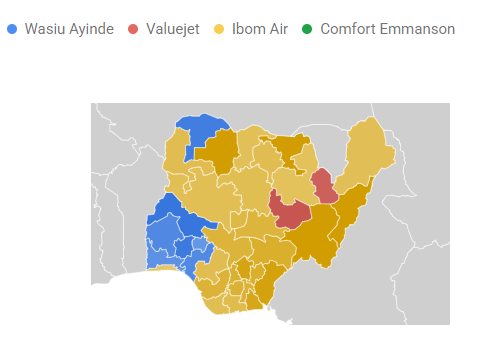
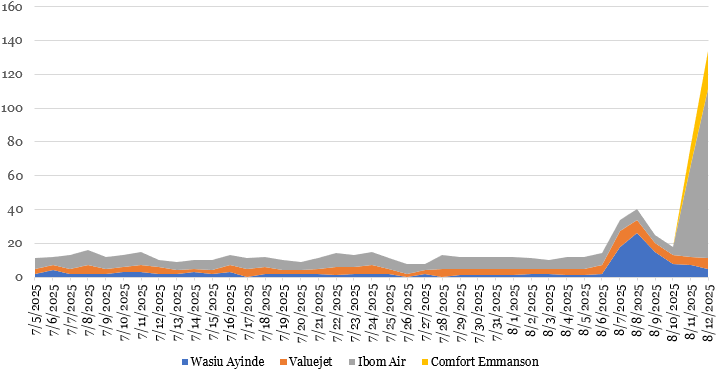
From July 5 to August 6, 2025, searches for Wasiu Ayinde remained low but steady, between one and four points on Google’s 0 to 100 scale. Ibom Air had a slightly stronger baseline of between five and nine points, suggesting a consistent background of brand curiosity. Comfort Emmanson did not appear in the data at all during this time. This period represents the normal noise level of public attention. It is within this quiet space that Google’s algorithms decide which stories are likely to trend once a triggering event occurs.

Exhibit 1: Public interest across regions

Source: Google Trends, 2025; Infoprations Analysis, 2025

A Celebrity’s Fast-Track to the Spotlight

On August 7, search interest for Wasiu Ayinde leapt from two to eighteen points as news of his Abuja airport altercation broke. By the next day, he reached 26 points, dominating celebrity headlines across the country. The surge lasted only a few days. By August 10, his score had dropped by half. Google’s trending system rewards rapid increases in searches, which means that once growth slows, a topic can quickly disappear from the top results, even if debates continue in the media.

A Slower Rise for a Lesser-Known Name

Comfort Emmanson entered the search rankings on August 11 with a score of 12, following reports of her incident at Lagos airport. By August 12, she reached 23 points. Her steady growth, rather than a sudden spike, suggests the public was learning about her case gradually, perhaps through ongoing coverage and social discussion rather than a single viral headline.

When the Brand Becomes the Story

On August 12, Ibom Air’s search score jumped to 100, the highest possible value on Google Trends. This indicates that the Lagos incident shifted the public’s focus away from the individual to the airline involved. Once users began adding “Ibom Air” to their incident-related searches, Google’s systems treated the airline as the central topic. This created a feedback loop where increased search visibility encouraged more coverage, which in turn drove further searches.

Three Insights from Google’s Data

First, celebrity status accelerates how quickly a story enters national consciousness. Second, sustained public interest depends on a constant flow of new information. Third, corporate entities can quickly overtake individuals as the main focus of public discourse when they are linked to an incident.

Exhibit 2: Interest over time

Source: Google Trends, 2025; Infoprations Analysis, 2025

Why This Matters

Airport incidents in Nigeria raise important questions about passenger rights, airline accountability, and the role of regulatory agencies. Google Trends shows that the platform does more than track these debates, it actively influences which ones dominate public attention.

For media, policymakers, and the aviation industry, this means that shaping the narrative is not only about statements and press releases. It is also about understanding how people search, what terms they use, and how Google elevates certain topics over others. The story of Wasiu Ayinde, Comfort Emmanson, and Ibom Air is a reminder that in today’s Nigeria, Google is not just a record keeper of public interest. It is a powerful participant in it.

The Partial Arm Embargo Marks a Nuanced Shift in Germany’s Israel Policy

0

German Chancellor Friedrich Merz announced a partial arms embargo on Israel, halting exports of military equipment that could be used in the Gaza Strip, in response to Israel’s plans to expand its military operations in Gaza City.

This decision, made on August 8, 2025, marks a significant shift from Germany’s historically strong support for Israel, which former Chancellor Angela Merkel described as a “reason of state” due to Germany’s historical responsibility for the Holocaust.

The embargo specifically targets weapons that could be used in Gaza, while exempting armaments for air and sea defense, which Merz emphasized are central to Israel’s self-defense. The move has sparked significant division within Merz’s conservative Christian Democratic Union (CDU) and its Bavarian sister party, the Christian Social Union (CSU).

Critics within the CDU, including its youth wing, have called the decision a betrayal of core party principles and Germany’s commitment to Israel’s security. CSU parliamentary group leader Alexander Hoffmann criticized the lack of consultation, while CDU lawmaker Carsten Müller condemned the embargo for disregarding security cooperation with Israel.

Conversely, some conservatives, like foreign policy expert Norbert Röttgen, supported the decision, citing concerns over Israel’s actions in Gaza. The center-left Social Democratic Party (SPD), Merz’s coalition partner, largely applauded the move, with Vice Chancellor Lars Klingbeil calling it “the right decision” amid the worsening humanitarian crisis in Gaza.

Merz defended the policy, stating that Germany’s solidarity with Israel remains unchanged but does not extend to supporting every Israeli government decision, particularly those risking high civilian casualties. He cited concerns over the humanitarian situation in Gaza, where UN agencies have warned of famine and mounting deaths from starvation.

Israeli Prime Minister Benjamin Netanyahu criticized the embargo, accusing Germany of “rewarding Hamas terrorism” and expressing hope that Merz would reconsider. The decision has also drawn international attention, with some European countries like France, the UK, and Canada recognizing Palestinian statehood, further isolating Israel diplomatically.

Public sentiment in Germany appears mixed, with a recent survey indicating 51% of Germans oppose arms exports to Israel, reflecting growing criticism of Israel’s actions in Gaza. However, the embargo’s practical impact may be limited, as Germany had already scaled back certain arms shipments to Israel in recent months.

Germany’s longstanding policy of unconditional support for Israel, rooted in historical responsibility for the Holocaust, is strained. While Merz emphasized that the embargo is limited to weapons for Gaza and spares air and sea defense systems, Israel’s Prime Minister Benjamin Netanyahu’s sharp criticism signals a diplomatic rift.

The embargo aligns Germany with a growing number of European countries, including France, the UK, and Canada, that have taken steps to distance themselves from Israel’s actions in Gaza, such as recognizing Palestinian statehood. This could embolden further European coordination on Middle East policy, potentially isolating Israel diplomatically.

However, it may also strain Germany’s relations with the U.S., which continues robust military support for Israel, creating tension within NATO and Western alliances. The embargo responds to the worsening humanitarian crisis in Gaza, where UN reports highlight famine risks and high civilian casualties.

By limiting arms that could be used in Gaza, Germany aims to reduce its complicity in potential violations of international humanitarian law. However, the practical impact may be limited, as Germany had already reduced certain arms exports, and Israel’s military capabilities are heavily supported by other allies.

The embargo may signal to Israel’s adversaries, such as Hamas or Iran-backed groups, a perceived weakening of Western support, potentially emboldening their actions. Conversely, it could pressure Israel to adjust its military strategy in Gaza to avoid further international backlash. The exemption of air and sea defense systems ensures Israel’s ability to counter threats like missile attacks, maintaining a balance in Germany’s approach.

German arms manufacturers, such as Rheinmetall, may face short-term losses from halted exports, though the embargo’s narrow scope limits broader economic impact. Israel may diversify its suppliers, potentially affecting Germany’s defense industry influence in the Middle East.

The embargo marks a nuanced shift in Germany’s Israel policy, balancing humanitarian concerns with strategic commitments. It risks internal party strife and strained ties with Israel but aligns with European trends and domestic sentiment. The long-term impact hinges on Israel’s response, coalition stability, and the trajectory of the Gaza conflict.