Here, I explained the Aggregation Construct using many case studies. I am expanding it by adding the integration element in this video. Integration is a very important component of aggregation and without it, no one can achieve aggregation capabilities. Aggregation drives scalable advantage because of the relative low marginal cost it anchors.
I identify four types of elements in the aggregation construct system: demand, supply, platform and enabler. The platform is very catalytic to make these elements work seamlessly.
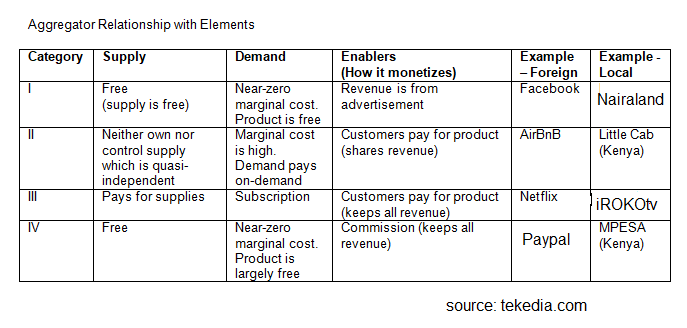
Looking at the construct, it is the unbounded and unconstrained internet that makes it possible, primarily because of immersive connectivity. By examining the relationships among demand, supply, platforms and enablers, I identify four categories of aggregators as shown in the table below.
This table is updated with examples from LinkedIn users
Looking at the integration part, I make a case that only the integration of customer relationship at scale within platforms can enable new basis of competition. And when new basis of competition is created, the outcome is typically disruptive at scale. The video is below.
This daily series focuses on business ideas for those looking to launch new ventures in Nigeria (and Africa in general). The short ideas are archived here.
The Problem
There are many mobile money systems in Africa. These systems are supported by banks, telcos, money transfer organizations, mobile money operators and broad financial institutions. Largely, these systems are disparate and disconnected from one another across Africa. Indeed, a system like Kenya’s M-Pesa is not connected to another mobile money system like Ghana’s Airtel Money at end-customer level.
The Opportunity
There is a clear need to link these mobile money ecosystems across Africa. In other words, there is a need for an aggregator that can integrate and link all these systems together. That way, someone with Airtel Money in Ghana can seamlessly remit and transfer money to someone using M-Pesa in Kenya in a way that location is eliminated with all compliance issues automatically handled by software.
Action Roadmap
Develop an API that will enable mobile money systems to become members of the aggregator system. Once connected, all their customers can then remit and transfer money across regional and national boundaries and borders while complying with all local regulations at receiver end. The aggregator system should support banks, mobile money operators, mobile transfer institutions, and companies with end-users in mind.
In this video, I explain the different business models to run energy (solar) small venture in Nigeria. I have also provided examples of companies using the models. The full text is here.
This daily series focuses on business ideas for those looking to launch new ventures in Nigeria (and Africa in general). The short ideas are archived here.
Problem
Over the years, sending money from Europe/US into Africa has advanced. The transaction cost continues to drop as innovations and more players enter the sector. However, remittance/money transfer within Africa (i.e. from one African country to another) continues to be expensive and non-optimal.
In this videocast, I discuss the need to build a truly pan-African digital remittance/transfer banking product which is agnostic of location or currency in Africa. None of the products we have today meets that standard. Largely, I envisage a situation where all you need to buy and sell across Africa is one bank account in just one African Union country. With that, you do not have to even think about the specific currency of that account as technology will seamlessly make it possible to access other African markets for payments, transfer etc. The banks or fintech companies must still comply with all regulations related to inter-national transfers, forex etc. The only difference is that customers will not see them as they will be hidden with technology
Opportunity
African intra-trade is low partly because sending and receiving money within Africa is hard. Just as many airlines will need to take you to Europe [for a trip originating within Africa] before taking you to another African capital, most money going from one African capital to another does require passing through London or New York. There is a huge market opportunity to fix that business friction by improving efficiency, speed and cost.
Action Roadmap
Build a payment system and settlement networks using modern technologies like blockchain, mobile money, etc with capabilities to serve broad spectrum of customers across Africa.
Partnership: We do not do it very well in Nigeria – everyone wants to go it alone. Many years ago, many banks went down despite a fair timeframe from the Central Bank of Nigeria for them to beef up their capital requirements. For most of the owners, “this bank belongs to me. I will always be the owner”. Yes, they ended up owning 100% of 0 as the central bank withdrew their bank licenses the next day.
You may ask: why didn’t the man accept 10% in a bigger bank for his dying bank? In Nigeria, he would look small, owning 10% when 100% is on the table!
Typically, Nigeria is not good with mergers & acquisitions. We like to be 100% in charge. That is bad. From Aba to Kano, Osogbo to Uyo, you would see guys killing visions purely because they do not want to TEAM up and build something greater.
Sure – I get it. We do not trust one another that much. So, if that is the case, there is no clear basis for partnership. Unfortunately, that is a lame excuse. Nigerian legal system is emerging and if you follow it properly, the risks are as what you have in most parts of the world. The problem is that the partnership was done in a beer parlor with no clear responsibilities, rules and defined modalities. Simply, it was created on chaos because it was not done professionally.
Do not be like them – partner with others. But do it brilliantly. To save cost especially in markets where the path to profitability takes long, one of the best ways of managing risk is to share risk, smartly.
The gestation period to profitability in a typical Nigerian startup is long. That long gestation is also the reason why many startups or small businesses collapse few years of founding. Typically, one way to deal with this is to raise capital, ramp up market entry to grow fast enough to attain profitability. But in our extreme volatile economy, if the timing is off by months, the company can collapse. You just run out of cash.
Think about it –if those shoemakers in Aba could tear down those small stores [their design centers and sales offices] and have a big one where they could use division of labour to deepen capabilities and drive process efficiencies, they would make more shoes, improve quality through specializations and possibly make more money per partner. Also, they would buy in bulk and that would improve their unit economics.
Aba shoes sector would grow with partnerships [source: techeconomy]Sure – men cannot talk at beer joints that they hold the titles of CEOs and Managing Directors post-partnerships in some cases. We like titles – a lot. But we need to understand that they are ephemeral. It is far better for three shoemakers to make progress when one is indeed a CEO, another is focusing on production while the other is driving sales/marketing. While the egos may be muted, the bank accounts will grow. And as the banks see the growing scale, those loans will begin to come in because they are seeing better digits hitting the bank accounts.
People, look for a smart partner, and combine capabilities and resources in what you do in Nigeria. It does not have to be in your city: having someone represent you in Yola, Uyo, Aba while you are in Lagos could save you massive logistical issues.