DD
MM
YYYY

PAGES

DD
MM
YYYY

spot_img

PAGES

Home Blog Page 7183

The Risk of Herding Strategy

0
Bitcoin is flawed but NairaCoin offers promise in Nigeria

In your business, do not do “herding” where everyone does the same thing. As I noted in Tekedia [had a long piece on that in Harvard Business Review print around 2011], when you do that, a new entrant has only one strategy to annihilate your industry. Yes, since everyone is doing the same thing, conquering the market is easier by a newcomer.

The same analogy above applies in many modern industries. Companies increasingly congregate in their competitive strategies. They tend to do similar things in order to self preserve themselves. In the era of Yahoo and AOL, they provided similar services. Cell phone companies provide services and pricing models that are largely the same. Everyone wants to eat from the same pot and let the help offer assured preservation or total destruction whichever flips.

Even the network televisions are not spared this effect. From casinos to airline industry, we can see an ordered communality across industries. They mutually agreed, though never admitting it, to move in features, services and prices alike. The airline industry was notorious for it about fifteen years ago. In most developing markets where Internet has not penetrated deep enough, the media empires move in tandem on their stories, prices and distribution networks.

I call this communal competitive strategy because it simply means that these firms in their respective industries form communal ties and agree to provide services that will preserve them with lesser disruption to their industries. They may not band together because that could be illegal but the outcome shows they watch one another. Many have called this win-win strategy. It has also been seen as co-opetition where, especially in banks, they cooperate though competing against one other in other to keep the industry healthy

This applies to how we grow wealth. When it seems like everyone is making profit with no apparent bleeding for some, it is probably MMM and will turn out bad. And when everyone seems to believe it will be all parties for everyone, hello cryptocurrency and Bitcoin.

Simply, any business or sector where there is no obvious risk of loss or gain by different participants in short term, it is probably not based on sound economics. If MMM says everyone would win, that is against the laws of markets. When Bitcoin promises same, it is an illusion.

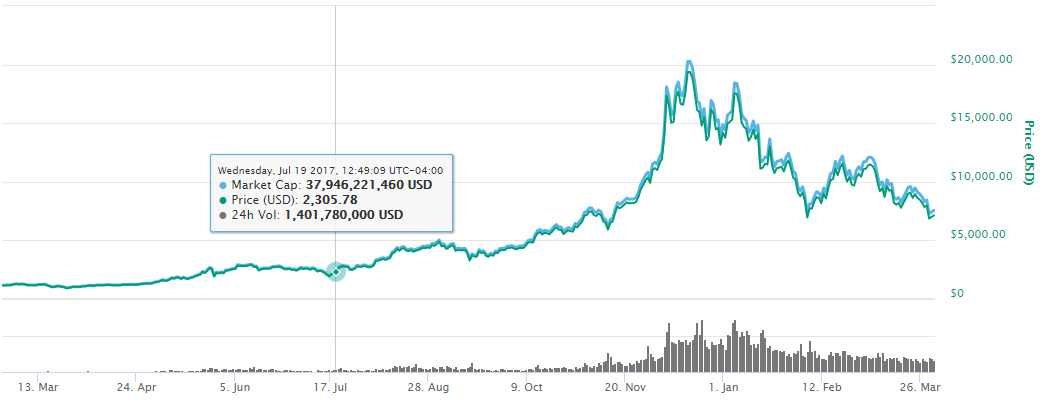
This is the Bitcoin price today (see the plot below): around $8,000. From Google to Facebook to Twitter, they are caging it. Now, the fraternity that did not want government is asking for government to come and regulate it. It wants legitimacy because the ICT utilities are indeed regulating it.

If you are banned by Facebook, Google and Twitter, you probably do not belong in this world. You are irrelevant. If you do not reverse it, the only destination is oblivion. You can see that from the price of Bitcoin. (Advertising on crypto-related products including ICO (initial coin offering) are banned by these ICT utilities. Simply, the ICT utilities have decided that they are not important for the real economies).
Price of Bitcoin

All Together

Just hope you did not buy Bitcoin at $22k because unless government can regulate it, it may be in deep trouble. Facebook, Google and Twitter are banning adverts on it. If you are banned from the ICT utilities, you do not belong in this world.


Dealing with Long-Profit Gestation in Nigerian Startups

4

The gestation period to profitability in a typical Nigerian startup is long. That long gestation is also the reason why many startups or small businesses collapse few years of founding. Typically, one way to deal with this is to raise capital, ramp up market entry to grow fast enough to attain profitability. But in our extreme volatile economy, if the timing is off by months, the company can collapse. You just run out of cash.

This is one problem we deal with in my Practice as we work with clients: how do you invest without getting into a trap where one sneeze in Saudi Arabi or Iran  [America coming with shale gas] can kill your business because Nigeria’s economy would be affected due to its dependence on crude oil.

According to a report by Pearl Mutual, a consultancy, an average of 5.7 million Nigerians are considered to spend within US$10 to US$20 per day. The country has an estimated $115 billion annual consumption spending.

That is a big one but the market is extremely fragmented that economies of scale rarely happen due to lack of infrastructure. Kano and Osogbo have little in common except that Osun and Kano states go to Abuja to collect cheques monthly. So the average national statistics has little meaning in the real execution of business strategy in Nigeria. We have heterogeneous markets making things more challenging.

While you may think that raising capital may help you, most people have noticed that you can raise capital and still crash. Think of Efritin which just gave up on Nigeria. It happens daily. They think that market growth is the solution when the path to profitability is what matters [path to profitability may not matter to a U.S. founder because they have massive sources of new capital. We rarely have here].

Yes, your new business problem in Nigeria is not just capital but the long gestation period required for profitability, affected by many factors at scale.

We have refined a strategy on this problem for consumer facing startups and companies. We have noticed that when clients deploy that model, they attain better outcomes. We ask firms to  discover “anchors”. And when they do, they always do well.

  • Advisory Services: Most times, after our presentations and workshops, clients usually engage us for Advisory Services. This is totally decoupled from the first two. In other words, you can engage us for either the presentation or workshop without the advisory services. Yet, we always welcome the moments when clients ask us to come and lead the implementation. Because we are already practitioners, making things happen is always the most exciting part of our works.

Opportunities in Nigeria’s Expanding Asset Financing Sector

0

Across global markets, information and communication technology (ICT) is facilitating the process of socio-economic developments of nations. ICT has offered new ways of exchanging information, and transacting businesses, efficiently and cheaply. It has also changed the dynamic architectures of financial, entertainment and communication industries and provided better means of using the human and institutional capabilities of countries in both the public and private sectors.

The impact has been consequential: ICT is rapidly moving nations like Nigeria towards knowledge-based economic structures and information societies, comprising networks of individuals, firms and states that are linked electronically and in interdependent relationships. From Lagos to Abuja, Kano to Owerri, and indeed across the nation, ICT has provided enormous productivity gains, anchoring efficiency in production and business processes. Indeed, the penetration of ICT has driven efficient allocation of the factors of production, powering and enabling new industrial systems.

One major change is the capacity to enumerate and validate the identity of citizens through the highly successful Bank Verification Number. Every Nigerian citizen that wants to operate a bank account is required to obtain this number which involves capturing biometrics data along with other personal data. This number is evolving a new credit system which would support the growth of asset financing through verifiable sources of income for both public and private sector customers.

Our data shows that asset and equipment financing sector (without SME funding) will hit N2.2 trillion by 2020 in Nigeria.

As Africa’s largest economy and the most populous with GDP of $510 billion and excess of 180 million people, Nigeria is poised for growth in finance, energy, telecommunications,  entertainment and indeed all key sectors of modern commerce and industry. It has fully recovered from recession, and as the global crude oil price accelerates, government spending would improve. The consumer confidence is already high and the sentiment generally from IMF to World Bank is that Nigeria is poised for long-term growth.

One sector would follow this trajectory: asset financing sector as Nigeria redesigns towards a credit-based economy. One of our clients, Amaecom, is a national leader in this space. You can manage your cashflow better by giving it a call. It does the following:

  • Provision of mechanism to enable workers acquire equipment even as they pay with interests over time.
  • Transparent asset financing across different equipment categories including electronics, vehicles, etc.
  • Helping workers and SMEs manage their cashflow challenges through trusted asset financing system.

Paying cash up front for brand new equipment, electronics or even cars can be expensive and can lead to cash flow problems. Individuals simply do not have the capital for a big purchase that’s where we come in, we make things easy and stress free.

Amaecom global limited was incorporated in 2004 as a asset financing Company. Today, we are Africa’s leading asset financing company with operations in Nigeria, with presence in Cameroon, Ghana and China.

Our expertise in manufacturing, professional services, logistics, engineering and asset financing, has earned us numerous awards and recognition, both locally and internationally.

We have 25 branches in various state capitals and 3 sub branches in three states, our headquarters in Abuja, Nigeria.

2M Bank Customer Closure: It’s Fee, not BVN Related

0
BVN
Nigerian bank customers

I had written many days ago that Nigerian banks lost customers in 2017 largely due to the sensitivities of customers to bank fees. Some agreed with me while others made the case that it was due to the introduction of BVN. The latter group noted that some government workers had to close bank accounts as a result of BVN. There was also another argument that it could be due to many customers consolidating their bank accounts. Besides, the banks themselves could possibly be closing accounts not tied to BVN.

Banks lost 2 million customers in 2017, dropping from 61 million to 59 million. Active bank accounts also shrank, from 65 million to 63.5 million in 2017.

Despite Central Bank of Nigeria’s (CBN) effort to promote financial inclusion, the Nigeria Inter-Bank Settlement System (NIBSS) banking industry statistics shows that the number of customers using financial services reduced in 2017.

The statistics obtained by the News Agency of Nigeria (NAN) from the NIBSS website on Sunday, showed that the total number of bank customers dropped from 61 million in 2016 to 59 million in 2017.

Similarly, active bank accounts reduced from 65 million in 2016 to 63.5 million accounts in 2017.

Possibly, it could be due to BVN but here are the bases of my call that fees have stronger correlation:

  • Two million CUSTOMERS closed their accounts (61 million minus 59 million) in 2017. Also 1.5 million bank accounts were closed (65 million – 63.5 million). There is a mistake here as there is no way you can have more customers than bank accounts since the people became customers due to the accounts they opened. It is impossible to have more customers than account numbers unless they are counting joint accounts as separate “humans” or “customers”. For example a married couple share one bank account and the closure is captured as two customers for the one bank account. Doing that is just to confuse people. Nonetheless, we do have 2 million CUSTOMERS here that left the sector.
  • Till today those who abandoned their bank accounts in commercial banks can still have access to them if they link BVN to them. So, technically commercial banks cannot record those bank accounts as closed. That the bank account has no BVN does not mean it is closed. The point is that if the corrupt people abandoned their bank accounts, as of today, banks cannot see those accounts as closed. So, abandoning bank accounts due to BVN could not have counted to this “2 million customer” number.
  • Nigeria does not have more than 100,000 people at the position of power to perpetuate corruption. So, any insinuation that 2 million people closed their bank accounts as a result of the need to cut-off the axis of corruption does not make sense [they closed the accounts to avoid being found].

If you look at this critically, we do not have 2 million customers in government at positions to cause corruption that would have been compelled to go and close their bank accounts to avoid being detected. Also, dormant bank accounts, not linked with BVN, are still counted as customer accounts. You cannot use the word “closed” against them unless the banks closed them and returned the balances to the national treasury (i.e. the Central Bank of Nigeria). That has not happened yet.

Looking at this critically, I do not see how 2 million customers left the sector unless there is an exodus associated with fees. The common people would NOT have left because of BVN as they have no reason to abandon balances in their bank accounts to leave the banking sector. I do believe most left because of the bank fees.

To accelerate financial inclusion, the Central Bank of Nigeria should reform the varying levels of fees in the banking sector. Those fees could be discouraging the very people it wants to attract into the banking sector. For someone making N18,000 monthly and having to part with N300-N500 on fees and associated SMS charges, it could be a disincentive to bank. People are smart and when there is a burden via fees for extremely cost-sensitive people, any policy will collapse. CBN needs to revisit bank fees and work with our banks to find better ways to offer products that can reduce cost burdens on poor citizens. This is not a problem that technology can fix because the fintech companies do not take customer deposits. So, it is only policy that can solve this, and only the central bank has the capacity to make that happen. Yes, banks are not charities and are there to make money. So CBN needs to balance its policy.

All Together

While we may say it does not matter to know why, I do believe if our banking sector could lose 2 million customers in a year, we have a real issue. From the data provided by NIBSS, I do not see any strong correlation to BVN. We are not talking of losing just bank accounts, we are talking here of bank CUSTOMERS. This is a big issue. While people could have consolidated their bank accounts, that would only reduce the number of bank accounts, not bank customers.

Note: NIBBS did not state if the customers are unique customers. It is certainly not but even with that the argument does not change.

Thank You – Scaling Opportunities in Africa

0
Ndubuisi Ekekwe receives award from Richard Branson

Thank you Virgin. More opportunities in East Africa.

Zenvus is a pioneering precision farming technology company that uses computational algorithm and electronics to transform farms. Zenvus collects soil fertility and crop vegetative health data to deliver precision agriculture at scale. It then uses the aggregated and anonymized data to deliver financial services to farmers.