DD
MM
YYYY

PAGES

DD
MM
YYYY

spot_img

PAGES

Home Blog Page 7186

Avoid This As You Launch Your Product

0
Products, perception demand

You have created a really brilliant product [you thought]. You begin a journey to present it to selected (potential) Nigerian customers.  They see the product, and in different ways remind you what you should do next. In other words, what you have not done at the moment. Magically, they shift the goal post with minimal acknowledgement of what you have actually done. We do this a lot in the land.

Your initial goal was not for people to tell you what should come next. You had expected to get people to pay for the product so that small revenue would come in. If you fanatically listen to those customers, you would be in a real problem. You would never finish that product because in this age, no product is ever finished.

Always remember that they are still developing Facebook, and if Mark Zuckerberg and friends have waited to “finish” Facebook, it would never be launched.

Sure, while it is good to listen to “pre-market customers”, know when to shut down the noise. Yes, switch off the noise and forget the reviews.  Note that even if you make those improvements and return, most of those customers would not buy. It does happen.

You have visited a government agency. The end result is that the product needs to be massively improved for it to be considered. No one is interested in supporting it at the present state. You begin the scramble to raise further capital to upgrade the product. You make it back to the agency only to note the agency has no immediate need for that solution. Now, you have a real problem!

I have noted how Steve Jobs avoided the noise through perception demand construct. We certainly do not share his peerless mind. But there is a lesson there: if you focus on satisfying every comment on your product, you would never have a product especially in Nigeria. My suggestion is to focus on people who are paying for the “current product” in the form you have launched it. Yes, the product you have now as it is. Focus on them and find ways to get more to buy. Sure, you can reduce the price knowing that as improvements arrive, price can move north.

The Perception Demand Construct is a construct where you work on things which are not really evident to be in demand. Yet you go ahead to create that product. The demand may not be existing but you are confident you can stimulate it. Yes, you do believe that your product can elicit demand and grow the sector when launched. This is different from existing demand which could be met via starting a web hosting company or selling light bulbs where you know people actually need those services.

It makes sense to get the perspectives of customers but know when to cut-out the elongation of quality. The construct of MVQ is not in this age for nothing. Yes, beware of the trap of having a perfect product at launch.

A product Minimum Viable Quality (MVQ) is that version of a new product which allows a team to sell the maximum amount of products to customers with the least effort and at the best optimized price even when delivering value. That is where you need to build as you launch your product, and even at product maturity, do not deviate from it.

The Weak Link in African Reforms

2
African Reforms

[I admire those working in the public sector across Africa. Yet, let us have a big conversation, purely on averages, not individuals. Of course the smartest people like professors are in the public sector. Let that guide as you read].

I was in University of Nairobi Engineering. I had gone to discuss building sensors for capturing emissions in cities. In the middle of the talk, I wanted to find out those that would even support the project from the government side. I asked two questions to the students. First, “Who are in the top 10% of their classes?”Some hands went up. Secondly – “To the 10%, who would work in the public sector after graduation?” All hands went down.

That is the African problem. You can accuse me for choosing private sector over a public sector career. Nonetheless, we have a problem in the continent. On average, our generation’s best are not interested in public sector, going for private sector [oil & gas, banking, telecoms and foreign-funded startups] or leaving the continent. As this trajectory continues, the quality in the public sector would deteriorate.

While we work on policies, Africa must work to find how to make public sector more attractive to its generation’s best. If the bottom of the class becomes the person making decisions on our roads in the Ministry of Works, we may not necessarily have good roads.

I have seen this problem in primary education in Nigeria: brilliant kids move on to universities. College of Education is not necessarily the domain for the brightest graduating secondary school kids. Yet, that is the place government would select those that would teach the next generation. If government does not make teachers’ wages attractive, college of education would never become a first-choice for any secondary school graduate.

The state government, had in September 2017 conducted similar test for the over 30,000 primary school teachers in the state, following which 21,780 who failed to obtain 70% pass mark were sacked and replaced with newly recruited 25,000 teachers.

Writing on Sunday via his Twitter handle, @GovKaduna, el-Rufai noted that the state is committed to restoring the integrity of the teaching profession.

“We are doing our best to restore the integrity of the teaching profession. We have finished tests for primary school teachers and we are going to administer competency tests for secondary school teachers.”

The competency test for primary school teachers and subsequent sack of those that failed the test caused verbal war between the governor, the Nigeria Union of Teachers (NUT) and the umbrella body for workers, Nigeria Labour Congress.

The summary is this: unless Africa invests to fix the public sector workforce, most of the reforms may struggle. The golden age of public service employment was also the time government was the best employer. That happened many decades ago, before 1990. Governments across Africa must revisit that formula if we ever hope to get out of the stasis we are now today.

All Together

It is a big challenge: you ran away from govt but the bottom in your class will teach your child! Then we rant, teachers are not doing good jobs. Ask Governor El-Rufai for the outcome. Unless he can pay the oil/ telecom/bankers’ wages, he would struggle in finding great teachers.

Marginal Cost And How To Price Digital Products

0

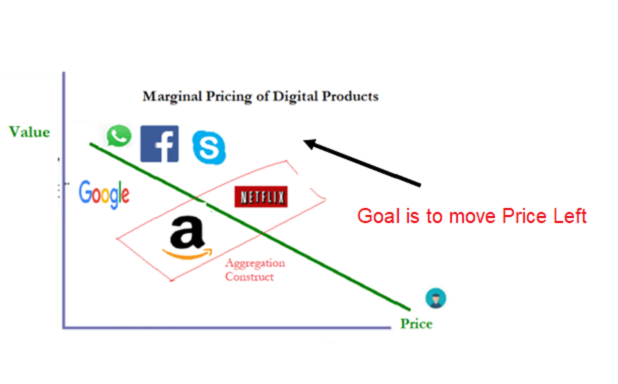
In a perfect market, the marginal cost of a digital (online) product is zero. This means that the price of a digital product tends to zero: welcome freemium and ad-supported business. However, only firms with network effects dominate and benefit. The core reason is that if in a perfect market, and the marginal cost of producing digital product is zero, the price will inevitably go to zero.

This is the heart of the freemium model where you get many things free, which is possible because of the aggregation construct, where companies provide those digital products and then create an ecosystem to sell adverts. The firms benefit more than the suppliers by providing the platforms [Facebook makes money for photos supplied by families. Sure you like the Likes]. As shown in the Figure, great companies deliver the near-zero marginal price for high quality product, making it challenging for anyone that carries a non-zero marginal price to compete, exacerbated if the product is even not top-grade. This is one of the biggest challenges digital entrepreneurs face.

FUTO Students Visit My Design Center in Nigeria (Photos)

0
FUTO Students
Exif_JPEG_420

Students of Federal University of Technology, Owerri (FUTO) Nigeria visited one of our design centers in Eastern Nigeria yesterday to learn about microelectronics, embedded electronics, FPGA and AIs. I graduated from this university and we have had a solid partnership for years. In short, most of our engineers are FUTO graduates. We work with the university to train the students on what we need. I have also taught courses in my former department. Our Intel FPGA partnership, one of the two in continental Africa, continues to be strengthened because of our FUTO partnership.

FUTO Visits to Fasmicro