DD
MM
YYYY

PAGES

DD
MM
YYYY

spot_img

PAGES

Home Blog Page 7202

What I Told a Job Seeking Graduate Today

8

Today, I met a brilliant young man. He was academically talented. But I am not sure if anyone had actually guided him in his journey as a university graduate looking for work. He hated his city. He hated his country. Largely, he was annoyed with everything. The nation had failed him.

He was speaking and yelling to his friend. You could see the bitterness in his spirit. Perhaps, his model in life was to get the best grade in the university, and Nigeria would do its part. He got good grades, but Nigeria has not done the expected part. So, he fell off with his nation.

As he was talking, I called him and said “Young man, you are making a mistake. Life is more than getting good grades. The smartest people are teaching in some classrooms, and most would retire within classrooms. But those that run the world might not have passed with great grades. And those that create most jobs on earth might not have written serious exams.” I asked him some questions. He provided some answers and I explained why he was making big mistakes. He studied computer science, made good grades. But the man that invented computer science did not finish college.

Without humility, education is a waste because the greatest education is the liberation of the mind. I felt his mind was not liberated even though he passed exams in school.

I told him a story when I started my secondary school education. I came home and complained that I did not like one of my teachers. That was in Ovim (Abia State). The man did not do anything to me. The rumor was that he liked to fail students.  So, I joined the wagon, hating him. But that day, I got a strong instruction from my brother: “ We are not sending you to school to decide the teacher you would like or not. You must like all your teachers. There is no alternative. It is by liking him that you would learn from him”. Indeed, I went back to school and started liking the man. Good enough, I started doing well in his class. The animosity that caged my little mind was gone. I saw him as a friend  I did well in his exams.

I have extrapolated that “teacher” to include liking my country knowing that by liking Nigeria, I would have the energy to succeed in Nigeria. If I hate Nigeria, it would be challenging to make progress in Nigeria. It would be a struggle to find the strength to overcome a society you despise.

So, I told the young man: “Unless you like Nigeria, I am not sure you would get anything from Nigeria. When your mind builds bitterness in the society, you shut down the best from that society.” I explained his problem could be that everything was negative before him. And when you approach everything with that mindset, nothing seems to work.

Negative attitude happens in families and relationships; if you do not like something, you would struggle to get the best form that thing. How can you benefit from a relationship you despise? Not possible.

As a teenager, I prepared people for WASC/GCE Mathematics while in JSS3 (Junior Secondary 3).  They paid me and I enjoyed the experience. I was three years off to write mine but it was evident that WAEC was a simple exam. During lessons, I devised ways to help my students. I noticed one thing: students like money-equations, and when you introduce money in equations, everyone understands. So, 8x + 6x is hard but N8 + N6 is easy. Yes, they get the Naira one but the “x” is confusing. So, I devised a technique, changing all equations with x to Naira. Magically, it became solvable. The students’ minds were opened for Naira (we like money) but the minds were locked for “x’ (we hate maths). Yes, unless you open your mind, knowledge and blessings would struggle to flow in.

As the young man listened, I told him that he would be fine if his negativity about Nigeria could turn into positivity. Nigeria is made up of people. Unless he likes Nigeria, he cannot appreciate his fellow citizens. Those fellow citizens are the people that would give him jobs. The attitude must change.

As I rounded up, he was beaten up with thoughts. I wished him the best as I left. I am confident that he would be fine.
About the Author – Ndubuisi Ekekwe, PhD

0

Dr. Ndubuisi Ekekwe is the Founder of African Institution of Technology, a 501(c)3 U.S. charity. He holds two doctoral and four master’s degrees including a PhD in electrical & computer engineering from the Johns Hopkins University, USA and MBA from the University of Calabar, Nigeria. He obtained BEng from Federal University of Technology, Owerri (Nigeria) where he graduated as his class’ best student.

A US semiconductor industry veteran, his working experiences include Diamond Bank, Analog Devices Corp and NNPC. In Analog Devices, he worked in the team that designed a generation accelerometer for the iPhone, and he created the company’s first wafer level chip scale package for inertial sensor.

Dr Ndubuisi Ekekwe speaks at the EU Commission (2017)

He writes regularly in the Harvard Business Review, and previously served in the United States National Science Foundation Engineering Research Center E&D Committee for four years. He was also a PACE Chairman and Gold Chairman of IEEE Boston section. Prof Ekekwe is a Co-Chairman of JPL Financial Group, a California-based financial advisory firm which syndicates capital for projects in Africa.

Prof Ndubuisi Ekekwe’s book received the prestigious IGI Global “Book of the Year” Award in 2010

An inventor, author, he held professorships in  electrical & computer engineering, Babcock University, and Carnegie Mellon University electrical/computer engineering. He is the recipient of IGI Global 2010 “Book of the Year” Award. He is also a TED Fellow, IBM Global Entrepreneur and World Economic Forum “Young Global Leader”.

As the Founder/Chairman of Fasmicro Group, he controls companies like Zenvus, an agtech pioneer in Africa; First Atlantic Cybersecurity Institute (Facyber); Milonics Analytics, an IBM PartnerWorld member; First Atlantic Semiconductor & Microelectronics; among others. He recently co-founded Atlantic Americas, an engineering firm, handling major operations in most parts of northern Nigeria.

Dr. Ekekwe is a selection board member of the $100 Million Tony Elumelu Entrepreneurship Program. He has written many books, authored many technical papers, and invented technologies. The African Leadership Network has honored him as a “New Generation Leader for Africa”.

How WhatsApp Payment and Google Tez Would Impact African Banking

0

I noted few days ago that WhatsApp’s move into payment would cause massive dislocation in African banking. In this age of chat and social media, transactions have evolved into content, commerce and financial services. To examine the impact in Africa, let us consider what these solutions have done in India where they are already or being deployed. India has about 250 million WhatsApp users, the world’s largest (China is a WeChat nation).

In anticipation of this move, commentators had already predicted a “WhatsApp moment” in banking, whereby technology disrupts the cash-heavy, inefficient methods by which people currently settle dues in developing countries.

But before WhatsApp, there was Google Tez. I had noted that Google Tez would also cause disruption with its potential voice banking capabilities.

Voice banking will be presented as secure and convenient and will open new vistas for a really brilliant startup to set a new basis of competition in the fintech world. 2018 is the year of Voice Banking in Nigeria, and Africa. If you have the capabilities, go for it.

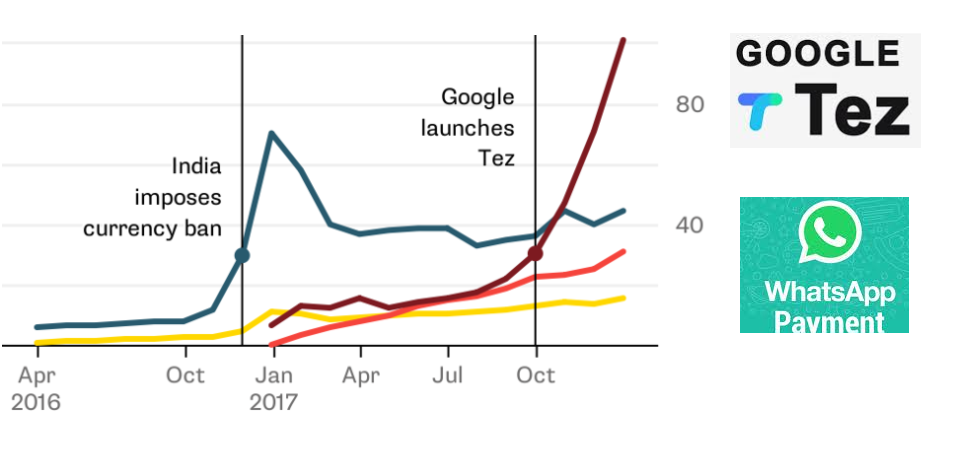
According to NDTV, Google Tez launched in India last September and quickly picked up 12 million customers, and by the end of the year, it had processed 140 million transactions. In the plot below, please note the explosion for Google Tez & co, from Oct 2017.

Tez, Google’s payments app for India that’s built on top of the country’s Unified Payments Interface (UPI), was launched in September last year. By early December – a little less than three months after the launch – the app had clocked 12 million users and 140 million transactions.

Those are impressive numbers, even if the government backed UPI app BHIM, which also launched last year, clocked 10 million users at a much faster rate – within 10 days. In terms of the number of transactions, however, Tez has completely blown past its competition.

Source: Bloomberg

The Challenge in Africa

Google Tez has about “70 percent share of all transactions on banks’ unified payment interface, or UPI, making it rather obvious that lenders’ own apps won’t be the dominant medium”. It took it less than three months to do this. That kind of growth for ICT utilities which never really care for profits should be a concern to African banks.

In the two months before Paytm added UPI support to its app in December last year, Google’s Tez accounted for 70 percent of transactions on the BHIM UPI platform. Whether it can sustain this kind of growth in the face of increased competition remains to be seen.

I expect the impacts of these entities in Africa to follow the same trajectory. When Google Tez and WhatsApp launch most likely in Kenya, Nigeria and South Africa later this year, we would see dislocation on many things. These entities would not make money in peer-to-peer payment. However, they would see opportunities in merchant supported payments. You always allow people to transfer free while merchants provide the profits.

Google Tez will likely lead the person-to-merchant segment while WhatsApp would take the person-to-person. Each would continue to find how to enter each other’s territories.

The challenge for Nigerian banks would emerge if people begin to warehouse their funds within the WhatsApp and Tez wallets to avoid moving them into their bank accounts. This is important as Nigerians pay fees when they withdraw their funds in their bank accounts [remember the stamp duty on digital transfers]. So, reducing that bank exposure would be strategic for many merchants. If WhatsApp and Google Tez provide the platforms to do banking with the big fees charged by banks, many would go for them.
google wallet vs android pay

Specifically on that, the Chinese banking regulator has to request that the BAT( Baidu, Alibaba and Tencent) move funds from their wallets to their bank accounts within 72 hours as local banks were having liquidity issues [yes, that does not help local banks. It only helps the banks where the BAT bank].  Indeed, what Google and Facebook are trying to do via Google Tez and WhatsApp respectively have been largely perfected in China. The BAT have built ecosystems where few leave Alibaba, WeChat and Baidu for any other place on the web. Specifically, WeChat is an operating system for business and lifestyle in China. Baidu is the window into the businesses while Alibaba enables the physical exchange.

All Together

We have entered into the era where transactions have evolved into content, commerce and financial services. You can call it social commerce. Like what happened in Kenya via MPESA where Dubai Bank, Chase Bank (Kenya), Imperial Bank, etc had issues, some of the problems could be linked to the existential impacts facilitated by MPESA. WhatsApp Payments and Google Tez would bring new bases of competition, and they are disruptive. African banks must take actions because the game has changed.


I acknowledge these sources for this piece: this and this.

Evolve Your Design – From Buying Things to Buying Experiences

0

This is what is happening in the world right now: we are moving from the age of buying things to buying experiences for those below 25 years. For these young people, they do not like to buy just things; they want to have experiences in the shopping process. It is a big change in habits. Your design must capture that if you are in fintech, retail or associated sectors.

With digital systems and smartphones, people like to pre-shop. That process is an experience and your product must be positioned for that. Yes, even before the product is in their hands, they have started the experience process.

Now, as soon as they buy, they want to tell the world that they have bought something. That is another element which has emerged. Think of Venmo; its main innovation, excluding the splitting of bills, is that you can share on social media what you have bought.

You have bought a ticket to a concert. Sharing that experience of buying the ticket adds another layer to the gratification. That is an experience which the ticket alone cannot give you. Also, when you are in that concert, the fun is not necessarily the concert, but the very fact that you can share on social media images from the concert.

Concert (Source:Iron Theatre)

As you build some products, ask yourself if you are building Things or Experiences. PayPal is a thing but Venmo is an experience. Yes, I paid for my haircut with PayPal; no one knows. But I paid for my haircut and shared that on Facebook. That is an experience especially if I add the haircut photo. I may not personally do that but most young people think that way. You need to capture that expectation in your design process for products geared for young people.

Your customers are evolving; you need to build for them. They are not just buying things; they are buying experiences. Help them broadcast themselves with your products – that is the world for under 25 these days.

Five Ways Great Innovative Ideas Emerge

2

Innovation is the engine that refreshes the world of commerce, industry and governance. It underpins the whole system of evolution and revolution in business processes, enabling organizational mutation and adaptation where necessary. Innovation provides new basis of competition in markets, disrupting empires and traditional economic orders. In this piece, I take an excursion to understand […]

This post is only available to members.