Nigeria has a weak link in our aspirations for development. That link is the duopoly in our political system. APC and PDP have now become political corporations structured to ensure their survivals and dominance irrespective of the quality of their products. Provided their immediate stakeholders are fine, the very customers they are supposed to serve – the Nigerian people – do not matter. So, just as in markets, they are anti-competitive because they are duopolists.
The difference between APC and PDP is the same between half-dozen and six. Practically, there is none. It is all business for the politicians. With no core beliefs and no clear distinctions, the parties and the players are indistinguishable. For them, it is one thing: “permanent interest, no permanent enemy” and that means no permanent core values. That is unfortunate. APC may be young on registration forms, but the members are as old as legions in PDP.
Understanding politics is the best way to read markets, because politics affects markets. In short, politics is the economy as no economy can exist without its politics. In Nigeria, the season has started, and the jockeying has begun, for 2019 elections. Most APC Senators who were in PDP have indicated they would march with former President Obasanjo as he launches a new movement in few days. PDP members looking for new lives are also coming along. Do not be deceived: nothing is changing because the actors are still the same people.
I am not going to ask anyone to join the fray because politics in Nigeria is extremely turbulent. You need to be normalized before you can become a winner. Yes, the party structures demand acceptance of their rules of engagement before the beatification. But where you can, now is the time to begin the discovery. Nigeria needs new ideas and new people in the political arena. What we have now right now is not working.
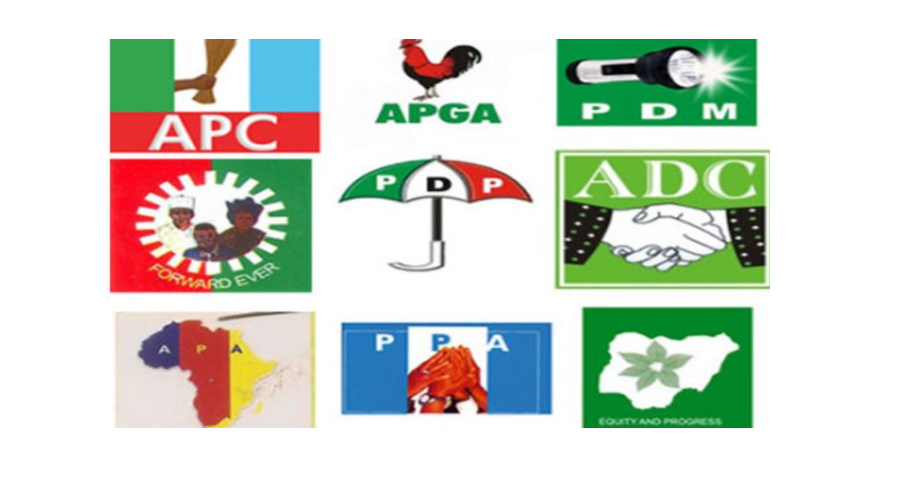
Sample of political parties in Nigeria (Source: Punch)
Yes, just as in markets, duopoly is never really good. You have these two dominant players who are more interested in their own gains than their customers. In the political industry, the customers are the voters – the Nigerian people. For Nigeria to innovate, we would need a redesign, and get out of the stasis we have found ourselves in this duopoly.
Yet, in the midst of the quagmire, Nigeria could have a future and a very good political party which does not need to be a party. That party is the hope of the Independent Candidacy which the APC restructuring committee has suggested.
Independent candidacy: … the committee still recommends that the party should support the demand for widening the political space by allowing for independent candidates. We believe that this will make the political party more honest.
The fact is simple: if we can allow the modification of the constitution to allow independent candidates in our political systems, you would see some pressures on the duopoly. The very fact that a Lagos banker could come home, and contest an election, would make the party gatekeepers irrelevant. If the man or woman has been good, and known in the community, nothing would stop victory. Independent Candidacy would make it possible for contestants to avoid the same people they have despised (ideologically), at least in local elections, and go out and win, for the good of the nation. We have to find a way to make that Independent Candidacy part of the law of the land because that is our best political party, if we hope to recover the soul of Nigeria, from APC and PDP.
That is how markets work; when you have a duopoly, the only way to fix the market imperfection is to enable new entrants. I am very confident that the National Assembly would allow that to happen. By having new entrants, you can improve the quality of the product, through competition. But it does not have to be just new political parties; independent candidacy would be the best for competition, as it reduces the burden for people with great ideas. We should demand for it to be!
The Guardian has a nice piece where it chronicled the evolution of 9Mobile including a prediction that Teleology Holdings, promoted by pioneer MTN Nigeria boss (Adrian Wood), is likely to take over 9Mobile. The company had submitted a bid of more than $500 million, at least $200 million, ahead of Smile Communications, the second highest bidder. Others like Globacom and Helios did not bother to submit any financial bid after their successful technical bids. Airtel had already noted that they saw many “hidden things” which were not revealed initially.
Bharti Airtel later came out to claim that too many “hidden things” were not revealed about the health of the troubled telecommunications company.Indeed, in the process leading to the final round of bidding, one of the shareholders in Etisalat, Spectrum Wireless, came out to demand for its return on investment, claiming that after investing about $35 million in the telecommunications firm, it was yet to get any return. The firm went to the court and gots an injuction quashing the CBN-led interim board. A Federal High Court, Lagos had on January 12 nullified the appointment of the interim board for 9Mobile. Justice Ibrahim Buba made the order based on an application by Spectrum Wireless Communication Ltd, which invested $35million in EMTS/Etisalat in 2009.
The report notes that Barclays Africa is now waiting for Teleology to back its bid with cash. So, if all goes according to plan, Teleology would take over 9Mobile for about $500 million. I am not sure how that amount would keep the cash-challenged telco operating; it has debts obligations with banks in the neighborhood of $600 million. Sure, it is possible there would be an equity play, with the banks keeping some equities besides the cash. In other words, even if Teleology wires the $500 million, the debts cannot be fully retired [yes, more than $500 million is unbounded; but we would work with $500 million]. Indeed, there are many things we do not know, and some options may not really make sense. Any buyer must still invest money to deepen the competitive capabilities of the fourth-largest mobile network operator, at least to keep its 17 million customers, and hold its 12% market share.
Smile team (source: African Telecom)
Zero Value for $35 Million Investment since 2009
Spectrum Wireless had gone to court, claiming that 9Mobile had misrepresented facts in the constitution of the new board. The court ruled in its favor.
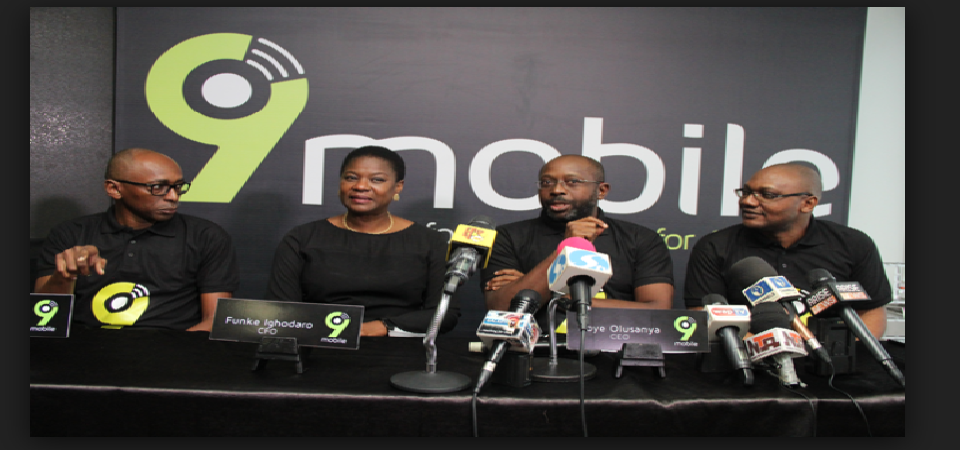
“The motion for stay is struck out having set aside the order. The respondent shall reverse all steps taken by it since the order was a nullity,”? the ruled.The order nullified the appointment of Dr. Joseph Nnana of the Central Bank of Nigeria (CBN) as chairman, Boye Olusanya as managing director, Mrs. Funke Ighodaro as chief financial officer, Seyi Bickersthet and Ken Igbokwe as members of the board of EMTS.
The key thing is that since Spectrum invested $35 million, it had not received any value. In other words, no dividend has been paid by the old Etisalat Nigeria or the new 9Mobile. Unless the company reinvested its profit, the implication is that 9Mobile (or old Etisalat NG) had not made any profit. Without profit, there would not be any dividend.
The Fourth Player
If they sell 9Mobile for $500 million, the Mubadala Development Company of the United Arab Emirates, the former largest shareholder, could justify its decision to write-off Etisalat Nigeria now. In other words, if the telco owned around $600 million, which it is required to pay, this new amount solidifies that decision to walk out. 9Mobile just lost at least $100 million of its value (based on the minimum outstanding debts), and if Mubadala Development Company had injected the new funds, this market-driven pricing efficiency would have been masked.
It is going to be extremely hard for any player that picks up this entity that is not Glo, Airtel or MTN. Being #4 in any wireless market is challenging. Number 4s rarely make money because the larger ones usually use scale to offer discounts which cripple the smaller players. I had expected an existing operating telco to take over. But it seems they developed cold feet when they saw 9Mobile books, as Airtel noted.
Finally, this game may just be starting. If the court follows through for Spectrum, this episode would have to be restated because even the Board in the eyes of the court was constituted illegally. Yes, as the court ruled, “[t]he respondent shall reverse all steps taken by it since the order was a nullity,” you can count that nothing has happened. Teleology would be extremely careless to wire funds for 9Mobile under that uncertainty. But if all holds, the winner here is Teleology because I see flipping as most markets rarely accommodate profitable #4 wireless operators.
The Nigerian Communications Commission (NCC) is the best government agency in Nigeria right now. Yes, you can have your own choice. I like NCC because it delivers results. The advent and the relative success of GSM in Nigeria should not be taken for granted. NCC got many things right. Nigerian bureaucrats have botched many great national visions. From water to electricity, we continue to struggle. Unlike NERC (Nigerian Electricity Regulatory Commission), the electricity sector regulator, NCC has made itself a recognizable brand.
Yet, the recent push by NCC on broadband may be very hard. The construct that ubiquitous 2G/3G in every part of Nigeria would catalyze economic growth has been at the core of the strategy. That is fine: Nigeria needs to pursue the aspirations to expand broadband connectivity.
But if you examine this from a business sense, as a telecom analyst with mandate to make money, it could be challenging. I do not really think anyone needs to preach to MTN, Glo, Airtel and 9Mobile to invest in new broadband infrastructures across Nigeria. They have the numbers, and would pursue growth where it makes sense. They do know that most Nigerians can talk but would hardly afford broadband services. In other words, for people making $2 per day, there is no business in building broadband infrastructures in their areas. Indeed, there is a huge difference between loading credit of N100 for voice and spending N1000 to check Facebook feeds. The former is a necessity to most Nigerians; the latter is largely a luxury across the nation.
Prof Umar Danbatta of Nigerian Communications Commission
So, it is going to be really hard for most telcos to justify the investments in broadband services, at least in the short term. That does not mean that NCC cannot try; that is its works, to push the entities to deepen connectivity nationwide. But expect it to be a hard one to achieve, as the telcos would not be a hurry to pick the instructions, and run with them.
The 30 Million Nigerians
If we discuss broadband connectivity and the associated required investment without considering the earning capacities of the users, we would fall into a trap. That trap is similar to parading Nigeria’s 180 million in population (some have 200 million; others 192 million. I like 180 million) when only about 30 million people earn decent income with spending power.
For most analyses, across industries, I like to work with 30 million people since that number is close to the total unique bank account users in Nigeria. Technically, anyone that does not have a bank account in Nigeria at the moment is largely poor. And when I do models for markets, for most products, I rely on this 30 million because those are the full market potential at the moment, unless the product is free or in some sectors like food. Most banks excluding First Bank which has about 14 million customers have lower than 10 million customers. That is not what you expect in a country of 180 million citizens. Yes, everyone is circling around 30 million people.
It is estimated that the Bank Verification Number exercise which links customers with their biometric data like facial features and fingerprints generated more than 28 million unique customers in Nigeria. Those 28 million customers accounted for about 52 million bank accounts in Nigeria. About 46 million accounts are not yet linked to BVN out of the total 98 million bank accounts in Nigeria, as at April 2017. (Please note that the exact statistics keeps changing. If you have the latest, please update in comment area).
This seems to be a more authoritative data on the total BVN number. Please note that this number is not the unique customers to the banks. In other words, some people have multiple bank accounts [ I know this number must have changed; if you have new numbers, share link in the comment section]
The total number of bank customers that now have Bank Verification Number (BVN) has increased to 51.72 million as at February 2017.
Data compiled from the Nigeria Interbank Settlement Systems Plc’s (NIBSS) website, showed that as at January 2017, the number of bank customers that had obtained their BVN stood at 50.92 million.
Now, where are those 30 million people? They are mostly in cities. That is why the telcos focus on the cities because that is where the customers are. That is also why the banks have most of their operations in the cities because that is where the people that can help them make money are located. So, if Nigeria funds broadband infrastructure in most rural areas, and fail to EMPOWER the citizens with economic opportunities, few would connect to browse. Simply, the infrastructure investments, from the lens of the telcos, cannot make business sense because the expected users are very poor to benefit.
Some numbers on Nigeria; most not unique users
The fundamental thing in Nigeria is economic empowerment. I am expecting all tiers and arms of government to pursue that with urgency. It is not really a question that if you have the broadband in rural areas, the people would use them to get out of poverty. That is not completely true: most would not because the web is still a luxury. They do not have the money at scale, and most telcos may not necessarily have the patience to put the massive investment, and then expect these citizens to rise up.
Taxing the 30 Million
To solve a similar problem in U.S., the government imposes taxes on every telecom user to help the telcos subsidize the cost of delivering telephony (not necessarily broadband) to rural America. So, the cost of voice services is cheaper in rural America even though in those areas the density is low which could have attracted more fees. But the taxes paid by those in the cities help mitigate potential loses to telcos for charging the rural people low. This is one area NCC needs to consider. Otherwise, expecting the telcos to invest in rural broadband, thinking that the investments would anchor the lifting of people out of poverty may not necessarily be true. You can build all those services and the people would not use them because they do not have the capacity to pay for them.
Yes, a better idea could be to find how the 30 million Nigerians could help. Indeed, as we talk of financial inclusion, we need to also add broadband inclusion in the national roadmap. That capacity to tax city-dwelling America to subsidize rural America connectivity is the missing link when people parade how broadband and telephony uplift people’s lives in Africa. If we do not model such strategies, we can build them, and they would be priced out of the reach of the same people we want to help.
De ja vu!! Interesting argument, I was also thinking about the infrastructure deficit we currently face in the Telecoms this week and I believe that in action the NCC is aware of this economic constraint. This is constraint is evident when you consider that we have been hovering around a penetration rate for some years now. The solution I thought of is for the FGN to treat Telco infrastructures required to deliver internet and voice capability as a utility infrastructure in that way Telcos can have the economics limitation preventing from building infrastructure removed. Fixed costs like RoW, Frequencies that enable rural and mass telephony and data should be given out at reduced cost. Tax points can be issued for building infrastructure in areas of lower economic development. This moratorium should be put in place for 5 years after which normal tax regimes can resume.
NCC has a role to facilitate sites on USPF (Universal Service Provision Fund) scheme. I know MNOs deploy such sites against negative ROI reports, primarily to deepen ICT penetration in the rural areas of Nigeria. I reason that they get refunded by the Government. When we say data penetration is less than 20%, it does not mean service coverage is not above 80% of our population. It means only 20% of total subscribers account for the multiple internet connections. A vast majority of phone users remain on voice only. A way to verify telephony coverage would be by light scan and cell coverage maps. Do not say 3G is not there, all 2G sites has GPRS function enabled. The next step for NCC is to drive improvement of KPIs which they understand better than anyone in Nigeria
The Nation newspaper ran a good piece on Zenvus today.
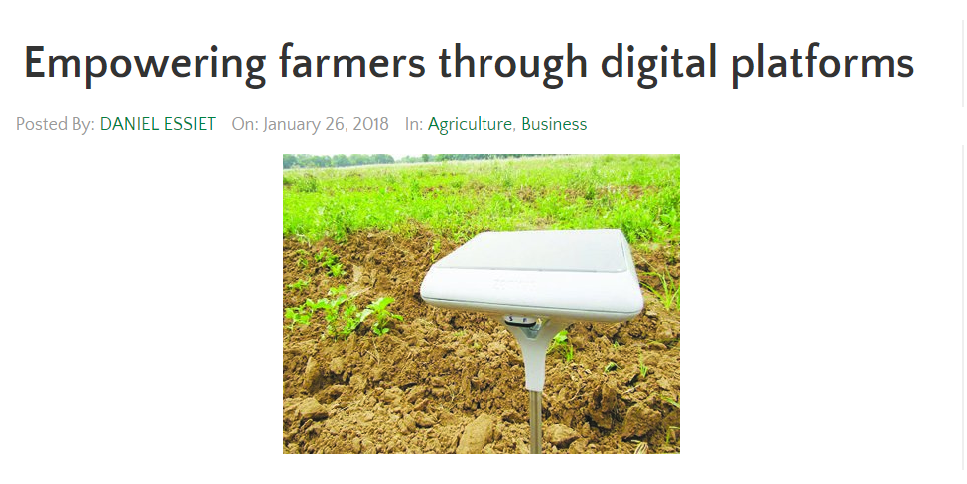
From precision farming to an efficient food supply chain, technology is bringing tremendous economic benefits to the sector. An application changing the face of Nigerian agriculture is Zenvus. Zenvus application was developed by Prof Ndubuisi Ekekwe, international scholar and founder of African Institution of Technology. The application measures and analyses soil data such as temperature, nutrients, and vegetative health. It helps farmers apply the right fertiliser and optimally irrigate their farms. The process improves farm productivity and reduces input waste by using analytics to facilitate data-driven farming practices for small-scale farmers.
To be a good advisor, you need to have capabilities. Nothing really matters to clients if you do not demonstrate competence. How do you expect them to re-redesign their businesses based on your recommendations if they do not trust you? Yesterday, I met mild pepper.
We had gone to the usual Board and Executive Management strategy session which my firm led for a Nigerian client. I began the program with a one-hour presentation. Everything was going fine until the Board Chairman said “Prof, can we put some of those new things in mathematical forms?” Yes, the Chairman holds a PhD in mathematics. He basically breathes maths.
I had spoken on growth, and of course I cannot provide context here. But simply, I was trying to get to the root cause of issues affecting growth and scaling in the firm. Briefly, we went into Limit, Functions and Sequence. My Further Mathematics in secondary school was helpful. I gave him this equation and 5 other supporting ones which I cannot share here.
Largely, if marginal cost goes to zero, you should expect exponential (or huge) growth (mathematically, the outcome should be “infinite growth” but it makes no practical sense to say “infinite growth” in business).
Using this equation, we went into convergence where the growth variables are now fixed points. Thank you Mohammed Bukar who introduced me to Mathematics in secondary school in Abia State.