DD
MM
YYYY

PAGES

DD
MM
YYYY

spot_img

PAGES

Home Blog Page 7252

A Nigerian 2019 Presidential Aspirant Commits To Implement Our Electricity Reform Proposal

2

Good People,

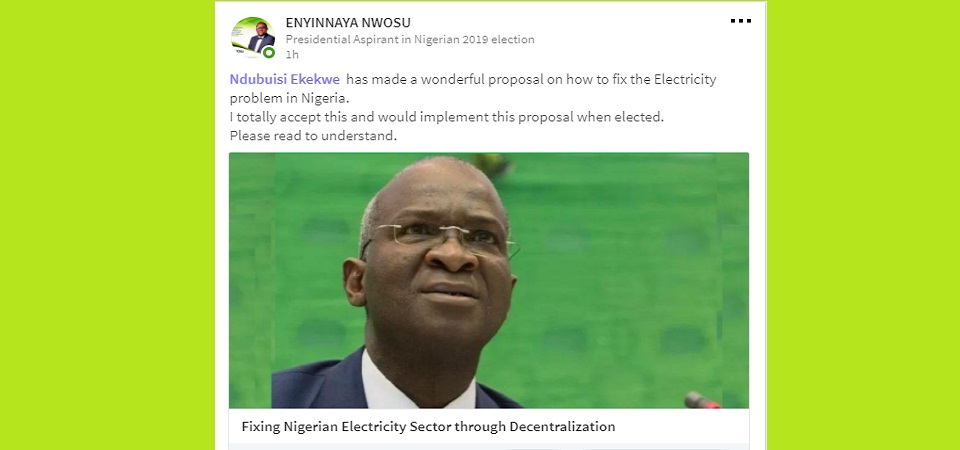
The big people are reading Tekedia. Barr. Enyinnaya Nwosu, a presidential aspirant for the Office of the Presidency, Federal Republic of Nigeria, has committed to implement our recommendations on the electricity sector. Barr Nwosu is one of the early aspirants for the keys to Aso Rock Villa, in 2019.

Ndubuisi Ekekwe has made a wonderful proposal on how to fix the Electricity problem in Nigeria. I totally accept this and would implement this proposal when elected. Please read to understand.

This is awesome. This is the proposal. You will like it.

By policy, I do not support any politician, but I work for all politicians. Politics is just a business sector which happens to be seasonal. Not working for any yet, though!

Google Honors Chinua Achebe on his Posthumous 87th Birthday

0

Google honors Chinua Achebe today for his 87th birthday. I knew that one of the reasons I desperately wanted to go to secondary school was to know what happened to Nwoye’s mother.

In Day by Day Book 6, in primary school, they summarized  a section. But the teacher would not finish the story, on Ikemefuna, telling everyone who wanted to know all parts of the story, yes Things Fall Apart, to apply for secondary school.

It was a marketing stunt between my village and the headmaster. Every kid liked the story and everyone applied to continue because we wanted to hear the rest of the story. It was like a movie: we wanted the part 2.

Then in JSS 2, everyone got a copy of Things Fall Apart, made possible by a son of the soil, a merchant in Aba. We then setup a reading challenge: finish the first 100 books of the African Writers Series.

Then I got to  the university, I noticed that Achebe was even writing in Igbo, via Okike – the journal of creative creating. Okike was one of his finest works where he pushed hard on the development of Igbo language with legendary FC Ogbalu and Tony Ubesie.


Thank you Achebe.

Nigeria Joins the Startup Fray, To Spend N458m To Hire Economic Growth Hackers

0

People, all the rants, strategies and discussions you are having on social media can turn out to be a money maker. The Nigerian government joins the tech world, looking for growth hackers. Yes, they need people that can hack national growth, similar to the ways startups employ managers, vice presidents, and staff with specific focus for hacking growth.

The Federal Executive Council on Wednesday approved the hiring of a consultant to conduct a study that will aid the implementation of the present administration’s Economic Recovery and Growth Plan.

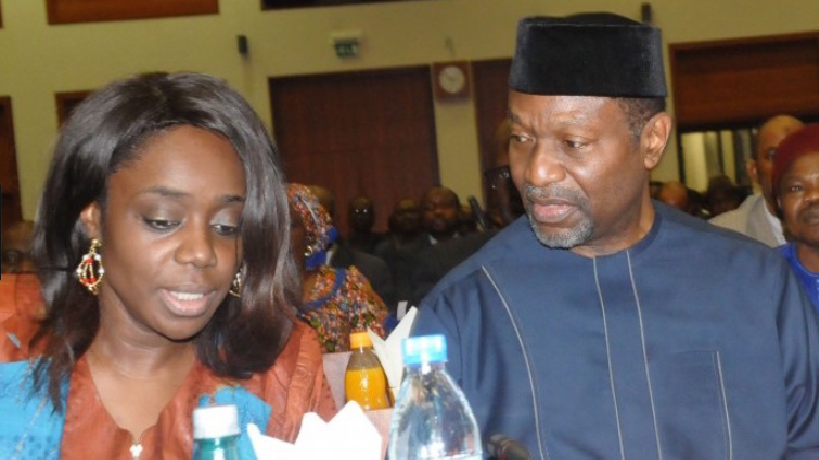
The Minister of Budget and National Planning, Udo Udoma, disclosed this to State House correspondents at the end of a meeting of the Council presided over by Vice-President Yemi Osinbajo at the Presidential Villa, Abuja

Udoma put the cost of the approved consultancy job at N458m.

He said the consultant would identify relevant stakeholders in both private and public sectors for the implementation of the ERGP.

He said the study would be conducted on agriculture, transportation, power, gas and processing, among others

I am not sure if the contract has been awarded or if they are still looking for tenders to begin the selection. Where this is still open, I hope guys organize themselves and compete. For the fact that it is made public, it means it will be transparent. And they will not likely give it to one company. They will spread the contract to at least 6 contractors, one per geopolitical zone. It is a multi-sector project which means they may look for different things.

Driving for Uber Does Not Mean You Run A Startup

0

In the technology pyramid, more value is created at the top: the upstream level has more value than the downstream level. There are more participants in the downstream than the upstream. Companies that play at that upstream have accumulated more capabilities which help them solve key frictions in the market to be in those positions. Because they are fewer, they control pricing more efficiently, and earn better margins.

In the technology arena, many downstream players look for opportunities. In Airbnb, people rent their free spaces in their homes to strangers and make small money. Airbnb is the upstream participant while those renting their spaces are at the downstream players.  In Uber, people drive: Uber is the upstream player while the drivers make up the downstream.

I see Airbnb as a better opportunity, if you indeed have that space, than Uber. Why? Uber ties your time, which means when you are driving, that is the only thing you can be doing at that time. So, that is the job, at that moment. But in Airbnb, the money can be flowing even when you are busy pursuing other things: you do not need to be fully engaged to make that money.

Then, the economics do not really work for Uber in the long-term. Uber drivers will deal with the laws of supply and demand, and must reach price equilibrium point. That equilibrium point will never move to higher-paying drivers, in the long-term. In other words, over time, the value Uber creates for its drivers will drop, at individual level, even though it may be paying more collectively. This working paper explains:

Using a city-week panel of US ride-sharing markets created by Uber, we estimate the effects of sudden fare changes on market outcomes, focusing on the supply-side. We explore both the short-run dynamics of market adjustment, as well as the eventual long-run equilibrium. We find that the driver hourly earnings rate—essentially the market equilibrium wage—moves immediately in the same direction as a fare change, but that these effects are short-lived. The prevailing wage returns to its pre-change level within about 8 weeks. This return is achieved primarily through permanent changes in driver “utilization,” or the fraction of hours-worked that are spent transporting passengers. Our results imply that the driver supply of labor to ride-sharing markets is highly elastic, most likely because drivers face no quantity restrictions on how many hours to supply and new drivers face minimal barriers to entry.

But for Airbnb, you do not have that problem since you can continue doing whatever you are doing as it does not tie up your time. The Uber example is even clearer in this piece from QZ.

Here’s the logic: Imagine Uber normally charges $1 per minute and $1 per mile, and it increases that to $2 per minute and $2 per mile (these numbers are obviously made up). In the short term, drivers will earn a lot more, because, well, both rates have doubled. But over time, a couple things happen. One, because Uber suddenly lets them earn more, drivers work more hours. Two, because Uber is now more expensive, people order fewer Ubers.

That brings me to the discussion when Uber drivers in Lagos say they are running startups. I used some of them. I simply commended them for finding a way to take care of family. There was no need of going into deep argument or explanation. But ideally, there were not running any startup: there were small businesses. There is nothing wrong with that. We want people to go out and take care of families. It is free enterprise.

Anyone driving for Uber should not see himself or herself as running a startup since that business is not scalable from the drivers angle. You can only drive one car at a time. The business does not have the organic capability that can make it grow. But of course if you focus on buying cars and deploying many people to drive Uber for yourself, then you have a business, and you can be called an Uber-dependent startup.

But irrespective, market pricing equilibrium will make Uber drivers to struggle in making decent income, over time. When the rates for Uber drivers go up, more drivers will be available.  Those drivers can make good money, in the short term. But over time, riders will reduce the number of rides because fares are now high. When that happens, using dynamic pricing, Uber will have to reduce the rates for drivers to jumpstart more rides. That will push the price to low-price equilibrium. Unless during emergencies or special occasions, this equilibrium should hold up over long term, meaning that price will be low. So, driving for Uber means you must be open to go with low rates. It is not really the fault of Uber; rather, it is the high price elasticity of the product.

The Italian Azzurri Crashed, American Soccer Retreats, Alabama Crimson Tide Soars: Business Lessons

0

Italy, yes, the Azzurri, will not be playing in the 2018 World Cup in Russia. That will be the first time that Italy would fail to qualify since 1958. In a match that decided its fate, the four-time world champions could not overcome Sweden. Sweden will be in Russia while the Italians will enjoy their coffee and pizzas as they watch the games on televisions and online video streams, at home.

Few weeks ago, U.S. Soccer team also failed to qualify: Trinidad and Tobago knocked out the U.S. team.

United States is a brilliant nation. It has the capacity to connect its citizens to a shared vision. From science to technology, literature to military, America has always set the global benchmarks. But in one specific sports, soccer (yes, football in anywhere else), America continues to struggle. This year, a very small country, Trinidad and Tobago, extinguished the U.S.’s plan to play in Russia 2018 World Cup. That is it: U.S. Men Soccer lost to Trinidad and Tobago and will not play in the next World Cup.

But my favorite sports team in America, the college football undisputed king, the Alabama Crimson Tide of the University of Alabama Tuscaloosa continues to perform. The Crimson Tide is so consistent that you know what you are getting when they march into the field against an opponent. As the Tide rolls, expect people living longer in Alabama (oh yes, football is a religion in Southern America!). With no top-four professional leagues (National Football League, Baseball, Hockey and Basketball) in that state, the Tide and the Tigers (The University of Auburn) are all that the citizens have as top-grade sports.

In all these occasions, there is a business lesson: legacies mean nothing, what matters is what is happening now. Yes, IBM was a storied tech juggernaut but today we have the likes of Google and Amazon eclipsing it. GE was iconic, but GE has since lost what made GE supremely legendary. Markets do not care about legacies, they care about results. When the results fizzle, markets move to the next great firms.

The Systems

There are three things in football (soccer for Americas) as you build teams: recruit, train (or prepare) and deploy. You have to have the talent, and you have to train them. Then, you need to deploy them to go and win games. The recruitment means that you must have a pipeline of talent from which you can assemble those that will work with the coach. Where you do not have that, a great coach may struggle.

In a scenario where you have the team, the next phase is preparation. That is where the coach leadership and capabilities come into play. Lastly, after you have done preparation, you must condition the team to go out and execute the strategy. They need to play, as you have prepared them.

U.S. Soccer: Soccer is a new game in America. It is not attractive and the finest sports people in U.S. have better options. Why join a soccer league to be paid $40,000 per year when you can play American football or basketball and command millions of dollars? The U.S. Soccer does not have the talent and that is the biggest challenge today. Without that talent pipeline, the training and deployment fail. The problem that stifle progress there is Recruitment.

Italy Football: The Serie A, the Italian league, has since lost its shine, and evidently diminished compared to the glory days legends like Maradona, Lothar Matthäus and George Weah played in it. Today, Serie A is a shadow of its past.  The best footballers do not see Serie A as the top destination. So, with a broken local league, Italy faces a challenge on building national teams. Yes, they still have Juventus but that will not be enough. The problem with Italy is not lack of talent, but preparation. If the league is not strong, even the best talent may not flourish. The problem in Italian football is at the phase of Preparation.

England has the same problem few years ago when it also failed to qualify for World Cup and then instituted that Premier League teams must commit to develop local football even if they are not playing English players. England was addressing the Recruit issue, at least to develop the talent pipeline. England has a good league but continues to struggle with local talent.

Alabama Football: The Alabama football team is the most successful college football program in the last ten years in America. Its recruitment is legendary with some of the reserves very capable of being starters in some other college programs. Also, the coach of the team, Nick Saban, has developed a process which makes it easy to build a consistent system. College football is inherently challenging because the average duration for players is about 2.5 years since most do not start on first year in college and within four years they have to graduate. The very best do not even wait to graduate; they abandon school and join the professional league. The implication is that a coach will have to recruit new students to develop, constantly. That process of finding them is not easy. There is nothing like contract as the students can also transfer to other schools. So, Nick Saban has recruited right, prepared the players, and then motivated them to go out and execute. The implication is evident: the team is winning.

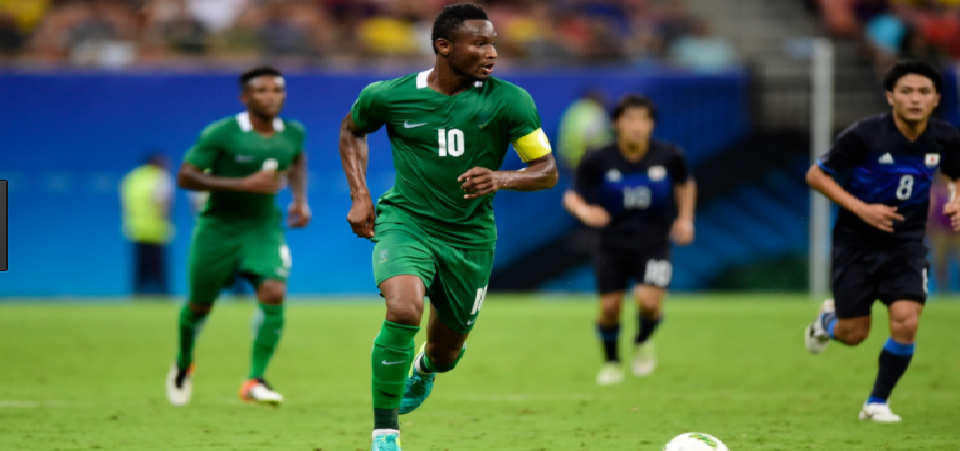
The deployment phase is critical. In most African national football teams, we do have talent though we struggle with preparation. But even when we prepare right, the deployment could be an issue.  Imagine in cases where Nigeria’s Super Eagles or Elephants of Côte d’Ivoire say they would not play unless their allowances are paid. With that challenge, these players are not in the best conditions to go out and execute anything they have been prepared for.

Business Lessons

Largely, running a sports team mirror how companies function. We compete for talent. We train staff and we expect them to perform their duties right. They need to execute so that we can win in the market place. If you want to start an AI company in Nigeria, you may struggle with elite AI talent, and that immediately puts you at a huge disadvantage to Silicon Valley. Also, in some sectors where you have seen the talent, but the training apparatus to develop them severely lacking, you can still struggle. Besides, there is the issue of staff motivation in order to execute the corporate goal and mission. When you miss any of those phases, companies struggle.

We talk of legacy, but truthfully markets do not respect such. There are constant disruptions happening and those disruptions are based on these factors of recruit, train and deploy. If you pay very close attention to them, you can get to Alabama Football quality. The Crimson Tide has mastered how to manage all the phases, and yearly, it presents to America a strong football team with potentials to win championships. It has a process, and there is something to learn from a team that remains consistent despite losing more than 70% of its players to graduations, professional leagues, etc yearly. If a sports team can work with that, it means companies with longer staff tenures should even perform better.