Over the last few years, we have seen the development and growth of the video-on-demand sector. iROKOtv is the undisputed leader in Nigeria. It commands great brand equity and is a recognizable leader in the industry.
But in coming years, the sector will see massive competition. With DStv, TStv, Showmax, GoTv, Supersports and the regular TV stations competing for attention, it is time for iROKOtv to explore if it can build a merchandising business in Nigeria. I do think there is a latent opportunity in the market for that, and any new revenue source will help the firm to finance its growth. It needs contents to stay on top with amalgam of options like Netflix arriving in the region.
For iROKOtv to have effective merchandizing, it may need to begin building characters in its movies. And that means, having a long theme that runs seasonably instead of the one-off model of today where movies come, and movies go. This present model cannot easily allow the firm to develop characters which can connect with fans, to open the merchandising business. The following are areas it can build merchandising business:
Sweater
T-Shirts
Action figurines
Toys
I also suggest that iROKOtv explores working with its top actors and actresses on merchandising. Besides, it can also partner with leading supermarkets like Shoprite to display its characters in its stores. As a modern company, having a Konga store to sell these items will be good. It can outsource the merchandising business so that it is not distracted from its core movie making business. And most importantly, it must make sure that the distribution channel is well managed to avoid the piracy of its wares.
Walt Disney Co. is a merchandise behemoth and Netflix is working on developing a huge merchandising business. But for iROKOtv to have success, relatively, like these American companies, it must develop a roadmap that produces movie series and premieres as I have noted above. As it does that, it needs to think critically about what kids will want and that means making movies for kids in Africa so that it can monetize the merchandising via toys, shirts and other things.
When you have more sources of revenue in any business, good things happen. I do think iROKOtv can make merchandizing work out. It simply needs to outsource it to partners who will take all the risks.
Every month, when I look at my company bank statements from different jurisdictions, I always notice one obvious anomaly in the Nigerian ones. Banks charge you fees for banking and doing business with them. In U.S., banks actually pay you money for banking with them. In other words, if you want to open an account in most U.S. banks, they give you free bonus. If you are aggressive, you can get up to $400 just for opening an account and setting up direct deposits in some banks.
U.S. banks want you to send your money to them. And at the end of the month, in most great banks like M&T Bank, no one will charge you a fee. No single debit in your account. In some bigger ones like Bank of America and Chase, they may require a minimum daily balance (say $1,500) or a direct deposit of say $750 to avoid about $10 monthly fee. If you maintain either, you will not have any fee penalty.
But in Nigeria, there are many entries on all kinds of fees. I used to work in the bank in Lagos. But then, it was Commission on Turnover (COT) – this is the fee, the bank imposes on your account for actually withdrawing your money. I have called it one of the most ingenious products that propelled the new banking era in Nigeria. Without COT, there will not be many new generation banks. They offered better services than the dinosaurs of the older banks, but needed to monetize the obvious preferences of their services in order to invest in technology and new operational models. Customers knowing the value in better service did not complain. The COT provided easy cash and they triumphed, took market share from old banks. So, even if they do not make loans to earn interests, provided that customers are coming and withdrawing money, they would make money. That is a setup that will never fail. They bring the customers with efficient services and then charge fees on their accounts as they do transactions.
To illustrate how critical COT was to most new generation banks, some were closing accounts of customers who had money with them but were not moving them in and out. For instance, if you have N100,000 in your account for a year without touching it, some of the banks would make a bank draft, informing you that the account has been closed. They have no need for that money because they were not necessarily interested in the money. They wanted the COT only. Yes, no need to invest your money to earn interest fees. But have N10,000 in the account and tomorrow you withdraw it and the next day you put it back, you become a damsel as that movement will generate COT for banks. That is why banks like traders because they generate so much volume and that means COT: say N3 per thousand, you can see massive income when people deal on millions of Naira.
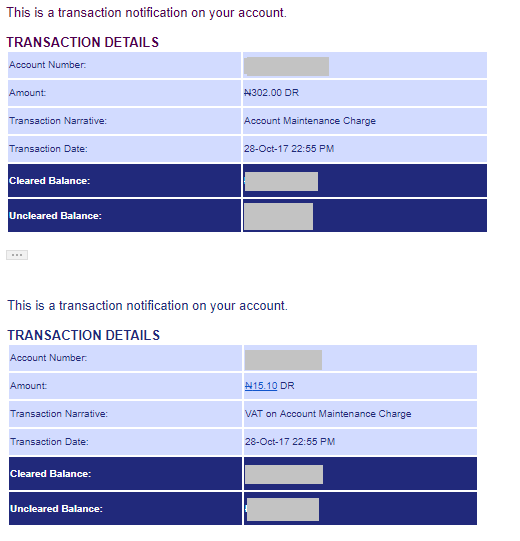
The Central Bank of Nigeria killed COT. But quickly, we saw new types of charges – Account Maintenance Charge. That charge also comes with a VAT. So, the banks charge you a fee and then ask you to pay VAT on it. That is the law of the land.
A Nigerian company bank fees
Then as you are dealing with bank maintenance charges, there is another one – the Stamp Duty. That one annoys me terribly because the duty is simply designed to make money from customers. All the transactions are done digitally and yet banks have to buy stamps! Sure, the cost of the stamps is irrelevant. It is an inherited nonsensical tradition from the British Empire which thinks that unless you stamp a document, it may not have full legality. Visit Corporate Affairs Commission, High Court etc and you will see stamps in action: if they do not put those stamps, some of the documents may not be completely valid. This means that you have to pay the stamp duty for that digital-based bank transfer to be legally binding!
A Nigerian bank fee
Yes, I must note that some of these new fees are imposed by the Central Bank of Nigeria (CBN) on bank customers. So, it may not necessarily be banks’ money: they share with CBN.
The Implications
There are people that do not want to bank in Nigeria simply because of the fees. For a citizen that makes a minimum salary of say N18,000 per month and has to withdraw money four times, you will see that at the end of the month, the person may be losing close to N500 especially if the individual has SMS alerts which attract another fee class (The SMS fee is expected, banks have to cover their costs on that one. They do make Internet banking free.)
Nevertheless, there could be a bank that can waive the SMS fees since by regulation banks are required to prepare monthly statements for their customers. Of course, having real-time information on payment via alert is priceless. People will prefer to pay for that instead of waiting for the monthly statements which the law expects from banks. SMS is good and customers can ask for it to be deactivated; it is an optional service. In technology, Nigerian banks have made progress.
But for the poorest citizens in Nigeria we are trying to bring into the banking fold, we need to think how other core non-optional fees can discourage them. I do not see how some of these citizens will embrace the banking sector with these fees. Either you want them to keep the money in the pillows or you reform the banking fee charges to make them attractive for extremely cost-sensitive people to bank. Without that, CBN may not be addressing the root cause of the issues before us on financial inclusion.
I must note that Savings Account in most Nigerian banks do not attract fees. However, some require a minimum balance which technically you cannot even draw below. In Union Bank, the amount is about N1,500 and that means unless you close the account, that minimum must be there. For some poor citizens, that balance is a huge burden.
All Together
To accelerate financial inclusion, the Central Bank of Nigeria should reform the varying levels of fees in the banking sector. Those fees could be discouraging the very people it wants to attract into the banking sector. For someone making N18,000 monthly and having to part with N300-N500 on fees and associated SMS charges, it could be a disincentive to bank. People are smart and when there is a burden via fees for extremely cost-sensitive people, any policy will collapse. CBN needs to revisit bank fees and work with our banks to find better ways to offer products that can reduce cost burdens on poor citizens. This is not a problem that technology can fix because the fintech companies do not take customer deposits. So, it is only policy that can solve this, and only the central bank has the capacity to make that happen. Yes, banks are not charities and are there to make money. So CBN needs to balance its policy.
Editor’s Note: Bolarinwa Durojaiye has worked in the Oil and Gas industry for over 10 years in the role of Information Systems Infrastructure Administration, with a particular passion for leveraging technology innovation for business process/workflow optimization. Bolarinwa is co-founder of Megacity Technologies, a startup with the mission of leveraging smart technology/smart city solutions to enhance the quality of life in emerging economies. @bdurojaiye
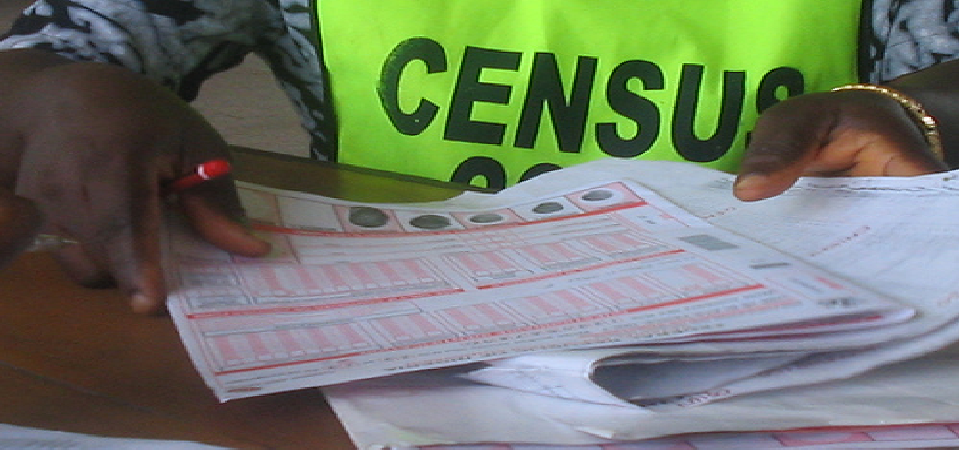
It is no news that the planned Census exercise, scheduled for 2018 is estimated to cost about 272 billion naira. These official figures were given by the Director General of the NationalPopulation Commission, Ghaji Bello in an interview in early April, sparking off debates about the wisdom of spending such an amount in the current challenging economic climate. Concerns have also been raised as to the timing of the exercise and the high risk of politically-motivated manipulation if the census is conducted before the 2019 elections.
What is the money for?
According to Mr Duruiheoma, Chairman, National Population Commission, the sum of N272 billion would be required for “procurement of hand-held devices for the biometric based census, engagement of 1. 5 million field staff, training of field officers and other preparatory activities”.
We probably all know that there are myriads of bio-metric data sets currently available to the Nigerian government. If you have an international passport, driver’s license, voters card or national identity card, your unique bio-metric data exists in all these disparate data repositories. This then begs the question: why does the government want to expend huge resources to create yet another biometric identity database silo?
A better way
My suggestion is to start with the largest data set currently available: the GSM number database.
According to Nigerian Bureau of Statistics figures, as at January 2017, there were about 150 million GSM subscribers. Factor in that most Nigerians have at least two numbers, and we can estimate perhaps about 75 million unique identities captured in the bio-metric databases and fully accessible to the government. This represents about 40% of the total Nigerian population, a high percentage even by international standards.
MVN not BVN
The regulatory requirement for registration and biometric data capture for all GSM and telephone lines could be seen a step in the right direction, but this was only the first step. With a bit more strategic thinking and planning, this exercise could have been conducted with the same approach as the Banker’s Verification Number (BVN) exercise and in this case would have produced what I call a Mobile Verification Number (MVN). Considering that the current BVN database size is about 30 million, it is obvious that the MVN represents a much larger sample set and in actual fact is a superset of the BVN database, since can safely assume that every bank account holder has a registered phone number. The logical conclusion of this is that if we had a consistent, verified Mobile Verification Number system, the entire BVN exercise with its associated costs would have been unnecessary. All that would have been required was to get all bank account holders to VERIFY and LINK their bank accounts with the existing biometric identities as captured in the MVN database.
Better late than never
So the National Communications Commission (NCC) didn’t get that one right, but it is not too late. Advanced deduplication technology is available to merge and harmonize the disparate biometric data from all the various GSM and telecoms providers into one consolidated database. Indeed, this deduplication process was applied successfully to remove identical records during the voter’s registration process for the 2015 elections.
If the NCC, in collaboration with National Identity Management Commission, can succeed in producing consolidated biometric identities each of which we can describe with a unique Mobile Verification Number (MVN), then this can form a ‘master’ National Identity Management base-line, within which the BVN can either become a single data field, or be replaced by the MVN and become obsolete.
Registration/application for all other identity related documents like the International Passport, driver’s license, voters card or national identity card would be verified against the master database simply by placing fingers on a fingerprint scanner.
The Value
The benefits of a consolidated, ‘living, breathing’ identity management system for the Nigerian economy are innumerable: Everything from government social intervention schemes, universal healthcare, banking credit, national security, crime prevention and prosecution, the electoral process and pretty much every aspect of the economy is dependent on an efficient Identity Management System.
Conclusion
Regardless of how much the 2018 national census will cost, these funds and the accompanying colossal effort should not be wasted on a fresh biometric capture exercise.
Rather, the strategy should be for biometric verification of the 75m identities that have already been documented, and capture of only the remaining undocumented part of the population.
My guess is that this will not cost up to N0.27 trillion.
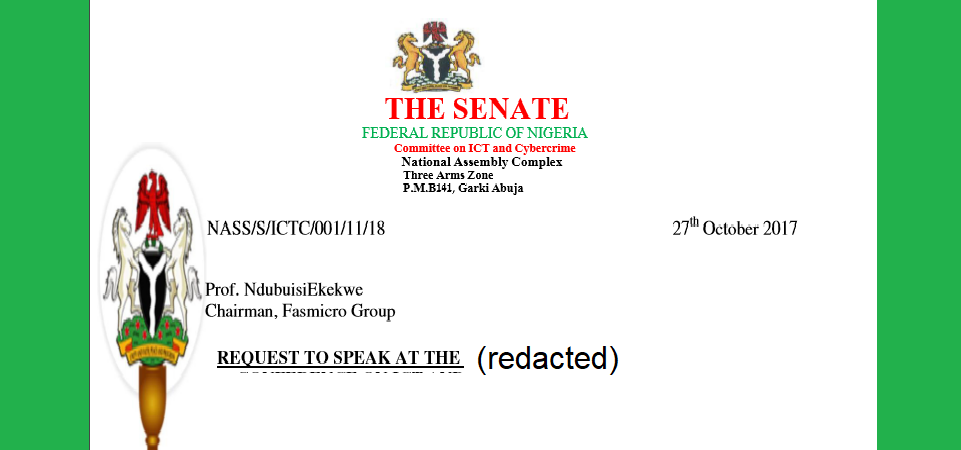
I have accepted an invitation to speak to the Senate Technology Committee next month. This is largely a restricted meeting with so many important national issues to be discussed. It is invitation only and is not open to the public or the press. I will speak on national technology readiness with specific focus on an area I cannot discuss here.
But I need your broad suggestions and pointers on what to share with our leaders. I do this a lot in most other African countries where they actually pay me good money to speak. But no fee here, it is Nigeria. I consider it an honour to be invited. So, I am not going to make money with your idea.
Where possible, please share. You can email me directly via Tekedia contact (team will process) or my LinkedIn InMail. I will acknowledge in bulk. Please again, do not move from the topic and let us be respectful as we collaborate on this.
Bottomline: In this piece, I explain why the Nigerian Society of Engineers will request to begin the regulation of banking infrastructure in coming years. As banks become engineering institutions (Goldman Sachs employs 9,000 engineers), they are doing many engineering projects. Yet, engineering regulation has not come to them, unlike other sectors like oil & gas, […]