DD
MM
YYYY

PAGES

DD
MM
YYYY

spot_img

PAGES

Home Blog Page 7266

Zenvus Boundary Franchise Opportunity Opens

5

Today, we are opening our franchising opportunity across Africa for people and entities to use Zenvus Boundary to serve their farming communities. We have piloted the administration of this service and the outcome is superb. So, we are scaling the service to the whole African farming market.

Beginning immediately till January 17 2018 [extended to give people time after the long holiday], we are looking for proposals from makers, entrepreneurs and entities that want to build on top of Zenvus Boundary (not Zenvus sensor; that one is coming later). Essentially, you will work with governments, cooperatives, micro-finances, banking institutions, farmers etc and use our technology to map farmers’ boundaries [you decide your market; we want to see from your proposal]. We have reduced the cost of mapping by a factor of 50 through technology.

Zenvus is an intelligent solution for farms that uses proprietary electronics sensors to collect soil data like moisture, nutrients, pH etc and send them to a cloud server via GSM, satellite or Wifi. Algorithms in the server analyze the data and advice farmers on farming. As the crops grow, the system deploys special cameras to build vegetative health for drought stress, pest and diseases. Our system has the capability to tell a farm what, how, and when to farm. It has in-built GPS, compass and accelerometer making it possible for a farmer to map the boundaries of his/her farm which could be useful during loan and insurance applications. One of the solutions available in Zenvus is Zenvus Boundary.
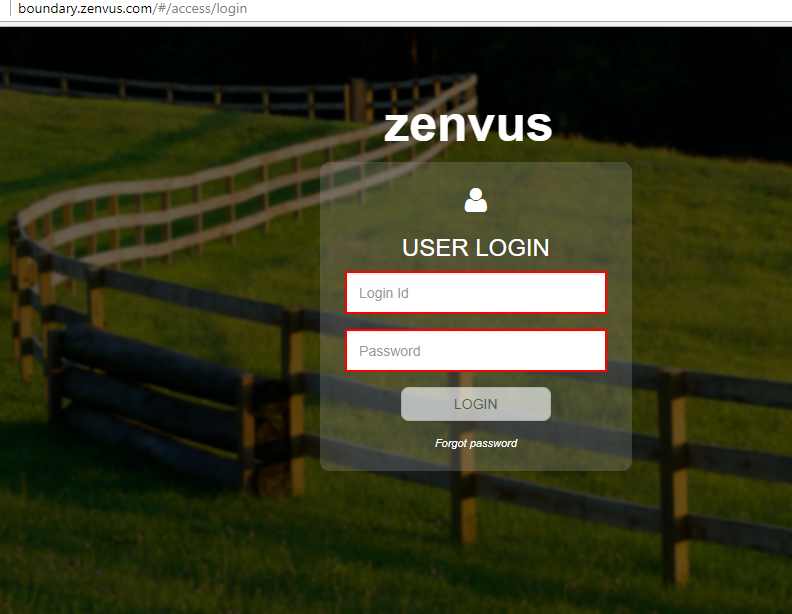
Login into Zenvus Boundary Partner Account

Zenvus Boundary maps farm (land, home, office or any landed property) boundaries and populates them via GIS on Google Map where the survey maps can be printed in our portal. And when done, register with their cooperatives which help them ratify the boundaries with governments. We use this to formalize farmlands and enable financial inclusion. Below is a sample result which the farmer can take to a bank as collateral for loans, after ratification by the local government..

How To Apply

Send us a one page document explaining why we should select you/your entity as a partner in the specific region in Africa where you want to cover [we want to see your scaling strategy. That means how you will get services to map boundaries of farms. Are you going to meet farmers one by one or would you approach a government, NGO, etc to pay you to do so for farmers?]. Your requested geographical coverage cannot be more than a state even though you can start from a state and expand. But at this point, we want you to specify the same or a part of a state you want to focus.

You will use our technology to support farmers in the digitization of their farmlands. We will take a very small commission from your charges to farmers or whoever is paying for the farmers. Also, you will be required to pay a small franchise membership fee (if we select you). Please we want you to see this as an investment, and that is why we are imposing the fees.

Application Deadline: Jan 7, 2018

Email to send application: zenvus@fasmicro.com

We will (privately) announce the selected entities on Jan 15, 2018. Selected partners will automatically join the Zenvus Developer Community.

Farm boundary from Zenvus Boundary

 

The BUA Group And Dangote Group Fight Should Stop

1

The Nigeria government needs to weigh in and stop the escalation of value-destroying tendencies between BUA Group and Dangote Group. Alhaji Abdulsamad Rabiu, Chairman of BUA Group, and Alhaji Aliko Dangote, Chairman of Dangote Group, are two of Nigeria’s leading industrialists. Over the years, I have noticed that these people and their respective entities are taking competition to the ugly paths. The latest is about rights to limestone, a key raw material for cement production.

Today, a news organization, APO Group, which has been distributing contents for Dangote Group released this:

The management of BUA Group has been using armed militia, soldiers and policemen to mine marble and limestone in mining sites allocated to the Dangote Group, the Ministry of Mines and Steel Development  has alleged.

In a statement signed by the ministry’s Permanent Secretary, Mohammed Abass, and made available to our correspondent, the ministry said the company had been using a combination of armed militia, soldiers and policemen to obstruct the ministry’s team from executing the stop work order issued to the company in October.

The ministry’s statement was in response to an open letter to President Muhammadu Buhari by the company alleging that a minister was involved in sabotaging its operations.

Abass said that in the records of the Ministry of Mines and Steel Development and the Nigerian Mining Cadastre Office, the BUA Group did not have a mining lease over the contentious site (No. 2541ML) and was therefore engaged in illegal mining.

He stated, “The ministry stands by the stop work order issued to the BUA Group and signed by the Permanent Secretary dated 17th of October 2017.”

The letter was issued after thorough investigation confirmed that the BUA Group was indeed engaging in illegal mining of marble/limestone at a mine pit located on geographical coordinates N070 21’ 47.4’ E0060 26’ 51.8’, while the run-of-mine is stockpiled at an area with geographical coordinates N070 21’ 48.4’; E0060 26’37.2’.”

“Clarification provided by the Mining Cadastre Office shows that the coordinates of the mine pit and RoM stockpile area fall wholly within the area of mining Lease No 2541ML belonging to Messrs Dangote Industries Limited.”

You do not need an oracle to know that the Dangote Group is behind the press release by  APO. Dangote Group and the ministry may have cogent points, but the way they have been handling this matter is not necessarily good for Nigeria. BUA Group, according to Reuters, feels that Dangote Group is trying to bully it to “relinquish mining rights in a limestone field as part of a bid to monopolise the cement market”. It rightfully asked the Nigerian president to intervene. Mr. President is yet to comment.

Nigerian conglomerate BUA group has accused Dangote group of trying to force it to relinquish mining rights in a limestone field as part of a bid to monopolise the cement market and asked the president to intervene, BUA’s chairman said

[…]

“Our cement business has of late come under intense, consistent attacks … as the minister, Dangote group and their cohorts have sought to employ instruments of state … to forcefully wrest control of our mining areas,” BUA said in a letter to President Muhammadu Buhari and seen by Reuters on Wednesday.

Rabiu called on Buhari to investigate. He said the company was under pressure to relinquish its mining area to Dangote.

This Goes Beyond Limestone

Forget what is happening today, BUA Group and Dangote Group have been fighting for the soul of Nigeria through cement, for years. In 2015, BUA Group wrote an open letter against the Nigerian Government for providing favorable foreign exchange to Dangote Group for its Congo business. The open letter which was published in many print newspapers attacked the heart of Dangote’s strategy which is pushing governments to offer concessions before investments. But something was different: Congo was not Nigeria and it was immoral to subsidize the investment through the special forex offered by the Nigerian central bank. BUA Group reasoned that Nigeria should not be paying conglomerate tax for investments in Congo. The letter was the first time we saw the level of animosity between these billionaires.

Buhari Needs to Step In

The Dangote group controls about 70% of Nigeria’s cement market in terms of output. BUA is an emerging player. The Cement market in Nigeria is littered with many broken promises: only Dangote Cement has flourished. The core of BUA accusation here is that the market leader wants to bully it to relinquish its source of raw material. If that happens, Nigeria will lose. Yet, Dangote Group has put a claim, maintaining that the asset is under its rights.

The government, especially the President should step in and see how to resolve this issue. This has gone beyond what a minister can do, since BUA does not even believe anything the ministry of Mines and Steel Development is saying, having noted that the ministry was working for its competitor.

They need to resolve this and get back to growing their enterprises. And President Buhari has a role to play here, urgently. This also explains why our mining rights must be digitized. Doing so will eliminate issues where two billionaires are fighting for the same thing, claiming  legal rights to the same property.

Two Key Pillars for Viral Digital Marketing

0

I used to write for the world. But no one cared. Then I focused on Nigeria and Africa, my network started noticing. It turns out that digital marketing has a secret sauce when you want to expand business through organic content origination. There is nothing like generic audience. In the drive to win all, you […]

This post is only available to members.

Nigerian Consulate Shanghai Republishes My Opinion on China and Nigeria

0

I like it when my piece makes it to the high chambers of power. Few days ago, I got a request for permission to reproduce one of my articles (Nigeria Needs To Invest To Understand China) in the Nigerian Consulate Shanghai website. Of course, it was CARRY GO. Now, they have it online.  I know that government is reading us. This site is not built for click-bait but deep conversations on Nigeria, Africa and their economies.

Note: The following article is entirely the opinion of Ndubuisi Ekekwe and does not reflect the views of the Nigeria Consulate (Shanghai).

I admire China. That country is very brilliant in its technology policy. In its economic and commercial policies, it is not far behind. I do not know of any nation in history that has accomplished what it did. It condensed what took the West one hundred years into 25 years. China has a population that is bigger than Africa’s, but its people are not dying in the Mediterranean, for attempting to smuggle themselves into Europe for menial jobs.

I must also commend those in the Ministry of Foreign Affairs, Nigeria: someone could have read that piece as attacking them. Yes, anytime a piece is not praising a government/company, but offering a new perspective, some will think it is an attack. But interestingly, the Nigerian foreign experts in Shanghai liked it to the point of sharing it on their website. That is a good development for democracy.

SAP Africa, Google Africa Laughable Training Numbers

0

Africa is largely operating on perpetual statistics-free construct. Anyone can throw any number it wants. It happens all the time, but when you see leading global brands do so, you will sob.

In 2010, I was in California where I asked former U.S. Vice President, Al Gore, that his message on climate change was tainted because American companies would do in my country (Nigeria) what they would never do in America. I explained to Mr. Gore that Chevron would not flare gas in Texas but in Nigeria, it was a business policy. Same company, but different attitudes, in different lands!

Mr. Gore took time and explained why only local leaders could change the world. You may make all the laws in the world but it is left to local leaders to enforce them or where necessary improve them to meet local needs. Simply, he threw it to Nigerians to police Chevron in the way they would expect the energy giant to behave.

African kids learning (credit: SAP)

The SAP and Google Training Numbers

The same double standards we are dealing with energy companies are creeping into technology companies. From SAP press release:

With an ambitious target of training half a million African youth between 18 and 25 October, Africa Code Week again this year exceeded all expectations by empowering 1.3 million youth across 35 countries with basic coding skills. This is also a 203% increase over the 2016 iteration, which had seen nearly 427 000 youth trained across 30 African countries.

[…]

According to Claas Kuehnemann, Acting Managing Director of SAP Africa, much of Africa Code Week’s success lies in the strength and support of its partners and collaborators. “Over the past three years Africa Code Week has grown into one of the best-supported and most far-reaching digital skills development initiatives on the African continent, with a broad range of governments, NGOs, private sector companies, educators, students and scholars all contributing to empowering one of the largest and most youthful workforces on the planet. We extend our gratitude to everyone who made this year such a resounding success, and look forward to building on its best practices over the years to come.”

Yes, SAP through its works has trained 1.3 million young Africans on coding. Clap your hands as we have extra 1.3 million coders for 2017 alone. I call this unfortunate because no one challenges these companies when they throw out these nice pleasing press releases.

African Sstudents learning (credit: SAP)

Google is doing the same thing through its efforts to train 10 million Africans on the workforce of the future. When I visited Nigeria last time, I attended an event where one of those training programs happened. What I saw was a four-hour PowerPoint presentation. The trainer explained all the digital strategies. At the end, everyone in the audience has been trained on digital marketing. Perhaps, she got there 250 and the march to 10 million continues.

Alphabet Inc’s Google aims to train 10 million people in Africa in online skills over the next five years in an effort to make them more employable, its chief executive said on Thursday

Google’s pledge marked an expansion of an initiative it launched in April 2016 to train young Africans in digital skills. It announced in March it had reached its initial target of training one million people.

The company is “committing to prepare another 10 million people for jobs of the future in the next five years,” Google Chief Executive Sundar Pichai told a company conference in Nigeria’s commercial capital of Lagos.

There is no problem with what SAP, Google and others are doing. They are offering services and people truly benefit. We must commend them and support them. However, I hate it when they design different standards on initiatives because they are in Africa, leaving what has worked in America. Google will not use the word “train” if it goes into Baltimore (USA), show a PowerPoint and come out to tell the governor that it has trained the citizens. That will not happen.

For Google to claim it has trained, it must have actually impacted real skills to young people. Apple is investing money in community colleges to train students on how to code. This investment involves hiring new teachers, buying equipment, upgrading curricula and then executing a program over months for the kids. When they graduate, they would have been trained indeed. Toyota North America does a similar thing on welding, casting etc. I mean these companies impact real skills to young people.

Water Everywhere, But No Water to Drink

If Google has produced REAL one million digital marketers and SAP produced 1.3 million basic coders just for 2017, you will feel the impact in Africa. Where are they? The reality is that there is marginal value, as those claimed to have been trained are not even aware that they have been trained. Google, SAP and others have the right incentives but they want big numbers to look great. Unfortunately, that is not necessary.

Google and SAP are smart companies: they know that picking 100k young Africans and develop them as elite coders and professionals will have more impacts than what they are doing today, pursuing mass numbers in millions.

But they will continue to do so, as no one cares to question them to improve, and deliver value, even as they take credits on things which do not necessarily exist. I do not believe that the 1.3 million coders that SAP is claiming it has trained this year have met the basic standards of coding. They may use the word “exposed” but using “train” is a disservice to companies that offer real training to young people. This is not a game of quantity: quality rules, and SAP and Google are the best companies to know that. Africa’s problem is not that we do not have 3 million coders. In my opinion, the issue is that we do not have good 100,000 coders.

Yes, if Google takes 100,000 young people and turn them into elite digital professionals and SAP picks 100k and do the same thing, the continent will experience more catalytic impacts than the poorly prepared millions. I commend the generosity: they just have to make the initiatives more impactful by focusing on quality over quantity.