DD
MM
YYYY

PAGES

DD
MM
YYYY

spot_img

PAGES

Home Blog Page 7275

Nigeria Needs To Invest To Understand China

6

I admire China. That country is very brilliant in its technology policy. In its economic and commercial policies, it is not far behind. I do not know of any nation in history that has accomplished what it did. It condensed what took the West one hundred years into 25 years. China has a population that is bigger than Africa’s, but its people are not dying in the Mediterranean, for attempting to smuggle themselves into Europe for menial jobs.

Yet, China is not perfect. It is a puzzle that no one understands. The West will bash it, only for the next day to ask China to come to party. It is a country that has become so confident of itself that it wants most things done on its own terms.

Think about it: China banned Facebook in the country, but it is also one of the main advertises on Facebook. It does not make sense, but when you pay more attention, you will understand that China operates that way. For all it does in the world, it is what it thinks will help its economy that matters. If advertising on Facebook makes that possible, there is no problem with that.

Cisco is now on its 8th consecutive quarterly drop, not because of competition from any U.S. company, but because of one major Chinese company named Huawei. In a period of global expansion, who would have projected that Cisco will be in this type of mess. Huawei has won, not just on pricing but also on technology.

If you go deeper, the trouble in GE today and its cutting or eliminating dividends momentarily is because of competition from China. The more I study all the press releases and the statements from GE, the more I see one key factor: GE is extremely powerless because its markets have changed dramatically. It will be tough quarters ahead for GE. Chinese state enterprises own the markets GE is participating in right now. Always remember that when China brings funds, Chinese companies do the jobs with Chinese machinery and technologies. When that happens, someone has to win and some will of course lose.

Even the challenges IBM has faced recently can be attributed to China. If the global economy is expanding and some of the finest Western companies are experiencing decreasing revenues, it simply means that someone is taking market share from them. China is indeed that someone. The wins are everywhere including in supercomputing.

Overall, China now leads the supercomputing race with 202 computers to the US’ 144. China also leads the US in aggregate performance. China’s supercomputers represent 35.4 percent of the Top500’s flops, while the US trails with 29.6 percent. With an anti-science regime in charge of the government, America will only continue to see its technological lead decline.

When I read that Qualcomm is investing millions of dollars in China, I smiled.

“This group of innovative companies focuses on AI, IoT and other areas. We strive to help these companies make their ideas and creativity a reality, by providing financial, technology and business support. Qualcomm Ventures will continue to enable innovation among startups in the frontier tech areas, and help grow the entire industry,” Quinn Li, VP and global head of Qualcomm Ventures, said in a statement.

Simply, from Qualcomm to Apple, Google to IBM, everyone has seen that the future belongs to China. It is obvious and there is nothing within view that can change that trajectory. China has advanced so much in manufacturing that no one even wants to try anymore. To try, you simply have to pay Chinese to come and open a branch office in your locality as the state of Wisconsin USA is doing.

Gov. Scott Walker (R) and Foxconn Technology Group Chairman Terry Gou will sign a final agreement Nov. 10 granting the electronics giant $3 billion in tax incentives for a massive manufacturing campus in southeastern Wisconsin.

Yes, an American state is offering $3 billion tax incentives to a Chinese firm. That is the story these days: China is coming and it has its own terms. You either comply or another nation takes the opportunity. And what they are doing is working as they continue to rack up billionaires. From Wall Street Journal:

The number of  billionaires in Asia surpassed that of the United States for the first time last year, according to a report by UBS and PricewaterhouseCoopers. The number of Asian billionaires grew by 23% last year, compared to 5% in the US, and half of those billionaires were Chinese.

According to Fortune Magazine, “on average, a new billionaire is minted there every other day” in Asia. That Asia is primarily driven by China. China is winning and there are many reasons why that win will continue:

  • China has a working leadership that gets things done. When they want to execute on a project, China mobilizes its citizens to get that job done
  • China is winning on trade. When you win economically, good things happen. As they turn out great empires like Alibaba, Tencent and Huawei, the strength of China will widen. Forget that Chinese government plans to take “equities” in some of these digital companies. That is also why it is China – a government takes equity in a private company so that it can be part of the company’s strategic decision making.

On top of all the external controls, Beijing is also considering taking a stake in some of China’s largest internet companies, according to the Wall Street Journal. Planting a flag in those firms would likely give the Chinese government a more absolute role in corporate decision-making.

  • China is doing a lot in the technology space. Some of the most fascinating technology companies of the future will come from China. The resources they have will give them an edge.

All Together

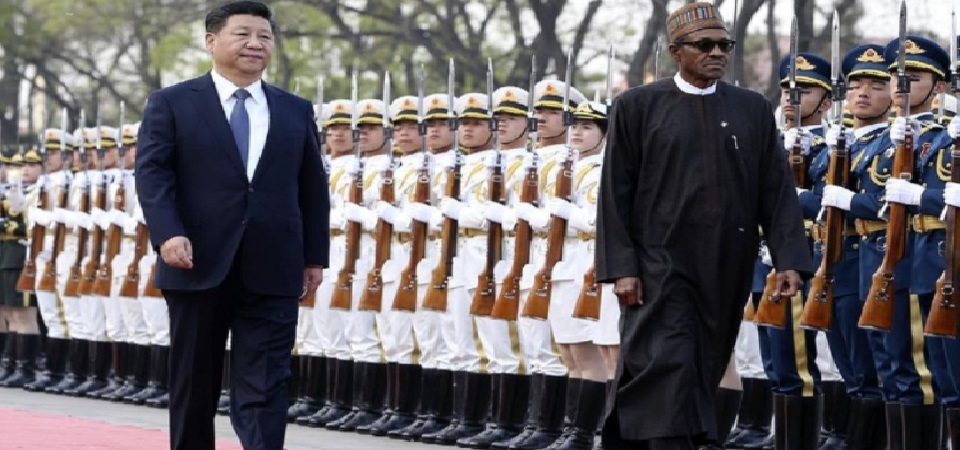
My recommendation for Nigeria is to push towards a stronger relationship with China. We need to be thinking of the state of the world in 30-50 years and how China is going to be making most calls. A man that gives cash is always at better positions to one that gives credits. China comes with cheque while the West comes with forms to apply for credits. You can accuse China on whatever you want to accuse it, but the fact is this: it is not freezing your brain to agree to its terms. If a Chinese company had come to Nigeria with a condition that it would not pay tax for years, many people will complain. But Wisconsin State, USA did just that. Brazil has been doing that regularly, attracting Chinese firms who use Brazil to serve Latin America. We need to have a real policy to understand China.

I do believe that Nigeria can begin that process by making efforts to structure its scholarships (NDIC, NITDA, NCC, etc) to include Chinese universities, not just American and European ones.  And those scholarships cannot just be for technology and engineering, but also policy. When we understand China, it will be easier for us to do business better with China.

A Nigerian 2019 Presidential Aspirant Commits To Implement Our Electricity Reform Proposal

2

Good People,

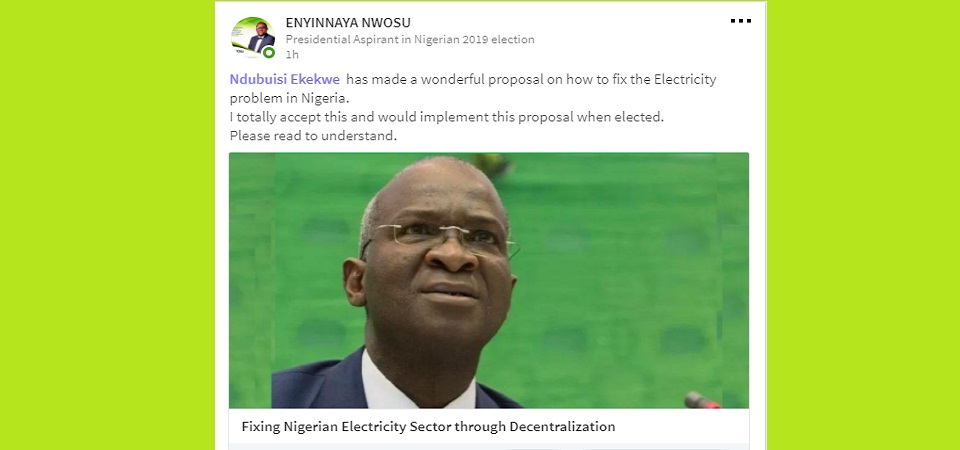
The big people are reading Tekedia. Barr. Enyinnaya Nwosu, a presidential aspirant for the Office of the Presidency, Federal Republic of Nigeria, has committed to implement our recommendations on the electricity sector. Barr Nwosu is one of the early aspirants for the keys to Aso Rock Villa, in 2019.

Ndubuisi Ekekwe has made a wonderful proposal on how to fix the Electricity problem in Nigeria. I totally accept this and would implement this proposal when elected. Please read to understand.

This is awesome. This is the proposal. You will like it.

By policy, I do not support any politician, but I work for all politicians. Politics is just a business sector which happens to be seasonal. Not working for any yet, though!

Google Honors Chinua Achebe on his Posthumous 87th Birthday

0

Google honors Chinua Achebe today for his 87th birthday. I knew that one of the reasons I desperately wanted to go to secondary school was to know what happened to Nwoye’s mother.

In Day by Day Book 6, in primary school, they summarized  a section. But the teacher would not finish the story, on Ikemefuna, telling everyone who wanted to know all parts of the story, yes Things Fall Apart, to apply for secondary school.

It was a marketing stunt between my village and the headmaster. Every kid liked the story and everyone applied to continue because we wanted to hear the rest of the story. It was like a movie: we wanted the part 2.

Then in JSS 2, everyone got a copy of Things Fall Apart, made possible by a son of the soil, a merchant in Aba. We then setup a reading challenge: finish the first 100 books of the African Writers Series.

Then I got to  the university, I noticed that Achebe was even writing in Igbo, via Okike – the journal of creative creating. Okike was one of his finest works where he pushed hard on the development of Igbo language with legendary FC Ogbalu and Tony Ubesie.


Thank you Achebe.

Nigeria Joins the Startup Fray, To Spend N458m To Hire Economic Growth Hackers

0

People, all the rants, strategies and discussions you are having on social media can turn out to be a money maker. The Nigerian government joins the tech world, looking for growth hackers. Yes, they need people that can hack national growth, similar to the ways startups employ managers, vice presidents, and staff with specific focus for hacking growth.

The Federal Executive Council on Wednesday approved the hiring of a consultant to conduct a study that will aid the implementation of the present administration’s Economic Recovery and Growth Plan.

The Minister of Budget and National Planning, Udo Udoma, disclosed this to State House correspondents at the end of a meeting of the Council presided over by Vice-President Yemi Osinbajo at the Presidential Villa, Abuja

Udoma put the cost of the approved consultancy job at N458m.

He said the consultant would identify relevant stakeholders in both private and public sectors for the implementation of the ERGP.

He said the study would be conducted on agriculture, transportation, power, gas and processing, among others

I am not sure if the contract has been awarded or if they are still looking for tenders to begin the selection. Where this is still open, I hope guys organize themselves and compete. For the fact that it is made public, it means it will be transparent. And they will not likely give it to one company. They will spread the contract to at least 6 contractors, one per geopolitical zone. It is a multi-sector project which means they may look for different things.

Driving for Uber Does Not Mean You Run A Startup

0

In the technology pyramid, more value is created at the top: the upstream level has more value than the downstream level. There are more participants in the downstream than the upstream. Companies that play at that upstream have accumulated more capabilities which help them solve key frictions in the market to be in those positions. Because they are fewer, they control pricing more efficiently, and earn better margins.

In the technology arena, many downstream players look for opportunities. In Airbnb, people rent their free spaces in their homes to strangers and make small money. Airbnb is the upstream participant while those renting their spaces are at the downstream players.  In Uber, people drive: Uber is the upstream player while the drivers make up the downstream.

I see Airbnb as a better opportunity, if you indeed have that space, than Uber. Why? Uber ties your time, which means when you are driving, that is the only thing you can be doing at that time. So, that is the job, at that moment. But in Airbnb, the money can be flowing even when you are busy pursuing other things: you do not need to be fully engaged to make that money.

Then, the economics do not really work for Uber in the long-term. Uber drivers will deal with the laws of supply and demand, and must reach price equilibrium point. That equilibrium point will never move to higher-paying drivers, in the long-term. In other words, over time, the value Uber creates for its drivers will drop, at individual level, even though it may be paying more collectively. This working paper explains:

Using a city-week panel of US ride-sharing markets created by Uber, we estimate the effects of sudden fare changes on market outcomes, focusing on the supply-side. We explore both the short-run dynamics of market adjustment, as well as the eventual long-run equilibrium. We find that the driver hourly earnings rate—essentially the market equilibrium wage—moves immediately in the same direction as a fare change, but that these effects are short-lived. The prevailing wage returns to its pre-change level within about 8 weeks. This return is achieved primarily through permanent changes in driver “utilization,” or the fraction of hours-worked that are spent transporting passengers. Our results imply that the driver supply of labor to ride-sharing markets is highly elastic, most likely because drivers face no quantity restrictions on how many hours to supply and new drivers face minimal barriers to entry.

But for Airbnb, you do not have that problem since you can continue doing whatever you are doing as it does not tie up your time. The Uber example is even clearer in this piece from QZ.

Here’s the logic: Imagine Uber normally charges $1 per minute and $1 per mile, and it increases that to $2 per minute and $2 per mile (these numbers are obviously made up). In the short term, drivers will earn a lot more, because, well, both rates have doubled. But over time, a couple things happen. One, because Uber suddenly lets them earn more, drivers work more hours. Two, because Uber is now more expensive, people order fewer Ubers.

That brings me to the discussion when Uber drivers in Lagos say they are running startups. I used some of them. I simply commended them for finding a way to take care of family. There was no need of going into deep argument or explanation. But ideally, there were not running any startup: there were small businesses. There is nothing wrong with that. We want people to go out and take care of families. It is free enterprise.

Anyone driving for Uber should not see himself or herself as running a startup since that business is not scalable from the drivers angle. You can only drive one car at a time. The business does not have the organic capability that can make it grow. But of course if you focus on buying cars and deploying many people to drive Uber for yourself, then you have a business, and you can be called an Uber-dependent startup.

But irrespective, market pricing equilibrium will make Uber drivers to struggle in making decent income, over time. When the rates for Uber drivers go up, more drivers will be available.  Those drivers can make good money, in the short term. But over time, riders will reduce the number of rides because fares are now high. When that happens, using dynamic pricing, Uber will have to reduce the rates for drivers to jumpstart more rides. That will push the price to low-price equilibrium. Unless during emergencies or special occasions, this equilibrium should hold up over long term, meaning that price will be low. So, driving for Uber means you must be open to go with low rates. It is not really the fault of Uber; rather, it is the high price elasticity of the product.