DD
MM
YYYY

PAGES

DD
MM
YYYY

spot_img

PAGES

Home Blog Page 728

EV Sales Surge as Americans Race to Beat September 30 Tax Credit Deadline

0

Electric vehicle sales in the United States are experiencing a sharp spike as consumers rush to take advantage of tax credits worth up to $7,500 before they expire at the end of September.

The looming deadline, set under legislation backed by Republicans in Congress and signed by President Donald Trump in July, marks a dramatic policy shift that will effectively eliminate federal incentives for new, used, and leased EVs after September 30 — a full seven years earlier than originally planned under the Biden administration’s Inflation Reduction Act.

Under Biden’s plan, the credits would have remained in place until 2032, part of a broader strategy to cut greenhouse gas emissions from the transportation sector, which is the single largest contributor to U.S. emissions. The change now leaves a narrow window for buyers to lock in significant savings, pushing the EV market into a frenzy.

Auto analysts say the surge is unprecedented. Stephanie Valdez Streaty, senior analyst at Cox Automotive, predicts the third quarter could set an all-time record for EV sales.

“People are rushing out to buy because they know the incentives are going away,” she said.

In July alone, Americans purchased nearly 130,100 new EVs — the second-highest monthly sales total on record, just behind December’s 136,000. That’s a 26.4% jump from June and almost 20% higher than a year earlier. EVs made up 9.1% of all passenger vehicle sales for the month, the largest share ever recorded.

Used EVs are also seeing record demand, with nearly 36,700 sold in July, according to Cox data. Certain models have emerged as clear winners, including the Chevy Equinox EV, Honda Prologue, and Hyundai IONIQ 5. The Equinox EV alone sold 8,500 units in July — the highest single-month total for any non-Tesla EV in the U.S. Tesla, still the market leader, has seen its own sales slip for two straight quarters, down 12% year-over-year in Q2 and 9% in Q1.

The appeal of the tax credits is simple economics. A new EV costs an average of $55,689, compared to $48,078 for a new gasoline-powered car. With the federal credit, the price gap all but disappears, bringing an EV’s cost to around $48,189 — near parity with conventional vehicles. Without that subsidy, the affordability advantage vanishes overnight.

Tom Libby, analyst at S&P Global, warns that the end of the credits will “jeopardize” EV price competitiveness, even as state governments and utility companies continue to offer smaller, localized incentives.

Dealers are making the most of the ticking clock. Tesla’s homepage now blares “$7,500 Federal Tax Credit Ending” alongside “Limited Inventory — Take Delivery Now,” urging customers to finalize purchases before the cutoff. To sweeten the deal, automakers are stacking additional discounts on top of the federal credit. In July, new EV buyers received an average of $9,800 in extra incentives from dealers, worth 17.5% of the average transaction price, the highest level since before EVs began to gain mainstream traction in late 2017.

But the rush may be short-lived. Analysts warn of a steep drop in sales once the tax credit disappears.

“EV sales are likely to collapse in the fourth quarter of 2025,” Streaty said, predicting that the market will have to recalibrate to a new financial reality.

One possible bright spot could be the used EV market, which has already been growing without much help from incentives. Only about one-third of used EVs sold qualified for the $4,000 federal credit even before the policy change, suggesting demand won’t crater as dramatically. With more used EVs entering the market and fewer subsidies for new ones, analysts expect pre-owned models to attract more buyers in the months ahead.

However, the looming expiration of federal incentives has created a paradox of an artificial boom in sales today, shadowed by the threat of a sharp contraction tomorrow.

Gold Prices Retreat As White House Moves to Quell Tariff Concerns

0

Gold prices retreated from their record-breaking high on Friday after the White House sought to quell fears that certain imported gold bars could be hit with steep U.S. tariffs, a move that had sent tremors through the global bullion market and stirred diplomatic unease with Switzerland, the world’s largest gold refiner.

On Thursday, gold futures closed at an unprecedented $3,491.30 per ounce, buoyed by a rush of speculative buying as investors braced for potential trade restrictions. But prices eased to $3,463.30 after Washington announced plans for an executive order aimed at “clarifying misinformation” over which gold products would be affected by the recently imposed 39% tariff on Swiss exports.

The market shock began earlier in the week when the U.S. Customs and Border Protection clarified that standard 1-kilogram and 100-ounce cast gold bars, the workhorse formats of international bullion trade, would not be exempt from the new tariff measures ordered by President Donald Trump. This detail cut deep because such bars account for a significant portion of Switzerland’s gold exports to the U.S., and their sudden cost inflation risked upsetting both trade flows and price stability.

The Swiss Precious Metals Association reacted with alarm, warning that the policy could “disrupt the international flow of physical gold” and fracture one of the most enduring trade relationships in the commodities sector. Christoph Wild, the association’s president, underscored the broader stakes, saying: “We are particularly concerned about the implications of the tariffs for the gold industry and the physical exchange of gold with the U.S., a long-standing and historical partner for Switzerland.”

A centuries-old gold connection

Switzerland’s central role in the global gold market is not new. Its refineries, concentrated in towns like Ticino and Valcambi, process nearly two-thirds of the world’s mined and recycled gold each year. Much of this output, after meeting the highest purity standards, is shipped to major financial centers, including the United States, where it underpins jewelry manufacturing, investment products like ETFs, and central bank reserves.

U.S.-Swiss gold trade has historically been stable, even during periods of global turbulence. During the 1970s oil crises and subsequent inflationary shocks, Switzerland’s refining capacity ensured a consistent supply to the American market, helping stabilize prices at a time when gold became a refuge asset.

Tariffs and precious metals — a volatile mix

While tariffs are common in manufactured goods, applying them to precious metals has historically had outsized consequences. In the early 1980s, for instance, temporary restrictions on South African gold — imposed amid apartheid-era sanctions—led to a surge in prices and a scramble for alternative suppliers, forcing refiners and traders to reroute supply chains at higher costs. Similarly, in the 1990s, when India briefly increased its import duties on gold, smuggling spiked and formal trade volumes dipped, demonstrating how sensitive the market is to sudden policy shifts.

In the current scenario, analysts warn that even the threat of tariffs on Swiss gold could push traders to explore alternative refining hubs in Asia or the Middle East, potentially diminishing Switzerland’s central role. This shift would not happen overnight, but the mere possibility adds uncertainty to a market where confidence in supply continuity is crucial.

Also, any sustained increase in tariffs on gold imports could affect not just traders and jewelers, but also the investment vehicles tied to physical bullion. Exchange-traded funds (ETFs) backed by gold could face higher acquisition costs, while retail buyers might see premiums rise on coins and bars. The effect could also ripple into currency markets, as countries holding large gold reserves reassess their sourcing and hedging strategies.

Gold is still hovering near its all-time high, but with the White House’s clarification pending, market sentiment is fragile. Some analysts believe that definitive exemption for Swiss bars could stabilize prices, while confirmation of the tariffs could trigger another wave of volatility, and potentially redraw the map of global gold trade.

Tesla Secures Texas Approval To Operate A Statewide Robotaxi

0

Tesla has secured a major regulatory green light in Texas, obtaining a permit to operate a statewide ride-hailing service through its subsidiary, Tesla Robotaxi LLC.

The license, granted by the Texas Department of Licensing and Regulation (TDLR), is valid until August 6, 2026, and allows the company to function as a “transportation network company” anywhere in the state. Uniquely, this classification also covers “automated motor vehicles,” meaning Tesla is not required to have a human safety driver or valet in its vehicles during operations.

The development comes after Tesla’s quiet rollout of a limited pilot robotaxi service in Austin in late June, where the company invited a select group of passengers—many of them social media influencers and Tesla analysts—to experience rides in its Model Y fleet equipped with its latest partially automated driving technology. These vehicles have so far been operated with a valet or human safety supervisor in the front passenger seat, tasked with intervening when necessary, and monitored remotely by Tesla staff at an operations center.

While CEO Elon Musk, who has famously described himself as “pathologically optimistic,” believes Tesla can serve half the U.S. population with autonomous ride-hailing services by the end of 2025, the road to that vision is far from smooth. Tesla’s autonomous vehicle (AV) program has long been under intense scrutiny. The company has faced federal probes, lawsuits, and recalls related to incidents involving its Autopilot and Full Self-Driving (FSD) systems, which regulators say still require active human oversight despite Musk’s repeated promises of full autonomy.

The Texas permit marks a turning point, as the state has historically been more permissive toward AV testing compared to jurisdictions like California, where Tesla has faced harsher pushback. A new Texas law signed by Governor Greg Abbott will soon require AV makers to obtain state approval before launching driverless services, with the Texas DMV empowered to revoke permits for safety violations.

For now, the green light positions Tesla to expand without some of the regulatory roadblocks seen elsewhere.

However, the company’s pilot in Austin was greeted with controversy. Videos and eyewitness accounts have documented Tesla robotaxis running traffic lights, failing to stop at train crossings, and making risky maneuvers. In one case, Tesla content creator Joe Tegtmeyer reported that his robotaxi ignored a train crossing signal and lowered gate arm, forcing a Tesla employee on board to intervene. The National Highway Traffic Safety Administration has since confirmed discussions with Tesla about the incident.

Also, Tesla’s AV push has been plagued by a history of unmet deadlines. Since 2016, Musk has claimed Tesla could make all its EVs fully autonomous via a software update. In 2019, he pledged one million robotaxis by 2020—a projection that helped secure $2 billion in investor funding at the time. Yet, competitors like Alphabet’s Waymo in the U.S. and Baidu’s Apollo Go in China remain far ahead in fully driverless ride-hailing operations.

Now, with Tesla shares down 18% this year—making them the worst performer among tech’s megacap stocks—analysts see the Texas permit as both a bold expansion opportunity and a high-stakes gamble. Given Tesla’s safety record, mounting legal challenges, and the gap between Musk’s promises and delivery, some industry analysts believe the company will face significant pressure to prove it can operate robotaxis at scale without repeating past missteps.

If Tesla succeeds, the Texas approval could be a springboard for broader adoption of its robotaxi vision across the U.S. If it fails, it will add to the growing list of ambitious Musk timelines that never materialized.

AI Fuels Digital Advertising: The Top Gainers

0

Artificial intelligence continues to fuel a resurgence in digital advertising, providing a significant boost to tech giants and reshaping competition across the online ad market.

A CNBC report notes that Meta and Alphabet both reported second-quarter sales and earnings that exceeded Wall Street’s expectations, with AI-powered ad optimization emerging as a central growth driver. Meta CEO Mark Zuckerberg credited artificial intelligence with creating “greater efficiency and gains across our ad system,” helping to deliver a 22% year-over-year jump in revenue to $47.52 billion.

Meta’s Chief Financial Officer, Susan Li, added more color during a follow-up call with analysts on July 30, noting that the online ad market had improved since April, particularly among Asian-based e-commerce companies. Earlier this year, such firms had pulled back sharply on U.S. ad spending in response to President Donald Trump’s aggressive tariff policies and the closure of the de minimis trade loophole, which previously allowed low-value imports to bypass certain duties.

Li said the rebound in spending was complemented by stronger activity from small, North American advertisers — a signal that confidence in consumer demand may be stabilizing.

“We generally expect another quarter of healthy advertising demand,” Li told investors, underscoring the broader recovery trend.

Gil Luria, head of technology research at D.A. Davidson, framed the sector’s resilience as part of a larger economic story.

“Digital advertising in general is doing well; it is simply an extension of the fact that the consumer is still strong,” Luria said. “There’s optimism that consumer spending will hold up and therefore all the downstream markets will hold up.”

Jasmine Enberg, vice president and principal analyst at eMarketer, emphasized that the strong core performance at Meta and other tech giants has enabled them to sustain heavy AI investment without alarming investors.

“You can spend a lot of money on AI when your core business is doing well, and especially when your core business has already been benefiting from those AI investments,” she said.

The scale of this spending remains staggering. Alphabet has increased its 2025 capital expenditure forecast by an additional $10 billion, bringing it to $85 billion. Meta has also raised the low end of its capex guidance for this year to between $66 billion and $72 billion, up from the previous range of $64 billion to $72 billion. Investors have largely shrugged off these massive commitments because sales at both companies continue to rise.

While the largest platforms consolidated their dominance, other players in the digital ad ecosystem saw mixed results. Reddit staged a remarkable turnaround, reporting $500 million in second-quarter revenue — up 78% from a year earlier — which sent its shares soaring as much as 20%. Luria described the company’s performance as a “phoenix” moment, especially given that its shares had plunged more than 15% in February after a Google search algorithm change weakened user growth.

In contrast, Snap and Pinterest delivered lackluster results. Snap’s revenue grew just 9% year-over-year, missing analyst expectations for global average revenue per user. CEO Evan Spiegel acknowledged that a problematic update to the company’s advertising platform hurt “topline growth.” In a sign of growing rivalry, Snap’s latest 10-Q filing formally listed Reddit as a competitor, highlighting the shifting competitive landscape in social media and digital advertising.

Pinterest fared worse in market reaction, with shares falling more than 10% after reporting second-quarter results that missed earnings per share estimates. CFO Julia Brau Donnelly reiterated that the company continues to see some tariff-related caution among advertisers and broader market uncertainty. Unlike Meta, Pinterest has not yet seen a rebound from Asian-based e-commerce retailers, which have remained hesitant to increase U.S. ad spending.

Enberg noted that the diverging fortunes of these companies illustrate the pressures facing smaller platforms in a volatile global economy.

“There’s very little room for mistakes or missteps,” she said, pointing out that in times of uncertainty, advertisers often consolidate budgets with the largest, most proven platforms.

For now, the momentum is firmly with the giants. Meta and Alphabet are demonstrating that when consumer spending is robust and AI is delivering tangible returns on ad efficiency, investor appetite for even larger AI investments remains strong. But analysts say for smaller competitors, the path forward will require not only technical innovation but also flawless execution in a market that punishes missteps swiftly.

How Google, News Media Commodified Wasiu Ayinde’s Airport Incident

0

When news broke of the confrontation between Wasiu Ayinde, popularly known as KWAM 1 or K1 De Ultimate, and ValueJet at Nnamdi Azikiwe International Airport in Abuja, the story followed a predictable path in Nigeria’s digital information ecosystem. It began as a celebrity scandal, quickly became the subject of news reports, and then turned into a searchable commodity shaped by Google’s indexing logic and amplified by media framing.

In this piece, our analyst notes that at first, the incident appeared to be just another airport altercation involving a public figure. However, search data reveals a deeper process. Public interest was not simply recorded; it was actively shaped and packaged into thematic clusters that serve both the news industry and the search economy.

From Incident to Search Commodity

Direct incident terms such as “KWAM 1 Abuja airport” and “KWAM 1 ValueJet” recorded hundreds of thousands of indexed results. For instance, “KWAM 1 Abuja airport” generated about 279,000 search results, while “KWAM 1 ValueJet” had around 235,000. Yet these numbers were modest compared to thematic aviation-related terms. “Aviation safety Nigeria” returned over 65 million results, and “no-fly list Nigeria” appeared in almost 40 million results.

This difference shows that once the story entered Google’s ecosystem, it was no longer treated only as a celebrity dispute. Our analyst points out that algorithms began associating it with high-volume and evergreen aviation topics. This ensured that the content remained relevant to a much larger audience and could attract clicks long after the initial news cycle ended.

How the News Media Framed the Story

Media coverage did not limit itself to narrating the confrontation. Traditional and digital-first outlets linked the incident to governance and security, bringing in institutional actors such as the Federal Airports Authority of Nigeria (FAAN), which had over 1.58 million indexed results, and the Nigerian Civil Aviation Authority (NCAA).

This type of framing benefits both the media and the search engine. For media houses, connecting a celebrity incident to official agencies adds credibility and extends the story’s appeal to readers who may be more interested in aviation governance than entertainment gossip. For Google, these institutional references strengthen the semantic connections between the incident and ongoing public policy debates, which helps the story remain visible in search results for months or even years.

Themes and Issues as the Real Traffic Drivers

The search volume for aviation-related themes far surpassed that of the incident-specific keywords. Aviation safety, no-fly lists, and airport security dominate the search space. For example, “airport security Nigeria” generated more than 29 million results.

This shows that the incident was quickly absorbed into a wider conversation about aviation safety and passenger conduct. For Google’s algorithm, these thematic connections are valuable because they keep articles about the incident ranked highly for as long as those themes remain relevant. For the news media, it means that stories can be republished or reframed under broader aviation or security headlines, prolonging their commercial value.

The Underused Legal and Regulatory Angle

Legal references such as “Section 459A Criminal Code Nigeria” and “obstruction of aircraft Nigerian law” appeared far less frequently in searches, even though they were part of some reports. While “aviation regulation compliance Nigeria” had more than three million results, specific statutes remained niche and did not draw significant search traffic.

This suggests that although the media mentioned legal consequences, they did not succeed in making them central to the public conversation. For Google, the lower search interest in these legal terms meant they were deprioritised in ranking. For the media, it was a missed opportunity to connect the incident to deeper discussions about Nigeria’s aviation laws.

Co-occurrence Patterns and Search Economies

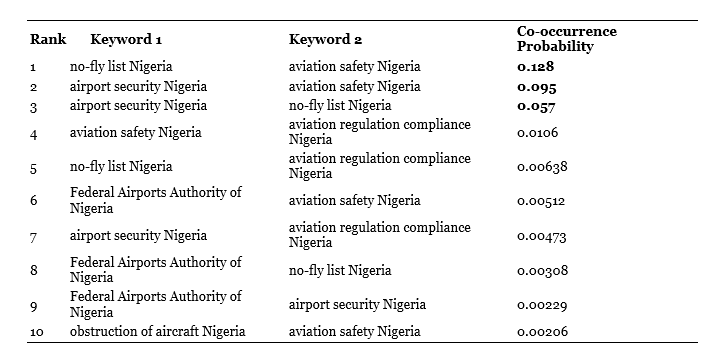
A co-occurrence probability analysis showed that the strongest connections were between “no-fly list Nigeria” and “aviation safety Nigeria,” “airport security Nigeria” and “aviation safety Nigeria,” and “airport security Nigeria” and “no-fly list Nigeria.” These are broad, structural themes that exist independently of KWAM 1’s celebrity status.

The data suggests that while the incident was the entry point for attention, the enduring search value lies in these generic themes. This is a key part of commoditisation: a transient event is repurposed into content that serves as an anchor for ongoing search interest.

Exhibit 1: Top 10 keyword pairs most likely to trend together based on search volume co-occurrence probabilities

Source: Google, 2025; Nigerian News Media, 2025; Infoprations Analysis, 2025

The Algorithm as a Cultural Broker

Google does more than passively index events. It acts as a cultural broker by determining which parts of a story will continue to be searchable and which will fade away. Specific keywords like “KWAM 1 Abuja airport” may spike in the short term but will eventually decline. Broader terms such as “aviation safety Nigeria” will keep trending and will continue to pull in any content historically linked to them.

For the news media, understanding this means adapting their coverage. By pairing celebrity names with broader themes and institutional references, they can secure long-tail discoverability. This is why many reports blended the details of the incident with discussions of safety, security, and regulation. It was not just a matter of journalism; it was also search-engine optimisation.