DD
MM
YYYY

PAGES

DD
MM
YYYY

spot_img

PAGES

Home Blog Page 7281

The $1,000,000,000,000 Nigerian Reminder

0

This month, the Sovereign Wealth Fund of Norway passed $1 trillion. In other words, it exceeded $1,000,000,000,000. That is twelve zeros.

Norway’s giant pension fund is now worth over $1 trillion. Yes, 1 followed by 12 zeros.

The fund’s managers announced Tuesday that currency shifts had helped push its value above $1 trillion for the first time.

“The growth in the fund’s market value has been stunning,” fund chief Yngve Slyngstad said in a statement. “I don’t think anyone expected the fund to ever reach $1 trillion when the first transfer of oil revenue was made in May 1996.”

For comparison: $1 trillion is roughly the size of Mexico’s economy

Simply, it means that Norway has a pension fund that is at least twice the GDP of Nigeria. Nigeria exports crude oil, just as Norway. But Norway has a strategic vision on building and accumulating wealth, Nigeria is a zen-master in wasting value.

Men (and women) build nations. We have not been lucky to have great ones in Nigeria. Norway started this fund in May 1996, and within roughly 20 years, they have $1 trillion in value.

As you dig deeper into that fund, you will notice other great numbers. In the first half of 2017, the fund returned $68 billion (i.e. with b). In other words, Norway could be receiving about $120 billion this year as income, if the second half of the year tracks the first half. That is more than four times the federal budget of Nigeria.

Let me explain, if Nigeria had seeded such a fund when Norway did, our national budget can be 4x as it is today, and that budget funded entirely from the returns arising from the fund. The fund continues to grow, and the returns will continue to accumulate. The future of Norway is secured.

Nigeria does have a sovereign wealth fund, which was seeded in 2011. I know that government has contributed about $1.5 billion into it. But I have no idea the value of the returns, if any.

Nigeria’s sovereign wealth fund stood at $2 billion this month with the investment agency seeking further growth through agriculture and the addition of asset management, its chief executive officer said.

The government’s contribution stands at $1.5 billion, with the rest including funds owned by the institution and those managed for several government agencies, Uche Orji of the Nigeria Sovereign Investment Authority said in an interview on Wednesday in Kazakhstan’s capital, Astana.

We need to learn from Norway on how to build a future for generations. We seem to have wasted our moments as the dawn of the petroleum era arrives. We will continue to pump crude but the earnings may not even be enough to fund government. Reading the Premium Times exclusive on CBN tells me that we have already started that financial engineering even when the play has not started.

A massive and clearly illegal multi-source funding of the federal government by the Central Bank of Nigeria (CBN) could drag the Nigerian economy to its knees, experts familiar with domestic monetary conditions and current happenings at the CBN have warned. […]

Insiders say the apex bank is “creating money” to “finance a government that is broke and which does not have economic vision,” in what one of them called a “desperate move by the central bank governor, Godwin Emefiele, to remain in office”.

The game is on. Nigeria has a $1,000,000,000,000 reminder to learn from.

Where Are Your Nigerian Customers?

7

The last time I visited Lagos, I spent good time in Oshodi market. I also took a bus to Yaba. I wanted to see Lagos and understand the evolution. The fact is this: nothing has changed that much. You have a higher chance of making money in Nigeria offline than online. In other words, for everything you do, you must have an offline strategy because the customers are still offline. You are not running a business in Nigeria if all you have is internet-based strategy. The customers and most of the richer citizens are not here.

In this video, I explain why you need to think less of what you get from Silicon Valley. UNWIND and be real; Lagos is not New York. No Director General in any government establishment will take you serious if you do not come in person. And I promise you that no one will respond to any email to the info@ unless you have written to congratulate them for doing a great good. In that case, they will respond to thank you. But anything business must be in paper and blood. That is where we are today.

It is irrelevant if your app runs on low bandwidth, your website is pure HTML or you can make the video download faster on a slow network. You are just pursuing a very small percentage of your potential customers.

This is what I suggest: get offline, go and build a business. You can mix it, to serve today’s customers while you plan to serve the evolving digital ones. But being purely digital, for most businesses in Nigeria and expecting to see success, is an illusion.

Towards Super Asset-Light Ecommerce Startups in Africa

0

I have written many times that African ecommerce companies have some severe challenges which work against them when compared with ecommerce companies operating in Continental Europe and the United States. One of those challenges is logistics/shipping. From my well-received Harvard Business Review piece, I explain thus:

Logistics: Amazon.com and eBay are great companies that depend on the U.S. postal system to serve their customers. I sell my own books online in U.S.; once a buyer makes payment, I drop the book off at the post office to close the transaction. In Africa, it’s more complicated with nonfunctioning postal systems. Online businesses operate delivery motorbikes, which increase the cost of doing business there.

This factor has also shaped my perspectives: indeed, anyone running an ecommerce business in Africa should see it as a business that goes beyond web-based digital business to a meatspace one (i.e. physical).

My client had a great marginal cost in the web side of the business, but in the logistics side, the amount goes high. To add an additional customer in a new city will require cost, even though the marginal cost in an already covered city may be low. So, the only way to bound the cost is to narrow the service region. By coming to that conclusion,  the company is no more an Internet business. That scalable advantage has gone and the unconstrained distribution channel which Internet offers has been made meaningless.

At the end, I told the team to go and build a new business model for a logistics company because indeed their success will be largely dominated by logistics and not just on what happens online.  That your business receives customers online does not mean it is a web business. What really matters is where the cost elements are. For this particular ecommerce company, the business is simply a logistics firm, as far as cost is concerned.

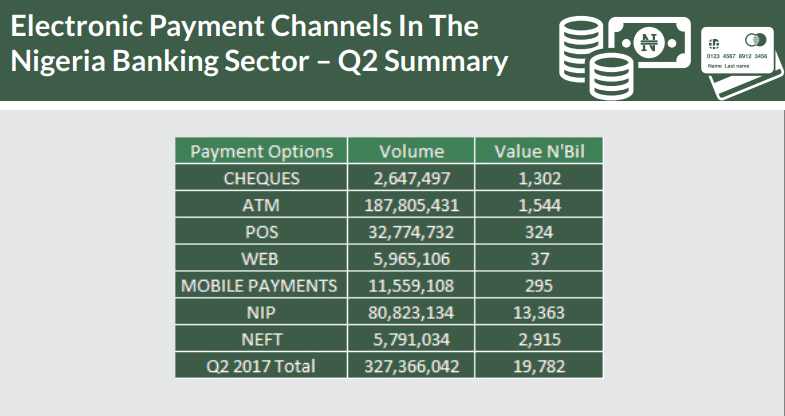
So the question is thus: how do we manage this logistical challenge, a big issue that drains our growth capacity and eventual profitability? We do not have a good postal service which means that we are expected to build logistical solutions to drive our ecommerce operations. It is refreshing to note that digital platforms are doing well in payments across the continent. In Nigeria, according to government data, both web and mobile payment channels are growing. This means that people are ready to shop and pay online. The hurdle now is how to cost-efficiently deliver the items to their homes and offices.

Q2 2017 Data (source: nigerianstat.gov.ng)

What A Startup Can Do?

This is not easy but I do think the best roadmap to deal with the logistics issue is to partner. Partnership will make distribution of items easier. The ride-hailing companies like Uber, Little Cabs, Max Go, and Taxify are good examples for any startup to partner. Walmart already does that with Uber in selected locations in U.S.

Walmart is expanding a test of its grocery delivery service, powered by Uber, the company announced this week. The retailer is now offering grocery delivery in two new markets — Dallas and Orlando — which join Tampa and Phoenix as locations where consumers can shop online for grocery items, then opt to have them come to their home for an additional $9.95 fee.

The advantage is that by modifying your business process, you can work with companies like Uber to make the delivery without necessarily incurring additional costs of buying motorbikes and employing people. It may not be easy to execute this seamlessly. My recommendation will be to start with some selected items and then expand the offering. There are things your own delivery man has to do, and there are items you can use Uber. Working with MAX Go, an on-demand motorcycle transportation company, may even work out better than Uber. An entrepreneur needs strategic partnership in this space to reduce the assets burden associated with logistics while managing a potential customer experience problem.

All Together

The challenge before ecommerce founders is huge with our non functioning postal systems. For us to see growth and profitability, finding a way out of this quagmire will be strategic. I had envisaged the community coming together to share logistical infrastructure to reduce capex. But that may not happen anytime soon. So, the roadmap is simply for any player to find one of these ride-hailing transportation companies like Little Cabs, Uber and Taxify and strike a deal to help deliver some items. That may not be perfect due to potential customer experience problems.

Sure, but I do know that what we are doing today will continue to put pressure on founders to keep raising money in a problem that is a continuum. There is no inherent scalable advantage in the near future that will benefit logistics in major African cities. That you have covered Ikega does not mean that you have fixed Festac (both in Lagos State, Nigeria) when you decide to support customers in Festac. So there is a non-zero marginal cost to expand to serve a new customer in Fastac despite covering all potential customers in Ikeja. It makes the economics harder as growth requires more capital from one city to the other. Outsourcing logistics will free that cash, and that will make your ecommerce business a super asset-light operation.


The Valuation of Your Nigerian Startup

0

Since the piece on Afro-Unicorn appeared, many founders have reached out asking questions on valuations. I had noted that valuation is not a science and while it makes us look great to be dropping the word “Unicorn” (a startup, usually technology-enabled, with valuation of at least $1 billion), our own moment is about $25 million and I used the term “Afro-Unicorn”.

While New York and Silicon Valley with their cousins Paris, London and recently Shenzhen influence us, we are not in the same league with them. I mean, the GDP of the United States is about 40 times the size of Nigeria’s GDP. Nigeria is perhaps the largest economy in Africa. So, if Nigeria is that far behind, using purchasing power parity and common sense calibration, our unicorn number should be around $25 million. In other words, an afro-unicorn is worth $25 million.

The big question is this: how do you determine what your company is worth? We have this feeling that investors in Nigeria are never helping matters. We think they do not give us the right valuation. That may not be true. What is happening is that you are comparing your startup to what you read online without taking into considerations that a business being run in an economy of say $480 billion (Nigeria GDP) will not be the same as one being run in one of $18.4 trillion (U.S. GDP).

Here are simple things to understand before we go into the art of the trade:

  • Supremacy of IP address: A U.S. based IP address has more value in the eyes of Facebook and Google for a startup that depends on advertising. Likewise, investors consider where your visitors are coming from in deciding your valuation. It can work both ways. There is a situation where a local IP address will give you a huge boost. For example, in media, where local advertisers are more likely to run ads in your platform if you have mainly Nigerian visitors over foreign visitors. In that case, you are better off being the leader in the local media sector. On the other hand, there are cases where they will prefer foreign-based IP addresses, over Nigerian ones. Everything depends on the sector and the product, but you need to have that in mind.
  • Purchasing Power of the Customers: This is related to the above point. The US-based visitor, on average, is assumed to have a higher spending power when compared to a Lagos-based visitor (U.S. per capita income is higher than Nigeria’s). This makes the U.S.-based IP more valuable in a site where someone is selling something. It is only a person with money that can buy things. So, an investor may include that to decide how a company is worth. Again, this can go both ways depending on what you sell. The key is to have that in mind. If you are selling packaged amala, the local Nigerian IP address becomes more valuable than any coming from Tokyo.
  • When an investor wants to invest, the location of your customers will be used to price the user base. The same applies when someone wants to acquire your business. While they may pay $30 per user in U.S., they may decide that each of your users in Nigeria is worth about $5. So, if you have one million users, you will be getting $5 million while a comparable U.S. startup gets $30 million. That is not discrimination, if there is anything like that. This is purely driven by market-forces. If that startup is in Chad with a GDP of less than $10 billion, they may even throw $0.50 per user. It is not as simple as I have noted it here, but that is the way the thinking goes. If you find a cure to HIV in Lagos, no one will care where you are located.  They will pay you what your idea is worth. The valuation synthesis you see online is largely flavored for web-based business.

Typical Valuation Techniques

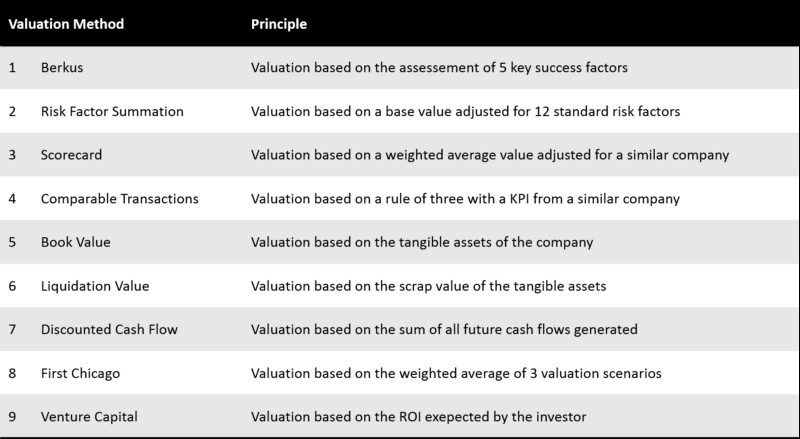
Now, let us go through some typical ways investors use to value startups. I will use Stephane Nasser’s work focusing on the pre-money valuation, i.e. before the investment is made. Most times, after the investment, the value changes because having raised that money means that risk is mitigated, and the startup can grow further, boosting its outlook and valuation.

Valuation Techniques (source: LinkedIn – Stephane Nasse)

Please read Nasser’s work directly for these 9 elements. There is no need of wasting time here as he did a great job in his explanation.

All Together

Yet, do not focus on valuation as you build. I will suggest you focus on creating value. But I do know that part of success is making sure that your hard work has been priced fairly by investors. Valuation is not a science. Luck plays a role here. A simple incident in the industry can make your startup extremely exciting, while new information can make it also-ran. So, when you look at the value created, you have to examine it beyond the quantitative to other elements. If you started a drone business in Nigeria and was growing it before the government technically banned it, you could have had a great company. But after the ban, it may not worth as much. The same business, but just with a week, it has gone from hot to cold.

Apple’s Formidable Challenge

0

Uber lost to Didi Chuxing in China. Facebook’s WhatsApp is a tech generation behind the innovation of WeChat. DJI is peerless in civilian drone making. Alibaba pioneered a new sector in digital commerce. Baidu has a vision to become the operating system of the autonomous vehicles through Apollo. Chinese companies are ferocious in battles and they are winning, at home. Apple is brutalized, in China. From Fortune Newsletter:

Apple’s omnipresence feels odd to me because in China, where I spend most of my time, Apple is just one species in a far more diverse gadget ecosystem that includes brands like Samsung, Huawei, Oppo, Vivo and Xiaomi. I live in a small beachside village on the far southeastern tip of Hong Kong island where every morning tour buses disgorge hundreds of selfie-mad mainland tourists. My totally unscientific observations of these throngs suggest that fewer than one in 20 is using an iPhone. That’s about the same ratio I’ve seen on recent trips to Shanghai, Shenzhen and Guangzhou. […]

China is still Apple’s most important market. As I’ve noted in last week’s CEO Daily, Apple’s market share in China has slumped to 7%, down from 16.5% in 2014. The current issue of The Week in China offers a detailed examination of why Apple’s China sales have faltered. Their conclusion: the specs of Chinese handsets now rival that of Apple’s phones, and Chinese consumers—who prefer the online services of China’s two tech giants, Tencent and Alibaba—are far less wedded to Apple’s operating system than their American counterparts

As I have noted many times, the future of Apple is not assured. It is losing China, not because it cannot make good phones. Its problem is that its operating system is not in sync with what other enterprise players are building upon. The implication is that with its closed ecosystem, any service that is not from Apple cannot be of best quality because the enterprises do not have access to iOS, the Apple operating system. Contrast that with Android where companies can even make a different flavor to meet their needs. They do not have that opportunity in Apple iOS and can only work based on limited access Apple provides.

Apple is a great firm that figured out how to monetize hardware with highly differentiated and exclusive software. To enjoy the Apple universe, you must use Apple physical product. Apple executed that in the consumer world. But as it moves into enterprises and other domains like cars, clinics, homes etc, Apple strategy will hurt it. In enterprises, after the era of IBM, no one wants to be tethered to hardware and software. Why use Siri which requires Apple hardware when Alexa is agnostic of hardware?

You can control the individuals (the consumer market) but in enterprises, the variants are many. No single company can model that. Nearly every car company is testing Android for car infotainment. Samsung will be a natural partner to them. With no access to iOS, Apple loses.

I do think it will be challenging for Apple to succeed in the enterprise with its strategy of keeping iOS out of reach. We are in the era of post-production and it must have a balance to drive new sources of growth with iOS

This disconnect will hurt Apple. It is clearly showing in China as users there see the integration of WeChat and Alipay services less robust in iOS than in Android. And with their lives built around the services, the physical hardware from Apple does not change the perception. They are not interested in Apple’s Music and other services it offers. They already have what they like and they want a phone that makes using those services easy for them. Apple’s closed ecosystem is not helping the companies that make those solutions. That is why as Tencent and Alibaba rise, Apple keeps losing market share because their services have abstracted the premium quality of Apple’s differentiated hardware which runs exclusive software. If WeChat cannot work well there, China does not care. Today, Tencent does not have access to iOS and cannot make a great WeChat for it, as it does for Android devices.

Apple cannot make all services and will lose on those it cannot create by itself. From services like WeChat to car infotainment services, Apple will lose because entrepreneurs cannot make the best products without access to core iOS technology as they do with Android. This, I believe, is Apple’s most formidable challenge. It is executing a very weak strategy which will hurt it once smartphone and tablet mature. Yes, it will come one day when their improvements will be marginal.

Laptop went through many phases until it hit maturity. Unlike in the past where on-board modem was seen as innovation, today’s laptops are mundane in their core-feature differentiations. When phones and tablets get to that maturity level, the business will move to what you do with them, and not really who made the mobile devices. With the devices largely the same, the interoperability of the services will become the driving acquisition factor. For today’s Apple strategy, only services it makes can deliver the best quality on iOS. But the world is not Apple’s as we have areas it cannot offer direct services. With partners not capable of delivering the best quality of service, owing to not having access to core iOS technology, Apple’s differentiated hardware and exclusive software will struggle. If Apple does not solve this challenge, it will struggle in the future.