I like Kobo, a logistics startup that operates from Lagos, Nigeria. It is a very fine company deepening its capacity as a network orchestrator through aggregation. Kobo is positioning itself as a company of the future in the broad logistics sector.
A global logistics platform right from the heart of Africa, leveraging technology and efficient processes to serve its citizens and the rest of the world. Putting transportation in the hands of every individual. Facilitating the movement of your goods and packages by guaranteeing, safety, speed and affordability.
Kobo has partnerships with DHL, UPS and other global logistics giants. Co-founded by Obi Ozor, the company uses technology to streamline shipping for clients. In an interview with CFA, Obi noted some of the challenges in the industry.
Obi stated that the Logistic industry, from the African market perspectives, is worth about $300 billion. He further emphasised that the industry has different branches, such as the e-courier, trucking and air and sea freight, but in Nigeria, we are more into the e-courier and trucking branches of the Logistic industry. “The trucking branch of the industry is about $80 billion across Africa, while in Nigeria, it is about $18 billion. The e-courier projection is about $2 billion”, he maintained.
Obi is of the opinion that, although, the reward derived from the Logistic industry is huge, so are the challenges therein, because, it is a tough line of business to venture into. He said that he decided to venture into the Logistic business because, it is the heartbeat of any economy. He alluded to the importance of transporting the products from one point to the other, citing the example of the fact that the building of the railways in the USA, aided, in no small measure, the movement of goods during the industrial revolution. He maintained that the Logistic is the foundation of economic development. “We know, of course that, if e-commerce and the new technology industry will flourish n our continent, we actually need to solve that underlying factor,” he stated.

Obi is right but what he did not say is that his platform is not the one directly challenged. Kobo is an aggregator which relies on its partners to serve its customers. It is like Uber which aggregates drivers and riders to deliver two-sided markets products. It works like Airbnb which links landlords and travelers. Yes,come rain, come sun, Kobo will always find value. The risks are handled by the partners, not Kobo. That is why I like Kobo business model. It operates under the Aggregation Construct which I have written extensively.
Under the aggregation construct, the companies that control the value are not usually the ones that created them. Google News and Facebook control news distribution in Nigeria than Guardian, ThisDay and others. Because the MNCs tech firms “own” the audience and the customers, the advertisers focus on them, hoping to reach the readers through them. Just like that, the news creators have been systematically sidelined as they earn lesser and lesser from their works. But the aggregators like Facebook and Google smile to the bank. The reason why this happens is because of the abundance which Internet makes possible. Everyone has access to more users but that does not correlate to more revenue because the money goes to people that can help simplify the experiences to the users who will not prefer to be visiting all the news site to get any information they want. They go to Google and search and then Google takes them to the website in Nigeria with the information. Advertisers understand the value created is now with Google which simplifies that process.
The Magic of Network Orchestration via Aggregation
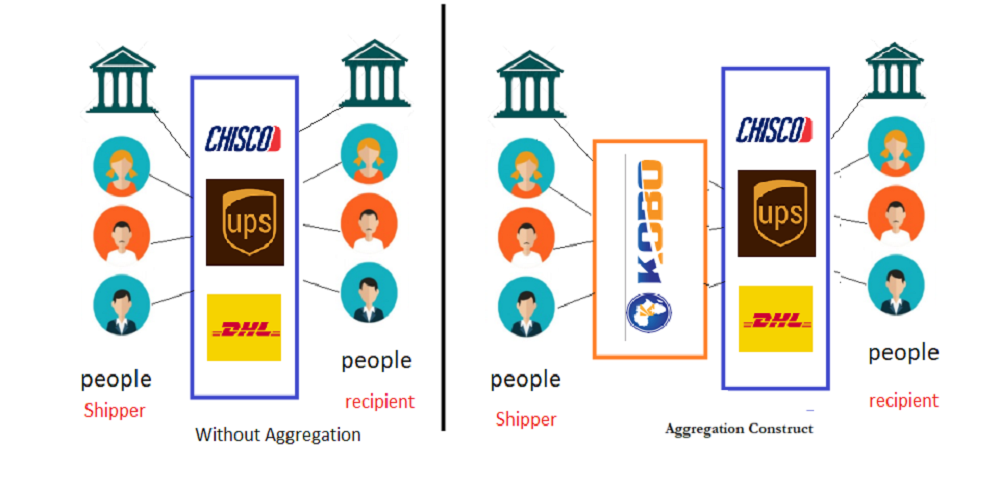
Kobo operates under the principle of Aggregation Construct which depends on network orchestration where it works as an arbiter for many partners and customers. With this model, the customer experience becomes a key part of its business. It does not have ships, planes and trucks delivering services from U.S. to Nigeria and beyond. But it has a technology to simplify trade and commerce. It has got happy customers who do think its services are even better than firms like DHL. Interestingly, companies like DHL make it possible for Kobo to serve those customers.
In the diagram below, I explain what Kobo is trying to do. It inserts itself between the shippers and the logistics firms. Largely, under most cases, it may not have direct contacts with the recipients of the goods. That is a weak link in its business as it cannot manage all faces of the two-sided business. But not doing that saves it money, since we cannot expect it to go and retrieve the goods, from the logistics firms, at destination cities, just to deliver to the end customers. That will be a mistake and it is doubtful if the firm will have that level of capacity. So, I will call this aggregation a Semi-Aggregation Construct: Kobo is fully invested in the shipper which originates the transactions and pays for them.
All Together
Kobo has a big challenge ahead of it. Its success will be dependent on the number of partners it can command in its portal. These are the companies that will help it move the items, from one location to another. It has a few like DHL, UPS, and Chisco, a luxury bus company. It has to add more partners to improve its network orchestration through aggregation. The partnership will be win-win as it will help these logistics firms to mop business opportunities across cities, before they begin to move them to destinations. Doing this effectively will involve scaling the operation, so that more users can use Kobo over going directly to DHL and UPS.
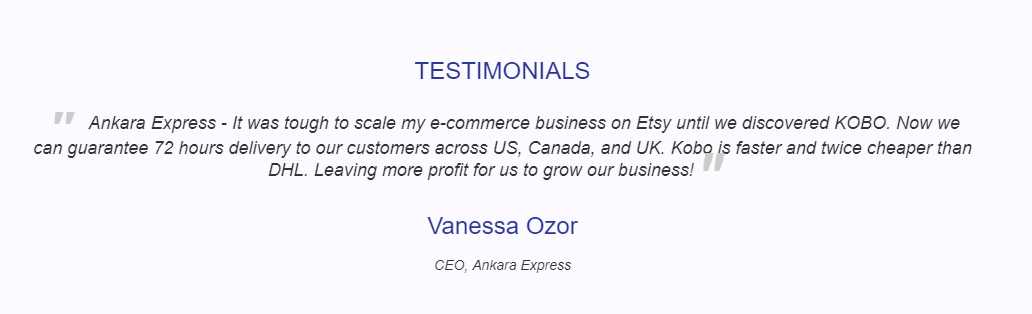
I see the model the airline industry uses with online ticketing companies like Wakanow to be relevant here. Kobo can get 20% discount on what a typical customer gets directly from DHL provided Kobo meets certain metrics on volume.If Kobo transfers 5% of that value to customers and then delivers better experience, compared with DHL, it could have a huge opportunity ahead of it. This is a very brilliant company, and has the capacity to become a leading African brand: it is asset-light, fixing a big market friction, and structured in a way that its scalable advantage is unbounded and unconstrained.