DD
MM
YYYY

PAGES

DD
MM
YYYY

spot_img

PAGES

Home Blog Page 7313

Africa’s Path to “Zero-Click Ordering”

2

Something interesting is happening. A new age of electronic commerce is evolving, and it is going to be exciting for African entrepreneurs. It is very possible that we can grow digital sales despite digital illiteracy in the continent. In other words, we do not need the correlation of improved digital literary rates for digital commerce to happen across rural villages.  Today, digital entrepreneurs are losing sales because most of our people are not necessarily good in online purchase.

I have a case study: buying my new book takes a very simple process, we thought. But it seems we are wrong. For some people, it is not that easy to read through a book content, click a button to add to a cart, verify the cart content, and make a payment. It was laborious!

But the process we have mirrors what Konga, Jumia and other digital companies follow. While Amazon has a one-click ordering process, the customer must have setup payment and logged in before beginning that process. So, if you do not discount those early preparations, one-click ordering by Amazon is not really one step. No one needs to be logged in to read a free blog, so the first time to pay for the book is the very first moment the person needs to create an account in this blog.

Most of our readers are techies and geeks. But there is no doubt that Woo Commerce which we use in Tekedia to collect payment is non-optimal. Some customers prefer to handle the registration and payment manually. That is a big concern to me because if our readers – very brilliant people – are experiencing this level of friction with Woo Commerce, then there is a problem.

Interestingly, going deeper to the root cause of this issue, you will notice a factor. What happens is that naturally people do not have time to read everything on their screens. We prefer to talk. For most digital orders, following the steps will remove any problem, but you are assuming that customers will read through. Personally, I do not read all; I just click through, sometimes. So, solutions have to be built with those assumptions.

For me, the very fact that potential clients are having frictions means the system is non-optimal. It has nothing to do with the customer. The system must evolve to eliminate the friction.

I need a way that will simplify my customer’s experience. I think we need “zero-click ordering” so that anyone that wants to order will not have any single reason to wait. I see that coming from voice control or voice ordering.  Alexa has it already but that is for Amazon.

Voice ordering is getting very popular in America. Amazon is leading in that space. This is designed to help Walmart catch-up with Amazon. It will also help Google build new services in this area. Finding that leg into the e-commerce and grocery will be very strategic in its capacity to compete against Amazon in the broad technology arena. Above all, many will buy Google  Home, partly because of this deal, and that is good for Google.

For the whole world and especially the developing regions like Africa, Google has a template through Google Tez. It is the path to the next billion customers. This is a huge product that will change many things.

According to TechCrunch, Google has a product named Tez that can allow customers to make payments via audio. Period, you talk and the transaction goes through. Where are they testing it? India. It has the same demographics in terms of literacy rate as most parts of Africa. […]

I expect African developers and entrepreneurs to position themselves for this emerging opportunity. They have to find ways to build on top of Tez which will be easier since Google has provided the core elements. Yet, we also have to find ways to manage the accents and our spoken English flavor. There are many opportunities in this area and people have to get excited and begin to explore. I expect banks to begin to explore solutions in this space. Agency banking in Africa and indeed Nigeria will be anchored by voice computing. Google Tez can make that moment happen

What I Need

If you have not gotten the idea, Africa will need a solution that will enable people to make orders with minimal friction, possibly through voice (yes zero-click ordering), online. That will fix many challenges. You will make more sales when people talk than click. Because we like to talk, ordering has to move to the audio universe.

Some pizza companies have zero-click ordering via smile-to-pay where just smiling executes payment and orders a pizza via mobile devices. For others, it is just as easy as launching an app.

Zero-click ordering is as easy as it sounds. Download the app and link it to a Domino’s Pizza Profile. When the new app is opened, the saved Easy Order is automatically re-ordered without a single tap, swipe or click. Customers will see a 10-second countdown timer before the order is placed (giving consumers a chance to stop their order) and voila!

Note: Nigeria’s former minister of agriculture and now the President of the African Development Bank, Dr Akinwumi Adesina, received the World Food Prize for mobilizing agriculture in Nigeria through innovation anchored on mobile technology. He redesigned Nigeria’s agriculture with mobile wallet and other elements. Yet, he executed this turnaround through text-based technologies.

Now, imagine what will happen if “voice agriculture” can be linked to some of the systems in Nigerian agriculture which Dr Adesina and his team pioneered. With voice, farmers can execute contracts through their mobiles devices and records archived in the cloud. They do this with no interference to their farming processes.

All Together

As the voice operating world evolves, voice ordering will emerge and that is going to benefit places like Africa. The one-click ordering will help many businesses improve sales because what we have today can be extremely time-wasting in the age where young people do not have time. I am asking our entrepreneurs who have experiences in voice technology to key into this area because they will have natural advantages over companies like Google through localization and differentiation by mitigating algorithmic bias arising from accent and English flavors. By thinking of commerce, over just dissemination of information, we can solve a market problem that will end up improving the wellbeing of our people.

Your Webinality Inc.

0
webinality

A startup health and wellness company was looking for young graduates to hire. They wanted people that have natural interests on wellness – eating right, exercising often, with positive attitude. What did they do? They asked for the usual resumes, but followed up with searching the online presence of the shortlisted applicants. Those that looked good on paper, but showed minimal online activities on health and wellness were eliminated. The ones with deep online interests in this area, though not strong on paper, were shortlisted for further assessments.

At the early phase of my firm, my colleague handling the team building had a strategy: she connected online with potential interests. She wanted to know the person’s interests. Are you an engineer that will come, and we spend time to train, and once a new bank teller job (a great job, please) comes, you jump?

If the guy likes engineering, you will see from the feeds. That is not the whole strategy. But I can tell you the the best time to audition for some jobs is when you are not planning to apply.

Indeed, across the world, technology is redesigning global commerce and how firms recruit talent is changing. Though the typical resume still matters, professional online network is becoming a more compelling factor for most hiring managers. A blog post could provide a hiring opportunity, just like some media firms have hired excellent blog commentators. Through twitter feeds, Facebook profiles and blogs, potential applicants can be easily evaluated. So, developing a professional online brand has become as important as crafting that resume. It is building a reputation to showcase skills and capability in a field, and telling hiring managers that you can add value in a team.

While thirty years ago, one needed a journal or conference, to present an idea, today, a free blog account is few clicks away. A professional online engagement could help build trust and followership while crafting a web personality. In this team oriented 21st century, not having an online presence, could imply disengagement and most employers will notice. Your professional web presence, i.e. your webinality, is strategic.

The following are some suggestions on how to build a professional online persona:

Presence: Open at least one social media or blog account.

Specialize: Define an area of interest and build around it. A five-minute online search should reveal what you represent. You need to differentiate yourself and showcase your core skills and unique capabilities to potential hiring managers.

Accuracy: Always remember that once that post goes online, you may not control who sees it. Make it accurate – always, otherwise, you will destroy your persona.

Comprehensive: While blog should be short, once in a while, develop comprehensive articles in your field and post them online. It could mean expanding a class project you worked on, adding more contents, and fully proving your expertise. Half-baked contents will not take you too far.

Judgment: What you post or share online defines who you are. Your profile defines your values, interests and reliability. For employers, they want reliable team leaders and you must not offer less in your web personality.

Vertical Integration: Seek to connect with people ahead of you professionally while building a horizontally network.

Generosity: Share and exchange good ideas. Invite people to your network and be generous to promote good ideas from others. Write professional reviews on books, journals and articles. In no distant time, people will reward you.

Policy Matters: If you are working, ensure you adhere to policies on using the company’s name online. There is a threat that you could be a source of data leakage that can hurt a place you work. Your profile must not be another portrait of your employer – you must be wise to separate both, where necessary.

Continuity: Professional online branding is a continuous work-in-progress that requires constant tune-ups of networks, contents and profiles. It must be constantly nurtured.


Solar Power Business With Novel Pricing

0

Description: Solar power business is a growth area in Africa. There are already many entrepreneurs in this space across the continent. But solar power business is still at infancy with entrepreneurs trying many business models to discover the best. We provide two cases of two successful solar power businesses in the world which solar power […]

To access this post, you must purchase Tekedia Mini-MBA (Feb 9 – May 2, 2026) | $170 or N120,000.

Election Tool And Technology

0

Description: We provide a potential idea which can be developed for elections in Nigeria. The thesis is combining big data and analytics with meatspace system that will make it possible to close deals with politicians and take up contracts to run the analytics parts of their elections. The 2019 election is just around the corner […]

To access this post, you must purchase Tekedia Mini-MBA (Feb 9 – May 2, 2026) | $170 or N120,000.

The Brilliance Of Nigeria’s Paylater. ng

14
PayVest Nigeria, PayLater Nigeriia

Nigerian entrepreneurs are innovating in the financial sector. Despite all the challenges we face on building companies, our young people are finding ways to demonstrate that we can think and redesign our economy, through hardwork and commitment to excellence.  We have seen the amazing works from AppZone, Paystack and other startups across the nation. I am introducing one here today which is going to the heart of average Nigerian core financial problem: lending.

Our banks do not have memories. No matter how many years you bank with them, if you need credit, they will ask for collateral. Yes, they may know that in the last 10 years, you have received at least N200,000 monthly, but that was the “last ten years”. They will remind you that anything can happen, from tomorrow. So, if you do not have collateral, that loan cannot be extended. Before we talk of credit bureaus, most banks already have enough customer data to give credits, but most do not without extra securities.

That is why Paylater is exciting. Owned by One Finance & Investments Ltd, Paylater is going after that market where the highest pain points are found in the Nigerian banking sector. We can surely live without shopping through the modern digital payments. But we know that it is challenging when there is an urgent need for funds and no friend or family can help. That is what happens across Nigerian families today. Challenges go beyond how to move money fast across digital channels. Simply, we want credits. Paylater focuses on short-term loans, mainly for emergencies.

Paylater is a simple, entirely online lending platform that provides short-term loans to help cover unexpected expenses or urgent cash needs. You can apply for a loan 24 hours a day, 7 days a week with our quick application process that lets you know your status within minutes.

Yes, we like the payments and remittance fintechs, but lending is going to be a key part of what will help many families move up. The capacity to take loans and pay school fees, or during those tough moments like taking a child to a hospital, when all borrowing options have been exhausted, will be another layer in the fintech evolution in Nigeria.

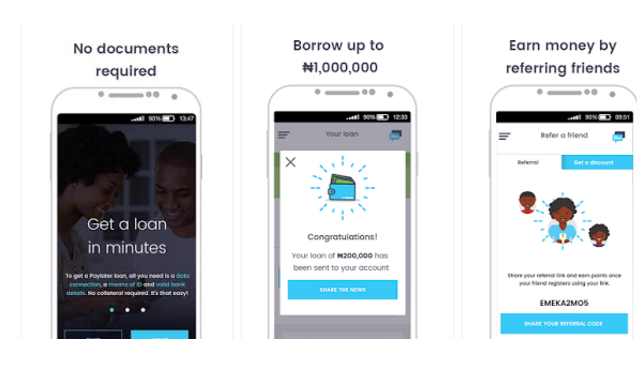
Screenshots from Paylater App

Paylater is focusing on those moments of craziness and it is finding success. It now disburses 1,000 loans daily. The firm is a CBN-licensed and regulated lender, meaning that CBN understands the need to bring new ideas into the lending sector in Nigeria.

At the start of the year when we were disbursing about 200 loans a day, we set ourselves what we felt was an aggressive target of 1,000 paylaterng loans issued on a daily basis.  We felt it was ambitious not because of a lack of demand (who hasn’t got a friend that needs a loan?) but rather the challenge to risk-assess 1,000 people that we had never met, living in all states of Nigeria and then disburse within a short time frame to their customers accounts.

Today we are happy to say that over 60% of these 1,000 loans are disbursed within 1 minute with the rest all under 5minutes and they span a range of N7,500 to N200k for first time borrowers.  The inevitable question is “yes, great but are you profitable? Any monkey can give out loans – but are you collecting?. Our mothers told us not to boast so let’s say that our default is between 10% and 20% but trust us that its a manageable number. If you don’t believe us then look out for us early next year – if you are right, then we won’t be around!!!

Whilst we are pleased with the team effort that has got us so far, we are not content.  Our mantra is “credit for all” and there are too many within Nigeria who don’t have access to credit.  We only give @paylaterng loans via smartphones so the 60% of Nigerians that have feature phones unfortunately are excluded. Moreover, for most local banks, “financial inclusion” is just another way of saying “let me provide another channel to take your savings”.  Less than 10% of customers have accessed loans from any formal financial institution but you don’t see banks showing the same energy to grow their retail assets as they do their retail deposits.

The Products

The product is a simple digital product with clear focus  on the digital and mobilized citizens of Nigeria.

The produce is a simple, entirely online lending platform that provides short-term loans to help cover unexpected expenses or urgent cash needs. With just an Android device and basic requirements, you can apply for a Paylater loan 24 hours a day, 7 days a week with a quick application process that lets you know your status within minutes.No collateral, guarantors or application fees required. Just a few clicks of a button.

We currently offer two loan packages: PAYLATER (loans available to all) & PAYLATER PLUS (loans for salary earners). We’ll discuss both in a bit more detail below, so you can decide which best fits your needs.

Borrowing and paying help clients borrow more

The Opportunity

Paylater has a huge opportunity ahead of it. It is in a very growth industry. However, it is evident that it is going after the formal workers who can demonstrate they are employed. It is an app with no desktop version. So, the focus is the mobilized Nigerians with smartphones. They are also the people largely employed in the formal sector. Paylater needs that to mitigate exposure to risks. Of course it has the lower segment where it can lend N10,000 but that is not necessarily significant for me. The opportunity lies in the N500,000 bracket.

Paylater® is a simple platform that provides short-term loans to help cover unexpected expenses or urgent cash needs. You can apply for a Paylater loan 24 hours a day, 7 days a week with a quick loan application that lets you know your status within minutes, and credits your account immediately.

It’s fast, secure and reliable. Currently available across Nigeria.

YOU’RE JUST A FEW STEPS AWAY FROM GETTING A LOAN

– Download the Paylater app
– Complete registration and submit the short loan application
– Receive your loan straight to your bank account within minutes
– Earn increased amounts and better loans by repaying loans on time

The Challenge Ahead

Running a lending business without a credit system will be a challenging business to scale. But what constitutes a credit system can vary. Some may use cellphone SMS data. Others have used Facebook feeds. They just make the loans and for most, it is working. There are risks in all these models. The entrepreneurs are managing them since most times, they do not ask for huge collateral like banks do. Of course, they do not give as much money as banks do, preferring to lend below N500,000.

That limit is the challenge. If the entrepreneurs cannot find a novel model to overcome that limit, they will not easily scale to serve more profitable customers who may need at least N1 million. The market today is mainly for students, and lower scale of the middle class with jobs. The middle and upper middle class may not necessarily be in positions to complete forms online for N500,000. Most will have access to the banks as they already have reliable income (the reason why they are middle/upper middle class) and today Paylater is not competing for their opportunities.

What Paylater is doing is tough. Despite the Bank Verification Number (BVN) and access to customer earning capacities, banks do not have so much confidence to give decent credit without collateral. They have their data and they cannot be wrong, on why they never lend liberally.  The lending startups will learn over time on how their loans are performing to explore how they can tighten the lending requirements. Once they can get to N1 million, a new market will open for them that will now begin the trajectory to challenge the banks. At that high amount, we can see small businesses going to companies like Paylater for loans. But those businesses cannot expect to hold the loan for long owing to the interest rates. I expect Paylater to also evolve by serving those small businesses when the time comes.

A Paylater loan attracts interest rates starting from as low as 2% monthly on the first loan. It is intended to meet urgent, short-term cash needs. Because of this, we have limited the lowest loan amount to NGN7,500 (for first-time applicants) and loan duration ranging between 60 days and 6 months, so you are not paying excessive interest rates. We also do NOT charge any additional fees – for late repayments or processing costs. Please do not take a Paylater loan if you intend to service long-term debts.

Paylater loan is certainly high, but that is expected for the risks it is taking

The company is aware of the risks and it is working to make it harder for defaulters to access the credit market. Government needs to get in and help build a centralized database so that responsible borrowing can emerge in Nigeria. Paylater with the CBN certification has access to BVN of customers. It is possible that it evaluates credit worthiness through data pooled from NIBSS (Nigeria Inter-Bank Settlement System Plc) which handles transaction details of Nigerian bank customers. I am not sure about this but since it asks for BVN, I do not understand any other value BNV offers than checking account history. NIBSS or Paylater can explain what it does with BVN.

Failure to pay off any loans taken trigger a notice to the consumer credit reporting agency which would negatively impact an individual’s credit score. Late payments can also affect your ability to borrow in the future, so please ensure timely repayments of obligations.

There are other players like Wema Bank’s ALAT and Piggybank.ng. These are competitors and also coopetitors and together these entities can pioneer a new sector that will make banking a sports for many Nigerians: something to cheer.

All Together

Paylater is pioneering a new area in fintech along with other lending startups in Nigeria. Though their annual interest rates can vary from “31% to 213%”, for most people, it is better than nothing. Simply, they are meeting the needs of customers, left behind by banks. For the very fact that they are CBN regulated, it means that they have to disclose every element of their loan terms in ways that customers will understand.

For Paylater, the firm is totally online, away from the bulk of the people that need its loans. That is the main weakness but also the strength since the Internet gives its unbounded distribution channel to scale, even while excluding the millions of Nigerians who are not yet online. Most of the excluded people are the people that desperately need the product. But Paylater has to start from somewhere and succeed first. It cannot serve everyone. The Internet helps it to operate lean with positioning to serve its desired customer segment efficiently. I see brilliance in this company and its mission.