DD
MM
YYYY

PAGES

DD
MM
YYYY

spot_img

PAGES

Home Blog Page 7324

Why Enacting The Act That Made Google Possible Will Boost Innovation In Nigeria

0

As nations try to emerge from the most devastating global recession since the Second World War, policymakers, business communities, academia, and governments will be looking at ways to accelerate growth and competitiveness. Many at the right will continue their propositions that governments should be left out of business, while those at the left will emphasize that governments must play central roles in shaping commerce and industry.

The reality is that governments do matter and a single legislation could have impacts that can redesign a nation’s economic destiny. Globalization makes it so important that nations must compete not just on technologies, but on policies upon which those technologies are developed and commercialized.

This makes it possible that two universities in two separate nations can develop similar technologies with one creating Fortune 500 companies within a decade and another having the idea locked up in a cabinet. In other words, the policies or legislations made by congress or parliament on what happens to inventions supported by government funds matter.

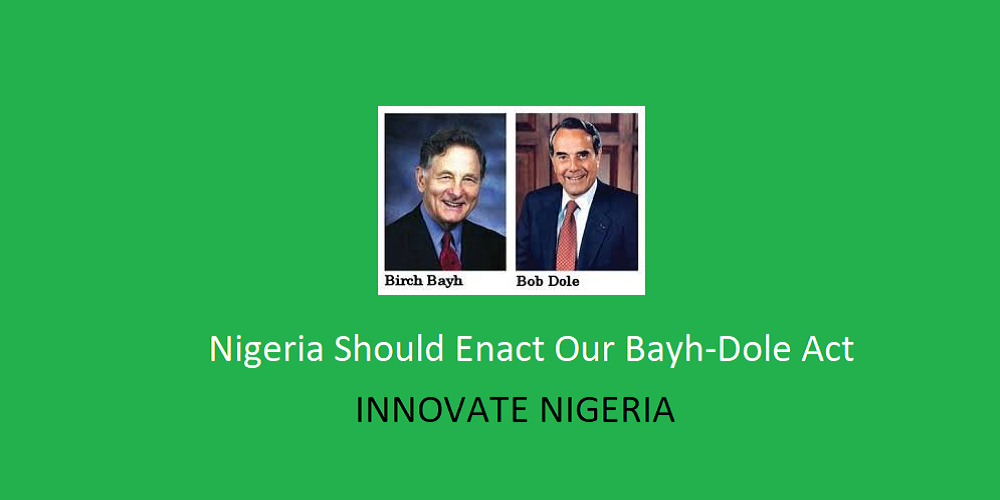
In 1980, a United States legislation dealing with intellectual property emanating from federal government-funded research was implemented. The legislature called Bayh-Dole Act (after two Senators Birch Bayh of Indiana and Bob Dole of Kansas that sponsored it) or University and Small Business Patent Procedures Act gave US universities, small businesses and non-profits intellectual property rights and control of their inventions, even though they were funded by government.

Through this Act, universities, small businesses or non-profit organizations could pursue ownership of inventions in preference to the government.

What this means is that instead of sending the patents or inventions to the government agencies like National Science Foundation (NSF) or National Institute of Health for them to file away in their office cabinets, this Act empowers the inventing entity to pursue commercialization of the idea. Simply, the U.S government elects to fund an idea and allows the fund recipient to profit from any invention that comes from that idea.

This Act provides clarity on many issues that could derail the process of taking ideas to market, especially when those ideas were funded by US federal government. For professors, it provides incentives to pursue research both for discovery and for profit since they also could profit from their inventions. Just as their students could discover and commercialize, the university dons can also do the same.

It has been a new era as the number of Technology Transfer offices in the US universities has increased many folds. As schools file more patents, they continually look for opportunities for venture funds to commercialize or simply license their patents to other institutions. These days, schools quote the number of start-ups they have incubated as a metric to their competitiveness. They will tell you the stories of their students who graduated and founded firms and use that as selling points in their brochures. This is business right in the four walls of the universities.

Interesting, schools do not just teach business regulation and competitiveness anymore, they experience them because they are getting products to the market, though indirectly. There are many start-ups which have become pipelines for the big MNCS to buyout. Before the Act, some of the ideas that enabled the start-ups might have been overlooked by MNCs. But as the former show promise and profitability, they could be bought over and that mission of making society better is given a bigger scale.

For me, Bayh-Dole Act is the most important business legislature of the last century in the United States. And this is American Congress at its very best moment. It delivered through legislature and transformed the pace of innovation by providing a fluidic system that enhances U.S competitiveness.

The outcome of the Act has spread around the world because of the number of technologies which have been commercialized and subsequently penetrated across the globe. The discovery of the search engine that powers Google was done in Stanford University. When Mr. Page and Mr. Brin decided to pursue commercialization of this algorithm and created Google, they must have been grateful for the federal funds that partly funded their discovery.

In a recent trip to Africa, I noticed that many universities now have Technology Transfer offices or what they call Consults. Good idea, but I must say that the structure where those offices operate is entirely different from what Bayh-Dole Act gave the American schools. The Act is helping American taxpayers to reap the benefits of funding the academic institutions through innovative products in the market. In Africa, you rarely see government in the mix of research and the whole constructs of technology transfer office seems superfluous since no research takes place.

It is one of those things that happen when African professors visit American universities for two weeks and afterwards go home trying to recreate the American educational system. Unfortunately, the root cause analysis is not thought through to appreciate the fundamental evolution of what goes in the US system. Yes, you have technology transfer offices, but the school has no electricity to run a lab.

Back to the Act, notice that many US universities are very competitive. While some could argue over the benefit of that since universities should traditionally share freely, the pursuit of commercialization and the rewards that come with it help to make research relevant to the needs of the society. And this new focus has created a platform where collaboration with industry has reached an all-time level.

Possibly, without this legislature, the idea that powers Google might still be filed out someone in the NSF cabinet. And the world will miss the dynamism, positive disruption, jobs, success-domino and information access that arrival of Google gave the world. When they introduced 1GB gmail, Yahoo was forced to upgrade its users from 4MB to 1GB and later, limitless storage.

It is not just Google, there are many small companies in pharmaceutical, semiconductor, and IT industries which exist today because the Act made it so easy that individuals and entities can hold rights in preference to government and in the process increase the chance of getting innovative products to the market.

The lesson here is that congress and parliament can change the future of any nation when good policies are made.

I understand that this Act might have reduced the free flow of information and ideas across the academia because everyone wants to guard its ideas for profit; but we have to live with the reality that there is nothing that does not have a potential drawback. Yes, some of our professors are now visiting venture capitalists more often. But at the end, it provides a perspective that makes education relevant and useful. And I think American students are better off when their professors are not decoupled from the industry.

ABWxD ’10 – Ndubuisi Ekekwe from A Better World By Design on Vimeo.

Also, early patenting of ideas or processes without pursuing immediate commercialization could decelerate the pace of their improvements from other partners. In other words, when schools patent their ideas, they could possibly be closing the channel of progressive advancement on those ideas. From professors to graduate students, few will be interested to work on ideas which have been patented.

But the reality is that over the last five hundred years, intellectual property rights (IPR) have proven to be the difference between the old world and the new one and this Act cannot be an exception. A world of IPR is a world of innovation and though Bayh-Dole can have some drawbacks, it is to me the greatest business legislation in the last hundred years.


Article Source: http://EzineArticles.com/4290212

Nigerian government is looking for how to diversify its economy. That is expected as the future of the world economy and specifically the automobile sector will not likely be powered by hydrocarbons but by electrons.That transitioning process is already happening with Nigeria’s junior minister of Petroleum Resources looking for petroleum demand within Africa.

Nigeria is a nation with talented people. With the right policy, our moment of glory will arrive. We have seen many countries fully recovered from the most devastating global recession since the Second World War, and their policymakers, business communities, academia, and governments pursuing ways to accelerate growth and competitiveness. Nigeria, unfortunately, is yet to recover. Our stock market is still embarrassingly under-performing.

I do believe that government has a major role in shaping commerce and industry. Yes, governments do matter and a single legislation could have impacts that can redesign a nation’s economic destiny. Globalization makes it so important that nations must compete not just on technologies, but on policies upon which those technologies are developed and commercialized.

This makes it possible that two universities or research institutions in two separate nations can develop similar technologies with one creating Fortune 500 companies within a decade and another having the idea locked up in a cabinet. In other words, the policies or legislation made by congress or parliament on what happens to inventions supported by government funds matter.

The Bayh Dole Act – America’s Most Important Economic Legislation

In 1980, a United States legislation dealing with intellectual property emanating from federal government-funded research was enacted. The legislation called Bayh-Dole Act (after two Senators Birch Bayh of Indiana and Bob Dole of Kansas that sponsored it) or University and Small Business Patent Procedures Act gave US universities, small businesses and non-profits intellectual property rights and control of their inventions, even though they were funded by government.

Through this Act, universities, small businesses or non-profit organizations could pursue ownership of inventions in preference to the government.

Without the Act, we may not have Google today


What this means is that instead of sending the patents or inventions to the government agencies like National Science Foundation (NSF) or National Institute of Health for them to file away in their office cabinets, this Act empowers the inventing entity to pursue commercialization of the idea. Simply, the U.S government elects to fund an idea and allows the fund recipient to profit from any invention that comes from that idea.

This Act provides clarity on many issues that could derail the process of taking ideas to market, especially when those ideas were funded by US federal government. For professors, it provides incentives to pursue research both for discovery and for profit since they also could profit from their inventions. Just as their students could discover and commercialize, the university dons can also do the same.

It has been a new era as the number of Technology Transfer offices in the US universities has increased many folds. As schools file more patents, they continually look for opportunities for venture funds to commercialize or simply license their patents to other institutions. These days, schools quote the number of start-ups they have incubated as a metric to their competitiveness. They will tell you the stories of their students who graduated and founded firms and use that as selling points in their brochures. This is business right in the four walls of the universities.

Interesting, schools do not just teach business regulation and competitiveness anymore, they experience them because they are getting products to the market, though indirectly. There are many start-ups which have become pipelines for the big MNCS (multinational companies) to acquire. Before the Act, some of the ideas that enabled the start-ups might have been overlooked by MNCs. But as the former show promise and profitability, they could be bought over and that mission of making society better is given a bigger scale.

The Act’s Impact – Google Effect

For me, Bayh-Dole Act is the most important business legislation of the last century in the United States. And this is American Congress at its very best moment. It delivered through legislation and transformed the pace of innovation by providing a fluidic system that enhances U.S competitiveness.

The outcome of the Act has spread around the world because of the number of technologies which have been commercialized and subsequently penetrated across the globe. The discovery of the search engine that powers Google was done in Stanford University. When Mr. Page and Mr. Brin decided to pursue commercialization of this algorithm and created Google, they must have been grateful for the federal funds that partly funded their discovery. It is possible if not for this Act, we may not have Google today.

The African Case

It is evident that many African universities now have Technology Transfer offices or what they call Consults. Good idea, but I must say that the structure where those offices operate is entirely different from what Bayh-Dole Act gave the American schools. The Act is helping American taxpayers to reap the benefits of funding the academic institutions through innovative products in the market. In Africa, you rarely see government in the mix of research and the whole constructs of technology transfer office seems superfluous since no research takes place.

Some products from ELDI Awka Nigeria


It is one of those things that happen when African professors visit American universities for two weeks and afterwards go home trying to recreate the American educational system. Unfortunately, the root cause analysis is not thought through to appreciate the fundamental evolution of what goes in the US system. Yes, you have technology transfer offices, but the school has no electricity to run a lab.

Case Study: South Africa

In 2010, the Intellectual Property Rights from Publicly Financed Research and Development Act enacted by the government of South Africa, went into effect. The Act regulates how private institutions access university research when public funding is also involved.  It strives to eliminate perceived exploitation of public funded university research by making sure that taxpayers are adequately compensated. The implication is that companies must not just fund research, but also ensure that no public funding is used, if they intend to become sole beneficiaries.

The proponents of this legislation have argued that they are helping the citizens by safeguarding the public funds. And across the continent, other countries followed South Africa and enact similar legislation to forestall profit-seeking institutions from ‘exploiting’ taxpayers.  The Act is a welcome development in a continent where IPR remains weak and developing the structure will surely help in the long-term competitiveness of Africa. The nation has the right to seek for companies to properly license or pay for research.

Yet, the challenge in Africa is not necessarily university licensing of technology, but actually developing an environment that can sustain quality research. In this case, following South Africa that has the best university research network in Africa to enact a similar Act will be a misplaced priority for the other nations. Any sign that involvement of public funds in universities that are predominantly owned by the public will limit access to research outcomes could alienate the few companies that support the schools. The relationship between the university network and the industry is weak and increasingly schools still destroy research outcomes, simply to make space to store new ones. Products nurtured in the university labs are not common. So any more legislation that can scare companies could dampen any prospect to enliven the academic-industry partnership in the continent.

Why Nigeria Needs Our Bayh Dole Act

US universities are very competitive, and they respond better to the needs of the society. They also work hard on managing their IPs. While some could argue over the benefit of that since universities should traditionally share freely, the pursuit of commercialization and the rewards that come with it help to make research relevant to the needs of the society. And this new focus has created a platform where collaboration with industry has reached an all-time level.

Possibly, without this legislation, the idea that powers Google might still be filed out somewhere in the NSF cabinet. And the world will miss the dynamism, positive disruption, jobs, success-domino and information access that arrival of Google gave the world. When they introduced 1GB gmail, Yahoo was forced to upgrade its users from 4MB to 1GB and later, limitless storage.

It is not just Google, there are many small companies in pharmaceutical, semiconductor, and IT industries which exist today because the Act made it so easy that individuals and entities can hold rights in preference to government and in the process increase the chance of getting innovative products to the market.

The lesson here is that congress and parliament can change the future of any nation when good policies are made. This is where I want Nigeria to pay attention. Our FIIRO and Electronics Design Institute (ELDI) Awka along with our universities can open up with a very smart legislation.

I understand that this Act might have reduced the free flow of information and ideas across the academia because everyone wants to guard its ideas for profit; but we have to live with the reality that there is nothing that does not have a potential drawback.  But at the end, it provides a perspective that makes education relevant and useful.

Also, early patenting of ideas or processes without pursuing immediate commercialization could decelerate the pace of their improvements from other partners. In other words, when schools patent their ideas, they could possibly be closing the channel of progressive advancement on those ideas. From professors to graduate students, few will be interested to work on ideas which have been patented.

But the reality is that over the last five hundred years, intellectual property rights (IPR) have proven to be the difference between the old world and the new one and this Act cannot be an exception. A world of IPR is a world of innovation and though Bayh-Dole can have some drawbacks, it is to me the greatest business legislation in the last hundred years.

I challenge the Nigerian National Assembly to begin work to liberate our research institutions so that along with our schools creators and inventors can profit from any federal funded research. We want them to be greedy as that will help stimulate innovation in Nigeria. Nigeria needs our Bayh-Dole Act.


 

Building Resilient Startups – Making Sure Your Success Does Not Kill Your Startup

6

In this piece, I use the success we have found in user growth which ended up crippling our hosting capacity on tekedia to explain the importance of continuity management and building resilience in startups. The fact is this: we did not anticipate to support thousands of readers in this blog, for few hours. But that happened and the site crashed. The hosting company noted that we had a “Facebook Problem”. Someone had shared one of our contents online and that drove traffic and the website failed.

We had success, momentarily, but it took the service away. Thank goodness, this is just a blog, not one of our core product like Zenvus, Facyber, and Milonics. There is something to learn here. I explain what we have learnt and what you can do to ensure your success does not trigger failure.

Why Messaging Will Win Africa: The New Platform of Competition For Fintech, Communication, Etc

0

In this piece, I explain why messaging will win Africa. I predict that any business with messaging flavor will do better in the continent than those building solutions only for apps or websites. The success of messaging will cut across industries, from Fintech to education, in coming years in Africa. The success of WeChat has proven that commerce works better under intimate communication node which messaging supports.


image credit: curative

The Perils of Cloning Foreign Startups in Africa

0

Author’s Note: A colleague, after reading through, suggested that I note that we had actually made the same mistake. We cloned Kickstarter.com via StartCrunch.com, becoming the first crowdfunding firm in Nigeria. We failed. We did not know that Nigerians or the world would not open their wallets to back Nigerian projects. So, people, no one has all the answers. We wasted thousands of dollars on StartCrunch, cloning a U.S. company, and failed big.

In this piece, I explain the perils of trying to clone successful foreign startups in Africa. While it is always good to explore how something that worked somewhere can be replicated at home, it is always important to understand the underlining reasons why the foreign companies worked. I present a case study on Yelp, an American company that provides reviews on local businesses, helping people make better decisions on who to hire for repairs, catering or where to eat.

Yelp will struggle to thrive in sub-Saharan Africa because the cornerstone of our economic processes is not contract-driven. We run “carry and pay” system while America is contract before service, thereby pushing people to look for the very best hands since you are paying for the time and not necessarily the outcome. You will still pay a mechanic for spending his time working on your car, even if at the end, he did not fix the problem. In Nigeria, that is not likely: you can pity the guy and give him something but because he did not do his job, he does not deserve the money. So in Nigeria, you have the opportunity to review the work before you pay (carry and pay). In America, by the time the mechanic is done, you are contracted. to spend money, either way. That is why I do think, it is a waste of time trying to clone Yelp in most parts of Africa.

Yes, there are many companies in U.S. you should clone: startups working on tools, productivity, processes and also ones which get competitive advantages owing to regions they operate.

The Growth Manifesto for African Telcos

0

We all know the challenges in the telecom sector in Africa. There is the problem of extra tax burdens on one side and the erosion of revenue, accelerated by OTT (over the top) services like WhatsApp which consume infrastructure capacities without the telecom companies earning decent revenue therein, on the other side.

Yet, these companies have opportunities to unlock more value if they can expand their sectoral focus. African agriculture is one area that promises growth for the industry. Our agriculture desperately needs telecom infrastructure in order to redesign it into the 21st century. Precision technology startups like Zenvus (which I own) will be catalytic for the continent, if connectivity is deepened.

Zenvus is an intelligent solution for farms that uses proprietary electronics sensors to collect soil data like moisture, nutrients, pH etc. It then sends the collected data to a cloud server via GSM, satellite or Wifi. Algorithms in the server analyze the data and advice farmers on the best farming techniques. As the crops grow, the system deploys special cameras to build vegetative health to help detection of drought stress, pests and diseases. Zenvus provides clear visibility for precision agriculture by looking at data in the soil and the crop vegetation. The data generated is aggregated, anonymized and made available via subscription for agro-lending, agro-insurance, commodity  trading to banks, insurers and investors.

With AgTech IoT (Internet of Things) innovation, companies like MTN, Airtel, 9Mobile and Glo can pipe a lot of agriculture data to farmers, banks, insurers and others, across the food chain. The telcos will aim to improve the connectivity of sensors and other data-capturing devices on farms to help farmers turn data into actionable insights through software platform. The opportunity is huge as this is an untapped market. I am hoping that telcos can come together to seed a new layer of African farming through connectivity. An initiative to connect African farms would be a necessary investment for them to expand beyond where they are today.

Zenvus precision sensors in farms

Telecom AgTech Initiative Committee

I recommend for the telcos in their respective nations, to come together and setup a special committee, AgTech Initiative Committee, with focus to accelerate agricultural innovation through provision of connectivity infrastructure. (This will be similar to the Bankers’ Committee, in Nigeria.) The goal of this infrastructure will be massive connectivity of rural and farming areas. With this infrastructure, the telcos will develop AgTech businesses. For example, we will have MTN AgTech to provide connectivity support to Agtech entrepreneurs working in the areas of IoT across Nigeria.

People are talking of smartcity in Nigeria. We think that is largely elitist because we have more urgent things to deal with before we care whether the city is smart or not. The real deal right now is agriculture and the demand projection is huge because farming productivity is very low and any improvement in yield will improve the living conditions of more than 60% of the Nigerian working citizens. (It is estimated that more than 60% of Nigerians work in the agriculture sector. across the different layers of the value chains.) Did we note that the telcos will make more money in the process? As Nigerians do well, the bulk being farmers, telcos will have better returns since they have practically lifted the earning powers of the customers.

The telecom companies will help agtech entrepreneurs handle connectivity issues with a national standard, if necessary, set in the nation for the agriculture space. This is good business because the new business will help boost demand for data. We suggest for the telcos to work together and build a new business segment. Bringing a network and platforms, from agtech startups, together will quickly help drive the ag-innovation process.

In addition to providing farmers with the ability to track everything that’s happening in their fields, such as water pipe leak, irrigation, efficient fertilizer application,  the telecom firms working with agtech entrepreneurs will aim to provide farmers with prescriptive recommendations, based on the combination of historical, geospatial and on-farm data. The key is partnership with the startups working in the agriculture technology space, who will need ways to move their data to farmers. Farmers pay data subscriptions and telcos enjoy.

Partnership for Agro-Productivity

The telcos need partnership with analytics and precision agtech entrepreneurs, across Africa. I have noted some of these companies in a recent piece in the Harvard Business Review. The telcos in this partnership will focus on their strengths in wireless connectivity and tackle some of the technical challenges of connecting devices and getting data out of the field and into the cloud. We envisage that they could decide to build a completely open IoT platform that any existing and future ecosystem of companies could build farmer-focused solutions upon, without being tethered to any network because the telcos have interoperability agreement. I do believe that participation and interests from the telcos will help accelerate innovation in this area.

Technology will play a major role in food productivity (source: farm connect)

The biggest opportunity for telcos will be soil mapping:  document the soil fertility data of any farmland in Africa by taking samples across the areas. The technology exists, but the data requirement is relatively unprecedented and enormous. The soil data will be used to support building growth model for crops for each area as well as managing fertilizer mix, for each region. This means we want farmers to focus on crops where they will earn more, over just following cultural traditions handed by ancestors. To make the call, data will be required.

It is important to note that future opportunities, in telecoms, will come when telcos begin to move into legacy sectors like health, agriculture and begin to connect them. They have to do this connection with a business model that makes sense, for them, though. Specifically, for agriculture, the areas that require connectivity technology from telcos include:

  • eFarm Diary: farmers need to use electronic farm diary in real-time. This diary will keep all records – financial, staff, tools, etc in one secured place. Farmers will need data to use this tool.
  • Pricing Information  – to empowers rural farmers with real-time produce prices across major cities. This will provide farmers with data to effectively negotiate prices with merchants who normally pay them little, owing to lack of pricing information, by farmers
  • Capital – helps farmers raise capital (loan or equity) by providing independent farm data from precision sensors to help banks and investors evaluate overall profitability of farms.
  • Crowdfund –  helps farmers crowdfund capital from local donors who they can deliver produce after harvest. Precision sensors validate the claims from the farms providing partners with confidence.
  • Insurance –  helps farmers insure their farms by providing independent farm data from precision sensors to insurers. This will hep insurance companies to model risks based on actual farm data.
  • Marketplace – provides a platform for farmers to sell their produce. This will be an avenue for farmers to expand  their markets by removing geographic limitations. Farmers list their harvest days and buyers connect.

Rounding Up

The promise of agtech is huge for telcos, to radically transform the agriculture sector in Africa. If the telcos adopt a strategy to build the agriculture sector connectivity, they will unlock a new growth area in their businesses. They need to come together in order to make this work.