DD
MM
YYYY

PAGES

DD
MM
YYYY

spot_img

PAGES

Home Blog Page 7335

The Challenge before MainOne and Rack Centre

5

There are four main cloud providers in Nigeria –  MainOne, MTN Cloud, Rack Centre and Vodacom. Two of these companies, MainOne and Rack Centre, have cloud services as one of the key components of their businesses. Sure, MainOne sells bandwidth, delivering connectivity services, but cloud service is a key business. MTN is known for its voice telephony and the broadband services, across Nigeria and beyond. Vodacom Nigeria is largely there to serve enterprise customers, since it is not operating any voice telephony service, yet.

For MTN, MainOne and Rack Center, which I have reviewed their cloud offerings extensively for clients, as part of my company advisory services in Nigeria, the data center technical capabilities are largely the same. They meet most of the industry top standards. However, the pricing model is totally different. (I will not get into which one is most affordable since they do not make their prices public).

MTN can live without the cloud business. Vodacom is testing the market and can retrench if it does not like what it is feeling. For MainOne and Rack Centre, if they fail in the cloud business, they could be imperiled.

Hosting and data center business is challenging because of the constructs of abundance which internet makes possible. If a business can tolerate small latency, anyone, anywhere can compete with anyone on cloud offering. That means U.S. data center providers are competitors to these local ones. From IBM to Microsoft Azure, to Google Cloud and Amazon EC2, local businesses have alternatives, besides the big four in Nigeria, for cloud services. This makes being local not necessarily a huge advantage. You have to be good with strong pricing to compete globally and anything less, is trouble.

Besides latency, there are regulatory elements in some industries, in Nigeria. Banks are not allowed, yet, to put their main servers in public clouds. However, their disaster recovery (DR) data centers can be co-located or stationed in outside companies, provided they are within Nigeria. At this time, MTN Cloud, Rack Centre and MainOne are the qualified ones. These three are competing to host the DR businesses of most of the banks that want so. It is important to note that nothing stops a bank keeping this DR server internal. (I am not sure Vodacom has data centers in Nigeria. IHS Towers also brings something on this through its expanded networking operating center which helps MainOne, its partner.)

Leaving the banking sector where most of the businesses would be expected to come, you move to insurance. The insurance sector in Nigeria is still at technology infancy. They do not really have the core capabilities and enablers to invest in huge data centers because the business is still done without real-time technology components. There is nothing there for them, in the way they operate, to invest in data centers. They have their small Microsoft servers which run their small IT operations.

Datacenter, MainOne [source: Techloy|

The SMEs and the startups could be the future opportunities. Unfortunately, looking at the pricing models of the big four data centers, few can easily use them. Sure, some are using them. The American competitors make things far easier, unfortunately, through many schemes and strategies. Sign-up is pretty easy. And Amazon allows you to use their services for extended period, during development, before paying. Microsoft gives you BizSpark for free. But in Nigeria, you have to spend real money to get on board. Few startups have that kind of change in Nigeria when alternatives are largely free to test their business models.

Did I mention government? Oh yes, we have Galaxy Backbone. But that one exists in name. It is supposed to handle government business, when it begins to adopt technology. At the moment, that is not what is happening. Galaxy Backbone itself may need a backup because it has severely under-performed and is becoming irrelevant. Count it as one of those government great ideas that failed.

Now, what is the challenge before MainOne and Rack Centre which must have good data center businesses, to execute a huge part of their strategies.

The Challenge before MainOne and Rack Centre

Amazon is coming. It is never a good thing when Amazon comes into town or in any sector, globally and locally. They have this ruthless business efficiency model that makes everyone look lost.

It is a matter of when rather than if Amazon Web Services opens one of its data centres in South Africa. That is the message from Amazon’s chief technology officer, Werner Vogels, who said on Wednesday the group was working on understanding not only South African entrepreneurs but those across the continent. “We have a lot of customers here already, especially when it comes to young business … but also larger companies, before opening up a region here,” Vogels told Business Times on the sidelines of the company’s summit in Cape Town.

It will not be easy for Amazon because it will have local competition. However, the challenge for the local companies will be dealing with Amazon’s history of doing all to win market share. Amazon can technically agree to host any company in Nigeria free for five years. You cannot compete against free and a really great quality free product, to add. That is the challenge before MainOne and Rack Center and they have to figure out how to deal with that.

MainOne is likely going to be fine since it has a business to sell bandwidth and connectivity. If Amazon comes and gets many people to the cloud, most of those will go through its infrastructure. That means, somehow, it will be paid. MainOne is a highly strategically positioned firm with a very critical infrastructure base that no one can easily cut off. The undersea cable it controls positions it for whatever happens.

(However, the undersea cable can be a dumb pipeline. Entities, like Amazon, pay for the bandwidth and make all the money on it. That is why the data center and hosting business is important for MainOne.)

With its global market position and brand recognition, Amazon will be a big MainOne customer. But if that is what MainOne wants to depend upon, it will have real problems. It needs to be a visible cloud provider. Here is what MainOne and Rack Centre could do.
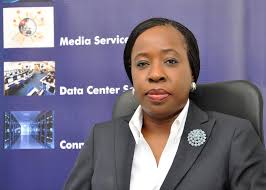
CEO of MainOne, Funke Opeke, a strong influencer in Nigerian tech sector (image credit: MainOne)


Running Away from Zinox and Omatek Indigenization

MainOne and Rack Centre must not follow the Zinox and Omatek indigenization/protection campaign, which they tried, when they say falling market shares in the PC sector. The government, then, tried to help them by pushing government institutions to buy the local PCs. Unfortunately, quality and pricing issues did not allow the directive to hold-up. In this area of Internet abundance, it is not likely that will work, either.

Nonetheless, they can make a case that some data must be hosted locally. A key factor will be managing it to create a balance that will not use regulation to undermine innovation for local companies. That will depend on pricing and ease of doing business with the companies.

New Data Cities

The last mile problem must have predicated the business model of MainOne – land this intercontinental cable and leave the rest to local entrepreneurs to use fiber to extend it into cities and communities. That has not happened. Sure – progress is ongoing with Glo and other companies expanding capacities. I do think the fiber density will take years  and more investment to come to global average parity. Waiting for that will be hard – the companies can try something new.

Jeff Bezos, Amazon CEO, is a ruthless competitor. His company plans to build data centers in Africa


My proposal will be for them to take selected cities in Nigeria and focus on that. For example, it can take Yaba and make sure it can reach Yaba very well with quality broadband. It takes South East, say Aba and do the same. It picks South South Port Harcourt  and so on. And in the cities where it is, it delivers world-class first rate service with better pricing to draw data-hungry businesses and startups within that vicinity. As it makes money, it can then scale to other cities. Where possible, six cities will be optimal. They make them Data Cities of Nigeria, with great bandwidth capabilities and competitive pricing that will attract digital businesses to move and do business.

If they do not do this, Amazon will likely do it when it makes it into Africa and Nigeria, with its piles of cash. Provide connectivity at scale and strategically make people to make decisions on company location based on where data pricing makes sense.

Do not forget VAS

The beauty of Amazon EC2 is that it saves you money, because many suites are there. EC2 was built on the primitive model. The local firms must find ways to make sure they get Remita, Flutterwave, banks APIs and anything possible, all integrated to provide extra value for anyone that signs. Imagine if signing-up to Rack Centre cloud solution saves one costs of paying for the integration of these other local services, because they have already been done.Those value-added services are big components of what makers data centers/cloud services great. MainOne and Rack Center must invest to have the best solutions for Nigeria.

Rounding Up

The datacenter business in  Nigeria will hit up in coming years as Amazon, Google, Microsoft Azure etc begin to build data centers in Africa to handle the issue of latency. The local players today must work hard to mitigate the competitive challenges through product and pricing innovations. They have to learn from the local PC makers and move fast to deliver visible products before the foreign brands emerge. Winning this business warfare will be extremely challenging because the foreign ones come with more capital and name recognitions. However, if  the local ones can offer solutions that differentiate them, they have the edge, and can win. They need to develop a strategy that uses “primitives model” engraved in Nigerian business processes and systems, which the foreign competitors lack.


The new name of Etisalat Nigeria is …. 9Mobile

0

Despite all the denials, Etisalat  Nigeria on Thursday has re-branded. Etisalat Nigeria is now history, just as we had Econet, Celtel, etc.

At end of a management meeting of the telecom firm in Lagos, 9Mobile was adopted by the company as the new brand name, reports Premium Times.

The embattled Etisalat Nigeria on Thursday rallied to move away from the shadows of its troubles by taking a new brand name. At end of a crucial management meeting of the telecom firm in Lagos, 9Mobile was unanimously adopted by the company as its new brand name….

EMTS Vice President Regulatory and Corporate Affairs, Ibrahim Dikko, had weighed in with an explanation that the company had a valid and subsisting agreement with its former parent company, to continue using the Etisalat brand regardless of the recent restructuring of the Company.

Mr. Dikko gave a hint as to what the new name of the company could be. He recalled that at the launch of EMTS in Nigeria in 2008, “0809ja” was adopted, to affirm the “Nigerianness” of its origin and the company’s sphere of influence.

Following Thursday’s announcement of the new brand name, PREMIUM TIMES learnt all staff of the company nationwide were sent notices of the change of name. The company’s new name is yet to be unveiled officially to the public. Early this week, Mr. Dikko said the new brand name would not affect the company’s operations.

New chief executive, Boye Olusanya said the new management was mandated to ensure the business was run as profitable venture.

“What is most important now is to ensure the business runs and meets its obligations. We will focuss on getting the company back on track as soon as possible,” he said.

Welcome 9Mobile.

Recall few days ago the firm said that it would not re-brand. Today, it just did so.

Why Nigerian Government is wrong on Establishing an ICT University

0

The Federal Republic of Nigeria is establishing a new university – the ICT University of Nigeria. This new school is designed on the construct that it will fix all our ICT related challenges. It will be the magic wand that will suddenly help take Nigeria into the league of ICT excellence.

The Federal Government says it will establish an Information Communication Technology, ICT, University …The Minister of Communications, Adebayo Shittu, disclosed this on Monday in Abuja …By the grace of God, in the next three to six months, we should have established in Nigeria an ICT university which will be first of its kind in Africa. This is with the sole purpose of providing training environment and training facilities to make the industry have enough skilled manpower in various sub sectors of the ICT sector. I am happy to say that we already have what is called the Digital Bridge Institute which is for short term training programmes in six locations across the country and we hope to transform this institute into the ICT University of Nigeria. I am already talking to a lot of operators at the international level, Facebook, Motorola, Ericson, all of them. We are encouraging them to come and adopt the university campuses as their own. They can bring in money and bring in faculties and a lot of logistics to assist in training Nigerians and we can now export these trained skilled facilitators to African countries to work.’’

Unfortunately, the government is wrong. The government is wrong because the university will not fix anything if the secondary school system remains broken. A broken secondary education will not produce a great university system. The pipeline matters. It is very important for the government to also work on how to fix the secondary school education, where Nigerian kids, are pushed to over-specialize to the extent that those going for engineering may not have to understand anything about economics, government, commerce and literature. Unfortunately, engineering functions under economic systems and governments.

The government is wrong because ICT cannot be used to fix ICT. ICT is a consuming, application phase of engineering. It cannot evolve until engineering has evolved. Simply ICT is a downstream application of the construct developed in engineering and science. If you do not fix engineering and science, you cannot get ICT right. Sure, the government may be focusing on training maintenance ICT graduates who may not need to think deeper. But that was not the promise by the government. No nation can be great on ICT without a strong engineering education, because everything seen on ICT  is a mere application of engineering and science.

The government is also wrong because we already have many ICT Universities but named elegantly. They are Federal University of Technology (Owerri), Federal University of Technology (Akure), and more. Had the government chosen to setup specific faculties within these schools called Faculty of ICT, the road map might have made more sense.

The government is wrong because it has abandoned the existing universities. So it does not have the moral capacity to entice us with another new university. Some universities in Nigeria are still teaching irrelevant curricula. Possibly, the professor does not know the new areas and government has not provided support for re-learning. With no incentive to for teachers to innovate, it is the government that will force the schools to improve. Many of the graduates are not employable, yet, nothing is done to fix that.

The government is wrong because at the end of this exercise, government does not have the funding to spread and fund it well. Buildings will be built but attracting top teaching talent will be stymied by the federal payment structure for universities. If the universities we have now, are not right, and are not producing the best ICT graduates, who will be the teachers in this new one? The same people? So what will change? The federal government cannot break the bank to attract more talent. Even if it has the funding, it has to follow existing federal payment structure. So, at the end, it is more of the same. But focusing on the teachers may miss the point – the teachers are great, but lack of funding is what makes their works difficult. So even if you get the smartest professor from MIT, he will not succeed in Nigeria, because he may be unable to find light to power up his laptop. That is what our professors go through, which unfortunately, make most look not top-rate.

The government is wrong because our problem is not multinational corporations taking a campus to populate their programs on our young ones. The government is asking multinational corporations to adopt some of the campuses. If these firms agree, the implication is that the university will become another avenue to accelerate further tech consumerism in Nigeria, with minimal creativity and innovation. The kids will be educated on how to repair and maintain, but never on how to design.

The government is wrong because any campus absorbed by any multinational corporation should have been better called a polytechnic, because they will not educate creators and innovators, but support and repairmen and women. We have polytechnics for them to absorb. Our university system must be technology and platform-agnostic so that students focus on facts, unconstrained by technologies supporting them. It will be very toxic if they cannot use iOS because Android is what every professor adopts in programming, in case Google is taking over a campus. Sure – we welcome them to provide lab tools and support but anyone should be open to do this, without any consideration that someone else has “adopted” a territory. But the reality is that without that territoriaal control, they will see no value in spending that money. Why should they?

The government is wrong because ICT university is fundamentally deficient. Innovation in ICT thrives on the amalgam of many disciplines because products have many elements. The best of Microsoft was not just Windows but also the branding and licensing strategy. Intel accelerated its market dominance, not just because of its technology, but rather, addition of excellent marketing like “Intel Inside” campaign. The techies did not create those elements. That is why  a campus that offers many programs across many fields actually creates more excellent startups. You do not expect kids trained in a mono-focused university to be the game-changers. They may be techies but the missing elements of other variables will put them in disadvantages. There is no evidence that ultra-specialized schools deliver better innovators – they tend to be better employees in their areas. Maybe that is what Nigeria is hoping. If so, that is unfortunate. Polytechnics should be started then, not universities.

The government is wrong because it is simply expanding bureaucracy. It will have to hire a Vice Chancellor with all the apparatus of University Senate, Governing Council, etc. Nigeria cannot afford that process. This new school could have been a faculty in already existing one saving us the extra management cost. The focus should be the consolidation of all schools so that we can have at most six federal universities with campuses across the country. That means six VCs with directors in the associated regions. Nigeria will save massive money in the process.

Nigerian ICT Minister Adebayo Shittu


The federal government is wrong because government is broke. A new campus will not help. As noted, the focus should be expanding capacity with better structures. Have 6 universities with one in each of the geo-political zones and all the federal ones becoming specialized campuses. For example, in the East, have all the universities with the name, University of Nigeria, South East and run from UNN. All federal universities in Nigeria will then be consolidated with focused specializations. FUTO becomes the School of Engineering,  University of Nigeria, South East. Michael Okpara University of Agriculture becomes School of Agriculture, University of Nigeria, South East. The others will be structured that way to save cost. That will save government the costs of maintaining top university management. The same goes in South West with UI becoming the center as University of Nigeria, South West. The fact remains, if Nigeria does not reform on emoluments and escalating administrative costs of government, we can crash as a country, post-petroleum era. (More on this later in a new piece). This reform should go beyond education to MDAs (ministries, departments and agencies). (Please note that the universities can retain their present names, but administratively they will be run by the six VCs.)

The federal government is wrong because at the end, the ICT University will not have any chance of challenging our federal universities of technology. There is no current government, in Nigeria, with  the legitimacy to establish any new university in Nigeria when the current ones can be expanded to absorb more students.. The ones established few years ago by the last Administration are nothing but laughing stocks. Usually nations make progress but unfortunately, in Nigeria, we are not. The same country that established ABU, UI, UNN, OAU, FUTO, FUTA etc is the one establishing the ones in Otuoke, Dutse, Dutsin-Ma etc. You will ask: where is the progression that comes by learning from the past to do better.

Rounding Up

The strength of a university is not the name, but rather its purpose, executed by the finest possible talent, supported with resources. No matter what the government calls a new university, it does not change anything. The university system in Nigeria, especially at the federal level, will continue to under-perform until it is properly funded. Making the schools attractive so that former military generals, former bank CEOs, and technology leaders, can find the opportunities exciting to teach therein, is what will redesign the system. Availability of new teaching talent with relevance in the emerging skills is critical . A new university of ICT is just another bureaucracy; government could have expanded the existing federal universities of technology with faculties of ICT. This is a misplaced priority by the government. They could have given the money to Co-Creation Hub, Wennovation Hub, and other hubs across Nigeria to offer scholarships and re-train the largely unemployable graduates, produced by our university system.

The Andela Problem

16
Andela

Update: Andela has addressed most of the operational concerns in this piece. You can read updates here and here.


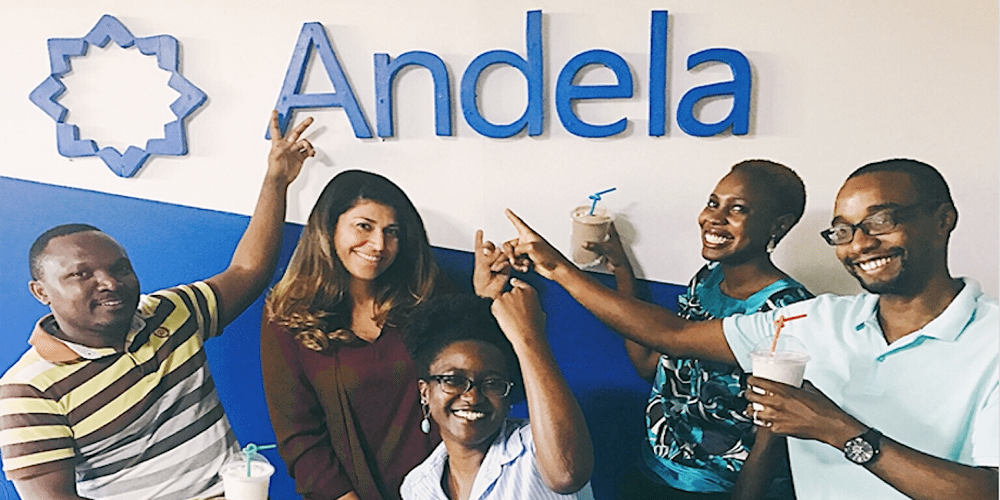
Andela is a fine engineering company. It provides leading global firms and high-growth startups with elite African developers to support their operations.

Andela provides companies with access to the top 1% of global tech talent by identifying high-potential developers on the African continent, shaping them into world-class technical leaders, and pairing them with companies as full-time, distributed team members. This allows Andela’s clients, which range from startups to the Fortune 500, to accelerate their product roadmaps while minimizing time spent interviewing, on-boarding, and training new hires.

Andela is backed by investors including Spark Capital, Google Ventures, Chan Zuckerberg Initiative, Omidyar Network, Susa Ventures, Steve Case, Founder Collective, Rothenberg Ventures, Learn Capital and more.

Its claim that it recruits the “most talented developers” in Africa is debatable; in my alma mater, Federal University of Technology Owerri (FUTO), where oil companies come and hire some brilliant students, before graduation, it is not evident they will forgo Shell and Chevron jobs because of attending Andela training. But there is no doubt that it is making a real contribution in the industry by training and developing young people and offering them opportunities. Also, since these developers are full-time employees of the paired companies, it does mean they are not working for Andela, post-training. Understanding this is important to understand the business model of Andela. How does it make money?

  • Option A: The companies, which are hiring Andela trainees, may pay a fee to Andela which is typical to the recruitment sector where companies are compensated for helping clients to fill positions. The only difference here is that Andela is using people from its “school” to fill those positions. So, that fee becomes its revenue. Also, there is also a likelihood that Andela may take besides the fee, a one-off percentage of the first year salary of the developer, paid by the hiring company. This is typical in the industry. We do not know yet because there is no information anywhere on this important part of Andela – are the trainees making money and how much percentage, post training? They are paid about $500 per month with boarding and feeding during training.
  • Option B: Another model could be taking a percentage of the developers’ salaries. This one is not interesting since the developer is a “full-time” staff of the paired company. You cannot be a full-time staff in IBM while getting a percentage of your salary going to Andela. So, this does not make sense. However, it is also possible that you can be a full-time staff on “time” but still be a staff of Andela. It is like what happens in the banking sector where OND graduates are employed “full time” in banks despite having the consulting companies that sent them paying them. The banks pay the consulting firms; they pay the OND graduates from there.
  • Option C: A hybrid of the Option A and Option B. Andela is paid a fee and continues to get a portion of the developers’ wages. The key part of this is how long are the developers contracted. Are they allowed to resign after training? And how many years are they compelled to remain in Andela network? Knowing the answers to these questions will help decide how Andela makes money. Since they are funding all aspects of the training, it is fair to expect them to have some clauses that demand the developers put some time with them to recover the money. Otherwise, a graduate can depart and source for that job directly.

So, for this analysis, I will focus on the Option C – Andela is paid a fee for facilitating the recruitment of developers into clients’ businesses, and it also takes a percentage salary of the developers, in perpetuity. The core of Andela is to transform bright graduates into elite developers, even those with limited prior-software skills.

Andela has raised about $41 million and one of our fellow citizens, Iyinoluwa Aboyeji, is a co-founder. Iyin now runs Flutterwave, another high-growth company. He is a brilliant mind.

The core of Andela mission is to use African developers to support global firms where there is a shortage of developers. This is a win-win since our citizens get exposed, get nice jobs and the foreign clients get the talent to grow their businesses. It is promoted as an “opportunity to plug the shortage of software developers in Silicon Valley by bringing in technological talents from Africa” .

Andela Fellows (credit: iHub)


Making Sense of The Business

For the mission on what Andela is doing, there are many models in the world. Many Indian firms have pioneered that process with dedicated training schools where they prepare people they ship to Western firms. Infosys, Tata and others do this with different flavors. However, for most of those firms, the developer, under most scenarios, remain the staff of the company that sent them. For example, if Infosys puts a developer in IBM, that staff remains a staff of Infosys, and never IBM. The implication is that Infosys continues to earn revenue from that staff throughout the deployment in IBM – it takes a percentage of the salary the staff is paid.

As noted above, I will assume a hybrid – Andela takes initial fees and over time, takes a percentage of the developer’s salary. This makes sense because it provides the office space the developers work from and the developers never paid for the training. In other words, before they are IBM or Microsoft employees, they have to be Andela employees.

(The construct of decoupling from Andela, once hired by the outside firm, post-training, does not make sense. Doing this will mean Andela will only benefit from initial fees paid by the client. This is not really likely, since Andela provides the office spaces where  these developers work from, remotely, to provide services to the outside firms. I do not think it is possible they can offer the service without being compensated either by the hiring firm or the developer.)

Andela Co-Founders Ian Carnevale, Christina Sass, Iyin “E” Aboyeji, and Jeremy Johnson (credit: Ventures Africa)


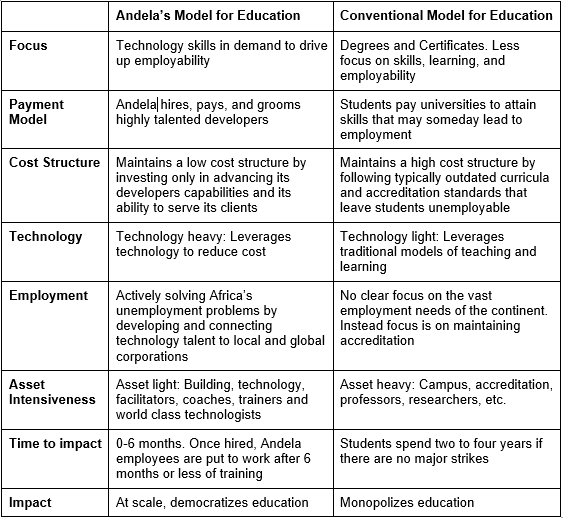
Andela is radically different from conventional model of education as noted in the table below which compares Andela model for education and the conventional one.

(Table Source: Medium)

The revenue model and how these developers are paid are not provided. This could be a huge difference between the Andela model and conventional education. Understanding that compensation is at the heart of this comparison, but too bad, no one has the data/information to make that call. Do you work for Andela for 4 years? What does the contract say, if you want to depart?

Training Models

Andela trains people. We will examine the processes. There are about four models for doing this:

  • You ask people to pay fees to get training/education: In this case you can think of Udacity Nanodegree where you pay to be trained. Or at best, you attend MIT without a scholarship – you pay the school fees. This one requires you invest massively in the program. Udacity is online-based which makes it scalable while MIT is restricted. The key element is making sure you get value in what you are paying for.
  • You make the training free: Here, the training is free. Codecademy comes into mind with its solid interactive online training suites which are free. This model scales rapidly because it is free. Quality issues are common in this model.
  • You retain people and train: In this model, you become selective, not mass as in Codecademy and you waive the training fee. Not everyone can access that training, you become selective. MEST Ghana has this model. Andela is doing the same. They provide stipends to the trainees. In this model, the revenue is designed where the developers become the products, which are now used to either build companies, or as in Andela case, deployed as employees in other firms. The Y Combinator is also a variant of this, though the focus is building companies.
  • NGOs with no sustainability: you offer training to selected developers, pay stipends during training, and when the money runs out, you close. This happens when you cannot find more donors to support the project. In this one, revenue is not a key part of the business. It is more of a community service.

Andela pays stipends, about $500 per month, to the developer-trainees while waving all training fees It has to recoup this investment, provided it is not an NGO. In other words, the investments must be returned.

Andela, a Lagos and New York-based education start-up has brought a brand new approach to education on the African continent. Instead of charging students for a four-year degree before releasing them to a brutal economic environment characterised by high unemployment, Andela recruits intelligent, local talent through a rigorous testing and interview process and then pays each student approximately $500 each month, with benefits, at the start of a four year fellowship designed to transform even the least tech-inclined person into a world-class software developer or project manager. As they progress through the programme and take on greater responsibility, Andela fellows are eligible for pay raises…Andela’s business model centres on training these students to be proficient in software and web development, before making their talent available (while they are still in training) to companies around the world in need of engineering talent.

Essentially, Andela is a talent arbitrage firm which subsidizes the cost of the developer-education through the fees earned from the foreign partners, made possible later by the developer.

The Andela Problem

Andela challenge is scaling. As it opens more offices, its expenses will increase. Because of the level of quality it wants, its growth will correlate heavily with more expenses. Unlike say, it is training on the web and deploying the developers from their homes, it will have to open offices, retain the developers from those offices to support the global clients. Two things happen here:

  • Andela is a decentralized school: It has locations in three locations, in Africa now. They are Nigeria, Kenya,and Uganda. It can use the same faculty which it can rotate to cover these locations, or alternatively, it can bring all the classes together to save cost. Alternatively, it is possible most of the training can be done via the web with minimal physical contacts.It is noted that most training is personalized, so it is likely online. Sure, some physical components will still be relevant since they do not just teach technology – they offer programs on communication, leadership and more.
  • It runs decentralized employment locations: When it hires and helps IBM to engage a developer, IBM has a record that the person is in Uganda. For Lagos, that person is in Nigeria. It will open many locations. By the time it gets to 100,000 people, it might have many office locations which have to be managed. Think of a  company with 100,000 staff.

The business cannot scale outside the blue, because the revenue is the developer, and you cannot mass produce them. There is a space constraint on how many you can have in the offices.Sure – you have more offices, but that also increases cost. For the very fact that these workers remain with Andela, and not leaving, it will quickly run into carry-capacity. But that is a good problem to have in Africa, though.

How? Let us assume, it pairs 200 people in Lagos yearly. Over ten years, it will have 2000 people in Lagos. It means every year, its offices must absorb new 200, assuming old developers did not leave (not clear on the terms for that). Building such a business will mean by the time it gets to 10,000 staff, it will have a huge real-estate like call-center but here developers. Getting to 10,000 is important because the staff is the product where the revenue comes.

Compare this to Infosys model where the developer actually goes to the client office, in some cases. It does not have to expand at that physical scale. But Andela has to invest in accommodation. The students are also housed and provided feeding which mean big expense.

The training process may be difficult, but the payoff is well worth it. Andela pays its fellows from the moment they are accepted, and the company showers them with a multitude of benefits like health care, a MacBook, subsidized housing, and, as is standard for many tech companies, meals every day

Mark Zuckerberg invested through his family foundation (image credit: Newslex)


Andela may become the largest company operating in Africa, if it attains its plan of 100,000 developers in ten years. If it continues the model of accommodating the developers and feeding them, managing that complexity will require that it registers as a real estate firm and also own its own hotel and catering services. So, it is safe to assume that the company will pivot as its capacity grows. This will be the biggest challenge for Andela – you cannot have the 100,000 in your system.

Finding and training people will remain critical in Africa. Compare to the model of Actis, a private equity firm, which runs Honoris United Universities, the difference is clear. Actis is not offering any job placement, though, but it is tapping a network of schools, to train at scale. Both Andela and Actis, are there to make money. Actis is going the old path. Andela offers higher value – it is indeed redesigning the system.

Actis, a leading investor in growth markets, announced today a major pan-African higher education initiative – Honoris United Universities 

Honoris United Universities is the first African private higher education network bringing together the leading tertiary education institutions in North and Southern Africa for the first time. Honoris United Universities will harness the collaborative intelligence and the pioneering efforts of these institutions to educate Africa’s next generations of leaders and professionals.

Looking At Revenue

From the heart of Andela program, it looks like a charity, but it is not. Everything depends on what the developers get when they begin work and what Andela makes from them, as they are paired in companies.

Andela’s training and education program unites qualified African students, regardless of age or income, with leading developers who teach them to code. The four-year training program, which pays its students, is highly selective. Jeremy Johnson, the company’s CEO, has said that in Nigeria its recruitment rate was around 0.7% of the 15,000 applicants it had received to that point. Within six months of starting the program, those students who have been accepted start to be placed at technology companies that partner with Andela, and receive continual training and professional development. Andela has partnered with Microsoft, IBM, 2U, Udacity, and others.

Andela pays the students and trains them for four years. This is like an undergraduate education. Though the training is four years, the developers start working from the 6th month. This means they could be working for 3.5 years which at the end, they become on their own. (This is not clear)  In all its materials, it emphasis training so you do not know what happens past the four years, if these developers, will remain in their networks. It plans to train more than 100,000 in ten years

Komolafe is just one of many Andela students who are betting on this young education start-up company, which intends to train 100,000 software engineers over the next 10 years.

At acceptance rate of say 1%, it means that Andela will be in contact, physically or online, with at least 10 million young Africans. Of course some of the processes are automated, but it is still a huge number. The cost of operation will also increase as this firm advances:

Finding these bright minds is an extensive process. Over its two years, Andela has seen applications from approximately 40,000 candidates. Those applicants are filtered out through automated aptitude tests. Top scorers are then invited in for in-person tests, and after that, the top 2 percent of candidates are invited back for the final round of the application process, a two-week boot camp. Only about a third of those individuals make the final cut, hence Andela’s razor-thin 0.7 percent acceptance rate….Accepted fellows move into Andela’s campuses and begin their personalized training right away, which is a process that typically takes about five or six months to complete.

At its peak, Andela could be making real money. I cannot put a figure without knowing what happens after training for the developers. How many years are they required to “work” for Andela?

Rounding Up

There is no question that Andela is pioneering a new model of talent development in Africa. It is going to seed a new generation of African tech leaders in coming years. Its vision is sweet and Africa will forever be better for it. However, depending on its contract with the developers, it may struggle to make money; its cost will scale massively with growth by operating real estates, accommodation and catering. If it gets to the 100,000 developers it hopes to train in ten years, on assumption that it can remotely have the developers work from its facilities, it will become one of the largest companies in Africa. Its products are the developers. By controlling all aspects of the developer experience as it wants to house, feed and keep them, it may very soon become a real estate and catering company because handling that will become a huge part of its business. But if it graduates them after four years, with the developers free to depart, after the training and pairing/mentoring, it could be seen as the most important social empowerment program in modern Africa. The story of this company is just starting – we need to know more how it plans to handle the future of the developers as it recruits very brilliant people with super-size ambitions in life. Andela problem is that humans are its products. That is always hard to control.

List of 19 Judges Appointed by Acting President Yemi Osinbajo for National Industrial Court of Nigeria

0

Yemi Osinbajo, the Acting President of Nigeria, on Tuesday, approved the appointment of 19 judges for the National Industrial Court of Nigeria.

This is contained in a statement signed by Soji Oye, spokesman of the National Judicial Council (NJC), said Walter Onnoghen, chief justice of Nigeria (CJN), would swear them in on Friday

According to Oye, Walter Onnoghen, Chief Justice of Nigeria (CJN), would swear them in on Friday.

THE JUDGES:

Targema John Iorngee (Benue)
Namtari Mahmood Abba (Adamawa)
Nweneka Gerald Ikechi (Rivers)
Kado Sanusi (Katsina)
Adeniyi Sinmisola Oluyinka (Ogun)
Abiola Adunola Adewemimo (Osun)
Opeloye Ogunbowale A (Lagos)
Essien Isaac Jeremiah (Akwa-Ibom)
Elizabeth Ama Oji (Ebonyi)
Arowosegbe Olukayode Ojo (Ondo)
Ogbuanya Nelson S. Chukwudi (Enugu)
Bashir Zaynab Mohammed (Niger)
Galadima Ibrahim Suleiman (Nasarawa)
Bassi Paul Ahmed (Borno)
Danjidda Salisu Hamisu (Kano)
Hamman Idi Polycarp (Taraba)
Damulak Kiyersohot Dashe (Plateau)
Alkali Bashar Attahiru (Sokoto)
Mustapha Tijjani (Jigawa)