DD
MM
YYYY

PAGES

DD
MM
YYYY

spot_img

PAGES

Home Blog Page 7382

MP3 Digital Music Format Is Officially Dead, Ending An Era

0

RIP MP3. Yes, the creators of the MP3 have declared the music format obsolete, closing the lid on the iconic audio files that popularised the iPod

MP3 has been by far the most popular digital audio format since its inception over two decades ago, and now it’s finally being killed off. The format’s developer has announced that it’s terminating the format’s licensing program. Yes, MP3 is officially dead

The actual patent history of MP3 is mired in controversy; many developers across the world claimed patents related to encoding and decoding the format in the past, resulting in a multitude of lawsuits and confusion as to which organisation’s licenses had to be purchased from during the early days of its adoption. However, the Fraunhofer Institute has claimed patents for licensing the format to developers who want to distribute or sell decoders and encoders since 2005, and won legal battles for its ownership as well. The company has now issued a statement it’s discontinuing the popular MP3 music format.

“Although there are more efficient audio codecs with advanced features available today, MP3 is still very popular amongst consumers,” the statement reads. “However, most state-of-the-art media services such as streaming or TV and radio broadcasting use modern ISO-MPEG codecs such as the AAC family or in the future MPEG-H. Those can deliver more features and a higher audio quality at much lower bitrates compared to MP3.”

Of course, most people and developers have already begun moving away from MP3, even if support is still provided for the format. The move, however, is significant as it’s reminiscent of when PC manufacturers first began to standardise CD-ROMs in their computers, as opposed to floppy drives.

Another example is now present in the smartphone and laptop industry, as we see tech companies gradually moving towards USB Type-C over Type-A USB and MicroUSB. AAC (Advanced Audio Coding), which was partly developed by the Fraunhofer Institute is today’s new audio standard for most streaming and distribution.

The MP3 Legacy

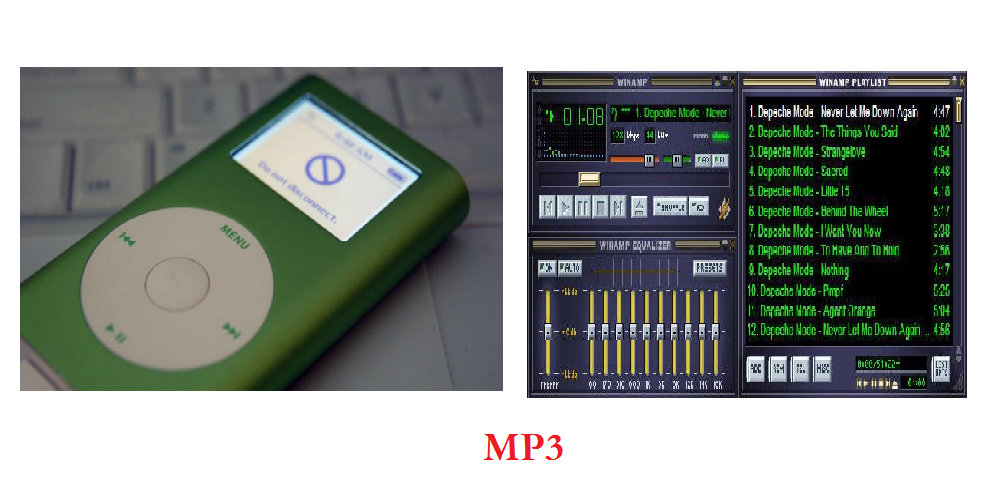
Of course, though MP3 may be dead, it’s left an inarguable impact on the tech world, and we couldn’t help but feel nostalgic at the news. After it first came out 24 years ago, in 1993, it slowly gained popularity in the later half of that decade. By 1997, with the launch of the Winamp audio player, people were regularly downloading MP3s from various websites offering the service (mostly illegally). That process skyrocketed in usage numbers when Napster (the granddaddy of peer-to-peer torrents we know today) launched in 1999, making it more convenient to download large batches of small audio files ripped from CDs.

Apple also owes the MP3 a lot of its success, the building block of its popular iPods and the iTunes service we know today, as well as the format paving the way for streaming services like Gaana and Spotify.

Unfortunately, MP3 may never see any sort of nostalgic revival like audio cassettes (Thank you for that Guardians of the Galaxy), or vinyls. Aside from being an audio format with no character to speak of, MP3 is also widely looked down on for its low quality. The same lossy compression rates that made the format a hit in the days of early broadband (and a lot of dial-up connections here in India) is highly inferior to other available options, with many critics even saying it enhances the bad audio qualities of instruments while burying their positives.

And yet, we have to say thank you, MP3. Thanks for helping form our early music tastes, for allowing us to share the tunes we cared about with our friends, and for letting us make that first cherished CD with more than a measly 12-15 tracks. It’s been fun, and we owe you so much.

JAMB Results Out – How to Check 2017 UTME Results

12
Nigeria needs stronger education systems

The Joint Admissions and Matriculation Board (JAMB) has already started releasing results for the 2017 Unified tertiary matriculation examination (UTME) that started on 13th May, 2017. Follow the procedures below to check your result.

How to check JAMB 2017 Results
1. Login to your profile at www.jamb.org.ng
2. Scroll down a bit and find the box that says “Check 2017 UTME Examination Results”. Click on it.
3. It should either display your result or tell you “No Result Yet”

JAMB usually release results in batches, If you have no result yet you can check again. Even if someone in your day schedule has seen his/her result, you still need to exercise some patience until your result is finally released.

If for some reason JAMB has decided to withhold or seize your result, an appropriate reason will be given to you; Example,
1. You were involved in Malpractice
2. You missed your schedule
3. You were too late to the exam
E.T.C.

Google Brings Transparency In AdSence: Page Only Violation Removal And Policy Center

0

Google has announced two changes to its AdSense network that it says will increase transparency about how it deals with violations and removes ads from websites.

First, AdSense’s technology has been changed so it can now remove ads from individual pages, instead of entire websites. Previously, Google usually removed ads from every page on a website after a policy violation, instead of just the pages with offending content.

Second, Google will launch a platform in a few weeks called the “Policy Center” to help website publishers understand the program’s rules and fix violations more quickly. Read the blog here.

Publishers are the backbone of the open web—the content creators, journalists, amateur videographers and our go-to guides for information. Fifteen years ago, we decided to help publishers make money from their content by starting AdSense, our first publisher platform. And today, our ad platforms are used by millions of publishers, large and small, as a way to grow their businesses. In 2016, we paid out more than $11 billion to our publisher partners from advertising.

Policies play an important role in protecting the open web. They ensure publishers have a sustainable way to make money through our ads platforms, setting rules about what we do and don’t allow. For example, publishers can’t just have a site full of ads. Our policies exist to balance publishers’ needs with those of our users, advertisers and all of the parties that depend on it to keep the open web going.

One of the top requests we hear from publishers is that they want more transparency about how we respond to policy violations on their content. They want more information about why we remove ads on their websites and more help to resolve issues quickly, minimizing the impact on their bottom line.

Today we’re announcing two updates, based on direct feedback from publishers, to how our policies are enforced and communicated to publishers.

Policy actions at the page level

We’re introducing a new technology for policy violations that allows us to act more quickly and more precisely when we need to remove ads from content that violates our policies. Historically, for most policy violations, we remove all ads from a publisher’s site. As we roll out page-level policy action as the new default for content violations, we’ll be able to stop showing ads on select pages, while leaving ads up on the rest of a site’s good content. We’ll still use site-level actions but only as needed. And when it’s necessary, such as in the case of egregious or persistent violations, we’ll still terminate publishers. Altogether, this means fewer disruptions for publishers.

A new Policy Center for publishers that use AdSense

We’re also announcing a new Policy Center as a one-stop shop for everything a publisher needs to know about policy actions that affect their sites and pages. We have been piloting this Policy Center with thousands of AdSense publishers, who have been very positive about these changes—and provided great feedback and suggestions on how to make the Policy Center more useful.

In just a few weeks, all AdSense publishers will have more transparency about why policy actions were taken and the violations found, including page-level action data, so they can quickly resolve these issues across all their sites and pages using step-by-step instructions. The Policy Center also makes it easy for publishers to tell us when policy issues have been resolved and their pages are ready for review.

Later this year, we’ll be adding policy centers in other publisher platforms in addition to AdSense.

With this launch, we’re moving two steps closer to our goal of making it easier to understand how our policies work so that publishers can drive their businesses forward, using Google ad platforms.  

MTN South Africa Shortlists Zenvus For MTN Mind2Machine IoT Award Finals

0

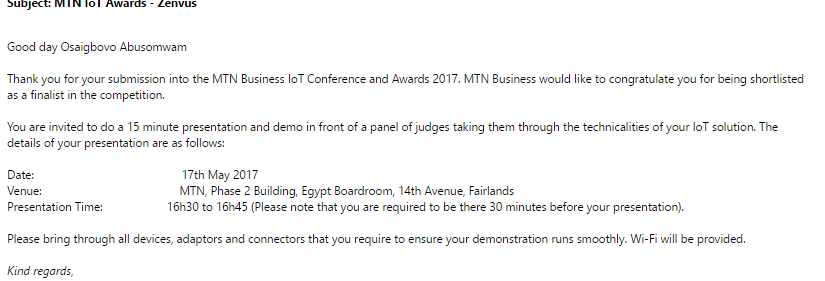
The MTN Mind2Machine Awards has shortlisted Zenvus for the finals of the IoT awards in South Africa. This is a competition that focuses on IoT and embedded systems.  It was communicated via email today. Our team will attend the program through a new South African affiliate Fasmicro Group is establishing.

Thank you for your submission into the MTN Business IoT Conference and Awards 2017. MTN Business would like to congratulate you for being shortlisted as a finalist in the competition.

You are invited to do a 15 minute presentation and demo in front of a panel of judges taking them through the technicalities of your IoT solution. The details of your presentation are as follows:

Date:                                              17th May 2017

Venue:                                           MTN, Phase 2 Building, Egypt Boardroom, 14th Avenue, Fairlands

Presentation Time:                    16h30 to 16h45 (Please note that you are required to be there 30 minutes before your presentation).

 Please bring through all devices, adaptors and connectors that you require to ensure your demonstration runs smoothly. Wi-Fi will be provided.

 Kind regards,


Women, Apply ToShe Leads Africa Accelerator Nigeria And Win Cash For Your Business

0

She Leads Africa has just opened applications for the 2017 She Leads Africa Accelerator, a 3-month program designed to identify, support and fund the next generation of Nigeria’s brightest entrepreneurs. She Leads Africa  is a social enterprise dedicated to supporting young African women and their journey towards professional success through online content and offline programmes.

SLA’s 2017 Accelerator will take place in 4 locations across Nigeria – Abuja, Lagos Island, Lagos Mainland, and Kaduna.

The 2017 Accelerator will consist of 1 week residencies in the four locations where entrepreneurs will receive training from the SLA team and business leaders and experts. During these residencies, entrepreneurs will be focused on business strategy, growth, marketing, finance and distribution. They will also receive a host of on and offline training as well as an opportunity to pitch their business to national and international investors.

This 2017 SLA Accelerator is run in partnership with the Work in Progress! Alliance – a consortium of Oxfam, Butterfly Works and VC4A focused on driving job creation and youth employment in Nigeria.

The Work in Progress! Alliance is focused on unlocking the economic potential of young women and men in Egypt, Nigeria and Somalia. The project aims to enable them to generate sustainable and living incomes – by finding regular employment or starting enterprises. Alliance partners include Oxfam, VC4A (Venture Capital for Africa) and Butterfly Works. As part of the project, VC4A partners with local accelerators and works to strengthen local investor networks.

Apply Here – Due  25 June 2017 at 11:59pm WAT.