DD
MM
YYYY

PAGES

DD
MM
YYYY

spot_img

PAGES

Home Blog Page 7400

Google Makes A Really Fast Microprocessor, RIP Core Competency Concept

0

Nonsense to the concept of core competency. Anyone can do anything because the cost of doing everything is lower. That is one of the problems of companies that have no platforms. That is why IBM is struggling because it has no platform. Everything it does can be easily done by its clients with marginal pains. As technology costs drop, there is no need to outsource. You can simply build in-house.

Google, Facebook and host of many companies are doing so. Facebook makes some of its servers, using largely open source solutions. Google has entered into the chip business.

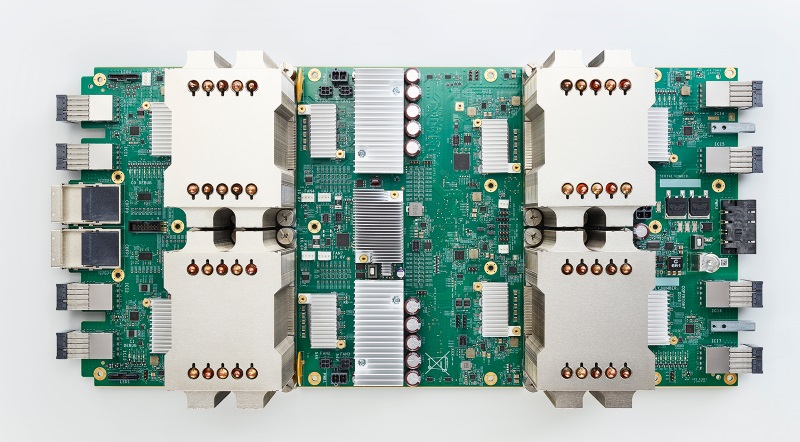
Google has designed and deployed a second generation of its TensorFlow Processor Unit (TPU) and is giving access to the machine-learning ASIC as a cloud service for commercial customers and researchers. A server with four of the so-called Cloud TPUs delivers 180 TFlops that will be used both for training and inference tasks.

The effort aims to harness rising interest in machine learning to drive use of Google’s cloud services. It also aims to rally more users around its open-source TensorFlow framework, the only software interface that the new chip supports.

The Cloud TPU supports floating-point math, which Google encourages for both training and inference jobs to simplify deployment. The first-gen ASIC used quantized integer math and was focused solely on inference jobs.

What is it that Google cannot do?

Top 30 Africa’s Facebook Messenger Chatbots

0

Facebook Messenger is an instant messaging service and software application. It is integrated with Facebook’s web-based chat feature. Facebook Messenger lets Facebook users send messages to each other. It was launched as a standalone app on the Android and iOS operating systems in August 2011 and the functionality was then removed from the main Facebook app in April 2014. Facebook has also launched Facebook Messenger Lite, a basic app with a limited feature set for areas with low-speed Internet or old mobile devices.

The following 30 bots are the top ones from Sub-Saharan Africa.

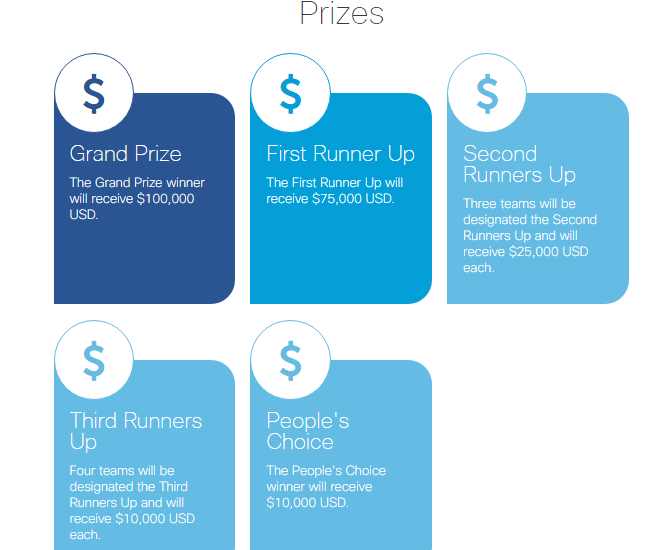
Win $100,000 From Cisco On Digitization and the Internet of Things (IoT)

0

Things like wells, cars, watches, refrigerators, and more will be connected to the Internet for the first time so that they can transmit and receive information.

Digitization is about connecting people and things to the Internet so that the information those connections provide can be used to improve processes and decision making.

With digitization and the Internet of Things (IoT), good ideas can make a difference more quickly than ever before by driving economic development and helping people solve some of our most pressing social and environmental challenges.

Who Should Enter?

This challenge is open to students or recent alumni from any college or university. Areas of impact could include, but are not limited to:

  • local industry/economic development
  • critical human needs (food, water, shelter, and disaster relief)
  • healthcare
  • economic empowerment/financial inclusion
  • education
  • environment
  • connectivity

Apply – Applications Close May 30 at 5 PM PT

Hail The Alpha, This Man Earned $1.6 billion In 2016

0
James Simons, chairman and founder of Renaissance Technologies LLC, sits for a photograph at the opening night of the World Science Festival in New York, U.S., on Wednesday, June 1, 2011. The 4th annual World Science Festival runs from June 1-5. Photographer: Amanda Gordon/Bloomberg via Getty Images

In this world, we have legends in our midst, extremely brilliant mathematicians. They are making real money.

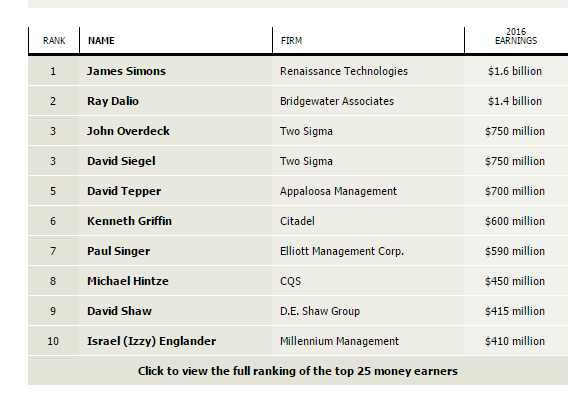
On Tuesday, the Institutional Investor’s Alpha magazine revealed the 25 best paid hedge fund managers in 2016. And it was James Simons, the founder of  Renaissance Technologies. Simons, a former codebreaker for the National Security Agency with a Ph.D. in mathematics, earned $1.6 billion in 2016. According to the Bloomberg Billionaire’s Index, Simons is worth about $15.7 billion.

Renaissance Technologies invests using computer algorithms and quantitative strategies. Its flagship fund, the Medallion fund, is known to charge much higher: a 5% management fee, and 44% cut of the profits. And investors were willing to pay for it. While many other funds suffered outflows in 2016, The Wall Street Journal, citing unnamed sources, reports that Renaissance attracted over $7 billion in new money during the year. Now, the firm is said to manage about $42 billion, with Medallion enjoying average annual returns of 40% since 1988. Still, Simons was paid roughly $100 million less than the year prior.

This Young Man Saved The World With $10 – He Made WannaCry Ransomware Actually Cry

2

The world was cyber-saved from WannaCry by a 22-year old man. Yes, when computers across the world were hit by a major ransomware attack over the weekend, pandemonium ensued. WannaCry was targeting both end users as well as corporate servers, locking them down and extorting an unlock fee from the victims. The worst part was how the malware used a vulnerability in Windows to spread the infection among unpatched systems.

Despite Microsoft issuing an emergency patch for Windows XP, the action was too late to stem the tide of infections across the globe. Eventually, that first wave was broken apart by one single white hat hacker.

British cybersecurity researcher Marcus Hutchins, who goes by the name MalwareTech, was responsible for stopping the spread of the first wave of WannaCry’s infection. How? He just bought a website.

After WannaCry had gained its notoriety, the 22-year-old was studying the code responsible for the worldwide panic, in an effort to understand it. What he noticed was that, after infecting a system, WannCry contained a set of instructions directing it to check a gibberish URL. Curious to see why that was, Hutchins went ahead and registered the domain name mentioned in the code for around $10. And that little bit of curiosity bought security researchers valuable time, as it killed off the malware’s ability to infect other systems.

Experts believe the initial infections of WannaCry were carried out by phishing attacks through email, or by exploiting a network security hole. After that, the malware was capable of spreading itself using the exploit in Microsoft’s Windows vulnerability. However, it seems the malware’s creators had programmed a “kill switch” into it, in case they ever needed to quickly deactivate the infection. That’s why WannaCry kept checking the bogus URL each time it infected a new computer. The idea is that, as long as the URL wasn’t a live page, the infection would continue.

The minute Hutchins registered the domain, it stopped the malware’s ability to spread; a huge relief to security researchers, even if the infected systems still remained on lockdown. It gave people time to update and patch security vulnerabilities, especially in the US, where WannaCry was yet to effectively penetrate before the kill switch was found. Hutchins’ actions may have saved thousands of people from being the next line of victims by the malware.

Unfortunately, that next wave is already here. It didn’t take long after Hutchins’ discovery for newer versions of WannaCry to show up online, all lacking the safety kill switch their predecessor had. Of course, cybersecurity researchers are also hard at work, attempting to track down where WannaCry initiated from. Patching holes and updating security is well and good, but the only way to stop people from being victimised by malware they aren’t familiar with is to catch the perpetrators and stop the infection at the source.

Great For Cybersecurity Companies.

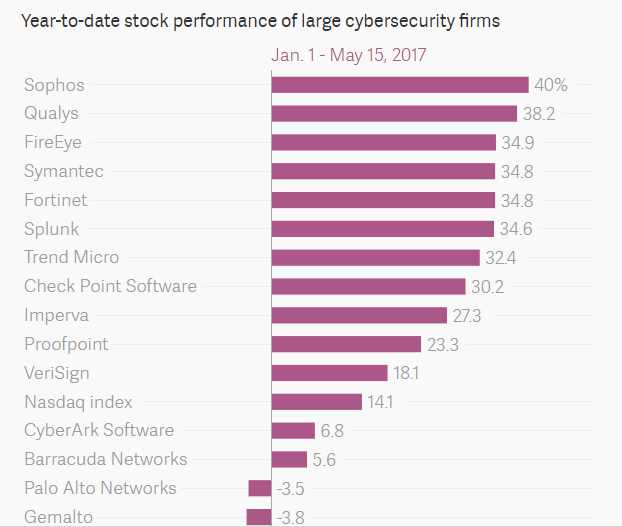
WannaCry has provided good advertising for cybersecurity companies around the world. The general constructs of cybersecurity in the last few weeks have been good for business. Symantec has jumped by around 4%, worth some $700 million in market cap. Companies like Fortinet, FireEye, Sophos, and Qualys have also jumped. F-Secure and Tokyo-listed Trend Micro also added a few percent to their share prices, worth several million dollars for each company. This is the state of the stock performances of major cybersecurity companies, according to Quartz. They are having one of the best years in a decade.