DD
MM
YYYY

PAGES

DD
MM
YYYY

spot_img

PAGES

Home Blog Page 7407

What Is Your Nigeria Legacy? Your Story, Our Moments

0

What Is Your Nigeria Legacy? Your Story, Our Moments

May 9 & Beyond

Good People. Great Nation.

On May 9 & Beyond, Tekedia convenes Nigeria Legacy, an open-invitation one sentence event bringing together Nigerian people and friends to share how they are shaping the future of the country. Boys, girls, men and women, companies and institutions, in all spheres, can share a one-sentence legacy statement.


We begin thus:

“We are helping farmers to improve productivity and cure extreme hunger in Nigeria through our technology”…Zenvus


What Is Your Legacy? Share it in the comment section below, even right now.

Proudly sponsored by

…Nigerians

photo credit: BellaNaija


€250,000 Equity Free IMPACT Growth Accelerator Extends Deadline To May 16 2017

0

IMPACT Growth has extended the deadline of its open call until May, 16th, 2017. Take this last chance and apply to get up to € 250,000 funding equity free for your scale-up if working in the areas of Smart Infrastructures and Cities, Smart Content, Smart Manufacturing and Smart Agrifood.


IMPACT Growth Smart AgriFood is the new project from IMPACT Accelerator, one of the top ten accelerator programs in the world.

In partnership with Danone, they are looking to select growth-stage startups working to solve problems related to farming, agri-logistics and food awareness, and striving to create new applications for traceability, logistics and quality control in production and distribution.

Danone is an international corporation focusing on four business lines: Fresh Dairy Products, Waters, Baby Nutrition and Medical Nutrition, to bring health through food to as many people as possible. Present in over 140 countries, Danone has expanded in strategic geographies. Danone will bring its experience and knowhow to help startups in the Smart AgriFood sector succeed.

Smart AgriFood startups work to solve the challenges of farming through technology breakthroughs related to smart farming, focusing on sensors and traceability; smart agri-logistics, focusing on real-time virtualisation, connectivity and logistics intelligence; and smart food awareness, focusing on transparency of data and knowledge representation.

The startups that are selected for the program will receive €100,000 equity free — up to €250,000 for the best projects — as well as training and mentoring and the option to receive private investment from one of our partner investors and VCs: Kibo Ventures, Accelerace, INVESDOR.

IMPACT Growth is a high performance and equity free acceleration program supported by Fundingbox, ISDI.education, Accelerace, Mobile World Capital Fiware Foundation, Kibo Ventures, Invesdor, Danone, Ferrovial, Docomo Digital, and MADE, among other big players. IMPACT Growth will invest €3.6 million euros equity free in 2017 and 2018.

The three-month acceleration program, led by ISDI and Accelerace, is de-localized, which means that startups can receive training, mentoring, and funding without having to move to another city or country. This means that startups don’t need to go through the hassle of establishing themselves in a foreign place, but can rather focus their efforts on expanding their business, attending the world’s top startup events, training camps, and networking events in Madrid, Copenhagen, London, Tel Aviv, and more.

The best startups will move on to a second phase of internationalization. The best projects will be awarded up to an additional €150,000 in equity free funding. Finally, the four top startups will have the opportunity to receive private funding of up to €1.5 million, led by Kibo Ventures.

Why should you apply to IMPACT Growth?

First of all, because you have the possibility of receiving up to 250,000€ in cash equity free! The companies that enter in the acceleration program will receive up to €100,000 € and the two best companies a prize of €150.000, so in total you can receive up to €250,000 in cash equity free. Furthermore the two best startups will have the possibility to receive up to €1.5 million of private investment, in funding rounds lead by our VCs (Kibo Ventrures and Accelerace).

Startup Criteria

IMPACT Growth is looking for startups in the growth stage. The ideal startup:

  • has a product already on the market
  • already has initial investment
  • has established partnerships with corporates or strategic partners
  • is looking to open in new territories in the short term
  • is looking for investment to grow the business
  • is established in Europe or willing to open in Europe before entering the program

Application

Applications for IMPACT Growth are due May 16, 2017.

Data, Not Oil, Is The World’s Most Valuable Resource: Alphabet, Amazon, Apple, Facebook, And Microsoft Must Be Regulated

0

This is global roundup, a summary of daily hot trending topics and news around the world.

Data, not oil, is the world’s most valuable resource. That means a new regulatory approach is needed for Alphabet, Amazon, Apple, Facebook, and Microsoft.

The better to see you with. Amazon is expected on Tuesday to unveil a new version of its Echo speaker-slash-digital-assistant that will include a 7-inch touchscreen, a camera, and the ability to make telephone and video conference calls. Dubbed the Echo Show, the device will reportedly sell for $230, $50 more than the screen-less Echo model.

Alipay struck a deal with US payments processor First Data. The deal will let Alipay users shop at 4 million US merchants and put China’s mobile-payments king in the same league as Apple Pay in terms of acceptance. If the deal encourages more US retailers to offer tap-and-go transactions to shoppers—whether they’re Chinese tourists or US consumers—Apple might actually benefit from it.

Schoolhouse Rock. Microsoft unveiled a new version of Windows and some Chromebook-like inexpensive laptops last week in an effort to claw back ground in the education market. A new survey by EdWeek shows Google is currently far ahead, with 68% of classrooms using the search giant’s productivity tools frequently, compared to 17% for Microsoft and 1% for Apple. Another 14% said they used none of the big three frequently.

A grammar-checking startup raised $110 million. Grammarly, based in San Francisco and founded by Ukrainian entrepreneurs, uses artificial intelligence to help users fix awkward phrases. Nearly 7 million people use its service daily, many through an extension of Google’s Chrome browser. Venture capital firm General Catalyst led the funding.

Aiivon Digital Solutions Seals Partnership With Global Cybersecurity Leader Facyber

0

Aiivon Digital Solutions (Nigeria) has entered into a strategic partnership with global leaders in cyber security First Atlantic Cybersecurity Institute (Facyber), USA to further improve the security of Nigerian businesses in the cyberspace through man power development and deployment of state of the art cyber security strategies and methodology.

Aiivon Digital Solutions, a leading Innovations and digital solutions firm in Nigeria with headquarters in Abuja, will facilitate the dissemination of Facyber’s cybersecurity modules throughout the country. These modules will equip participants with the much needed skills and understanding needed to combat cyber attacks in Nigeria.

Facyber, a Fasmicro Group business, and a U.S-based cybersecurity institute and a member of the prestigious IBM Partner World through Milonics Analytics (a Fasmicro Group subsidiary), will help governments, businesses and schools develop and build manpower capabilities to protect, harden and secure Nigeria’s digital space through their partnership with Aiivon.

“Across Africa, cyber-attacks continue to increase as digital adoption accelerates,” said Professor Ndubuisi Ekekwe, the Chairman of Fasmicro Group. “Facyber is structured to provide capacity building to professionals and students in all key areas of cybersecurity and digital forensics; from cybersecurity policy to cybersecurity technology, and from cybersecurity management to cybersecurity intelligence.”

Key beneficiaries from this cyber security capacity building partnership will be government ministries, public office holders, schools, small and large businesses, police, military and airports.

“This is an ideal partnership for us, we’ve just added to our roster of consultants, a strategic partner, a leader in developing and implementing cyber securityprograms that will keep African nations and businesses safe.” said Timothy Uzua, the CIO of Aiivon Digital Solutions.

With expertise in Software solutions, and innovations that are springing disruptions in the way business is done in Nigeria and Africa at large, Aiivon Digital Solutions is indeed a Home of Experts, linking world business specialists to Nigeria and Nigeria to the world.

We welcome Nigeria to the world of peaceful digital business and ask you to begin the cybersecurity capabilities with us.

For Further Information please contact:

Aiivon Digital Solutions Africa

167 Adetokumbo Ademola

Wuse 2, Abuja, Nigeria

Phone: +234 807  745  2402

info@aiivon.com

New home


First Atlantic Cybersecurity Institute (Facyber)

7429 Lighthouse PT,

Pittsburgh, PA 15221 USA

info@facyber.com

http://facyber.com/

Main Risks To Doing Business In Africa

0

Africa’s CEOs are confident that the outlook for business on the continent remains positive notwithstanding the unpredictable economic and socio-political climate. PwC’s Africa Business Agenda report shows that 85% of African CEOs (Global: 85%) are confident in their own company’s prospects for revenue growth over the next 12 months. Despite the fact that only 30% of CEOs in Africa (Global: 29%) believe the global economy will improve in the next year, no less than 97% (Global: 91%) are confident about the prospects for their own company’s growth in the medium term.

Hein Boegman, CEO for PwC Africa, says: “This level of optimism is the highest recorded since we started our research on Africa CEOs in 2012. However, in the past year we have seen a change in the outlook for some countries as external developments impact many of the drivers of Africa’s growth.

“As countries around the globe try to make sense of the increased levels of risk and uncertainty that have gripped the world, Africa needs to continue rising by capitalising on all the opportunities that lie ahead.”

The report suggests that one of the reasons for such optimism on the Africa continent is that CEOs have learned to look for the upside and seize on opportunities that may arise in the face of uncertainty. In the wake of climate of muted growth, CEOs have also acknowledged that while they focus on organic growth and cost reductions, they also need to prioritise investment in new strategic alliances and joint ventures to expand their markets and grow their customer bases. According to the survey, organic growth (Africa: 80%; Global: 79%) and new alliances (Africa: 69%; Global: 48%) are the top activities CEOs are planning in order to drive corporate growth or profitability.

The Agenda compiles results from 80 interviews with CEOs across 11 countries in Africa and includes insights from business. The results are benchmarked against the findings of PwC’s 20th Annual Global CEO survey of 1 379 CEOs in 79 countries conducted during the 4th quarter of 2016. The Agenda provides an in-depth analysis and insights into how businesses are adopting to meet the challenges of operating in Africa.

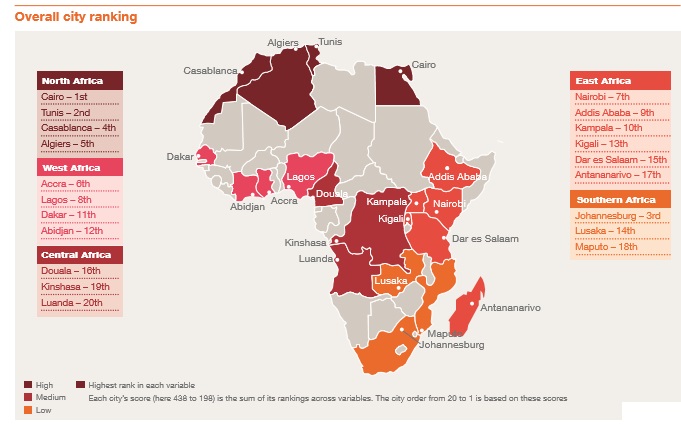
Notwithstanding the current climate and challenges, it is notable that there remains a significant amount of potential to unlock more growth on the continent. African CEOs are looking to international markets for opportunities, with the US (31%), China (28%) and the UK (24%) considered the top three countries for growth. Johannesburg (36%), Lagos (16%) and Cape Town (14%) are considered the top three African cities for growth opportunities.
Main risks to doing business in Africa

Although the returns for doing business on the continent can be high, so too can the risks. Africa’s CEOs are working in difficult times – finding the right talent for their business, dealing with hurdles that come with working with governments, and managing expansion plans across the continent.

In addition, infrastructure remains a challenge as it lags well behind that of the rest of the world. More than two-thirds of African CEOs (69%) are concerned about inadequate basic infrastructure (Global: 54%) and a stronger focus on expanding power supply is required to solve one of the biggest challenges in the business environment.

Other clouds on the business horizon include exchange rate volatility (Africa: 90%; Global: 70%); social instability (Africa: 85%; Global: 68%); geopolitical instability (Africa: 79%; Global: 74%); unemployment (Africa: 79%; Global: 45%); and climate change and environmental damage (Africa: 64%; Global: 50%). For most of these factors, the level of concern among African CEOs is higher than the global average. In addition, over-regulation features on the list of concerns this year, with almost half (46%) (Global: 42%) of African CEOs saying they are “extremely concerned”.

CEOs also believe social instability resulting from inequality, an increasing tax burden, a lack of economic diversity with an overdependence on natural resources, and corruption remain problems in many countries.

Globalisation

Overall, globalisation has benefitted connectivity, trade and mobility. However, just over half of African business leaders say globalisation has done nothing to promote equality, in particular in closing the gap between rich and poor – in fact, this gap may well be widening.

A number of CEOs think it is vital to address social challenges. CEOs believe the corporate community can assist in spreading the benefits of globalisation more widely. The majority say the best way is to collaborate, particularly with government. “While Africa’s potential is undoubted, its achievement remains in question. Business, government and civil society will need to work harder to turn potential into tangible gains against the backdrop of a rapidly changing world,” Dion Shango, CEO of PwC Southern Africa adds.
Talent and technology

The forces of globalisation and technology are increasingly transforming the workplace. Over half of African CEOs (53%) are exploring the benefits of humans and machines working together in the workplace. Over a third of African CEOs (36%) are considering the impact of artificial intelligence on future skills needs.

In some sectors, automation has already replaced some jobs entirely. “As automation takes deeper root in the workplace, companies in Africa will have to increasingly focus on achieving the right cognitive re-apportionment between man and machine,” Shango adds.

However, as CEOs develop their services, they are finding that human interaction in the workplace is still important and place the investment in talent as a top business priority. Just over half of African CEOs (51%) plan to increase their headcount in the next 12 months. Conversely, 23% plan to cut their company’s headcount over the coming year, with more than two-thirds of expected reductions being attributed to automation and other technologies.

According to the survey results, no less than 80% of African CEOs (Global: 77%) see the availability of key skills as the biggest threat to growth (ahead of volatile energy costs and cyber threats). They are finding it particularly difficult to source soft skills – adaptability, problem solving, creativity and leadership.

Technology & trust

Technology has brought about a number of advancements in efficiency and the ease of doing business in Africa. No less than 91% of African respondents (Global: 90%) believe technology has changed competition in their industry in the past five years.

While the digital era offers a host of opportunities, it also creates significant challenges and constraints in the arena of privacy and security. Organisations are holding increasingly large volumes of personal data about their customers, suppliers and employees. According to the survey results, 71% of African CEOs (Global: 61%) say they are concerned about cyber threats. Furthermore, the vast majority of African CEOs (93%) (Global: 91%) believe that cybersecurity breaches affecting personal information or critical systems will negatively impact stakeholder trust levels in their organisations in the next five years. A high 96% of business leaders are also concerned that IT outages and disruptions could impair trust in their respective industries over the next five years.

As disruptions gain more speed, the ability to ensure trust, security and privacy across all interactions will become critical to businesses’ competitiveness. But almost two-thirds of African CEOs (61%) (Global: 59%) are concerned that they are not prepared to respond to a crisis in their business, should one arise.

“In the face of economic and socio-political uncertainty, we remain confident that the outlook for business in Africa remains positive. But to succeed, businesses need to adapt swiftly to change,” Shango concludes.

Download the PWC report here.