DD
MM
YYYY

PAGES

DD
MM
YYYY

spot_img

PAGES

Home Blog Page 7444

The new Chief Executives for federal agencies appointed by President Buhari; key changes in PENCOM, NDE and NSITF

0

 
OSGF PRESS RELEASE:
PPR/OSGF/PR/03 , 13th April, 2017
PRESIDENT BUHARI APPOINTS CHIEF EXECUTIVES FOR FEDERAL AGENCIES

His Excellency, President Muhammadu Buhari has approved the underlisted appointments in various Federal Government Agencies.

S/N
ORGANIZATION
APPOINTEE
DESIGNATION

1
National Agency for the Prohibition of Trafficking in Persons (NAPTIP)
Barrister Julie Okah-Donli
Director-General

2
National Centre for Women Development (NCWD)
Barrister Mary Ikpere-Eta
Director-General

3
Nigeria Social Insurance Trust Fund (NSITF)
Bayo Somefun
Tijani Suleiman
Mr. Jasper Azuatalam
Kemi Nelson
Managing Director
Executive Director
Executive Director
Executive Director

4
Federal Mortgage Bank (FMB)
Arc. Ahmed Dangiwa
Melvin Eboh
Hajiya Rahimatu Aliyu
Umaru Abdullahi Dankane
Managing Director
Executive Director (Org. Resourcing)
Executive Director (Loans Department, Securities Issuance and Market Development)
Executive Director (Policy and Strategy Loans Set-Up and Pay Off)

5
Bureau of Public Enterprises
(BPE)
Alex Okoh
Director General

6
Petroleum Products Pricing Regulatory Agency (PPPRA)
Abdulkadir Saidu Umar
Executive Secretary

7
National Park Service (NPS)
Ibrahim Musa Goni
Conservator-General/Chief
Executive Officer (CEO)

8
Service Compact (SERVICOM)
Nnenna A. Akajemeli
National Coordinator/CEO

9
National Directorate of Employment (NDE)
Dr. Nasiru Mohammed Ladan
Director General

10
Michael Imoudu National Institute for Labour Studies
(MINILS)
Saliu Dada Alabi
Director General

11
National Research Institute for Chemical Technology
Professor Jef. T. Barminas
Director General

12
Nigeria Institute for Social and Economic Research (NISER)
Dr. Haruna Yerima
Director General

13
Nigeria Insurance Commission (NAICOM)
Sunday Thomas
Deputy Commissioner

14
Consumer Protection Council
Tunde Erukera
Executive Secretary

15
Federal Character
Commission
Barr. Mohammed Bello
Tukur
Secretary

16
National Pension Commission (PENCOM)
Dikko Aliyu Abdulrahman
Funso Doherty
Akin Akinwale
Abubakar Zaki Magawata
Ben Oviosun
Nyerere Ayim
Director-General (Subject to Senate Confirmation)
Chairman
Executive Commissioner

17
Federal Capital Development
Authority
Engr. Umar Gambo Jibrin
Executive Secretary

18
Nigeria Agriculture Insurance Corporation
Mrs. Folashade Joseph
Managing Director

19
Administrative Staff College of Nigeria (ASCON)
Cecilia Umaru Gaya, mni
Director General

20
Lagos International Trade Fair Management Board
Mrs. Luci Ajayi
Executive Secretary

21
Nigeria Export Processing Zones Authority
Barrister Emmanuel Jimme
Managing Director

22
Nigeria Lottery Regulatory Commission
Lanre Gbajabiamila
Director General

23
Nigeria Automotive Design and Development Council
Jalani Aliyu
Director General

All the appointments take immediate effect.

(Signed)
Bolaji Adebiyi
Director (Press)
Office of the Secretary to the Government of the Federation
theRIM London commends Zenvus’ work on sustainability and smart farming

0

theRIM, an online platform dedicated to the curation of insights and ideas around the issues of sustainability by exploring the nexus of cities, business, global affairs, technology, design, and lifestyle, has published a brilliant piece titled “Big Data for Big Challenges”. African agtech pioneer, Zenvus, was one of the companies mentioned as leading the way on this global redesign:


Advancements in the field of the ‘internet of things’ (IoT), a term referring to the connection of millions of ‘things’ via networked sensors to more easily generate and transmit large volumes of (real-time) data, hold equally strong potential for helping farmers improve their output. Equipped with data gathered from sensors in the soil or on their cattle (see e.g. Connecterra) or satellite and drone imagery, farmers can make well-informed adjustments to their systems.

Sensors are also used in agricultural fields to monitor aspects of the environment such as the weather situation or soil conditions to help farmers achieve optimal crop production. Nigeria-based Zenvus Smartfarm, for instance, collects data on things like humidity, temperature, PH, soil moisture, and nutrient levels, etc. and uses cloud-based advanced analytics to extract insights and help farmers understand what is happening on the farm.

theRIM is a modern space that sources compelling questions and solutions on how to move towards an enduring future. In an email, theRim noted that “Zenvus’ work is part of the important effort to enable and facilitate a sustainable transition. … we greatly admire what you do”.

Please read the piece here – a very brilliance one.

“Zenvus’ work is part of the important effort to enable and facilitate a sustainable transition…we greatly admire what you do”…theRim, London


About theRIM: 

Established by Ascha Lychett Pedersen and Ijeoma Onyeji-Nwogu in 2016, the curators have backgrounds in the private sectors and as consultants to the UN agencies with vast experience working with energy, climate change and inclusive industrial development. Eager to translate complicated relations into tangible information, the concept of theRIM as a conduit for a new kind of dialogue on sustainability was born.

As theRIM evolves, each topic will unfold from introductory pieces framing the underlying ideas into microsites that dynamically connect everything from opinions, interviews and articles, to user friendly how-to guides, podcasts and case studies. theRIM is designed to become the quintessential interactive exploration of sustainability that will keep expanding as new knowledge is added. Ultimately, theRIM will pursue surprising partnerships between companies, influencers, organisations and institutions to realise projects through which big and small ideas will be tested.

Sustainability as a topic remains abstract and the challenges it entails can often seem overwhelming to the individual. By leveraging the power of visuals and storytelling, theRIM sets to cultivate and engage a caring global community, which we hope to inspire to take meaningful action across the world no matter the location, climate or funds available.


What You Should Know about Meningitis in Nigeria

0

Meningitis is a disease condition in which microorganisms such as bacteria, viruses, fungi and even chemical agents invade the protective coverings of the brain and spinal cord, called meninges, causing the immune system in this part of the body to react against them. The immune system reaction while trying to destroy these microorganisms also affect the meninges, hence the name meningitis.

Currently, there’s an outbreak of meningitis in some states in the northern part of Nigeria. This particular meningitis is caused by a bacterial organism called Neisseria meningitidis. The microorganism usually invades the wall of the nose and throat where it may not lead to infection until the time is right: the person’s immunity is down or there’s a large number of people carrying the microorganism crowded in a small pace. These conditions enable the bacteria to enter the blood and spread to different parts of the body including the brain.

Meningitis caused by the Neisseria meningitidis microorganism occurs commonly as outbreaks in the northern part of Nigeria during the dry season, between December and March. Infection results when a healthy person comes in contact with droplets from the nose or throat of an infected person.

This happens very commonly during the dry season because of the dusty nature of the weather that carries droplets from people’s noses or throats coupled with crowded living conditions in places like prisons, internally displaced persons (IDP) camps and markets. Also, smoking, a viral infection of the respiratory tract or immunodeficiency diseases like HIV predisposes people to infection by the Neisseria meningitidis which can go on to infect the protective coverings of the brain and spinal cord, causing meningitis.

People with meningitis usually complain of the following:
-severe headache
-fever
-the feeling of vomiting
-vomiting
-neck stiffness which may be absent in children less than one year
-severe eye pain on exposure to bright lights

Young children with meningitis may be restless, crying all the time and may have convulsions especially in the first few days. Older people may have abnormal mental manifestations because of the irritation to the brain coverings.

Meningitis is a very serious and life-threatening condition which requires immediate medical attention. If treatment with the appropriate antibiotics is started early, most patients recover completely, especially if there is no history of convulsion, coma or abnormal changes in the mental status in the patients. However, in some cases, there may be complications such as deafness, eye problems or problems with speaking.

In addition, every household member and other people who came in contact with someone being treated for meningitis must receive complete antibiotics treatment to prevent them from developing and spreading the disease.

Most importantly, everyone is advised to receive the cerebrospinal meningitis (CSM) vaccine to build up immunity against the microorganism. Also, people should adopt hygienic measures, avoid sleeping in overcrowded rooms and keep their rooms ventilated to curtail the spread of meningitis.

For more advice and help, feel free to ask a Doctor on Kangpe

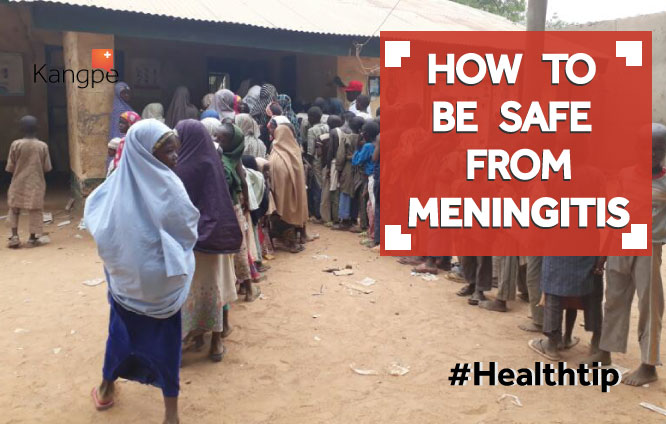
How To Be Safe From Meningitis in Nigeria

0

The current meningitis outbreak in Nigeria has reached a total of 19 states. About 4000 people are suspected to have been infected so far, out of which over 400 are already dead.

Like we stated in a previous health tip on meningitis, Nigeria is one of the countries in the African meningitis belt: a broad region across Africa, cutting across many countries, where the rate of meningitis infection is very high. In Nigeria, the entire north and some parts of the southwest fall within this African meningitis belt, meaning that outbreaks are common in these parts of the country, especially the north, during the dry season, between December and March.

This current outbreak is a bit dangerous because a lot of people are not immune to the particular bacterial strain that has been identified as the cause. There were nationwide programs in the past few years to vaccinate Nigerians aged between 2 and 29 years against the Neisseria meningitidis type A which has been the major cause of previous outbreaks. But this current outbreak is being attributed to the type C strain of the organism and the vaccine against it is not widely available, even outside the country because it is not that common.

Meningitis is a medical emergency and is deadly especially in young children. In order to be on the safe side, every person, family, and community should:

1. Observe strict personal hygiene

The Neisseria meningitidis microorganism causing meningitis usually reside in the nose and throat of those who are exposed. This means sneezing, coughing and handling of objects with soiled hands can transmit this microorganism to another person. Therefore, endeavour to:

-always wash your hands with soap and water after handling dirty things

-don’t share water bottles, eating utensils or cups, especially in places where cases of meningitis have been reported

-Don’t share towels, lipstick or lip gloss

2. Avoid overcrowding

Overcrowding is one of the factors enabling quick transmission of this meningitis microorganism. Hence,

-families should ensure their rooms are well ventilated (windows are fitted with nets and open) and are not overcrowded

  • parents and teachers should ensure that creche and nursery school classrooms are well ventilated. They should also make sure fewer children stay in one classroom to avoid overcrowding. Once, a child comes down with any illness, he or she should be taken to the sick bay immediately for treatment to prevent the spread of whatever infection it may be.

3. People who smoke, especially in states where cases of meningitis have been reported, should cut down and stop cigarette smoking as it makes their respiratory tract more vulnerable to being invaded by the Neisseria meningitidis organism which can go on to cause meningitis.

4. Early treatment

People should look out for symptoms of meningitis such as a severe headache, fever, vomiting, neck stiffness, eye pain on exposure to bright lights. Noting these symptoms early means the affected persons can be taken to the hospital for immediate treatment with the appropriate antibiotics.

Also, members of the family of affected persons and other people who came in contact with them should receive appropriate antibiotics treatment to prevent them from developing the disease.

5. Get vaccinated

Vaccines against infections train the body’s immune system to properly defeat these infections when the body is exposed to the microorganisms causing them. Getting vaccinated is the best way to stay safe from meningitis. This starts from:

-ensuring that babies, from birth, receive all the recommended vaccinations according to the National Programme on Immunisation plus other vaccinations such as the meningococcal vaccine against meningitis for children (after 2 years of age) in the northern parts of Nigeria.

-people planning to travel to the north, those who are HIV positive and people whose spleens (the spleen is an organ in the body which recycles old red blood cells and helps in fighting certain bacteria that cause pneumonia and meningitis) have been removed should endeavour to receive the meningococcal vaccine as they are at a higher risk of coming down with meningitis.

-people should make themselves available for any nationwide vaccination programme especially now that the Nigerian government is making plans to bring in hundreds of thousands of vaccines against the type C strain causing the current meningitis outbreak.

For more advice and help, feel free to ask a Doctor on Kangpe.

Fidelity Bank results show the problems in Nigerian banking, uncorrelated with reality

0

Fidelity Bank Plc grossed N152.0bn in earnings for the financial year ended December 31, 2016 and is proposing to pay a dividend of 14kobo per share to shareholders. The full year audited results for the top Nigerian lender, released over the weekend at the Nigerian Stock Exchange (NSE), show a 3.5% growth in gross earning, compared with N146 billion achieved in the corresponding period in 2015.

That will seem impressive for a country in recession, for a bank to be growing. But the reality is that banks always grow in Nigeria because what they do largely correlate with the main economy. If you buy from Central Bank of Nigeria and sell dollar to traders, you will also make money.

In other performance indices, net interest income grew by 1.7% from N60.9bn to N61.9bn, whilst total deposits, a measure of customer confidence, grew by 3%, rising from N769.6 billion in 2015 FY 2015 to N793.0 billion. Similarly total assets increased by 5.4% to N1,298.1bn from N1,231.7bn in the corresponding year.

Profits however were moderated in the period under review by the one-off staff cost incurred during the year. Consequently PBT stood at N11.1bn down from N14bn in FY2015.

“Our financial performance in FY2016 reflects the sound fundamentals of our evolving business model as we continued with the disciplined execution of our medium-term strategy which positions the business for improved and sustainable profitability” said the Fidelity Bank CEO, Mr. Nnamdi Okonkwo.

He explained that profits dipped due to the cost of N4.8bn cost incurred as Fidelity Bank discontinued its legacy gratuity and retirement scheme. “Excluding this one-off charge, PBT for the year would have been at N15.8bn” he stated.

Meanwhile, Fidelity Bank’s retail and electronic banking strategy has continued to deliver impressive results with savings deposits growing by 30.1% to N155.0bn while customer enrollments on its  flagship Instant Banking (*770#) and Online Banking products grew by over 200% leading to a 44.6% growth in net e-banking revenues to N7.5bn. This performance he said was “driven by the upgrade of our core banking system which provides a superior architecture that enhanced our operational efficiency and deepened our electronic banking capabilities.”

Banks will continue to make money. But we do hope Nigerian banks can show one company they supported or funded. They continue to trade dollars. The economy can be on recession, they will just be fine.