DD
MM
YYYY

PAGES

DD
MM
YYYY

spot_img

PAGES

Home Blog Page 7459

#OpposingViewpoints: Do Economic Moats Happen By Accident?

0

Do economic moats occur naturally or by accident? I had never contemplated this question till Andy Rachleff graciously emailed me back after I sent him my presentation on economic moats seeking his comments about two weeks ago.

Why did I email Andy? That’s a great question.

In early 2010, when it started becoming clear that we would head down the path of building an independent venture fund, I put together a list of venture capitalists I admire and started reading some of their work. I noticed that invariably, at some point some of them would make a statement like; “I did not fully understand this concept until Andy Rachleff explained it to me.” After encountering this more times than I expected, I decided that I should find a way of learning as much from Andy as I possibly can. I started by connecting with him on LinkedIn and later followed him on Twitter.

Since then I have emailed him about once a year, perhaps somewhat less frequently, to ask him a question . . . A book recommendation, for example. Each time he has responded by pointing me in the direction of an answer to my question.

Here’s Andy’s comment about economic moats; “. . . I do not agree with your assertion. Successful companies do not create moats. They happen naturally or by accident. Companies that attempt to create moats usually do so at the cost of not spending time on further delighting their customers – which almost always backfires. This is a major point I teach in my product market fit class because it is a common misperception.”

Andy is a legend in venture capital. He co-founded Benchmark Capital in 1995 and was a GP there till 2004. He is a co-founder of Wealthfront, and now serves as executive chairman after having previously served as CEO and president. He also currently teaches courses in technology entrepreneurship and venture capital at the Stanford University Graduate School of Business.

So . . . as you might imagine, his comment gave me pause.

It was just before 6:00 AM when I read his email. I walked away from my desk, drank a cup of strong coffee and thought about his comment. It was then I realized that I am more aligned philosophically with Andy’s view on economic moats than it first appears.

Yes, in trying to communicate the concepts on which the idea of an economic moat is based we often speak about “building a moat” or “digging a moat” . . . . That can be misleading in the context of early-stage technology startups. However, I am not surprised that misperception arises since much of the vocabulary for economic moats is borrowed from value investors who invest in publicly traded, or mature privately held, companies. Specifically, it is a concept first attributed to Warren Buffet and Charlie Munger and it is one aspect of their approach to investing at Berkshire Hathaway.

Sometime in late June, I made an observation to my teammates at KEC Ventures; I had come to the realization that each time we met the founder of an early-stage startup who spent a lot of time talking to us about the economic moats around that startup’s business model we usually later discovered that the startup was failing to keep its existing customers/users and was also failing to recruit new customers/users. Andy’s comment helped me connect the dots . . . The early-stage founders who talk to us at length about economic moats are insufficiently focused on creating value for their customers/users.

When founders ask me about the role KEC Ventures plays as an early-stage investor, I have always said that once we decide to make a Seed-Stage or Series A investment we believe that we have a responsibility to help create the conditions that will allow our founders to do 4 things well;

First; Keep their existing customers as happy as possible.

Second; Improve the startup’s product, in order to make existing customers happier than they already are.

Third; Recruit additional team members, to enable their startup to do a better job of executing the two preceding tasks.

Fourth; Win new customers.

If we deliver on that promise, I think we would have fulfilled our primary obligations as an early-stage investor. Doing this involves a mix of activities that basically boil down to taking on assignments from our founders when something arises that needs to be done, but that does not directly help the startup accomplish the 4 tasks I have listed above.

Nowhere on my own list do I expect our founders to “Build an economic moat.”

However, when I am thinking of the startups in which KEC Ventures should invest I think about the potential for economic moats to develop if the startup’s founders;

  • create value for their customers and delight them,
  • find product-market-fit,
  • discover a business model that scales profitably, and
  • build a team to do those 3 things successfully.

My interest in studying economic moats is so that I can recognize those instances in which the probability that they emerge is high, whether naturally or by accident. Seed-stage technology startups with a high potential for economic moats to eventually emerge are the ones that I personally find most attractive as potential investments.

But Andy was right; After reading my blog posts and the accompanying presentation deck, one could come away thinking that I am suggesting that founders of early-stage technology startups add “build an economic moat” to the list of things that they should be doing. I am not.

At the stage at which we invest at KEC Ventures, I believe founders need to focus on only the things that directly enable them to delight their current customers/user and find new ones. Everything else proceeds from doing that successfully. Failure to do that? Nothing else will even matter.

So, perhaps it is fitting for me to now say; I did not fully understand why early-stage startup founders should not focus on building economic moats until Andy Rachleff compelled me to think about it more critically.

“Liking” Facebook’s Business Model – The #EconomicMoats Remix

0

Note: I published “Liking” Facebook’s Business Model on December 26, 20011 at Tekedia. This article updates that discussion by incorporating developments since then. It also folds in discussion of the economic moats that Facebook has developed around its business. Large segments of this article are exactly identical to the post that was published by Tekedia in 2011.

Introduction

The primary purpose of this post was to demonstrate how one might apply the Business Model Canvas in trying to understand Facebook’s business model. Assuming we understand the business model, I then apply the Economic Moats framework to thinking about Facebook.

It is a fair critique to accuse me of playing “Monday-Morning Quarterback” since it is easy to pick on an extreme success like Facebook and use it as an example. However, from my perspective as an early stage venture capitalist who is basically teaching himself the trade that critique ignores at least one benefit of this kind of case study – mainly that it is useful for trying to recreate the path I might have followed in thinking about Facebook had I been introduced to Mark Zuckerberg in 2004 when he was raising his first outside capital from investors. Think of this as the self-taught early stage venture capitalists’ version of working in a science laboratory, trying to recreate the experiments and reproduce the results that have brought us the advances of the past. Such work is what lays the groundwork for original scientific discoveries in the future.

Also, I should point out that I do not have direct access to inside-information about Facebook’s early days. This case is constructed on the basis of information, reports, and data that are in the public domain.

Okay, with those disclaimers out of the way . . . On with our case study.

According to Michael Rappa; “In the most basic sense, a business model is the method of doing business by which a company can sustain itself – that is, generate revenue. The business model spells-out how a company makes money by specifying where it is positioned in the value chain.” Alex Osterwalder and Yves Pigneur say that; “A business model describes the rationale of how an organization creates, delivers and captures value.”

What problem does Facebook solve?

My son’s paternal grandparents live in Nigeria, as does his uncle – my younger brother. His aunt – my younger sister lives in Ghana. His grandfather has never met him, nor have his uncle and aunt. His grandmother paid him a visit for three months soon after he was born. He was only two months old when she visited.

I had been asking myself the question; “How can I ensure that his grandparents, his uncle, his aunt and other members of his extended family do not miss out on his childhood entirely?” My desire to answer that question in a comprehensive way helped me to overcome my objections to Facebook. I joined Facebook in November 2009.

Facebook enables its users to connect with one another through the company’s social networking online portal. Users connect socially with their “friends” in a “social-network” to share status updates, articles, videos, music, photographs and other content through Facebook.

Facebook’s users can interact with one another in a number of different ways:

  • Users can connect directly as “friends” – this allows the highest degree and freedom of interaction subject to privacy controls that each user can put in place to govern their activity on Facebook.
  • Users can connect to one another as subscribers/followers – this is a one-way connection. Subscribers will see and can comment on the public posts by the person to whom they have subscribed. This feature was a recent addition when I wrote the original post in 2011.
  • Users can interact with one another through Facebook Messenger, an instant messaging app that has evolved since the function was first introduced to Facebook’s users in 2008.
  • Facebook acquired Instagram in 2012 Instagram built a social network for sharing photos.
  • Facebook acquired WhatsApp in 2014. WhatsApp is a mobile instant messaging app that is popular in developing markets.
  • Facebook acquired Oculus VR in 2014. Oculus VR is  a virtual reality technology startup.

Founded in 2004, Facebook’s mission is to give people the power to share and make the world more open and connected. People use Facebook to stay connected with friends and family, to discover what’s going on in the world, and to share and express what matters to them.

– Source: Facebook, as of March 2016

The following list highlights some of Facebook’s features:

  • User profiles and homepages – users post status updates on their homepage or wall.
  • Messages, Chat and Social Hangouts (video chat).
  • Photos + Videos – users can tag one another in photos and videos.
  • Games + Apps – people can play games with one another, or share other information through specialized apps.
  • Groups and Pages – people can form a group or create a page for sharing information around an issue of interest.
  • Events – people can use Facebook to plan events and invite others to participate.
  • Credits – this is the virtual currency for transactions on Facebook.

Reports in the press suggest that Facebook has about 800 million active users around the world. An active user is a user who has returned to Facebook’s website within 30 days.

ComScore reports that 82% of the world’s 1.2 billion online population participates in some form of social networking. Social networking eats up 20% of the time people spend online. Facebook’s users account for 75 percent of the time spent on social networking websites. Facebook’s users also account for more than 14 percent of the time people spend online around the world.

December 2015 Update: 

Monthly Active Users: 1.59 billion monthly active users as of December 31, 2015

Daily Active Users: 1.04 billion daily active users on average for December 2015

Mobile Monthly Active Users: 1.44 billion mobile monthly active users as of December 31, 2015

Mobile Daily Active Users: 934 million mobile daily active users on average for December 2015

How Does Facebook Make Money?

Facebook does not charge its users a sign-up or monthly fee. So, how does Facebook make money if users like me get to use it for free? There are three sources of revenue for Facebook;

  • Advertising – Facebook can deliver targeted ads to its users based on information that they provide during sign-up or as they interact with their friends.
  • Games + Apps – Facebook is paid a 30 percent fee by companies that develop games and applications for its user base. This fee is applied to in-game or in-app sales.
  • Virtual Goods – Facebook earns a slice of revenue from the sale of virtual goods to its users.

Reports in the press speculated that Facebook’s 2011 revenue would be in the neighborhood of $4.5 Billion. Advertising should account for the majority of that amount, followed by revenue from games and apps. Virtual goods account for only a small portion of Facebook’s revenues.

March 2016 Update: Revenue for the full year 2015 was $17.93 billion, representing an increase of 44% over revenue for the full year 2014.

The Business Model Canvas – The Building Blocks of Facebook’s Business Model

Note: Business Model Generation was not published till July 2010, nearly 6 years after thefacebook.com launched. Still, using the business model canvas to analyze Facebook’s business Model is instructive.

Customer Segments

  • Mass market – any one that uses the internet and wants to connect and socialize with family, friends and other people that are online.
  • Advertisers – big, medium and small companies that wish to advertise to the hundreds of millions of people that spend time on social network websites. Reports estimate that people spend about 3 to 4 times as much time on Facebook as they spend on Google.
  • Developers – apps, social games, and virtual goods.

Value Proposition(s)

  • Enable users to connect and share with family, friends and other people with whom they share a common interest.

Channels

  • Website
  • Mobile App

Customer Relationships

  • Network effects – users will gravitate to the social network where most of their friends are already users.
  • Relatively high switching costs – users are less likely switch to a competitor after sharing a lot of content on Facebook.

Revenue Streams

  • Advertising – fees generated from online display banner ads delivered to users through Facebook.com. There are probably two or three different categories of advertising.
    • Not entirely clear if this will work, but the team has been pitching this to advertisers since it was two months old. Might need to verify this assumption with someone in the advertising industry.
  • Facebook Credits – 30 percent share of in-app and in-game transactions.
  • Virtual goods – straight virtual goods sales not connected to use of an app or a game by the user.

Key Resources

  • People – employees, and Facebook’s more than 800 million active users.
  • Technology – software, servers and other cloud-based services that Facebook must purchase from other companies to support its operations.
  • Brand – people have to trust in what Facebook represents.

Key Activities

  • Developing and improving the Facebook platform – both the frontend user experience and backend data processing capacity. The company was reported to have started working on proprietary server designs to support its operations – reports suggested the company might be worried about the speed at which conventional server designs allow it to serve content to its millions of daily users.

Key Partners

  • Third party developers – apps, games and other features to enable people connect and share with one another using Facebook’s platform.

Cost Structure

  • Employees – Facebook reportedly has between two and three thousand employees spread across offices in 15 countries. The company seems to be preparing for a burst of growth in the size of its workforce.
  • Technology – server maintenance, software latency and optimization issues; this will continue to be a concern as people generate and share more and more content using smartphones.

The company says that more than 50% of its more than 800 million active users log onto Facebook on any given day. Nielsen estimated in a report on social media that American internet users collectively spent more than 53 billion minutes on Facebook in May 2011. The average user has 130 Facebook friends. The company also says people interact with more than 900 million objects on the website and that the average user is connected to 80 community pages, groups and events. On the average day Facebook’s users upload 250 million photos. Facebook is available in 70 languages, and 300,000 users helped to translate the site by using Facebook’s translations app. On the average day, Facebook’s users install apps 20 million times. During the average month, half a billion people use an app on Facebook or experience the Facebook platform on other websites (e.g. to share this story from Tekedia with your friends on Facebook). In all more than 7 million apps and websites are integrated with the Facebook platform. There are 475 mobile operators globally working to promote and deploy Facebook’s mobile products through their mobile networks and on their mobile devices (for example Facebook’s Android, iOS and Blackberry apps). More than 350 million active users currently access Facebook through a mobile device.

Facebook was launched in February 2004. As the preceding paragraph clearly demonstrates, the over-arching elements of Facebook’s business model that we have discussed have led it to unbelievable success. This success has occurred in spite of the fact that Facebook was not the very first social networking company. MySpace launched in August 2003, and before that Friendster was founded in 2002. Classmates.com, SixDegrees.com and Makeoutclub.com preceded Friendster. One may argue that Facebook benefited from technological advancements that its predecessors could not exploit. One may also argue that Facebook launched at a time when millions of people had become accustomed to the concept of social networking. I suspect there’s a lot of truth in both of those arguments. However, I would also argue that Facebook did a better job of understanding the intricacies of its business model better than its predecessors, and then executing that business model more effectively than any of its predecessors. Put those three arguments together and one can see that Facebook’s phenomenal growth is not completely outside the realm of possibility.

Facebook Menlo Park HQ (Image Credit: Facebook)

Facebook Menlo Park HQ (Image Credit: Facebook)

Economic Moats Analysis

I am now going to pretend that I have travelled back in time, to September 2004. As fortune would have it I am a reasonably well-liked early stage VC who invests in startups raising their very first round of capital from institutional investors. Someone I know has introduced me to the founder of The Facebook; and describes it as “a web directory that the college-kids are going crazy about.” I agree to meet in two weeks, when some time opens up on my schedule. In the meantime I start doing some cursory reading about this “thing.”

The issues I am most concerned about are, in order of priority;

First, how do I know that thefacebook.com has proven that its value proposition will hold? Around that time reports in the press highlighted how addictive thefacebook.com had become to its users. Here are some examples:

  • According to this article in the Harvard Crimson, 650 students had signed up for thefacebook.com within 5 days of the site’s launch on February 4, 2004.
  • An article in the Duke Chronicle in April 2004 described how popular the social network had become with students at Duke University.

Even those who don’t know why they love Thefacebook can’t stay away.

“It’s a stupid, stupid website, but I am completely addicted,” freshman Emily Bruckner said. “I just go around and look at all of my friends and see who they’re friends with. It’s like a contest to see who has the most friends.”

Source: Thefacebook.com Opens to Duke Students, Duke Chronicle; April 14, 2004.

Value Proposition – The bottomline: Users love thefacebook.com, and there is plenty room for growth. The are millions of college students around the world that thefacebook could target as users.

Second, do I have a sense of how the team intends to grow the business? Will the team’s ideas about growth work? Based on reports in the press, it appears thefacebook is growing rapidly, and so I have to assume the team has figured what it will take to grow within the market on which it has chosen to focus initially. There may yet be some work to do here, but so far so good. Each user is encouraged to invite some friends upon first signing up for thefacebook, and the website also suggests people that new users might know who are already on the site. Friendster is doing well within the general population, so there’s one example of how thefaceboook too might grow beyond college-campuses . . . when that makes sense.

Growth – The bottomline: The team seems to have figured out a method to accelerate growth on college campuses. That’s a good sign. There may be a few outstanding questions, but this is probably a good point at which to consider making a investment if growth can continue to accelerate.

Third, and finally . . . How does the team believe thefacebook.com will make money? This is a critical question since it speaks to thefacebook.com’s future prospects for becoming a self-sustaining entity. The team has been pitching itself as an online marketing service to advertisers . . . It will be interesting to see how advertisers react to this.

Revenue – The bottomline: Murky. Not clear if this will work. But Google is having success selling ads online through its Content Targeting Advertising. So not out of the realm of possibility. But no definitive answers at hand.

Economic moats help early stage technology startups preserve and enhance the advantages they enjoy over their competitors as time goes on their business model matures. There are five ways in which a startup can build an economic moat; Network Effects, Switching Costs, Efficient Scale or Cost Advantages, Intangibles, and Brand. Note, that I discuss “brand” under the heading of “Intangibles” but it stands alone as one of the 5 sources of an economic moat.

  • Brand: High. Becoming known as the platform for college students for intra- and inter- college social networking. Highly sought after by students at colleges where it is yet to launch a community.
  • Network Effects: High. Platform gets more useful for users as more of their friends sign-on to become users.
  • Efficient Scale or Cost Advantages: High. Users invite friends. Word-of-mouth seems to be spreading and helping keep costs of acquiring new users relatively low.
  • Switching Costs or Buyer Lock-in: Undetermined. Need more data. But should increase as people interact more and more on thefacebook.com. Described as addictive. Wonder how long that addictive quality will last. Need to get better understanding of user-perception of value.
  • Intangibles:
    • Intellectual Property: None necessary right now, but might be needed in the future to solve technical problems caused by growth. TBD.
    • Research and Development: Need to figure out revenue model. Also, what problems has Friendster run into that might be relevant for thefacebook.com? How is the team thinking about this?
    • Culture and Management: TBD. Young team, college students. Mark has prior experience building social-networking applications.

Conclusion: So, would I have invested? I do not know. There is more that goes into a decision like that one than the preceding analysis. However, at first blush there are no “smoking-gun” reasons not to take a closer look. To avoid saying no at this stage it would help to keep the following lessons in mind – they are adapted from Andrew Chen’s discussion about his decision to pass on making an early stage investment in Facebook when he had the opportunity to do so after he convinced himself that “Facebook would never be a billion dollar company.” Note: I wrote about this in April 2012 in a post that was published at Tekedia. The following discussion is adapted from that post.

  • Lack of experience and lack of knowledge are two distinctly different things. Do not confuse them with one another. Pass on making an investment because of a lack of knowledge, do not pass only because of a lack of experience.
  • Do not take solace in data and statistics without first verifying that such analyses are relevant within the given context. Data and statistics often inspire unjustified confidence, but calculations are useless if what you are calculating is wrong, irrelevant or simply inapplicable to the startup’s situation and future markets.
  • Do your own homework. Treat data and statistics from others with extreme skepticism. At the very least, try to interpret third party data based on your own analyses.
  • By definition, your past experience might be useless in understanding the most promising startups that you will encounter. Start from first-principles. Understand the fundamentals of what the startup is trying to do before you leap to conclusions grounded in your past experience. Don’t let your professional history and learned logic become a hindrance.
  • Business models matter, but execution matters more than the relative attractiveness or unattractiveness of the business model that exists at the time you encounter and early stage startup.
  • Heuristics are useful, but only up to a point. See the point on “past experience” above.
  • Keep an open mind, peel away the layers . . . Lack of conformity with the stereotypes you have become familiar with is an insufficient reason for passing on a startup.
  • Lastly, set all the analyses aside and spend some time thinking about what would happen if the team succeeds in accomplishing what it is setting out to do. If that happened, is that a story you’d want to be part of?


Making Africa Great Again

0

Africa can feed herself

Sub-Sahara Africa (SSA) is now the hottest emerging market in the world. Top tier SSA countries are generating over 8% GDP growth per annum by creating and capturing value from abundant natural resources. However, the continent cannot feed itself and spends over $50 billion per annum on expensive food imports. Millions of Africans die from starvation each year despite the continent having approximately 600 million hectares (24%) of the world’s most fertile arable land to sustain a growing population.

Productivity gap is widening

Productivity has remained flat over the last six decades. Developed countries like Australia and USA have managed to harness technology to increase yields by 300%, however, African yields have remained stagnant over the last six decades.

Negative perceptions about agriculture

Africa has a growing, young, educated population that is not interested in agriculture. Generally, there is a negative perception that farming is for dummies. Many consider farming a non-viable alternative to get out of poverty even though there are many other value-add opportunities across the agricultural value chain. Young farmers often complain that the African dream to own a big house and drive nice cars is very distant for farmers.

Education and capital is required to unlock value

With over 50% of Africans still living in rural geographies, most subsistence farmers grow their food to feed their families and livestock. Most peasant farmers have not harnessed modern mechanization ‘to do things’ more efficiently because of capital constraints and continue to use animal power. These farmers struggle to produce sufficient food to feed their families and often rely on foreign donors to fill the gap. Consequently, there is $50 billion value leakage per annum from expensive food imports from developed countries.

Subsistence farming models have failed to deliver growth and prosperity

Although local African governments understand the benefits for adopting commercial farming models, adoption is low. Most governments are reluctant to shift policies to support commercialization because they fear dissent from the majority rural voters. The promise for independence from colonial powers was that each family would get back their freedom and land. Without education and creating alternative opportunities, local rural farmers will resist industry consolidation if they perceive it will jeopardize their way of life.

Closing the gap

I believe that agrarian reforms in SSA will alleviate the current humanitarian crisis. Reforms in agriculture will create stable economies, provide wage-paying jobs, reduce child mortality and end wars. The recommendations below will drive industry performance.

  • Consolidate small farms in strategic locations to gain economies of scale and drive productivity.
  • Enact government policy to support local farmers. For example, impose quota limits on imports to drive productivity for local industries.
  • Harness technology to reduce costs, improve quality and service delivery.
  • Mitigate climate risks by investing in irrigation infrastructure to support all year round farming cycles.
  • Provide affordable finance to small-scale farmers to enable them to grow and prosper.
  • Raise awareness and appeal for farming to young Africans who are abandoning their rich fertile land in the rural areas to pursue manufacturing and white-collar jobs in major cities

Jo Chidwala is an experienced business leader with proven record of accomplishment to transform businesses by formulating and executing product and pricing strategies that generate value. He is a strategic thinker with strong analytics, modelling and communication skills; can lead and motivate teams to drive projects to completion.

Connecting The Dots: Economic Moats and Early Stage Technology Startups

0

I started writing about economic moats in September 2014. Since then I have written about Network Effects, Switching Costs, Intangibles, and Efficient Scale and Cost Advantages. The purpose of those posts was to outline how I think about economic moats while I am studying a seed stage startup and trying to determine how things might unfold in the future.

This is how I define an economic moat in relation to early stage startups:

An economic moat is a structural feature of a startup’s business model that protects it from competition in the present but enhances its competitive position in the future.

In this post I will wrap things up with some final observations;

First, in relation to economic moats, my responsibility as a seed stage investor is to identify startups that can build or acquire an economic moat as their business model matures and as the startup becomes a company. Directly tied to this, I have to make an assessment about the founders’ willingness to conceptualize and build such a moat if things go well. There’s no point worrying too much about a moat if the rest of the world is apathetic about what the startup is doing.

Second, An economic moat is not the same thing as a competitive advantage. A competitive advantage is temporary. This is because a competitive advantage is typically designed on the basis of Michael Porter’s Generic Competitive Strategies. A durable economic moat is unique, and typically can not be duplicated by others.

Third, to withstand the effects of sustained challenges from incumbent and new-entrant competitors startups need an economic moat that is derived from more than one source. In relation to Internet and other software technology business models, indirect network effects can prove to be as important as direct network effects.

Fourth, some of the strongest foundations on which a startup can build an economic moat are also some of the most difficult to come to grips with. Mainly, these are lumped together as “Intangibles” . . . Among the sub-items under intangibles Management & Culture, and Research and Development stand out to me as being things I should look out for at the seed stage because everything else emanates from those two.

An organization’s ability to learn, and translate that learning into action rapidly, is the ultimate competitive advantage.                                                      – Jack Welch

Fifth, cognitive costs are a real barrier to entry and till an early stage startup has established itself within a market, uncertainty works against it but in favor of the incumbents. This is especially true for startups building products for sale to other businesses. These aspects of buyer lock-in might be nearly impossible to articulate or measure, but that does not mean startups and their investors can afford to ignore them. At the outset a seed stage startup must find that niche of potential customers for whom the sum of cognitive costs and uncertainty is a minimum. It is worth thinking about this at the outset of product development.

Sixth, thinking about cost advantages has to go beyond the obvious advantages it confers on the startup in terms of its operations. The most important consideration is how a cost advantage enables the startup to create more value for its users or customers. A cost advantage that does not yield increased value for users and customers is not one that will last.

Lastly, as a startup scales it must pay attention to how that is affecting the macro environment in which it finds itself. A bad market can remain unfavorable far longer than any startup’s ability to scale its way to a profit. It is one thing for a startup to find product-market-fit, but quite another for that startup to scale efficiently in that market. Finding product market fit does not automatically lead to conditions that favor efficient scale. Extended unprofitable growth is one sign that a market might not have the characteristics to support efficient scale, or that the startup has not thought its business model through enough.

When I study a seed stage startup I am trying to answer a number of general questions about how the future might unfold for that startup, thinking about economic moats gives me a useful framework for doing so.

How Social Enterprises can Navigate the Scourges of Bribery and Corruption

0

Running a business in Sub-Sahara Africa (SSA) can generate tremendous financial reward particularly if your organization targets strategic growth markets. Abundant opportunities are there to be exploited, however, navigating the economic environment requires skill and local market intelligence.

Most African countries are ranked in the lower quartile based on the latest rankings for the ease of doing business provided by the World Bank Group. In comparison to developed Western economies, most African entrepreneurs take the ‘easy’ treacherous route by paying bribes to win tenders, to operationalize their businesses quicker and to ‘get protection’ from corrupt senior local government officials.

Corruption is deeply rooted in African culture

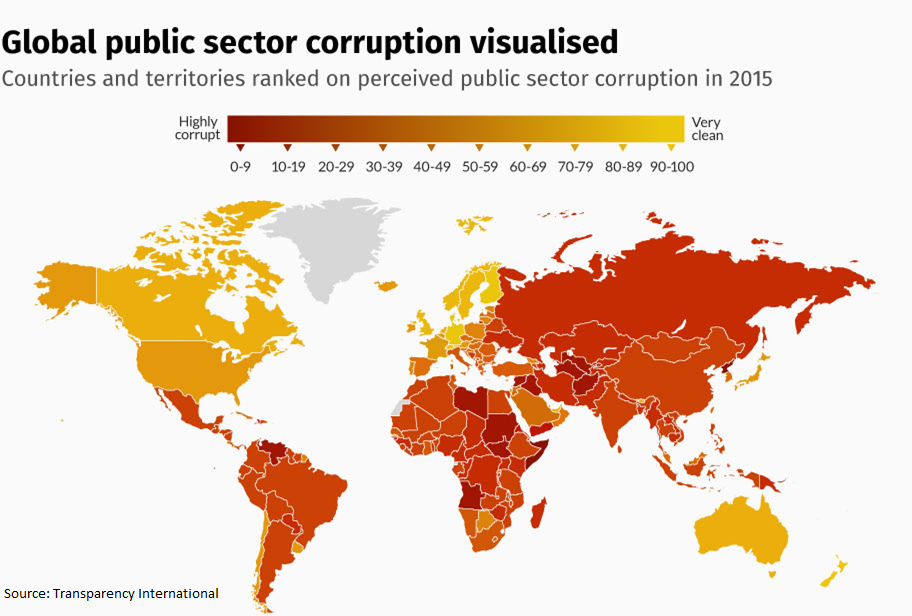
Corruption is of one the main causes impeding innovation, business growth and economic prosperity. This has exacerbated poverty, exclusion and brought suffering to 300 million Africans.

Powerful leaders continue to enact porous organisation architectures (including systems and processes) that enable them to fatten their wallets at the expense of wider development. The fight for survival forces many poor people to participate in corrupt activities to access basic needs like water, education, shelter and medication.

There is a school of thought that corruption opened the floodgates to colonialism by European settlers. Although all African countries gained independence from their colonial masters, modern exploitation is common. Multinational companies, powerful nations and rich individuals continue to bribe African leaders to gain access to natural resources, trade and in some extreme cases facilitating overthrowing governments by sponsoring coups.

Furthermore, extreme corruption is slowing development and causing leakage across value chains. For example, senior Zimbabwean government officials made a public announcement that US$15 billion revenue from diamond sales had vanished from government coffers over a period of four years. Surprisingly, no one has faced charges for embezzlement, however, a Christian pastor Evan Mawarire who mobilized millions of Zimbabweans to condemn corruption was arrested and will likely spend more than ten years in prison unless he is acquitted.

It’s not all doom and gloom

Contrary to general perceptions, not all African countries are corrupt. Mauritius and Botswana have low incidences of corruption with rates on par with developed countries in Europe and North America.

Paying bribes destroys long-term value

Paying bribes does not guarantee success. Whilst paying a bribe might deliver short-term benefits, this strategy exposes your organization to financial and operational volatility in the long-term. Paying bribes increases upfront costs to launch a business and generates ongoing trail expenses to ‘assist your organization to remain in business’.

Don’t pay bribes

Over the past thirteen years, l have heard many sad stories from APAC investors who have lost money from bad deals. The majority attributed compounding expenses resulting from paying bribes as the major cause for losses. When things go wrong, you cannot recover a bribe by lawful means. So why do many foreign investors pay bribes in emerging markets when they don’t commit similar acts in their home countries? Based on my humble opinion, ignorance, greed and stupidity are common traits.

Maintain high ethical standards and integrity

Strive Masiyiwa is one of the most successful entrepreneurs in SSA who has a strong reputation of shunning corruption. Strive launched a billion-dollar mobile telecommunication company called Econet in Zimbabwe in 1998. Despite resistance from the local government, Strive persevered and won a legal battle to launch Econet, resulting in the liberalization of the telecommunication industry.

Econet’s footprint continues to grow and now has business operations and investments in more than 20 countries in Africa, Europe and Asia Pacific. In addition to good stewardship, Strive attributes the refusal to pay bribes to vendors or government officials as one of his key success criteria.

Transparency also underpins Econet’s success. The organization provides full disclosure about product features, pricing and financial performance. Consequently, Econet continues to deliver superior business performance by leveraging its strong brand power to win new customers and drive loyalty from brand advocates.

Winning the battle

  1. The first step in fighting corruption is knowing that the giver is equally as guilty as the receiver of the bribe.
  2. All foreign investors must avoid paying bribes if they want to sustain business growth and enhance their organisation’s brand value.
  3. There is evidence of government reform. For example, Senegal created a National Office to fight corruption and fraud. The government enacted laws in April 2014 that requires elected officials to declare their assets.
  4. African leaders should lead by example by promoting transparency, accountability and respecting the rule of law. Ali Mufuruki, CEO of Tanzania’s Infotech Investment Group mentioned that solutions abound in ethical leadership, strong and enforceable laws against corruption, severe sanctions for corruption underpinned by a national culture of promoting ethics from family to national level.
  5. Shifting mindsets will uproot corruption, currently embedded in African culture. All Africans must question their own personal stand on corruption before taking the fight to the national level.

How can Sub-Sahara Africa reduce or eliminate corruption?


Jo Chidwala is an experienced business leader with proven record of accomplishment to transform businesses by formulating and executing product and pricing strategies that generate value. He is a strategic thinker with strong analytics, modelling and communication skills; can lead and motivate teams to drive projects to completion.