DD
MM
YYYY

PAGES

DD
MM
YYYY

spot_img

PAGES

Home Blog Page 7460

Opportunity for Nigerian students to work part-time on campuses and earn income

0

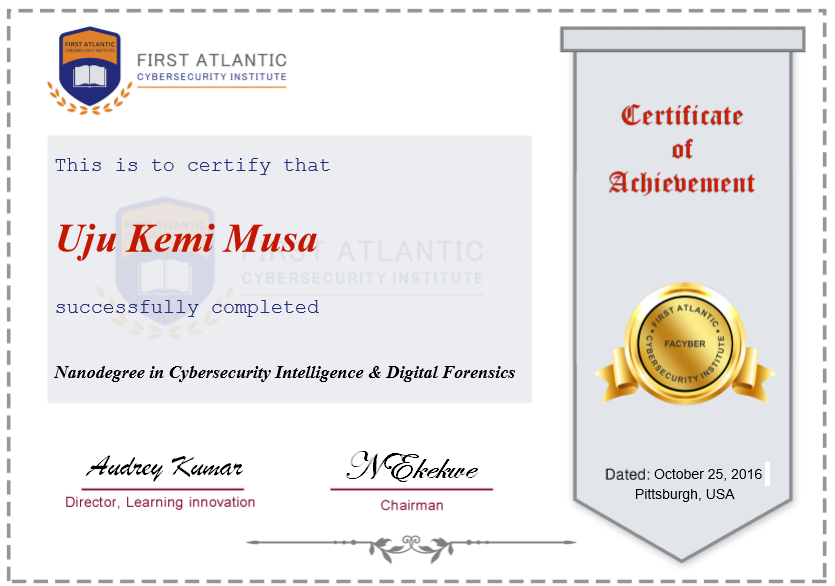
This is innovation and training. We are looking for Students Ambassadors  to cover all universities, colleges of education, and polytechnics across Nigeria. This is to assist the enrollment of students in our online cybersecurity business, First Atlantic Cybersecurity Institute (Facyber), which is U.S.based, but coordinated in Nigeria by Fasmicro.

About the Job
First Atlantic Cybersecurity Institute (Facyber) is a cybersecurity training, consulting and research company specializing in all areas of cybersecurity including Cybersecurity Policy, Management, Technology, Intelligence and Digital Forensics.  The clientele base covers universities, polytechnics, colleges of education, governments, government labs and agencies, businesses, civil organizations, and individuals. Specifically, the online courses are designed for the needs of students of any discipline or field (CS, Engineering, Law, Policy, Business, etc) with the components covering policy, management, and technology. Please see complete Facyber curricula here.

The programs are structured thus:

  • Certificate Program (Online 12 weeks)
  • Diploma Program (Online 12 weeks)
  • Nanodegree Program (Live 1 week)

The purpose of a Students Ambassador is to promote Facyber training programs in the respective campus. The incumbent will coordinate the enrollment of students in his/her campus. When necessary, the incumbent will help coordinate cybersecurity and digital forensics seminars/workshops in the campus in partnership with Fcyber local partner, Fasmicro.

Qualifications for Students Ambassador include:
•         Be an active student of the school to be represented
•         No sales experience needed
•         Tech-savvy with strong presence in social media
•         Relationship development skills a must. You must be self-driven . We want students with good networks in  their schools.

All the students will report remotely to our Director of Campus Initiatives who is based in Owerri, Nigeria.

Qualified applicants are encouraged to send an intent email (add a short CV please) to info@facyber.com. We plan to have 2-3 students per school and once we meet our targets, the opportunities will close.

This is an opportunity to earn extra naira while in school, so do not delay.

Facyber Diploma in Cybersecurity Management

0

First Atlantic Cybersecurity Institute (facyber) offers diploma programs on Cybersecurity Management.

This is a practical-oriented program where learners are tasked with developing cybersecurity project management capabilities with the guidance of a mentor. Examples include developing cybersecurity implementation frameworks, cybersecurity Center of Excellence charters, cybersecurity management processes, etc. Learners are encouraged to take on projects which will have real impacts in their organizations. A project report is required at the end of the program. Has Certificate in Cybersecurity Management as a prerequisite.

Curriculum: Learners will be guided by an instructor to use the knowledge acquired during the Certificate program to undertake a Capstone (a project) which is expected to last 12 weeks. Learners must write an acceptable report at the end of the project.

Table of Contents: Click the prerequisite Certificate program detailed Table of Contents

To register, click here today .

Please Note: If you had already purchased the prerequisite, email us for a code to enable you pay for only Diploma. Click Here . Otherwise, proceed to pay covering the Certificate program prerequisite and the Diploma.


What Is A MEMS Microphone?

0

MEMS microphones are very small devices that employ a pressure-sensitive diaphragm etched on a semiconductor. The microphones are commonly employed in cellphones, headsets, notebook PCs and video cameras, replacing conventional electret condenser microphones (ECM) while providing greater clarity and reception of sound for the commands spoken by users into their devices.

Although they are significantly more expensive than ECM devices, MEMS microphones provide a host of advantages in terms of size, scalability, temperature stability and sound quality. These attributes have spurred the adoption of MEMS microphones among major brand names like Apple and Samsung, resulting in rapid sales growth.

Apple uses two analog MEMS microphones in its iPhone 4 and 4S phones, one analog MEMS microphone in the headset sold with the iPhone, and one digital MEMS microphone for Pad 2 tablets.

Samsung uses dual MEMS microphones for its smartphones, and the microphones are also utilized in the company’s Galaxy 10.1 tablet.

Other notable MEMS microphones buyers include LG Electronics for its phones and G-Slate tablet; as well as Motorola Inc., an early adopter via its Razr phones as early as 2003.

What is a Mobile Search Engine?

0

Mobile search is an evolving branch of information retrieval services that is centered around the convergence of mobile platforms and mobile phones and other mobile devices. Web search engine ability in a mobile form allows users to find mobile content on websites which are available to mobile devices on mobile networks. As this happens mobile content shows a media shift toward mobile multimedia. Simply put, mobile search is not just a spatial shift of PC web search to mobile equipment, but is witnessing more of treelike branching into specialized segments of mobile broadband and mobile content, both of which show a fast-paced evolution.

Mobile Search is important for the usability of mobile content for the same reasons as internet search engines became important to the usability of internet content. Early internet content was largely provided by portals such as Netscape. As the depth of available content grew, portals were unable to provide total coverage. As a result Internet web search engines such as Google and AltaVista proved popular as a way of allowing users to find the increasingly specialist content they were looking for. In a international journal article,’Exploring the logic of mobile search’, Westlund, Gómez-Barroso, Compañó, and Feijóo(2011) outline a through review of research on mobile search usage, and also present an in-depth study of user patterns. They conclude that mobile search has started to change mobile media consumption patters radically. they also emphasize that future developments of mobile search must be sensitive to the mobile logic.


Types of mobile search
Mobile optimized search engines — Most major search engines have implemented a mobile optimized version of their products that take into consideration bandwidth and form factor limitations of the mobile platform. Mobile question and answer services — These services allow a user to text a question to a central database and receive a reply using text. A usage example would be a user that wants to know the answer to a very specific question but is not in front of his/her computer. Most mobile ‘Q&A’ services are powered by human researchers and are therefore a type of organic search engine.

Mobile directory search: This service is known by different names dependent on country and operator. It can also be known as ‘Find My Nearest’ or ‘Mobile Yellow Pages’ services. The basics of the services allow users to find local services in the vicinity of their current location.

Mobile discovery services: These services offer users recommendations on what they should do next. An example would be recommending a user a similar ringtone to the one that s/he has just browsed for. They operate, in a mobile context, in a similar way to the recommendation engines provided by internet retail shops such as Amazon.com.

Mobile navigation services: These services provide the indexing structure to the portals provided by mobile operators. They index the content already on the operators’ portal but also provide users access to mobile specific content that is available outside the confines of the portal.

Dynamic Mobile Selection Interface Services: A new category of mobile search tool that is emerging is one in which a pre-selected set of possible search content is downloaded in advance by a mobile user and then allows for a final internet search step. An example of such search tools is the Worldport Navigator for the iPhone, which provides users with a push-button experience of selecting from thousands of human-screened and categorized Web selections in three or four seconds, without the need for text entry, search, result review, or page-scrolling.


*Contributed by  Ahman Makams

Ceteris Paribus: When A Startup’s History Really Matters

0

Once in a while I meet a startup that makes me scratch my head in bewilderment. At first glance everything looks fine, but I can’t help but wonder if I might be missing something. In such instances I think to myself; Is there some important detail that is not so obvious, and that is concealed such that my normal due diligence efforts might not be enough?

I am not suggesting that anything is concealed in an attempt at dishonesty. It is just that under normal circumstances certain pieces of information do not seem relevant and so for purposes of brevity, such information is excluded from the information that is shared with potential investors.1

Historical analysis can prove useful under such circumstances.2 What is a historical analysis?3The fundamental goal of a historical analysis is to understand if there are signs from the past in a startup’s existence that give some indication about what a potential investor might expect in the future. In my analysis I will be looking for patterns of past behavior, activity, choices and trade-offs that may affect the way the startup functions now, or how it might function in the future. An effective historical analysis must look at the startup’s history through various phases of its development. Such analysis must also study the startup’s leadership, how the startup has navigated various crises, its strategy, and its culture.4

Historical choices have a direct connection to the strategic options that will be available to the startup. For example, historical choices affect operations, technology, and infrastructure. The capabilities that the startup builds internally versus the capabilities that it acquires through partnerships with external organizations are directly related to choices that were made in the past. Such choices directly affect where the startup faces the greatest risk and uncertainly in its business model. Certain past choices will constrain the startup’s ability to pursue new, previously unforeseen opportunities in the future, while other past choices will give it enough flexibility to make rapid adjustments to keep up with new developments in the market.

Most historical analyses look at events after the fact and mainly focus on connecting the dots between the past and the present. In the context of an investor studying a startup, connecting the past and the present is important, but more important is connecting the past with the present and then extrapolating to possible outcomes in the future.5

Here’s a list of questions that I might start with in conducting a forensic historical analysis.6

  1. What is the original hypothesis that led to the formation of this startup? How did that change over time? If it changed, why did it change? Has that shift proved to be one that will benefit new investors or is it one that will  be a disadvantage? What does that tell me?
  2. Given the amount of capital that has already been consumed by the startup, would one expect more or less progress than has already been made in solving the problem it set out to solve? Why? If less progress has been made than one would expect, is that a result of reasons I feel can be justified objectively, or did the entrepreneur make costly but avoidable mistakes along the way? How do I know that such mistakes will not be repeated in the future? What does this tell me? Are there signs to suggest this entrepreneur will continue to make mistakes that hinder the startup’s ability to succeed? Why?
  3. What promises did the entrepreneur make to previous and existing investors? Do those investors feel that the entrepreneur has fulfilled those promises?7 How has the startup performed against its historical budgets and operating targets? What does that tell me about what I should expect in the future?

Many more questions need to be asked, but this is a good start. Ultimately, my goal is to decide if I should say yes or say no.


  1. For example, decisions made 3, 4 or 5 years ago might not be explained in any great detail in the due diligence documentation. ?
  2. One might describe this line of analysis as a forensic historical analysis. While the conclusions of this analysis are not shared with a court, the investor will use the results of this analysis to argue for or against an investment in the startup. ?
  3. I am relying on a paper I wrote in my Global Perspectives on Enterprise Systems class at NYU Stern for inspiration. If you are interested you can read my analysis of Toyota and Deutsche Bank here: PDF – Ceteris Paribus, Does History Matter? ?
  4. Numerous academic studies suggest that a startup’s culture is directly and significantly affected by the behavior and cultural norms of its founders and the founding team. ?
  5. This is not as straightforward as it might seem. I attempt to study the question of relying on experience to predict a startup’s future potential here: Tekedia – How To Recognize, Hunt And Invest in Big-Game Startups. ?
  6. This only serves as a starting point. I would need to create a specific list of questions for each case. ?
  7. It is not enough to look only at financial returns, because past results might not be sustainable if the startup’s choices have locked it into a rapidly deteriorating position. ?