FM transmitters devices can be complicated to build. But here is how to make it fun. You need to buy only 2 Parts for that ! The FM Transmitter circuit is very simple and has very good range,about 10-30 meters.


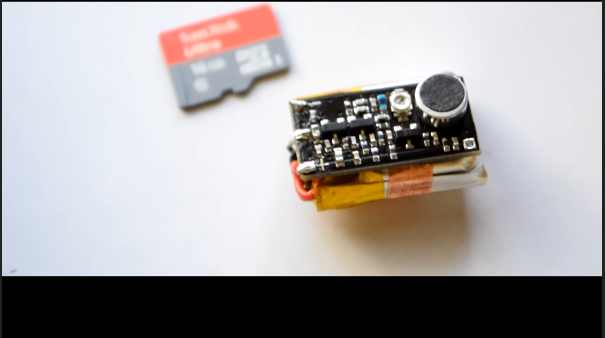
FM transmitters devices can be complicated to build. But here is how to make it fun. You need to buy only 2 Parts for that ! The FM Transmitter circuit is very simple and has very good range,about 10-30 meters.
Bastian Gotter is leaving iROKO Partners. He has served as COO/CFO and will be replaced by Lauren Miller. The full press release:
Monday 30 January 2017. Lagos, Nigeria. The board and executive team of iROKO, today announces that Bastian Gotter, the company’s co-founder and original seed investor, is moving on from his role as COO/CFO, after four successful years at the company. The changes will take effect as of January 2017, with Gotter’s replacement, Lauren Miller, taking up the role of CFO from the company’s London office.
During his tenure at the African entertainment and tech company with his co-founder, Jason Njoku, Gotter has been pivotal in the company’s meteoric growth, having raised an additional $33Mn from new and existing investors, and has also overseen key organisational infrastructure and built out a number of the company’s tech functions. In conjunction with his work at iROKO, Gotter and his business partner, Njoku, have seed invested in Lagos-based tech start-ups through Spark, their $2.5M investment platform. Together, they have invested in and worked with some of Nigeria’s hottest technology companies, including Hotels.ng and ToLet.com.ng, both of whom have gone on to raise additional investment rounds.
Following his passion for investing in and building companies in Africa, Gotter will now apply his considerable expertise in the sector to working with start-ups across Africa. Gotter says, “I leave iROKO in the knowledge that the company has a strong vision and a solid management team to execute it. iROKO’s relentless focus on riding the macro trends of high-quality local content and mobile in Africa will drive it to become a massive consumer success and I’m proud to have been there from the start.”
“My departure is bittersweet; naturally, I’m sad to leave the company that has been central to my life for so long, but I couldn’t be more excited to embark on a new journey, searching for and building up the next wave of truly exciting African tech companies.”
Jason Njoku, CEO and co-founder adds, “iROKO would not be the company it is today, without Bastian’s seed investment and faith in me to ‘figure out Nollywood’. In 2010, Bastian put his money where my mouth was, and together we embarked on the huge adventure of building an African entertainment brand that has changed the face of media consumption on the continent forever. This is no small feat.
“Everyone at iROKO, the board, and our investors, thank him for his unswerving commitment to helping build iROKO, and we wish him all the very best on his new journey. The companies he goes on to work with and invest in will find an experienced, dedicated and shrewd partner”.
In 2010, Gotter invested $150,000 for a 50% stake in iROKO, and later, when the company closed on Series A investment from Tiger Global in early 2012, left his role as a London-based Oil trader at BP to relocate to Lagos and take up the reins as iROKO’s COO and CFO. Replacing Gotter will be Lauren Miller, a corporate finance heavyweight who brings with many years of experience in top roles at Millicom, Paramount, Vodacom, JP Morgan & Chase and Warner Brothers.
Gotter concludes,“From my very first cash transfer for Jason to jump on a plane to Lagos to figure out the Nollywood distribution model, to the company we’ve built together today, it’s been an almost indescribable journey. I’d like to thank Jason, and the entire iROKO family, for all that iROKO has given me”.

Chelsea FC – Celebrating victory in the 2012 UEFA Champions League. Image Credit: Chelsea FC
I spend a lot of time thinking about teamwork; how teams function, how they operate, how they fail or succeed, and how the most successful teams make their success repeatable in the face of changing conditions. This post is my attempt to synthesize what I have learned so far.1
What is a team? For the purpose of this blog post I will define a team as: A group of people with complementary skills who choose to work collaboratively together towards accomplishing a shared vision and a common objective, within an environment of mutual support in which each team member is empowered to independently set goals, solve problems and make decisions with support from other members of the team, based on an agreed-upon framework, under severe resource constraints.
A team will perform better than an individual in situations where the task at hand can only be completed through:
The presence of the following phenomena help us identify a team2
In research using Letters-to-Numbers Problems, a task-grouping that combines elements of hypothesis testing, mathematical and logical reasoning, cryptographic reasoning, and collective induction: Groups of size three, four, and five performed better than the best of an equivalent number of individuals, but groups of size two performed at the level of the best of two individuals. Groups of size three, four, and five performed better than groups of size two but did not differ from each other. These results suggest that groups of size three are necessary and sufficient to perform better than the best of an equivalent number of individuals on intellective problems.3
Other research found that: “Groups are better than individuals in making difficult decisions, but the opposite effect is found when decisions are easy. The model suggests that the reason lies in the different assessment mechanisms operating at the level of individuals and colonies. For a difficult choice, solitary ants have a relatively high probability of accepting the worse nest, because they rely on quality dependent acceptance probabilities that differ little for similar nests. Successive comparisons cause these probabilities to diverge, but the ant is likely to make her decision before this slow process has had much effect. Whole colonies, on the other hand, do much better at difficult choices, because they use social information to accentuate the quality difference between sites. Rather than rely on individual comparisons, the colony’s choice emerges from a competition between recruitment efforts. Recruitment generates positive feedback on the number of ants at each site, with the better site slightly favored by its higher acceptance rate. The quorum rule amplifies this difference, allowing the colony to settle on the better site more frequently.”4
The importance of the team that is working to build a startup cannot be overstated. The team is the most important aspect of a startup during the earliest stages of its existence, while it is searching for a repeatable, scalable, and profitable business model. Once that business model has been found, the startup has a better chance of surviving team instability. Before that, team instability can be fatal. Also, the traits of the people in that early team determine the culture of the company that might evolve out of that startup.
Lesson # 1 – Every team goes through Development Stages: Bruce W. Tuckman’s model of how groups form is the foundational work on which our understanding of how teams develop and function is built. His paper ‘Developmental sequence in small groups’ was first published in 1965.5
Lesson #2 – To sustain success, leadership matters: Anita Elberse conducted research on Manchester United Football Club’s legendary leader, Sir Alex Ferguson. About Sir Alex Ferguson, she writes “Some call him the greatest coach in history. Before retiring in May 2013, Sir Alex Ferguson spent 26 seasons as the manager of Manchester United, the English football (soccer) club that ranks among the most successful and valuable franchises in sports. During that time the club won 13 English league titles along with 25 other domestic and international trophies—giving him an overall haul nearly double that of the next-most-successful English club manager.” Following are some observations based on her research.6

Denali
Image Credit: NPS Photo/Tim Rains
Lesson #3 – Great teams learn how to adapt their leadership structure to match the intensity and difficulty of the task at hand: In a study of 5,104 mountain-climbing expeditions that took place between 1905 and 2012 on more than 100 mountains around the world, researchers found that: “In sum, hierarchical cultural values predicted summiting and fatality rates only for group expeditions. Hierarchy did not predict summiting or fatality rates in solo expeditions, providing evidence that group processes are a critical driver of the observed effects.”7 In other words, groups characterized by a higher degree of “command-and-control” style leadership – and a lower degree of egalitarian leadership, were more likely to summit but also faced more deaths than groups with a higher degree of egalitarian leadership – and a lower degree of command-and-control style leadership. Commenting on the study, Cecilia Ridgeway, a professor at Stanford University observed that:
Related questions raised by this study:
Cecilia Ridgeway offers this advice: “The team would have to know itself well and all the members would really have to trust one another and be willing to go with their boss but also pull back from that in a kind of kaleidoscopic way. It’s not impossible but it wouldn’t be easy to do. It would depend a lot on the interpersonal skills, not just the climbing skills, of everybody involved.”
The best teams shift fluidly from one organizational form to another, depending on the circumstance, and depending on the nature of the task at hand. This is a function of the effectiveness of the team’s leadership, and reflects the complex nature of the environment in which startups and other businesses operate today.
Lesson #4 – Great teams are made up of people who each strive for true mastery in their area of specialization. The greatest soccer teams usually have players who each would be selected amongst the very best players in the world for the position that they fill on the team.9 To become the best each member of the team must hold a worldview that is keeping with what the Japanese describe as Shokunin kishitsu (????) – translated roughly as the “craftsman spirit” and commit to the following five principles:
Lesson #5 – A team should strive to become collectively more intelligent than any single member of that team could be acting alone.
A good team has learned how to make one plus one equal two. A great team has learned how to make one plus one equal three.1
Lesson # 6 – In order to sustain performance teams should be aware of the problems related to intra-group collaboration and intra-group creativity.
Concluding Thoughts
If you want to go fast go alone. If you want to go far go together.
The Big 5 of Team Work and The Coordinating Mechanisms of Teamwork: In Is There a “Big Five” in Teamwork? Eduardo Salas, Dana E. Sims and C. Shawn Burke provide a helpful summary of The Big Five and the Coordinating Mechanisms of Team Work. I am reproducing part of that summary below.20
The Big Five of Teamwork
The Coordinating Mechanisms of Teamwork

As infrastructure improvements to both mobile and broadband technologies continue, the global telecommunication sector continues its transformation process in the upcoming year as well. New revenue streams relating to the apps and services are generated continuously and are being pursued by the operators of these technologies. Throughout 2016, the industry has been focused on plotting the future of 5G. Whilst standards are yet to be defined, we have seen a number of operators and vendors moving aggressively to conduct trials of the technology, as they look to shape how it will be introduced to the market. Yet 4G has also continued to evolve, with LTE-Advanced Pro deploying new features such as higher levels of carrier aggregation and interference management, which provide faster data rates and better performance at the cell edges.
The key global trends impacting the telecoms sector in 2017 and beyond are:
5G is a very important area of development for telecom and wireless companies. 5G has been predicated as an enabler of next-generation IoT and M2M applications such as autonomous vehicles and virtual or augmented reality, which will need the low latency it promises. 5G will also be necessary to meet the ever-increasing demand for higher data rates and capacity. The new use cases that will be supported by 5G will depend on proving that new radio interface technologies can deliver the throughput, latency and capacity that will be required, and therefore validating the user experience for new applications will be a key consideration. New and sophisticated testing and validation techniques are already being developed for both the network infrastructure and the interoperability of the devices themselves. By adopting the ‘testing by design’ methodology, it is possible to build in quality and an understanding of system design and performance right from the start.
In 2017, we will see major operators and standards bodies pushing forward with the commercialization of narrowband IoT (NB-IoT). This is a Low Power Wide Area (LPWA) technology that transmits data intermittently, enabling connected devices that use only a small amount of data to operate with low current consumption. This can greatly improve the battery life of IoT devices.
Compared to propriety LPWA technology such as LoRa and Sigfox which operate in the unlicensed spectrum, NB-IoT operates either in the LTE licensed spectrum or in re-farmed GSM spectrum. This means it uses only a narrow bandwidth, leading to spectral efficiency and allowing carriers to prioritize data-intensive internet services and applications. Testing will play a vital role in ensuring the delivery of a high quality service that operates effectively within LTE bands, while mitigating interference from other devices.
As a cellular-based standard, it is critical to ensure the ability of the network to cope with the huge number of additional devices, potentially exceeding that of current networks by an order of magnitude or more. NB-IoT devices can be flexibly deployed and scheduled within any legacy LTE system, sharing capacity and cell-site resources with other connected devices, and even using re-farmed GSM frequencies. This introduces new test challenges due to the diverse frequencies and the potential to interfere with other LTE traffic, as well as a proliferation of IoT device types with very different traffic and application profiles.
In 2017, the number of DDoS attacks targeting IoT devices will increase, as hackers look to exploit service provider and business networks. The recent DDoS attack on DNS provider Dyn, driven by the MIRAI malware, was the world’s largest orchestrated hack via IoT devices. It brought down Twitter, Spotify and Reddit. However, next year will likely see an escalation of DDoS attacks, with hackers targeting higher risk services and institutions with far more severe consequences.
Imagine hospitals being cut off from internet-enabled life-saving devices, or power grids plunged into darkness, leaving towns and cities without access to crucial utilities like heating and electricity. Public transport systems could grind to a halt, and traffic light systems could stop working, causing havoc on roads. However, service providers and enterprises can put measures in place to prevent attacks of this scale. This can be achieved by implementing a modern security strategy which involves stress testing networks using the emulation of malware threats to identify weaknesses which would be targeted by cyber hackers. As a result, firms can protect themselves and their customers from IoT-driven threats.
In 2017, we will see high-end smartphones incorporating WiGig technology – Wi-Fi in the 60GHz spectrum. This will create an ecosystem for short-range applications which can make use of this spectrum, allowing for developments and improvements in wireless video streaming, AR and VR, gaming, and networking applications. The 60GHz spectrum offers much wider bandwidth than the current 2.4GHz and 5GHz bands, which are becoming very congested. The technology allows devices to connect at speeds of up to 8Gbps, though these will typically be over a short distance as a 60GHz signal has a range of around 10 meters at this power level.
WiGig will also bring improvements to home entertainment, allowing media to be shared across devices – for example, streaming content from a smartphone to a TV, or music from a smartphone to a speaker – without the need for and hassle of multiple wires and connectors. Productivity at work could also be improved, as WiGig could enable sharing of resources between colleagues. In 2017 the number of WiGig enabled smartphones will increase as more device manufacturers look to leverage the technology.
Virtualization has taken the telecoms industry by storm this year, enabling business to leverage the ability of host software solutions in the cloud. It enables companies to break free from the shackles of rigid hardware solutions, which are typically expensive and a scarce resource. Conversely, virtualized software solutions can be accessed from anywhere at a much cheaper price point, and also have the flexibility to be adapted based on the requirements of a business. These benefits will be reaped by network equipment providers and operators in 2017, particularly when it comes to testing their networks and solutions.
Virtual testing solutions will create demand for ‘Lab-as-as-Service’ solutions, where operators and NEMs can license testing solutions on a subscription basis, rather than paying for physical equipment. This can enable them to centrally manage and allocate their testing resources in a data center or cloud environment, testing services rapidly and cheaply, meaning developments can progress in parallel. It will also enable them to more frequently test their networks against cyber security threats, preventing potential damage to their businesses. We can expect some of the biggest operators in the world to move away from fixed lab environments and take advantage of emerging Lab-as-a-Service solutions as they look to reduce costs and centrally manage their resources.
Author: Mr. Stephen Hire is Vice President, Asia Pacific for Cobham Wireless. He has written this article keeping in mind the advancements in infrastructure, both mobile and broadband technologies that are transforming the global telecommunication sector in the years to come.
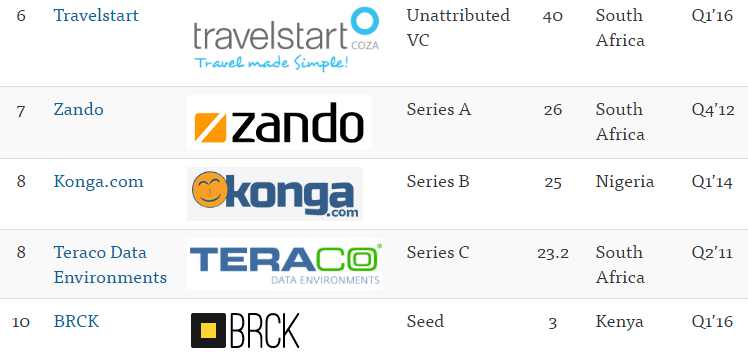
The table below presents major VC financings in the technology sector in Africa, from 2011 to 2016, from data aggregated by CBInsights
| Notable African VC Tech Financings 2011 – 2016 YTD (2/16/16) |
||||||
| Rank | Company | Logo | Round | Amount ($M) | Country | Quarter |
| 1 | Jumia |  |
Series C | 150 | Nigeria | Q4’14 |
| 2 | Takealot Online |  |
Series A | 100 | South Africa | Q2’14 |
| 3 | Africa Internet Group |  |
Corporate Minority | 83.5 | Nigeria | Q1’16 |
| 4 | Wananchi Group Holdings |  |
Unattributed VC – II | 57.5 | Kenya | Q2’11 |
| 5 | Smile Telecoms Holdings |  |
Unattributed | 50 | Mauritius | Q3’15 |
| 6 | Travelstart |  |
Unattributed VC | 40 | South Africa | Q1’16 |
| 7 | Zando |  |
Series A | 26 | South Africa | Q4’12 |
| 8 | Konga.com |  |
Series B | 25 | Nigeria | Q1’14 |
| 8 | Teraco Data Environments |  |
Series C | 23.2 | South Africa | Q2’11 |
| 10 | BRCK |  |
Seed | 3 | Kenya | Q1’16 |
| 11 | Kopo Kopo |  |
Series A | 2.1 | Kenya | Q4’15 |