DD
MM
YYYY

PAGES

DD
MM
YYYY

spot_img

PAGES

Home Blog Page 7472

A Note on Developing and Testing Hypotheses

0

This post is a continuation of the discussion I started in A Note On Startup Business Model Hypotheses. In this post I will describe how one might go about developing and testing a hypothesis about any aspect of a startup’s  business model.1

I will use a fine-dining restaurant as a motivating example.

To ensure we are on the same page, first some definitions.

Definition #1: What is a startup? A startup is a temporary organization built to search for the solution to a problem, and in the process to find a repeatable, scalable and profitable business model that is designed for incredibly fast growth. The defining characteristic of a startup is that of experimentation – in order to have a chance of survival every startup has to be good at performing the experiments that are necessary for the discovery of a successful business model.2

Definition #2: What is a business model? A business model is the description of how a startup will create, deliver and capture value. Alex Osterwalder’s Business Model Canvas is one framework for describing and documenting the elements of a startup’s business model.

Alex Osterwalder's Business Model Canvas, from the book Business Model Generation

Alex Osterwalder’s Business Model Canvas, from the book Business Model Generation

Definition #3 What is a hypothesis? A hypothesis is a statement, or a group of statements, that proposes an answer to a question, or a solution to a problem, in a manner that is testable through experimentation. The goal of experimentation and testing is to determine if the hypothesis is correct, and to inform the subsequent actions that the startup should take on the basis of that evidence.

A hypothesis is;

  1. A guess about the process underlying a set of observations that have been made by the founder.
  2. A testable guess, in the sense that it attempts to establish and predict the basic relationship between two or more variables that interact with one another to lead to the observed phenomena. This allows the researcher to test what happens when one of those variables is allowed to change, while others are held constant.
  3. Not the same as a research question; in the sense that a research question is broad while a hypothesis is more narrow in scope.

Motivating example; A fine-dining restaurant is experiencing an ongoing slump in revenues. The restaurateur wishes to test a number of possible approaches to reversing that trend. From prior experience they believe that the following factors each has a positive impact on overall sales at the restaurant;

  1. Wine Sales
  2. Liquor Sales
  3. Appetizers
  4. Seasonal Menu Changes
  5. Table Turns
  6. PR, Advertising and Marketing

How should management determine where to make an adjustment in order to improve overall sales without incurring a large capital outlay?

Discussion

Let us assume that Sales can be modeled by the following relationship.3

Restaurant Sales as A Function of Various Factors

Restaurant Sales as A Function of Various Factors

Remember that the goal is to try to figure out a course of action without spending too much by way of capital until the restaurateur is fairly certain that any capital deployed to this end will yield a disproportionately positive result.

To keep the discussion brief, let’s focus on two of the factors that management believes play an important role in driving revenues from the preceding list. Let’s focus on Wine Sales and PR, Advertising, and Sales.

Assume the restaurant is laid out such that the front-of-the-house is organized as two nearly identical dining rooms, they are separated by an ornate vestibule. During the experiment one dining room is operated status quo, while the other is operated as part of the experiment. Management feels this makes sense because guests are typically evenly split between the two dining rooms. Let’s call them Dining Room #1 – the control dining room, and Dining Room #2 – the dining room in which the experimental change is implemented.

Possible Hypotheses for Wine Sales Program – Experiment #1

  1. General Hypothesis: Implementing a wine-program will have an effect on sales.
  2. Directional Hypothesis: Implementing a wine-program will have a positive effect on sales.
  3. Testable Hypothesis: If we implement a wine-program we will increase revenue significantly because average check size increases substantially when wine sales increase.

Experiment #1: Management might hold all the factors constant, but implement an in-house training program to get wait-staff more comfortable speaking to guests of the restaurant about it’s current small collection of wine. Waiters in Dining Room # 2 are coached to discuss wines before guests order their meal, and afterwards when a guest might be considering a dessert. Let’s assume this program lasts a month. At the end of the month, management compares data from Dining Room #1 with data from Dining Room #2.

Possible Hypotheses for Inside-Sales Program – Experiment #2

  1. General Hypothesis: Implementing an inside-sales program will have an effect on sales.
  2. Directional Hypothesis: Implementing an inside-sales program will have a positive effect on sales.
  3. Testable Hypothesis: If we implement an inside-sales program we will increase revenue significantly because average check size increases substantially when wait-staff are encouraged to engage with guests.

Experiment #2: In this experiment, which also lasts a month, management trains wait-staff in Dining Room #2 to engage guests in casual conversation and to speak more enthusiastically and informatively about each day’s specials. Wait-staff are trained to highlight upcoming events at the restaurant that regular guests might find interesting enough to return for – a special prixe-fixe Wine Dinner the following week, for example. On occasion, every 90 minutes or so, the restaurant’s chef de cuisine spends about 10 minutes walking through Dining Room #2 and socializes with guests. The restaurateur wishes to determine if making things like this a more consistent part of how the restaurant operates makes sense from the perspective of increasing revenue.

During each experiment management collects the following data for each day, each week, and also for the month:

  1. Total Revenue
  2. Average Check Size – Revenue per Table
  3. Average Wine Sales – Wine Sales per Table
  4. Positive Social Media Mentions
  5. Negative Social Media Mentions
  6. In-restaurant Reservations – future reservations made while the guest is at dinner as a result of learning about an upcoming special event. This only applies to Experiment #2.


9-inch tall stack of paper - 6 months worth of studying

9-inch tall stack of paper – 6 months worth of studying

Now that the restaurant has collected some data it is time to test the data to see what conclusions the restaurateur might be able to reach based on each of the experiments.

Stating Null and Alternative Hypotheses

To test the hypotheses our restaurateur must make two different statements that will form the basis of a test; The Null Hypothesis states that the effect our restaurateur thinks exist does not in fact exist. The Alternative Hypothesis makes a statement opposite to that made in the null hypothesis, and typically is the statement we want to prove.

Experiment #1: Null and Alternative Hypothesis

  1. Null Hypothesis: Implementing a wine sales program has no effect on revenue.
  2. Alternative Hypothesis: Implementing a wine sales program has a positive effect on revenue.

Experiment #2: Null and Alternative Hypothesis

  1. Null Hypothesis: Implementing an inside-sales program has no effect on revenue.
  2. Alternative Hypothesis: Implementing an inside-sales program has a positive effect on revenue.

Note that the null and alternative hypotheses stated above are merely examples. The restaurateur could formulate each of those statements in more general terms, or with more specificity than I have done. To some extent that choice depends on the granularity of the data that was collected from the experiments.

At this point our restaurateur can perform a test of statistical inference to reach a conclusion – the outcome would be a “rejection” or “a failure to reject” the null hypothesis. A rejection of the null hypothesis leads us to accept the alternative hypothesis. A failure to reject the null hypothesis leads us to fail to accept the alternative hypothesis.

Assuming that the restaurateur rejects the null hypothesis in both instances, then it makes sense to spend some capital trying to build out a more robust version of each of the experiments we described, with the intention of operationalizing what was done during the experiment and making those practices a permanent part of how the restaurant is managed and run on an ongoing basis.

Closing comments:

  1. I have glossed over a significant amount of detail. That was deliberate. The goal of this post is not to discuss statistical theory, but to think about how statistical thinking can help startup founders who need to make important choices about how to utilize scarce resources. More detail can be found in any good introductory level business statistics text book.
  2. While going through this process our restaurateur needs to ask more questions than I did in this post. For example, what does “significant” mean? Is a 5% increase in revenue significant? Why? Is a 20% increase in revenue significant? Why? Or, why not? Are the costs associated with implementing the changes necessary to make what was done during the two experiments a permanent operating practice of the restaurant justified by the restaurateur’s forecasts of the long term benefit of doing so? Why, or why not?
  3. It is always important to think about sources of error whenever one is conducting an experiment that is supposed to yield data that decisions like the one I described in this post will be based upon. In this instance, one concern might be that the restaurateur is not collecting the appropriate data on which this decision should be based. Or, for example, that a single month is not a wide enough window of time to determine if the effect observed during this period of the experiment persists during the remaining 11 months of the year.

Notwithstanding those concerns, I believe that when it is possible, this kind of analysis should always complement management’s intuition.


  1. Let me know if you feel I have failed to attribute something appropriately. Tell me how to fix the error, and I will do so. I regret any mistakes in quoting from my sources. ?
  2. I am paraphrasing Steve Blank and Bob Dorf, and the definition they provide in their book The Startup Owner’s Manual: The Step-by-Step Guide for Building a Great Company. I have modified their definition with an element from a discussion in which Paul Graham, founder of Y Combinator discusses the startups that Y Combinator supports. ?
  3. I am in no way suggesting this is the appropriate model for this problem. I am using this only for the purpose of this discussion. Assume the restaurateur has developed this model after years of experience in the industry, and based on trial and error. This model is supported by the last 5 years of sales data. ?
Zenvus Wins AgTech Startup of the Year in Casablanca Morocco [Video]

1

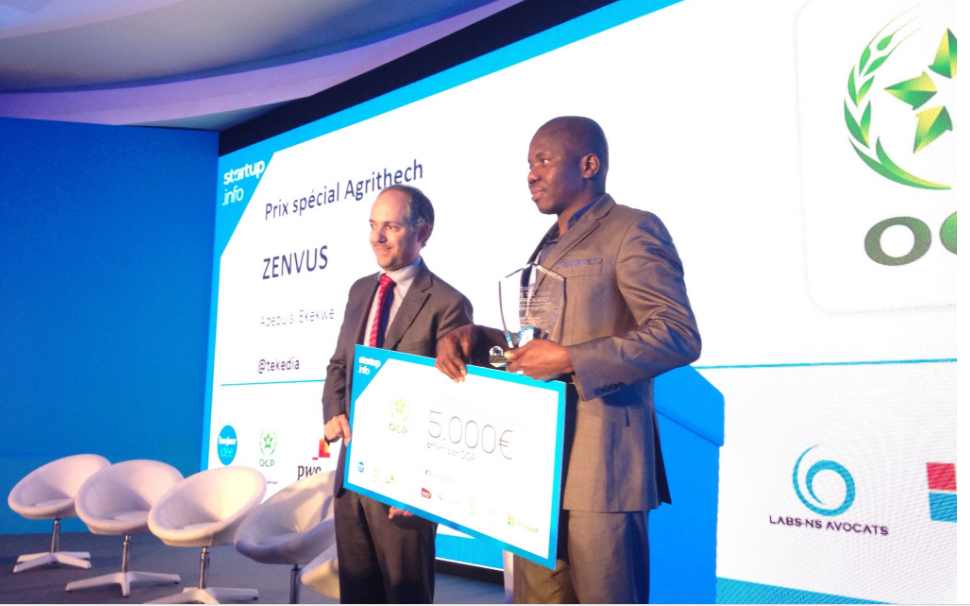
Today in Casablanca, Morocco, a wholly-owned subsidiary of Fasmicro Group was honored by the world’s largest fertilizer producer, OCP Group. Zenvus is the 2017 AgTech Startup of the Year.

Accepting the award, Fasmicro Group Founder, Ndubuisi Ekekwe,dedicated it to all African farmers. Watch clip here.


To all African farmers, we love you all. This Award is for you. As Zenvus team meets you from Nigeria to Morocco, from Kenya to South Africa, we assure you that your interests are #1 in all we do on Zenvus.

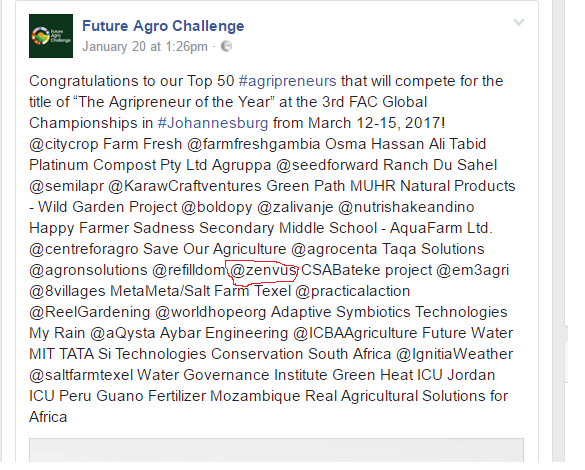
AgTech pioneer Zenvus to represent Nigeria in 2017 Future Agro Challenge Global Championships in Johannesburg

0

Zenvus, the agtech pioneer in Nigeria, will represent Nigeria in the Future Agro Challenge Global Championships taking place in Johannesburg, South Africa from March 12-15, 2017.  The event will hold during the Global Entrepreneurship Congress.

Future Agro Challenge (FAC) is the largest global competition that discovers innovative fundable food, agtech, and agriculture ventures from various corners of the globe addressing national, regional and global challenges. FAC provides key tools and opportunities to help them grow their business and expand them into new markets. FAC is working to make a difference on a global level by increasing interaction among agro innovators, entrepreneurs and stakeholders, by addressing national policies and challenges.

This news was communicated via email and has been posted on the Facebook page of FAC.
The FAC team has promised to make a formal press release with all the finalists and their countries, according to a Facebook post entry accompanying the preliminary communication: “Dear All! A formal update will be sent next week! We will be in touch with each person that applied. There will be information coming your way to share with media”.
Zenvus is an intelligent solution for farms that uses proprietary electronic sensors to collect soil data like moisture, nutrients, temperature, pH etc. It subsequently sends the data to a cloud server via GSM, satellite or Wifi. Algorithms in the server analyze the data and advise farmers on what, how and when to farm. As the crops grow, the system deploys hyper- spectral cameras to build crop normalized difference vegetative index which is helpful in detecting drought stress, pests and diseases on crops. The data generated is aggregated, anonymized and made available via subscription for agro-lending, agro-insurance, commodity trading to banks, insurers and investors. Zenvus also has a mapping feature which can help a farmer map the farm boundary with ease.

Lagos-based Printivo makes ITNewsAfrica Top 10 African Startups

0

Nigeria-based cloud printing pioneer Printivo has made ITNewsAfrica Top 10 African Startups. It is the only Nigerian company in the list. The buzz on the technology ecosystems continue to accelerate as these startups continue to demonstrate how technology and innovation could help bring solutions to some African challenges.

Besides the Nigerian startup which helps other startups and SMEs print business and marketing material with ease, other top startups are:

  • Instabug – Egypt, allows users to offer feedback from within apps and to report bugs and issues.
  • RoamSmart – Tunisia, assists mobile operators to manage their roaming businesses by allowing them to optimise workflows and monetise existing roaming sources through an automated data reporting and analysis platform.
  • Tutorama – Egypt, the online tutoring platform connects parents with top quality local tutors in their area.
  • Fuzu – Kenya, allows users to learn new skills and find jobs regardless of their levels of education.
  • Flare – Kenya, application aggregates available ambulances onto a single system, and allows patients or hospitals to request emergency help via smartphone.
  • Jumaii – Tanzania, health app offers a mobile micro-health insurance product targeted at the low income and informal sector.
  • Custos Media – South Africa, uses blockchian technology to crack down on piracy in digital media.
  • Cape – South Africa,  operates a WiFi network and application quality monitoring tool.
  • Dr CADx – Zimbabwe,  developing a computer-aided diagnostic system to help doctors diagnose medical images more accurately, and to provide pervasive radiology diagnostics in regions which currently do not have radiologists.

A Note on Startup Business Model Hypotheses

0

One of the observations I have arrived at over the course of meeting founders of early stage startups is that often it is not clear during our conversations if they have spent time examining the hypotheses that underlie the business model for the startup they are building.

This post1 is my attempt to outline some of the areas that I consider as I try to understand an early stage startup’s business model and the hypotheses that are the foundation on which its success must rest.2

To ensure we are on the same page, first some definitions;

Definition #1: What is a startup? A startup is a temporary organization built to search for the solution to a problem, and in the process to find a repeatable, scalable and profitable business model that is designed for incredibly fast growth. The defining characteristic of a startup is that of experimentation – in order to have a chance of survival every startup has to be good at performing the experiments that are necessary for the discovery of a successful business model.3

Definition #2: What is a business model? A business model is the description of how a startup will create, deliver and capture value. Alex Osterwalder’s Business Model Canvas is one framework for describing and documenting the elements of a startup’s business model.

Definition #3: What is Customer Development? Customer Development is a 4-step process by which a startup answers the questions it needs to answer in order to find a business model that is repeatable, scalable, and profitable. Step 1 and step 2 of Customer Development cover the “search” phase of a startup’s life-cycle. Step 1 is Customer Discovery. Step 2 is Customer Validation. More on those a little later.

Definition #4 What is a hypothesis? A hypothesis is a statement, or a group of statements, that proposes an answer to a question, or a solution to a problem, in a manner that is testable through experimentation. The goal of experimentation and testing is to determine if the hypothesis is correct, and to inform the subsequent actions that the startup should take on the basis of that evidence.

Step 1 in the Customer Development Process: Customer Discovery – this involves translating the initial vision behind the startup into a set of hypotheses about each component of the business model. This allows experiments to be performed that either validate or invalidate each proposed hypothesis. In my experience the exercise of testing hypotheses about the business model with prospective customers accomplishes at least two things. First the startup entrepreneur gets to hear directly from customers about the elements of the business model’s value proposition that are most critical from the point of view of the startup’s customers or partners. Second it jump-starts the sales process even before the startup has invested much time or money into building a product. The founders of a hardware startup discussed their idea for an innovative new product with a potential partner. The partner’s input proved crucial in determining the direction they followed with regard to product design – it evolved from a product with one offering to one with three distinct but complementary offerings.

The revenue model also changed based on those discussions. Even better, the partner agreed to work with this startup to bring the product to market when it is ready. Obviously, there’s still a lot to be done – product design, product development and manufacturing for example. Yet those initial discussions have been critical in conferring the kind of credibility that has made it possible for the startup to seek an audience with other potential partners. Customer discovery for this startup also involved market research to determine the priority of features from the perspective of individual end-use customers – the men and women who might actually decide to purchase the startup’s offering once it becomes available to consumers.

Step 2 in the Customer Development Process: Customer Validation – this step proves that the work done in step 1 is easily repeatable, scalable, and capable of delivering the customer volume required to build a profitable company. The startup I described above is now building prototypes based on all the information it gathered during the Customer Discovery process. Eventually we will test our ability to deploy the product in the field – a few hundred first, then a few thousand, and barring any major setbacks, tens-of-thousands, then hundreds of thousands.

During that process we will test how well the back-end software works with the hardware that we have designed and manufactured once people are actually using the device. At each step I expect we will go back to the drawing board on several aspects of the product and the business model. For example, our pricing model may not reflect reality since our market research confirmed the hypothesis that our potential customers have never encountered a device like the one we are developing. We may discover that customers will gladly pay more for the value proposition we offer than we currently plan to charge. It is important to note that we have gone through a number of product pivots during Customer Discovery. For one, we made an incorrect hypothesis about the amount of space our partners would be willing to devote to this new device, never mind all the assurances they gave us during early conversations.

We also made a number of pivots in terms of the user experience and the interface through which users will interact with the device because we realized that a number of hypotheses we had made about certain design, engineering, and manufacturing issues related to the product were just flat out wrong. The product we will soon show to our partners satisfies the desires individual end-use customers told us they seek in a product like ours4, in a manner that accounts for the constraints our partners expressed they would eventually have to contend with in deploying the devices when they come to market. Moreover, this exchange of information led us to develop a product with performance characteristics far superior to what we would have achieved within the parameters of our previous vision. We expect to make a few more pivots before all is said and done.

Developing Hypotheses During Customer Discovery

The first step in customer discovery is developing a rough estimate of market size and sketching an initial business model for your startup using the business model canvas, which I have discussed in some detail in What is Your Business Model? Using the business model as a guide, develop a hypothesis brief for each component of the business model canvas. A hypothesis brief should contain a succinct statement of the hypothesis itself as well as a sufficiently detailed but brief outline of the information that makes the hypothesis a reasonable and valid one for that business model component.

The market size hypothesis is probably the most critical, even though it does not correspond directly to any of the business model canvas components. Investors like to back companies that target potentially large markets. At the same time, be careful to differentiate the total addressable market opportunity, the serviced addressable market, and your target market. Needless to say, your initial target market will be the smallest of these three. In most cases a bottom-up estimate is better than a top-down estimate because it is relatively easy for an investor who wishes to do so to replicate a bottom-up estimate. Whereas, a top-down estimate could be viewed as “hand-waving” with no basis in reality.

The value proposition hypothesis should discuss the problem your startup solves for its customers. A segment of this brief should capture product features, and a minimum set of initial product features that early customers would be willing to pay for. This is the minimum viable product, a bare-bones version of your product that solves the “core” problem your customers face. Put another way, your minimum viable product is the least developed product that you can create in order to validate your most important hypotheses about the problem you are solving and what your customers or users will accept.

The customer segments hypothesis forces you to answer the questions “Who are my customers?” and “What problems do my customers face?” The hypothesis brief should discuss customer problems, types, and archetypes respectively. Understanding “a day in the life” of your typical customer is a powerful way to understand your startup’s customers. Finally, Steve and Bob suggest you develop a customer influence map. There is an important aspect finding customers that can be overlooked. What is the smallest group of customers that is experiencing the pain or problem you are solving most acutely? Perhaps they do not have enough money to be attractive to incumbents. Or, perhaps they are a niche that is considered weird and unprofitable by your competitors. Start your experiments there. Why? If your product indeed solves their problem, they will adopt it quickly. On the basis of broad adoption within that niche, you can plot a path to other communities of customers who are facing the same problem. In other words, find the groups of people who will be your “Innovators” and “Early Adopters” and focus your early efforts on those groups.

The channels hypothesis should differentiate between physical, web, and mobile channels. An important consideration during the development of this brief is whether your product fits the channel. At this stage it is important to pick the channel with the most potential and to focus on gaining customers and cultivating sales through that channel to the near exclusion of every other alternative. With very few exceptions, since you are still testing your hypotheses, developing your business model, and determining what product is best positioned to solve your customers problems avoid the temptation to launch via multiple channels.

I was having lunch with the founder of an early-stage startup on Thursday, last week. She was giving me an update – the struggle to raise seed capital from investors, what she’s learning about building a team, and so on. We got to talking about how she would distribute her startup’s MVP. Her initial plan would have cost her a lot of money – capital she can’t afford to spend and a significant portion of the round she’s trying to raise, because she was thinking about traditional channels – the most obvious route to the customers she thinks she needs to get to. I pointed out that without further testing, she was taking a very risky gamble whose most likely outcomes do not favor her startup. Instead I suggested she spend the least amount of money she can to test non-traditional channels, and maximize the yield from those avenues before she does anything big and splashy through traditional channels. In this example, her hypothesis was poorly formed because it failed to take her startup’s capital constraints into full consideration.

The market-type and competitive hypothesis discusses the nature of the market into which your startup is entering and tries to anticipate the competitive landscape of the market that you will be attacking. You might consider it the second half of the value proposition hypothesis – your product solves a product for a group of customers, or a market. In broad terms a market already exists, or your startup is creating a completely new market where none existed previously. Your market entry strategy will depend on the market type you identify, as will your cost of entry into that market. In an existing market, your startup will have to position itself against the competition in a manner that ensures it can win given the basis upon which you have chosen to compete.

The customer relationships hypothesis describes how you get, keep and grow your customers. It is similar to the LBGUPS model, which I discussed in What Is Your Business Model? There’s no need to emphasize that this is an important hypothesis brief – without customers or users your startup will die a not premature death. How you get, grow and keep customers is very channel dependent. Your analysis should take that into account, and should also factor in related costs.

The key resources hypothesis discusses how you’ll obtain resources that are critical to your startup’s operations but that you do not have within the startup. These resources might be physical resources, financial capital, human capital, or intellectual property. In each case it is important to list the resource and an outline of how it will be secured to enable the startup run its operations. For example, servers can be rented in the cloud at a cost that is lower than managing your own server. Another example, a first-time founder who does not yet have a technical co-founder might partner with an outsourced software development shop to build and MVP with which to run some experiments. Often the devshop will remain as a service provider till the startup becomes self-sufficient enough to bring that work in-house. I have a bias for startups that control their intellectual property.

The key-partners hypothesis describes the partners that are essential to enabling your startup to succeed. It also describes the value-exchange that keeps the partnership alive. For example, a startup might have all its development and design work done by a software engineering consulting firm established for that specific purpose. In this case the startup pays the software engineer money in exchange for software engineering related to its product. Key-partner relationships might take the form of a strategic alliance, a joint new business development effort, a key supplier relationship, or co-opetition. Certain of these are more common early in the startup lifecycle, and others are more common late in the startup lifecycle. It is important to realize that a partner should not have control over anything that is critical to your startup’s ability to exist and do business.

The key activities hypothesis summarizes your startup team’s understanding and assumptions about where its energies should be most focused in order to create the most value for its customers. These are those activities that you feel cannot be left to one of your startup’s key partners. For example, a hardware startup might view design as a key activity, while assembly is left to a manufacturing partner in a low-cost manufacturing jurisdiction.

The revenue and pricing hypothesis brief is important because it ensures that the startup can extract value for itself and its investors. It asks a number of simple questions all related to revenue. The nature of the specific questions asked depends on the channel, but the essence of those questions remains the same. Together they should enable you determine if there’s a business worth pursuing along the path you have chosen for your startup.

The cost structure hypothesis brief forms the second half of the value extraction hypotheses – the first being the revenue and pricing hypothesis. Your startup’s cost structure must ensure that it can effectively deliver on the value proposition it has promised customers, and keep a portion of the revenues that the startup cultivates in the form of profits. Here too the questions asked will be relatively simple, and will reflect the channel and the market type. For example, a startup whose only channel is the web will have a lower cost structure than one with a physical channel.

Once your hypothesis briefs are complete, your entire startup team should discuss the output. Seek contradictions, conflicts and inconsistencies. The most important reason for developing these hypotheses is to ensure that the actions that your startup is taking have the highest probability of yielding success that is possible.

During my conversations with founders I listen carefully to determine if the startup has thought about these issues, or is thinking about them – it depends on the stage. I become concerned when I get the sense that important questions have been left unasked and unanswered.


  1. Any mistakes in quoting from my sources are entirely mine. This post is an updated and adapted version of my posts The Startup Customer Development Model and Customer Discovery Phase I: State Your Business Model Hypotheses? which were published at Tekedia.com on September 3rd, 2012 and January 21, 2013 respectively. Large portions of this update are identical to the originals. ?
  2. I have adapted portions of: Chapter 2 and Chapter 4 of The Startup Owner’s Manual Vol. 1: The Step –by-step Guide for Building a Great Company, Steve Blank and Bob Dorf, Pub. March 2012 by K and S Ranch Publishing Division. ?
  3. I am paraphrasing Steve Blank and Bob Dorf, and the definition they provide in their book The Startup Owner’s Manual: The Step-by-Step Guide for Building a Great Company. I have modified their definition with an element from a discussion in which Paul Graham, founder of Y Combinator discusses the startups that Y Combinator supports. ?
  4. Market research involved nothing more than a description of the device. In other words, we relied on potential customers’ ability to imagine a future in which they could use the device we were setting out to develop. ?