DD
MM
YYYY

PAGES

DD
MM
YYYY

spot_img

PAGES

Home Blog Page 7477

How Social Enterprises can Navigate the Scourges of Bribery and Corruption

0

Running a business in Sub-Sahara Africa (SSA) can generate tremendous financial reward particularly if your organization targets strategic growth markets. Abundant opportunities are there to be exploited, however, navigating the economic environment requires skill and local market intelligence.

Most African countries are ranked in the lower quartile based on the latest rankings for the ease of doing business provided by the World Bank Group. In comparison to developed Western economies, most African entrepreneurs take the ‘easy’ treacherous route by paying bribes to win tenders, to operationalize their businesses quicker and to ‘get protection’ from corrupt senior local government officials.

Corruption is deeply rooted in African culture

Corruption is of one the main causes impeding innovation, business growth and economic prosperity. This has exacerbated poverty, exclusion and brought suffering to 300 million Africans.

Powerful leaders continue to enact porous organisation architectures (including systems and processes) that enable them to fatten their wallets at the expense of wider development. The fight for survival forces many poor people to participate in corrupt activities to access basic needs like water, education, shelter and medication.

There is a school of thought that corruption opened the floodgates to colonialism by European settlers. Although all African countries gained independence from their colonial masters, modern exploitation is common. Multinational companies, powerful nations and rich individuals continue to bribe African leaders to gain access to natural resources, trade and in some extreme cases facilitating overthrowing governments by sponsoring coups.

Furthermore, extreme corruption is slowing development and causing leakage across value chains. For example, senior Zimbabwean government officials made a public announcement that US$15 billion revenue from diamond sales had vanished from government coffers over a period of four years. Surprisingly, no one has faced charges for embezzlement, however, a Christian pastor Evan Mawarire who mobilized millions of Zimbabweans to condemn corruption was arrested and will likely spend more than ten years in prison unless he is acquitted.

It’s not all doom and gloom

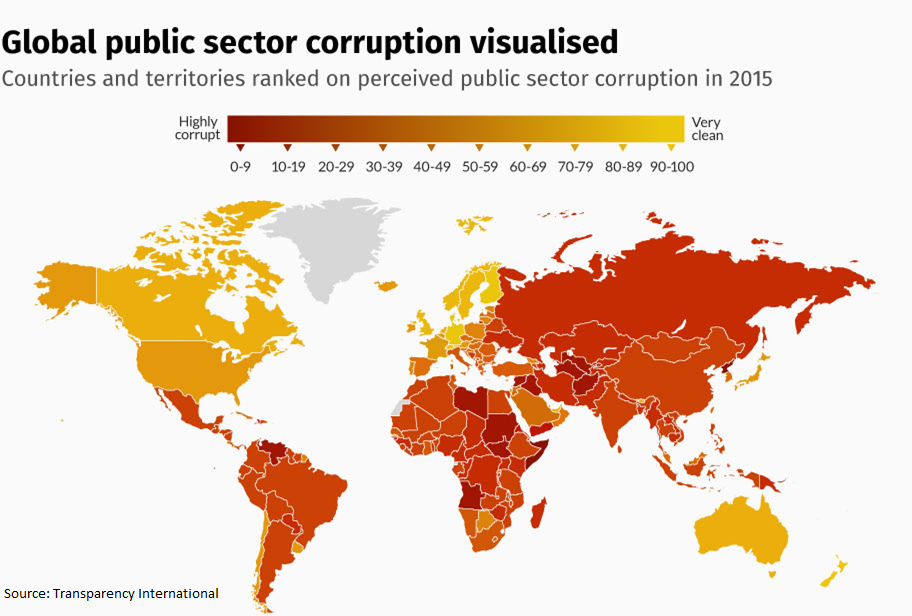
Contrary to general perceptions, not all African countries are corrupt. Mauritius and Botswana have low incidences of corruption with rates on par with developed countries in Europe and North America.

Paying bribes destroys long-term value

Paying bribes does not guarantee success. Whilst paying a bribe might deliver short-term benefits, this strategy exposes your organization to financial and operational volatility in the long-term. Paying bribes increases upfront costs to launch a business and generates ongoing trail expenses to ‘assist your organization to remain in business’.

Don’t pay bribes

Over the past thirteen years, l have heard many sad stories from APAC investors who have lost money from bad deals. The majority attributed compounding expenses resulting from paying bribes as the major cause for losses. When things go wrong, you cannot recover a bribe by lawful means. So why do many foreign investors pay bribes in emerging markets when they don’t commit similar acts in their home countries? Based on my humble opinion, ignorance, greed and stupidity are common traits.

Maintain high ethical standards and integrity

Strive Masiyiwa is one of the most successful entrepreneurs in SSA who has a strong reputation of shunning corruption. Strive launched a billion-dollar mobile telecommunication company called Econet in Zimbabwe in 1998. Despite resistance from the local government, Strive persevered and won a legal battle to launch Econet, resulting in the liberalization of the telecommunication industry.

Econet’s footprint continues to grow and now has business operations and investments in more than 20 countries in Africa, Europe and Asia Pacific. In addition to good stewardship, Strive attributes the refusal to pay bribes to vendors or government officials as one of his key success criteria.

Transparency also underpins Econet’s success. The organization provides full disclosure about product features, pricing and financial performance. Consequently, Econet continues to deliver superior business performance by leveraging its strong brand power to win new customers and drive loyalty from brand advocates.

Winning the battle

  1. The first step in fighting corruption is knowing that the giver is equally as guilty as the receiver of the bribe.
  2. All foreign investors must avoid paying bribes if they want to sustain business growth and enhance their organisation’s brand value.
  3. There is evidence of government reform. For example, Senegal created a National Office to fight corruption and fraud. The government enacted laws in April 2014 that requires elected officials to declare their assets.
  4. African leaders should lead by example by promoting transparency, accountability and respecting the rule of law. Ali Mufuruki, CEO of Tanzania’s Infotech Investment Group mentioned that solutions abound in ethical leadership, strong and enforceable laws against corruption, severe sanctions for corruption underpinned by a national culture of promoting ethics from family to national level.
  5. Shifting mindsets will uproot corruption, currently embedded in African culture. All Africans must question their own personal stand on corruption before taking the fight to the national level.

How can Sub-Sahara Africa reduce or eliminate corruption?


Jo Chidwala is an experienced business leader with proven record of accomplishment to transform businesses by formulating and executing product and pricing strategies that generate value. He is a strategic thinker with strong analytics, modelling and communication skills; can lead and motivate teams to drive projects to completion.

User Manual: The Early Stage Startups I Want To Hear About Most in 2017

0

At KEC Ventures, I have been largely focused on finding and meeting the founders that we can become most excited about and partner with. I will continue to maintain that focus over the course of 2016 and 2017.

Here are some notes for the founders of the startups I am most eager to meet.

About KEC Ventures

We are a team of early stage investors based in New York City. We invest in information technology startups that are pursuing business models with the potential to transform the way business is done in their market. In such startups, we generally invest in the first institutional Seed Round or, less frequently, we will invest in the Series A round of financing. Often, but not always, we act as the lead investor. On rare occasions, we might invest earlier than this when we meet a founder pursuing a vision that we believe in. Currently, we focus on investing in startups based in the United States or Canada.

Connecting With Me

If you know someone who knows me, an introduction would help. If you do not, never hesitate to communicate with me directly. I am easy to reach on the major social networking platforms. Also, I hold regular and frequent office hours at various co-working spaces in New York City. Some allow non-members to sign-up and attend.

The best time to start communicating with me is at least 6 – 9 months before you believe you will raise a round in which KEC Ventures might invest because I believe it is important to build trust before entering into the kind of working relationship that exists between startup founders and their early stage investors.

That also gives me sufficient time to understand the problem you are solving, so that if we invest, we are doing so with conviction. Time enables me to become a more effective advocate on the startup’s behalf when my colleagues and I have discussions about making an investment.

Communicating With Me 

If we are not meeting through an introduction, I will respond quickest to founders who get straight to the point, and explain why we should meet in 250 – 400 words in their first email to me. I try my best to respond. However, depending on what else I have going on, I may not respond if I feel the startup is outside KEC Ventures’ areas of interest and that the founder could have easily found that out before emailing me. Please follow up with me once or twice if you believe I have made a mistake.

If you are not connecting with me or anyone else at KEC ventures through a warm intro, you can email me at: pitch@kecventures.com. I’ll go through submissions to that email address every Friday.

Characteristics I Look For in Founders, and Teams 

I look for teams in which the founders have known one another for a considerable amount of time prior to launching their startup. I look for teams in which the level of trust and respect between the co-founders is high. I look for teams that will not have difficulty attracting other great people to join the startup. I look for founders who inspire confidence and loyalty from others because they are good at what they do, the kind of people I could picture myself working for.

I look for founders for whom solving the problem that their startup is solving has become their life’s mission and they plan to solve that problem with or without help from outside investors. I look for founders who have an unconventional opinion about the market opportunity they are pursuing, and can explain why their position is correct with evidence which investors can analyze independently.

At the outset I look for teams that can focus on building a simple product that their initial customers love, and who can focus on a niche within which to launch their product. I look for teams that are judicious and frugal in how they deploy the startup’s resources.

I look for founders who value teamwork, and who can become great leaders if they desire to do so. I value transparency, honesty, and openness. I value self-awareness. I like people who are determined and tenacious, who do not give up just because the going gets get uncomfortable and things seem bleak.

I look for founders who have a hard time doing something simply because it is what someone else expects them to do. I look for founders who are not afraid to be different.

Characteristics I Look For In Markets 

I look for large markets that could ultimately be served by the startup’s product, even though the initial target might be a small portion of the whole. I look for customers capable of and willing to pay for the product, and who are looking for and eager to find a solution to their problem.

I look for markets in which the pain is acute because the problem suppresses customers’ profits significantly, or because the problem makes users less happy than they could be.

If currently the addressable market is between $1B and $10B, I want to see evidence that it is growing quickly enough to support the startup’s future goals, and the competition that I assume will quickly follow if the team is successful.

Characteristics I look For In Business Models 

I look for products and business models that:

  • will benefit from network effects as time progresses,
  • can scale efficiently and quickly, and
  • can eventually benefit from an economic moat.

The Themes I Am Focused On

Notes:

  1. These themes cut across different industries and sectors. That is a deliberate choice.
  2. The technology sector evolves constantly. Accordingly, our team’s interests might ebb and flow in response. The themes I have described below should serve as a rough guide to how I think about the universe of startups in which we wish to invest.
  3. Ideally, a startup raising its first institutional seed round should have raised less than $1.5M – 2.0M or so prior to the round in which KEC Ventures would be investing.

I am currently interested in hearing about:

  • Marketplaces: Platforms that enable the participants in large, global markets to interact with one another in ways that reduce waste or create new, untapped opportunities.
  • Interconnectivity: Platforms that enable large numbers of different types of connected devices, machines, apps, and websites to communicate with one another and with the people managing or using them within a secure environment.
  • Data & Analytics: Platforms or applications that help people or other machines to manage, analyze, interpret, make decisions, and take actions based on vast and growing troves of centralized or decentralized data.
  • Effectiveness & Happiness: Products that enable people to accomplish more at work, or to become happier outside work. Products that help large enterprises and other types of businesses and organizations to grow or function more effectively.
  • Distribution: Products that make it easier to create, manage, distribute, and consume existing and emerging forms of digital media and content.
  • Asset Management: Technologies for managing different forms of enterprise, business, or individual assets. Technologies for managing different forms of enterprise, business, or individual risk.
  • Other: New, and as-yet unknown technologies and innovations founders are building to solve problems that exist only because no one else has developed a solution.

Things I am Not Interested In

  1. Exploding rounds: An exploding round comes with a caveat like “Seed round in ground-breaking tech startup closing in 1 week!” I do not like exploding rounds, not even exploding rounds that are being led by a name-brand VC. I need time to do my own homework.
  2. Meetings led by an advisor: I prefer my first few interactions with a startup to be with the team of co-founders, not with an advisor. It is okay for an introduction to come from an advisor, but I do not like to have advisors or mentors micro-manage my interactions with startup founders. That does not inspire confidence.
  3. Lack of control over core technologies: I try to avoid situations in which the startup has a product that has launched to the public, but the startup’s team has no primary responsibility for actually building the core product.
  4. Founders who will not share bad news: I only want to work with founders who will not hide bad news until it is too late for investors to do anything that might help the startup make a course-correction. I absolutely want to hear about difficulties, challenges, and problems. I expect the good news, but I think we have an obligation to try to fix the bad stuff before it becomes unfixable.

My Commitment to Startup Founders

Based on Gil Dibner’s VC Code of Conduct;

  1. I will be transparent.
  2. I will respect your time.
  3. I will not ask you for material I do not need.
  4. I will not string you along.
  5. I will let you know about any competitors in our portfolio.
  6. I will be transparent about conflicts of interest.
  7. I will not share any of your material without your permission.
  8. I will not speak with your customers without your permission.
  9. I will educate before I negotiate.
  10. I will be honest about what standard terms are.
  11. I will not issue a term sheet unless my firm has made a firm decision to invest.
  12. I will reflect the term sheet in the final legal documents.
  13. I will not seek an unreasonable equity stake.
  14. I will avoid surprises.
  15. I will always act in the best interests of the company.

The Proliferation of Sustainable Social Enterprises in Sub-Sahara Africa

0

Over the past ten years in Sub-Sahara Africa (SSA), there has been a proliferation of social enterprises replacing traditional donation-led philanthropic organisations.

A social enterprise is a business whose main objective is to tackle social problems, improve people’s lives and improve the environment. Additionally, a common characteristic shared by all social enterprises is sustainability, both social and economic.

Emerging markets pioneered the development of social entrepreneurship by developing and scaling successful social enterprises in the form of micro-finance and mobile phone banking. In Kenya, M-Pesa transformed the banking sector by providing affordable mobile banking solutions to more than 10 million poor local businesses and individuals.

In Zimbabwe, there are more than 500,000 social enterprises generating nearly three million jobs across the agriculture value chain. This translates to more than $5 billion value generated, contributing nearly 60 percent of the country’s overall GDP.

Contrary to common misconceptions, social enterprises are outperforming the small and medium-sized enterprise (SME) segment. Per market research conducted by GIIN in 2016, almost a third more social enterprises compared to SMEs increased their revenues in 2016.

Although historical industry performance has been favorable, there are some significant constraints slowing full growth potential.

  • Many social enterprises are still in infancy stages of development and operating at a sub-optimal scale. Consequently, these businesses have limited capacity to optimize business performance, hence struggle to compete with larger established for-profit businesses. Approximately 80 percent of social enterprises in SSA, have less than five employees, while just 1 percent have more than 100 employees. However, in developed markets like the United States, social enterprises operate at larger profitable scale with approximately 10 percent having more than 100 employees. African social enterprises generate less than $10,000 annual revenue relative to $250,000 annual revenue generated by social enterprises based in United States.
  • “Lack of appropriate capital across the risk-return spectrum” and “shortage of high-quality investment opportunities with a track record” are slowing industry growth. Approximately $13 billion in impact investing funds were looking for investment-worthy social ventures in 2014, up 19 percent from the year before based on the latest industry report published by GIIN in 2016. However, there is a shortage of tools for developing compelling propositions to promote investment. To close the gap, industry leaders are mentoring social entrepreneurs, developing networks, enhancing information transparency and diversifying capital streams – in the form of blended patient capital, debt, equity, or hybrid financing that better serve the needs of social enterprises.
  • Individual geographies have their own economic and political issues that can constrain growth or impact the viability of a social enterprise model. Last year, Ignition Impact Fund assessed the social enterprises in its portfolio to determine which ones would best scale up in certain country. That analysis yielded specific insights about the interactions among product innovations and ideas, business models, and country-specific conditions. As such, investors should carefully assess each deal to determine its standalone attractiveness given large discrepancies in different environments.
  • Logistical and value chain barriers limit full growth potential. A product or service may be innovative, but appropriate ecosystem enablers must be in place to ensure access, availability, and affordability. For instance, A.T. Kearney helped establish a cash-and-carry chain in Ethiopia, based on the government’s aspiration to lower food prices. The focus was on developing the resources and infrastructure behind the food supply chain.

The successful evolution of social enterprises requires both commercial and legislative mindset shift. Investors need to look beyond the expectation of turning a quick profit and consider the benefits of patient capital. On the legislative side, investment incentives, such as partial tax subsidies, would encourage investors to finance social enterprises over profit-oriented businesses that offer more compelling returns. From a policy perspective, this is a justifiable trade-off, since social enterprises often substitute for or complement public sector services.

Until changes are incorporated into the ecosystem, the fundamental question social enterprise leaders should be asking is not just “How do we expand?” but rather “How do we expand in a commercial and regulatory environment that restricts our growth?”

I am keen to hear your thoughts.


Jo Chidwala is an experienced business leader with proven record of accomplishment to transform businesses by formulating and executing product and pricing strategies that generate value. He is a strategic thinker with strong analytics, modelling and communication skills; can lead and motivate teams to drive projects to completion.

Revisiting What I Know About Efficient Scale, Cost Advantages, & Early Stage Technology Startups

0

This is the fourth post in my series of blog posts on economic moats. I have already written about Network Effects, Switching Costs, and Intangibles. In this post I will discuss how Cost Advantages and Efficient Scale might develop as an early stage startup travels through the discovery phase of its life-cycle. 1

My goal for writing this post is to provide one example of how I might think about this topic when I am studying an early stage startup that is raising a round of financing from institutional venture capitalists.

To ensure we are on the same page, I’ll start with some definitions. In the rest of this discussion I am primarily focused on early stage technology startups. If you by-chance have read the preceding posts in this series, you would have seen some of these definitions already.

Definition #1: What is a startup? A startup is a temporary organization built to search for the solution to a problem, and in the process to find a repeatable, scalable and profitable business model that is designed for incredibly fast growth. The defining characteristic of a startup is that of experimentation – in order to have a chance of survival every startup has to be good at performing the experiments that are necessary for the discovery of a successful business model.1

A company is what a startup becomes once it has successfully navigated the discovery phase of its lifecycle. As an early stage investor one of my responsibilities is to assist the startups in which I am an investor to successfully make the journey from being a startup to becoming a company.

Definition #2: What is an economic moat? An economic moat is a structural barrier that protects a company from competition.

That definition of a moat is the one provided by Heather Brilliant, Elizabeth Collins, and their co-authors in Why Moats Matter: The Morningstar Approach To Stock Investing.

I take things a step further in thinking about startups and companies with business models that rely on technology and innovation. I think of a good moat as performing at least two functions; first, it provides a structural barrier that protects a company from competition. Second, it is an inbuilt feature of a company’s business model that enhances and strengthens its competitive position over time.

As a result I have arrived at the following definition of an economic moat pertaining specifically to early stage technology startups;

An economic moat is a structural feature of a startup’s business model that protects it from competition in the present but enhances its competitive position in the future.

Definition #3: What is a cost advantage? According to the authors of Why Moats Matter, a cost advantage arises when a company can sustainably lower its costs of doing business relative to its competitors. Such a reduction in costs can be due to process advantages, superior location, economies of scale, or access to a unique asset. In other words;

A cost advantage is a structural feature of a startup’s business model that enables it to maintain sustainably lower overall costs of doing business than its competitors while earning equal or higher margins over time.

Definition #4: What is efficient scale? According to the authors of Why Moats Matter, “efficient scale describes a dynamic in which a market of limited size is effectively served by one company or a small handful of companies. The incumbents generate economic profits, but a potential competitor is discouraged from entering because doing so would cause returns in the market to fall well below the cost of capital.” In other words, from my perspective as an early stage investor;

A startup can scale efficiently if doing so does not drive its customer or user acquisition costs to unsustainable levels over time, and if the startup’s decision to enter that market does not drive returns in the market to levels that are below the cost of capital for incumbent companies in that market over the short term.

Sources of Cost Advantage

For early stage technology startups, these are the most important sources from which a cost advantage may be derived.2

People & Culture: This cost advantage arises when a startup develops a unique organizational culture, management processes, and organizational structures that enable and empower members of the team to consistently generate results for the startup’s business that are significantly better than the results of its direct competitors and that beat the adjusted-performance of more well-established incumbents in that market. This source of cost advantage is intimately connected to the intangibles of Management and Culture, and Research and Development.

Systems & Processes: This cost advantage arises when a startup develops unique organizational processes that enable it to consistently generate comparatively superior results. The key categories of such systems and processes are Marketing and Sales Processes, Operational Processes, Distribution Processes, and Support Processes.

Marketing and Sales Processes focus on the activities that the startup takes in order to create demand for its product or service, and subsequently to satisfy that demand by delivering the product to its users or customers.

Operational Processes focus on the activities in a startup that take inputs and turn them into the final product or service through which the startup’s value proposition is delivered to the market. These are the processes that enable the startup to turn tangible and intangible inputs and turn them into something the market is willing to pay for. I have previously discussed this in: Why Tech Startups Can Gain Competitive Advantage from Operations.

Distribution Processes focus on the channels through which the startup’s product or service will be delivered to its users or customers. A key consideration that has to be made here is the choice between direct distribution and indirect distribution channels, and how the startup’s choice in this respect will affect its ability to maintain an overall cost advantage over its competitors.

Support processes focus on all the activities that make everything else that the startup does possible; for example HR and Talent Management, and Financial Planning and Analysis fall under this category.

This source of cost advantage is intimately tied to People & Culture, since the two combine to create an environment in which unique tangible and intangible assets are developed consistently over time such that the startup’s competitive advantage over its peers increases, and evidence that this is happening is seen in the startup’s historical key performance indicators.

Facilities: This cost advantage is derived from the physical infrastructure that a startup needs in order to operate. For early stage tech startup the hard decisions related to this source of cost advantage begin to be necessary when the startup has scaled to a point at which off-the-shelf hardware products are no longer good enough for what the startup seeks to accomplish. This is often the point at startups must consider the advantages or disadvantages they may derive from building custom hardware instead of relying on what’s available from outside vendors or partners. It can also be tied to a geographic location which gives the startup unfair access to an input that is critical for what it does.

Capital: This cost advantage is determined by the startup management team’s ability to allocate capital in such a way that the startup successfully navigates the path it must travel between being a startup and becoming a company. Cost advantages due to capital are determined by external sources of capital – potential outside investors and sources of trade credit, and internal sources of capital – existing capital raised from investors, financial management of money the startup expects from its users or customers and money it owes to the vendors and business partners with whom it has a working relationship.

Key Considerations for Efficient Scale

Here I am assuming that the investor has determined that the startup’s customer or user acquisitions costs will most likely decline over time, or in the worst case scenario they will stay relatively flat.

How I think about efficient scale for an early stage startup is closely linked to the concept of product-market fit. An early stage startup is approaching the product-market fit milestone when demand for its product at a price that is profitable for the startup’s business model, begins to outstrip the demand that could have been explained by its marketing, sales, advertising, and PR efforts.

When I am chatting with startup founders and I am trying to explain this concept I use the analogy of a cyclist on a steep hill to represent the founder’s startup. It’s probably a poor analogy, but I think it gets the point across in a way that is easy for them to internalize.

Before Product-Market Fit (BPMF) everything takes a lot of effort. Every sale is tough, everything that can go wrong will go wrong, and most of the sales deals will fall apart for reasons that are hard to explain. The cyclist is pedaling very hard to get uphill, and even maintaining balance on the bike is quite a challenge. Every breath brings with it the possibility that the cyclist could fall off the bike. With luck, the cyclist makes it to the top of the hill. Then, there is that moment when the cyclist senses that it is possible to keep going without as much exertion as it required to get to the top of the hill. Now the downhill journey begins. Gravity kicks in. The bike is gaining momentum even as the cyclist is frantically trying not to careen off the path. The cyclist’s exertions are now focused on skillfully applying the brakes at sharp turns and corners on the way downhill, and speeding up when then the path is straight and clear of obstacles. If this is a race and there are other cyclists ahead, then our cyclist must also focus on overtaking then one after another, and must also avoid getting caught in crashes caused by other cyclists in the race. After Product-Market Fit (APMF) demand for the startup’s product threatens to outstrip the startup’s ability to meet that demand. This is when a startup must scale, and scale fast and efficiently. There are two reasons to scale at this point. The first and most important reason is that there is demand for the startup’s product and the startup should meet the demand from its users or customers. The second reason is that APMF is also the point at which copy-cat competition starts to materialize from new entrants, and possibly from incumbents too.

Efficient scale means different things at different points in the startup’s lifecycle: The way a team of 2 co-founders scales the startup’s business is much different than the way that same startup will scale its business when the team has grown to 20 people. In other words the way to pursue scale BPMF differs markedly from the way to pursue scale APMF.

Premature scaling seems great initially, until it leads to startup failure and death: The Startup Genome Report Extra on Premature Scaling reports that startups that scale prematurely tend to start scaling earlier than startups that do not scale prematurely, they often also raise 3x as much capital and have valuations 2x as high as startups that do not scale prematurely. This trend continues till they fail. Also, 74% of startups scale prematurely. I will not go into the details of that report in this post, because I covered that in Notes on Strategy; Where Does Disruption Come From?

The cadence of hiring is important: BPMF hiring should be slow, deliberate and methodical since it is not yet clear what new team members will be working on and if what they will be working on is relevant for the startup’s overall success and longevity. APMF the challenge is to hire the right people for the startup as quickly as is necessary to keep up with demand, and cope with competition. For this reason building sound and cost-advantageous systems & processes, and modifying them as the startup grows is important. Startups that scale prematurely, and then fail tend to hire more people sooner in their lifecycle than startups that do not scale prematurely.

Technology-enabled scaling wins: Whether a startup focused on consumers or enterprises, it is important for the founders to think about ways in which technology can be used to enable and support the scaling process. This should go beyond the obvious area of gaining new users or customers. Rather, as the startup scales thought should be given to how it ensures that:

  • Teams do not become too large to get critical work done quickly, and that they have the tools to promote communication and collaboration once the startups physical layout is taken into account.
  • Customer or user acquisition is not slowed unnecessarily by a failure to account for what customers are willing to do in order to get the product.
  • Sales and revenue generation is not hobbled by a failure to use tools that will make salespeople as effective as they can be, given other existing constraints.
  • Operations can seamlessly transition from one order of magnitude of scale to another without a deterioration in customer or user satisfaction.

Culture makes a difference: All things being equal, startups with a strong culture will scale more successfully than startups that do not. Why? Culture ensures that as the startup grows by hiring new people, the entire organization continues to solve the problem the startup set out to solve in a consistent manner.

Eventually, most founders must also become managers and coaches: It gets to a point where the founders job evolves into one of mainly facilitating and enabling the work of other people, setting strategy, nurturing a vision, and managing a team of executives. This is how founders gain managerial leverage. Not every founder is cut out for this. Some want to remain as close to building the product as possible because that is where their passion and drive comes from. I prefer founders who are self-aware enough to know if they want to remain close to building the product, or if they want to make the transition from building things to managing people, and setting strategy. Usually, this is not an issue at the Seed or Series A stage, where I am most involved. Still, I like to get a sense of what might happen. I’d rather not invest if this could become an intractable problem before the startup has reached escape velocity.

This wraps up my main posts about economic moats.

As a sector, technology is notorious for being one in which economic moats are hard to maintain. However, every tech startup that was able to build a wide moat around its business earned fantastical returns for its earliest investors. Many have also had a lasting impact on how people live life, and how the businesses that use their products get work done. You would recognize so-called “wide-moat” or “narrow-moat” tech companies if I mentioned names. You might also recognize the “no-moat” tech startups that initially seemed destined for great heights, but then were dragged back down to earth by a combination of market forces.

In either case, I will be thinking about economic moats almost daily.

Further Reading

  1. Scaling Up Excellence
  2. Traction: Get A Grip on Your Business
  3. Scaling Up: How A Few Companies Make It . . . and Why The Rest Don’t

  1. I am paraphrasing Steve Blank and Bob Dorf, and the definition they provide in their book The Startup Owner’s Manual: The Step-by-Step Guide for Building a Great Company. I have modified their definition with an element from a discussion in which Paul Graham, founder of Y Combinator discusses the startups that Y Combinator supports. ?
  2. I do not include Materials and Supplies under this discussion because I do not think that is a sustainable source of cost advantage for an early stage technology startup. ?

The Path To Disaster: A Startup Is Not A Small Version of A Big Company – The Office Hours Remix

0

Note: This is a remix of The Path To Disaster: A Startup Is Not A Small Version of A Big Company, a blog post I wrote for publication at Tekedia on August 20, 2012. This remix is based on my experience meeting early stage startup founders in NYC since then.

Each time I hold office hours in New York City, I encounter at least one individual who comes by to ask me a version of the question: “Where do I start?”

Some are first-time founders just getting started, others are in the midst of making a transition from being employed at a company to striking out to start something on their own, or with one or two other people. In every case so far I would not characterize any of the people who have asked me this question as completely clueless, in the sense that they have a network that includes many early stage investors – angels, and venture capitalists, and they know other people who are startup founders, they read numerous blogs etc.. They have asked this question of others . . . . . and yet when they encounter me at office hours they say they still feel confused.

I always promise that they will leave with a framework that they will always be able to use as a guide. This post outlines the conversation we have.1

I like to start with a few definitions, because that ensures that we are on the same page and thinking about things in the same way.

Definition #1: What is a Project? A Project is an undertaking by an individual or a group of individuals in order to accomplish a specific goal.

Definition #2: What is a Startup? A startup is a temporary organization built to search for the solution to a problem, and in the process to find a repeatable, scalable and profitable business model that is designed for incredibly fast growth. The defining characteristic of a startup is that of experimentation – in order to have a chance of survival every startup has to be good at performing the experiments that are necessary for the discovery of a successful business model.2

Definition #3: What is a Company? A company is a business organization that has been built for the specific purpose of scaling a repeatable, and scalable business model.

Given those definitions, let’s revisit the question I get asked by first-time founders; “Where do I start?”

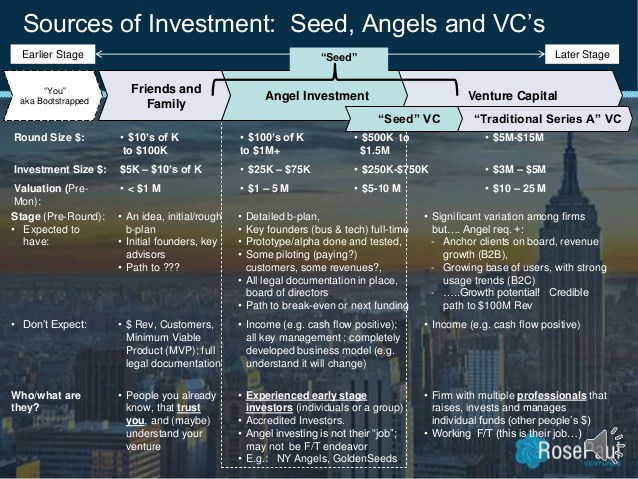
Sources of Investment: Seed, Angels and VCs by Thomas Wisniewski, via SlideShare

Inflection Point 1: Idea -> Project

Initially, an individual, perhaps two or three individuals who know one another discuss an idea and feel that they may be onto something that could become big. At that point they have a project, and their goal is to determine if their idea is a big enough one to merit devoting more resources to transforming into a physical thing. This could happen while they are still in school, or perhaps while they are employed. So work on the project occurs at night, during weekends, and in whatever free time they can find. Importantly, the project is not yet a top priority. During this stage the founder or founders will be bootstrapping, spending their personal capital in order to conduct whatever research they feel they need to perform in order to make some progress.

If they eventually conclude that the idea has enough merit to become a business one day, and they would like to pursue building that business, then they begin the transition from working on a project to forming a startup.3

Inflection Point 2: Project -> Startup

Once they make the choice to become a startup, it is most likely that the team will need to devote additional resources to their endeavor. For example; the team needs to start building a  product – a minimum viable product, someone has to start thinking about how to win early customers/users, and more time has to be devoted to sorting out a number of other issues like how everything that needs to get done at this stage will be paid for.

Friends & Family

If everything is going well so far, the founders might decide that they need some external capital. At this stage the easiest source of capital is the founders’ friends and family and the amount of capital raised will generally be less than $1,000,000. This round of capital should be devoted to building a minimum viable product (MVP) and confirming the hypotheses that the founders started to examine when  this undertaking was “merely” a project.

The key point here is that people in this group know the founders personally and are making an investment largely on the basis of their trust and belief in the founders. Often the investors in this category do not understand much about what the founders are building if the product involves a technological innovation. However, they likely believe “Brit is smart and hardworking. We know she will do great. We want to support her build her dream.” So while a financial return would be nice, it is not the primary motivation. Nonetheless, I advise founders to make it a habit to pitch the idea formally even to this group of potential investors because it is worth the effort to start learning to pitch other people even at that early stage.

This round will probably be a convertible debt round, with terms driven by the founders.

The minimum viable product is the smallest, least expensive product that can be built in order to test the most important hypothesis on which the startup’s business model will depend.

– Paraphrasing Teresa Torres

Angel Investors

If things go well enough, the founders decide that they need to raise even more capital, more than they can expect to raise from their immediate social circles. There are still important questions that remain to be answered. The business model has not yet been discovered. Although early customers/users have been identified there is not yet any meaningful revenue traction. It may be a few more months before the product is mature enough to generate meaningful revenues although potential customers/users are testing the product and so far the key performance indicators (KPIs) look promising. There is still substantial work to be done on product features, but there is enough for some early customers to consider paying for.

An angel round will generally be about $1,000,000 or slightly more, but generally less than $2,000,000 or so. With each angel investor typically investing an amount between $25,000 – $100,000 or so.

This round will probably be a convertible debt round, whose terms will be driven by a lead angel who will do some work on behalf of the group. If the round is raised from an organized angel investor network, then the process might unfold according to the framework within which the group operates.

Angels will generally have a much more sophisticated understanding of the product and the market than individuals who invested in the Friends & Family round.

Seed Stage Venture Capitalists

Two important differences between Angel Investors and Seed Stage Venture Capitalists is that Angel Investors typically do not invest on a full-time basis, and Angel Investors typically are making investments on their own behalf.

If things go well, it gets to a point where the team working on the startup has key members in place, the product has advanced beyond the MVP, there is meaningful customer/user traction, and revenue is early but indicative of a significant market opportunity. The team now decides that it makes sense to raise venture capital.

A seed stage venture fund will likely invest between $150,000 – $1,000,000 at a time, in financing rounds that range from $1,000,000 – $3,000,000 or so, but generally less than $5,000,000. Some funds might have requirements such as:

  1. Minimum investment size, of say $500,000.
  2. Ownership targets, of say 10%.
  3. Syndicate composition, preferring a syndicate that includes at least one or two other institutional seed-stage venture capital funds.

This round will likely be a priced round, and the venture fund leading the round will set the valuation, agree to a term sheet with the startup, and negotiate the final documents that will govern that round of financing.

Here are a few nuances about this segment of the startup and venture capital ecosystem.

  1. Founders should focus their efforts on finding and speaking with funds that have a current fund size that fits the size of the round the founders are trying to raise. What does that mean? A seed stage VC investing a $50,000,000 fund will likely set a minimum investment size of $500,000 or more as an internal rule of thumb.4 I would not spend my time pursuing a meeting with this VC if I were a founder raising a $750,000 round, for example. Why? Minimum investment size and syndicate composition would likely pose stumbling blocks. On the other hand, a seed stage VC investing from a $10,000,000 fund might be worth the time and effort I put into getting a meeting because such a fund has likely set a minimum investment amount that is less than $500,000 – say, $350,000, and may also be willing to invest as part of a syndicate that is largely filled by angels. So my $750,000 round could be filled as follows: $350,000 from a lead investor (institutional VC #1), $200,000 from another VC (institutional VC #2), $100,000 from an angel investor (angel investor #1), $50,000 from another angel investor (angel investor #2) and the remainder in $25,000 increments (from angel investors #3 and #4)
  2. I do not advocate completely ignoring investment professionals at larger seed-stage funds. Let’s go back to the example of a founder raising $750,000. Assume that angel investor #4 is friends with a VC at a $120,000,000 seed stage fund and offers to make an introduction because ” . . . this is the sort of stuff they love to invest in . . . ” Then that meeting is very much worth taking because it enables the founder to start building a relationship with that VC and determine if there’s an investment and personality fit, and it enables the VC to observe the progress the startup is making over time and to get a more intimate sense of the founders’ management decision-making skills. This matters because this VC could be a potential investor in a subsequent “Institutional Seed Round” in which the startup is raising $2,500,000 for example.

Inflection Point 3: Startup -> Company

If things are going well, our startup gets to the point where it now wants to raise more than $5,000,000 because the founders believe they have:

  1. Confirmed their primary hypotheses,
  2. Understand how to win customers/users, and how to generate revenues and profits,
  3. Need more capital to pursue sales, and
  4. Hire more people.

This organization is still a startup, but it has started the slow transition from being a startup to becoming a company. This transition will depend to a large extent on how successful the startup is at creating and satisfying demand for its product. This transition will probably traverse several rounds. Generally I think of Series A, B, C and D as covering the period during which a startup is building out the internal and external structures that help it become a company. How do you know a startup has become a company. Well, it starts resembling organizations to which we are often accustomed. The existence of a full complement of c-suite executives is one good indicator.

Ultimately we get to a point where, the search and discovery stage has receded far into the past, and the structures of a company have been built. All that is then left is for the company to grow by executing and scaling the business model, and generating profits.

In Sam Altman’s article “Projects and Companies” he points out that the distinction is important mainly because of how it affects the way founders behave and think about what they are doing. The underlying feature of the transition from an idea to a company is that founders should be in a learning, experimentation, and discovery mode.

Distinctions matter. There is an important difference between a startup and a company.

In a company customers are already known, the product features that matter to these customers is already known, how much they will pay for the new product or service has already been established, and the market opportunity has already been sized and is well understood. In a company the business model is already known, and most activities are designed to execute a detailed business plan.

In contrast, a startup begins with no customers, no real understanding of the features customers need, no idea what customers will be willing to pay for the product, and no knowledge of the business model that will be most suited to creating, delivering and extracting value.

Steve Blank and Bob Dorf describe The 9 Deadly Sins of The New Product Introduction Model in their book The Startup Owner’s Manual.5 These are the lessons they offer startup founders who are in the search and discover phase.

  1. Don’t assume you know what the customer wants – start with guesses and hypotheses. These become facts only after they have been validated with customers willing to pay for the product.
  2. Don’t assume you know what features to build – this follows directly from the preceding lesson, avoid building features no body cares about by first testing your assumptions about them with customers willing to pay for them.
  3. Don’t focus on a launch date – instead focus on building a product that customers want to pay to use. Focusing on a launch date can cause the team to place an emphasis on the wrong things, causing the startup to hurtle towards the launch date even if it does not yet know its customers, or how to educate them about its product. Also, this becomes a milestone by which the startup’s investors will judge the performance of their investment.
  4. Don’t emphasize execution. Rather emphasize developing and testing hypotheses, learning, and iteration – the emphasis on getting things done at a startup can lead employees to focus on execution rather than searching for answers to the guesses that the startup is operating under. Hypotheses have to be tested, and tested again. Executing on untested hypotheses is a “going-out-of-business strategy.”
  5. Don’t focus on a business plan, instead search for a business model – A business plan offers the great comfort of presumed certainty. The reality of a startup’s existence is one of acute uncertainty. That can be very unsettling. A startup’s founders, investors, employees, and board of directors must avoid the seduction that accompanies reliance on business plans, and the management tools that characterize the experience of large companies with known customers and well-established business models. Results of experimentation and validation tests should matter more than milestones.
  6. Don’t confuse traditional job titles with what a startup needs to accomplish – the traits that an individual needs in order to succeed in the environment of a startup differ significantly from those that lead to success in a large company with a known business model, a fixed business plan, known customers, and a known market. In contrast, to succeed in the startup environment an individual needs to be comfortable with chaos, flux, and “operating without a map”. The worst thing that could happen for a startup is for employees to default to behaving as they would if they were working in a large company.
  7. Do not execute a “Sales and Marketing” plan too early – sales and marketing can become too focused on executing to a seemingly great plan rather than learning the identity of a startup’s most profitable customers and gaining knowledge about what will spur those customers to engage in behavior that enables the startup generate revenues and profits. Consider a scenario in which a startup has gained hundreds of customers but only a tiny fraction of those customers actually make a purchase, and to make things worse a vast majority of completed purchases are made by a an even smaller number of repeat buyers. A focus on the “number of customers” might camouflage the startup’s dire need to determine what steps it needs to take in order to dramatically increase the number of paying customers.
  8. Don’t presume success prematurely – executing to a business plan often leads to premature scaling, even when the reality might call for the startup to hit the brakes. Expanding overhead costs before the revenue to support such costs materializes is the shortest path to disaster for a startup. Hiring, and infrastructure expansion should only happen after sales and marketing have become predictable, repeatable, and scalable processes. Moreover, startups need to be impatient for profits but patient for growth. A startup that know’s how to earn a profit can survive indefinitely.1 A startup that does not know how to earn a profit, but instead is focused on other measures of growth is playing a dangerous game of Russian roulette.
  9. Don’t manage by crises, that leads to a death spiral – the accumulation of all these mistakes leads to the inevitable demise of the startup that makes the mistake of operating as if it is merely a small version of a big company.

For those potential first-time founders who are grappling with the question: “Where do I start?” . . . I hope this helps.

Next? I think you should read: Paul Graham – Default Alive Or Default Dead?


  1. Any errors in appropriately citing my sources are entirely mine. Let me know what you object to, and how I might fix the problem. Any data in this post is only as reliable as the sources from which I obtained it. ?
  2. I am paraphrasing Steve Blank and Bob Dorf, and the definition they provide in their book The Startup Owner’s Manual: The Step-by-Step Guide for Building a Great Company. I have modified their definition with an element from a discussion in which Paul Graham, founder of Y Combinator discusses the startups that Y Combinator supports. ?
  3. Sam Altman discusses the distinction between a project and a company in “Projects and Companies” which might be worth reading. ?
  4. This is a general rule of thumb. Clearly, a fund like 500 Startups will have a different rule. ?
  5. Steve Blank and Bob Dorf, The Startup Owner’s Manual Vol. 1: The Step –by-step Guide for Building a Great Company, Pub. March 2012 by K and S Ranch Publishing Division. ?