DD
MM
YYYY

PAGES

DD
MM
YYYY

spot_img

PAGES

Home Blog Page 7488

The main reason why iROKOtv is outperforming in Nigeria; 2019 will be the breakout year

0

Over series of tweets, the founder of iROKOtv, Jason Njoku, informed the world that his company is outperforming in Nigeria as the country has overtaken UK  in subscriber base.  He also noted that U.S. has the #1 position in subscriber base, and he expects Nigeria to overtake U.S. in coming years.
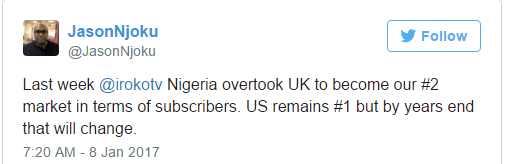
But the most amazing feat is that he was able to execute his strategy without committing a lot of money in advertising. This is where Jason has shown a good mastering of digital business in Nigeria.

The reality is that paid customer acquisition is ephemeral especially in Nigeria where you build up traffic only for it to fizzle when the campaign ends. By then Google and Facebook had taken their payments.

Konga, Jumia, and Lyf had used the paid customer acquisition strategy. The results have been missed. The key is focusing on product development, and relying on that build customer growth in an organic word-of-mouth way. It takes more time but it is more durable.
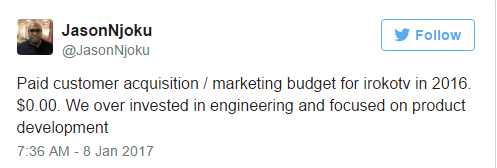
In the tweet, Jason noted that he had achieved this new milestone by investing in innovation and retooling his products.While those are critical like the N100 per week payment plan, N3,000 yearly plan and kiosk delivery, the key one is what Jason has no control.

Notice that N3,000 yearly subscription is a good pricing point in Nigeria as that is less than $7. Largely, most people can afford that. We are not sure the UK subscribers are on the same payment plan. So that means, the UK subscribers may be paying more to have the same service in Nigeria. The implication is that the strategy is biased to have more Nigerian subscribers.

That is not a bad strategy, considering purchasing power parity (PPP), as it is far easier to make, say, $10 in UK, than make $7 in Nigeria.

Sure, iROKOtv has done well in strategy as here in Owerri we do enjoy it. But the biggest reason for the success is that the cost of broadband has gotten cheaper. That is the main reason why Jason’s strategy is working. Right now, one can load a N500 Glo plan and binge for a decent amount of time on iROKOtv.

As meters are running both for telcos and iROTOtv, people are conscious of the cost of broadband before watching videos in Nigeria.

iROKOtv can see 2000% growth in 2017 if it can pay for MTN to remove metering in its platform. Then, the only cost becomes the subscription fee. Of course, the subscription cost may not cover any contract iROKOtv will sign with MTN.

In corollary, if the price of broadband rises, very unlikely because of Moore’s Law, the the portal subscription growth can fluctuate.

As we move into 4G and then 5G, iROKTOtv will continue to experience higher growth in Nigeria and indeed across Africa. We think 2019 will be the breakout year as our internal data shows that Nigeria will be at parity with some leading economies on broadband cost, using PPP, when you look at the trajectory over the last five years. When that cost of broadband becomes marginal, digital ecosystems like iROKOtv will flourish.
Nigeria plans to distort the growth of e-payment with planned pricing policy coming in May

0

When things are working well in Nigeria, we never like to step away and let the fun continues. Paga just reported a massive progress in 2016 with excess of N156 billion in transaction value. That shows that what we have now is working well as the sector is growing looking at investments in Paystack, Flutterwave, and other firms.

But in Nigeria, we do not like such positives.

The Central Bank of Nigeria (CBN) has hinted at effecting a new e-payment pricing policy, which will start May this year.

According to the apex bank, the move is in and in tandem with the objectives of the Payments System Vision 2020. “We are the verge of coming up with a new Merchant Service Charge (MSC) which is the fee paid by merchants for e-transactions done through Point of Sales (PoS) terminals,” said Dipo Fatokun, CBN Director of Banking and Payment System.

He stated that the deregulation will give way to a new pricing regime on electronic transactions or interchange fee by Q2 of 2017 and will ultimately boost payment card issuance, investment in loyalty programmes and the expansion of acquirer network infrastructure across the country. That is always the thinking. Why must government be involved in setting up the price? Why not allow market forces to determine?


Nigeria’s FASMICRO Makes the final of Africa Finance & Investment Forum (AFIF) Entrepreneurship Award 2017

1

Finalists for the Africa Finance & Investment Forum (AFIF) Entrepreneurship Award 2017 announced
Six African projects with big economic and social impact will be presented during the AFIF 2017, convened by EMRC in Nairobi, Kenya
BRUSSELS, Belgium, January 9, 2017/ — Six African SMEs have been nominated as finalists for the AFIF Entrepreneurship Award 2017, supported by the Rabobank Foundation. Out of the 51 projects from around the continent and following a few rounds of selection, the jury has selected these innovative projects from Ethiopia, Kenya, Nigeria and Tanzania for their social, economic and ecological impact, and their potential for growth and job creation nationally and regionally. The winner will be announced during the Africa Finance & Investment Forum (AFIF) 2017 (http://APO.af/y28Bux), which will be held in Nairobi from 13-16 February.

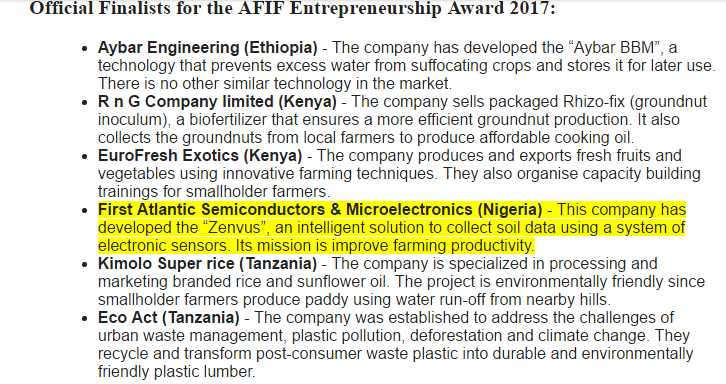
Official Finalists for the AFIF Entrepreneurship Award 2017:

  • Aybar Engineering (Ethiopia) – The company has developed the “Aybar BBM”, a technology that prevents excess water from suffocating crops and stores it for later use. There is no other similar technology in the market.
  • R n G Company limited (Kenya) – The company sells packaged Rhizo-fix (groundnut inoculum), a biofertilizer that ensures a more efficient groundnut production. It also collects the groundnuts from local farmers to produce affordable cooking oil.
  • EuroFresh Exotics (Kenya) – The company produces and exports fresh fruits and vegetables using innovative farming techniques. They also organise capacity building trainings for smallholder farmers.
  • First Atlantic Semiconductors & Microelectronics (Nigeria) – This company has developed the “Zenvus”, an intelligent solution to collect soil data using a system of electronic sensors. Its mission is improve farming productivity.
  • Kimolo Super rice (Tanzania) – The company is specialized in processing and marketing branded rice and sunflower oil. The project is environmentally friendly since smallholder farmers produce paddy using water run-off from nearby hills.
  • Eco Act (Tanzania) – The company was established to address the challenges of urban waste management, plastic pollution, deforestation and climate change. They recycle and transform post-consumer waste plastic into durable and environmentally friendly plastic lumber.

The AFIF Entrepreneurship Award 2017 aims to provide African-based innovative SMEs with support to grow their businesses. The six finalists will receive a free accreditation to join the AFIF 2017 full programme (http://APO.af/JM5nx8) (conferences, trainings, B2B meetings and networking opportunities). The award winner will receive cash prize and one year of national and international media promotion.

“We are delighted to announce the finalists for the AFIF Entrepreneurship Award 2017 after a really difficult selection process. The innovation and creativity of African-based SMEs makes our job more difficult every year. We look forward to welcoming these and many more entrepreneurs at the AFIF 2017 in Nairobi” says Inês Bastos, EMRC (www.EMRC.be) Senior Project Manager.

“I am now internationally known,” says Lazaro Mwakipesile (Raphael Group, Tanzania), winner of the AFIF Entrepreneurship Award 2015. He adds: “I have travelled abroad four times this year to present our company. I expect to travel to the United States soon for a meeting with the Bill and Melinda Gates Foundation”.

The new edition of the Africa Finance & Investment Forum (AFIF) will be held for the first time in the vibrant city of Nairobi, Kenya, hosted by the Strathmore University. In line with growing international trends, the AFIF will focus on entrepreneurship, innovation and access to finance in key sectors such as energy, water, ICT, health and agriculture. Delegates (SMEs managers, investors, entrepreneurs…) will come from across the world to participate in the AFIF 2017.

Distributed by APO on behalf of EMRC.

What is Robotic Process Automation (RPA)?

0

A typical software ‘robot’ is an application that has the ability to share and assist in the activities of a human interacting with a computer system. The software robot works on the user interface (UI) in a similar way as that of humans – this is a substantial deviation from traditional forms of IT integration, which have historically been machine-to-machine forms of communication created on data layers which operate at an architectural layer under the UI. After the RPA software has been educated to understand any specific process, it can automatically route transactions, work with data, initiate responses and collaborate with other systems as and when required. The technology is designed to provide an alternative to perform high-volume IT support, workflow and back-office processes (finance, accounting, supply chain management, customer service and human resources related processes).Moreover, RPA does not require any coding experience and is non-disruptive to the existing environment, besides being user-friendly – features that make it easy and convenient to deploy.

The adoption potential around RPA varies as per the volumes and transactional business processes. The Finance and Accounting functions such as accounts receivable, general ledger etc. in banking and financial services and manufacturing industry have high adoption potential. On the other hand, procurement and human resources function have low adoption potential in the insurance industry.

Impact of RPA

In the coming years, service provider capabilities around RPA could well be the deal maker when it comes to outsourcing contracts. RPA is expected to play a major balancing the role between the various tiers of outsourcing service providers.

Traditionally, more work required more manpower to complete; the emergence of RPA has changed this equation. With automation in place, where sophisticated computer programs are equipped with much better processing capabilities than those of humans, routine, rule-based work can be done far more rapidly.

Emergence of RPA has created cost deferential in the outsourcing engagement models. However, the cost difference does not necessarily result in loss of jobs as companies might move the freed resource from volume-driven work to value-driven and more complex jobs thereby adding value to their organisation

At present, close to 50% of business process outsourcing engagements are based on traditional models; however, a large number of companies are expecting transformational changes to this model in the next two to three years. While this does not mean that the traditional engagement models will disappear, it presents cost-saving and operational efficiency opportunities for service providers that are embracing change and adding automation capabilities to their portfolio.

Future outlook for outsourcing companies

In the years ahead, RPA capabilities will be one of the most crucial considerations for selecting an outsourcing vendor. Companies have started including ‘RPA capability’ as a criterion while inviting outsourcing service providers. They are considering an onshore plus automation solution as a substitute to a purely offshore solution. They are also considering the compliance and productivity benefits of using robots over humans.

As the BPO landscape evolves, service providers that incorporate RPA capabilities at the earliest are set to reap huge benefits from this emerging trend in the BPO space. As RPA has the capability to reduce cost substantially – the very factor which led to the boom in the outsourcing industry, RPA would visibly and permanently alter the business and pricing models in the ITO and BPO spheres. RPA will support, BPO providers to get up to speed and offer new service capabilities to their existing clients.

As per industry experts, traditional outsourcing would not become obsolete very soon; in fact, RPA is expected to strengthen and boost existing relationships. Deloitte Business-Process-as-a-Service (BPaaS) is investing heavily to further develop its existing RPA capabilities. The firm has already established a number of strategic alliances and partnerships with companies that offer Robotic Automation platforms, such as Automation Anywhere, Open Span (Grid Infocom) and Bizagi. To hone its RPA capabilities and push further innovation in existing and new engagements, the firm is developing an innovation & automation lab in the Woodmead, Johannesburg office. This lab will house state-of-the-art facilities and capabilities to offer clients a live demonstration of its latest automation tools and smarter technologies.

Cost: No longer a differentiator

As software robots increase in sophistication, more and more process will be automated and outsourcing companies will begin to lose the cost advantage they previously enjoyed as the cost of robots will be lesser. Consequently, they will have to look beyond cost and focus more on high-end services. However, before embracing RPA capabilities, providers need to perform an objective assessment of these capabilities. Their decision to implement RPA should be genuine, and should be executed strategically only in required areas of the business.

Mobile transactions continue to grow in Nigeria

0

The Central bank of Nigeria has noted that over 37.33 million transactions with total value of ?589.34 billion was recorded, across mobile money ecosystems, as at October 2016. The final figure at Dec 31, 2016 is not yet available.

Speaking at a local event, Chai Gang, who represented the Director, Banking and Payment System at the apex bank stated that since the launch of mobile money few few years ago, the scheme has experienced significant transaction both in number and value year to year.

“We know there are challenges making mobile money not to have gotten the desired attention and subsequent growth, but we are glad to announce that mobile money has continued to experience growth of 2.29 million transactions with a total value of ?31.50 billion in 2012 to 27.74 million transactions with a total value of ?339.23 billion in 2014. It has also moved up to over 37.33 million transactions with total value of ?589.34 billion by October 2016,” he stated

Naira exchanges for $1 in the interbank at about N325.