DD
MM
YYYY

PAGES

DD
MM
YYYY

spot_img

PAGES

Home Blog Page 7515

Large African companies are growing faster and more profitable than global peers

0

Large companies in Africa are growing faster than their peers in the rest of the world, raking in $1.4 trillion in annual profits and contributing to government taxes and higher wages, a new report finds.

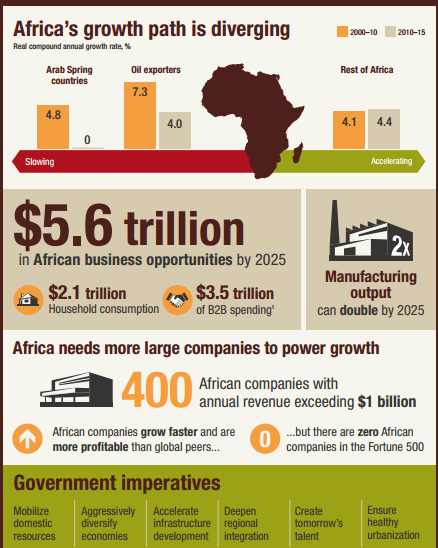
The continent has 700 companies with annual revenue of more than $500 million, 400 of which generate more than $1 billion, says the new study from the McKinsey Global Institute (MGI). These large companies consist of both African-owned brands and foreign-based multinationals operating within the continent across a wide range of sectors.

Corporate Africa needs to step up its performance to make the most of these opportunities. The continent has 400 companies with revenue of more than $1 billion per year, and these companies are growing faster, and are more profitable in general than their global peers. Yet Africa has only 60 percent of the number of large firms one would expect if it were on a par with peer regions—and their average revenue, at $2 billion a year, is half that of large firms in Brazil, India, Mexico, and Russia, for instance.

No Africa owned company is in the Fortune 500. Companies looking to grow across the continent should develop a strong position in their home market, use that as a base for expanding into markets well beyond their immediate region, adopt a long-term perspective and build the partnerships needed to sustain success over decades, and be ready to integrate what would usually be outsourced.

They should look for opportunities in six sectors that MGI finds have “white space”— wholesale and retail, food and agri-processing, health care, financial services, light manufacturing, and construction—with high growth, high profitability, and low consolidation, and invest in building and retaining talent. ?

data

Visa unveils Mvsia App to challenge M-Pesa in East Africa

0

Visa is taking on M-Pesa in Kenya. The credit card company has launched its Mvisa app that allows users to make purchases or transfer money on their cellphones in Kenya.

Visa admits that one reason for entering the mobile money market is because its hasn’t had much success promoting its traditional credit cards in the largest economy in East Africa.

Mvsia users have to be connected to one of four Kenyan banks that have partnered with Visa. M-Pesa users only need an ID card and registered cell phone—they don’t have to be connected to a bank, which is one reason why the platform has become so popular.

Tony Elumelu Shares Operational Strategies as he builds Tenoil, an Oil and Gas Production Firm

0

At Heirs Holdings, we believe in, and demonstrably practice, Africapitalism as  our investment strategy. Our investments across key sectors of the economy including financial services, hospitality & real estate, power, oil and gas, amongst others, reflect our commitment to engage in businesses that generate economic profits while contributing to widespread social prosperity on the African continent.

For example, our inclusive approach to banking, first through Standard Trust and now United Bank for Africa (UBA), has allowed millions of people formerly excluded from the formal financial services sector, to now own bank accounts, access capital and execute fund transfers to friends, relatives and business partners all across Africa and around the world. Just as we have done in banking, I look forward to Tenoil – our oil and gas investment arm –  to impact the Nigerian energy sector through building a truly indigenous  company that is fully integrated across the energy value chain.

Today,  at the Millennium Jetty in Marina, Lagos, I inspected Tenoil’s readiness to sail offshore to commence the last and final lap of our first field development, and I am happy to share the remarkable progress we have accomplished on this journey. After a successful drilling campaign in 2014 that proved commercial  quantities of hydrocarbons, we strategized on the best way to commence production from this our first oil and gas asset, with a minimum chance of failure.

One option was to employ the services of foreign and proven international companies to ensure that we reached the milestones we wanted to on time. However, we weighed this option against our philosophy of Africapitalism, which endears us, as Africa’s private sector, to make deliberate long term investments that lead to both economic profits and social prosperity in Africa,  we chose to invest locally to develop indigenous expertise so that Africa can eventually become self-reliant on her people and their talent.

This is the philosophy behind our decision to  use Nigerian oil and gas service companies to deliver  our first oil and gas project. We made this decision realizing the risks involved in terms of the level of experience and availability of quality materials locally, and as such ensured  that in-house at Tenoil, we have sufficient knowhow and experience to mitigate these risks.

Our experience so far demonstrates that choosing and supporting a reasonably good local company can still lead to the desired end, while being significantly cheaper. The gains from using a local company are numerous– more accessible workforce, greater cost savings, and an opportunity to invest in the next generation of African professionals. All the engineering design and fabrication of a substantial number of the equipment we intend to deploy offshore, were undertaken by two local companies, JK Orion and Compact Manifold & Energy Services (CMES), working closely together with our in-house teams. We hope that by the end of the year, all the equipment will be fully installed and ready for production to commence.

This is not to say that we have not employed any foreign expertise in our operations. Where we had to, we have augmented with foreign service providers to ensure that our equipment is best in class and fabricated to international standard. Some of the units that we intend to deploy were manufactured in the USA. At the end of the day, it is this blended combination of local ability and foreign proficiency that will take our continent to where we need to be.

Despite the handholding involved in using local contractors, it gives all of us at Tenoil great joy to witness the developmental impact of our decision to support #MadeinNigeria. It’s been a wonderful experience and we would do it all over again

Credit: Tony Elumelu

Nigeria lost “$450 million within the last one year” on cyber-related thefts, says Central Bank

1

Bank customers involved in fraudulent activities will now be placed under the radar of the Central Bank of Nigeria (CBN).

The country’s apex bank disclosed yesterday that it was working out regulatory framework that would enable it either blacklist these set of bank customers or put them on watch-list across the banking industry.

Speaking at the Finance Correspondents Association of Nigeria (FICAN) Bi-Monthly Forum in Lagos, CBN Director, Banking and Payment Systems Department, Mr Dipo Fatokun, said the Bank Verification Number (BVN) it recently introduced would be used to achieve this.

Mr Fatokun explained that the BVN involves capturing of customers’ physiological or behavioural attributes like fingerprint, signature among others which is coordinated by the CBN and banks in collaboration with the Nigeria Interbank Settlement System (NIBSS).

At the event hosted by the CBN, Mr Fatokun, who spoke on the theme ‘Recent Developments in the Electronic Payments System and Implications for Consumers of Electronic Payment Services’ disclosed that data from the apex bank showed that although e-fraud rate in terms of value dropped by 63 per cent last year, after the BVN introduction and improved collaboration among banks via the fraud desks, the total fraud volume rose significantly by 683 per cent within the year compared to 2014 figures.

He further disclosed that Nigeria experienced a total of 3,500 cyber-attacks with 70 per cent success rate and loss of $450 million within the last one year mainly through cross channel fraud, data theft, email spooling, phishing, shoulder surfing and underground websites.

“I want to assure you that the BVN has assisted us a lot in the banking system. It has assisted us to check frauds, and we are working on a framework, that will enable us if not to blacklist customers, because of some legal implications, but at least to watch-list a customer that is identified to have been fraudulent, or have done what he is not supposed to do across the banking sector,” he said.

He said the PSV 2020 strategy is aimed at providing a roadmap for efficient payments system infrastructure that would be nationally utilized and internationally recognized.

“The payments system plays a very crucial role in any economy, being the channel through which financial resources flow from one segment of the economy to the other. In setting out the objectives of the National Payments System (NPS), the goal is to ensure that the system is available without interruption, meet as far as possible, all users’ needs, and operate at minimum risk and reasonable cost,” he said.

He added that the BVN project is jointly undertaken by the CBN in collaboration with the Bankers Committee and remains a strategy of ensuring effectiveness of Know Your Customer (KYC) principles.

“Each Bank customer is given a unique identity across the Nigerian Banking Industry, including Nigeria bank customers in Diaspora,” he said.

The CBN Director said the number of BVN linked to customers’ accounts as at August 23, this year was 36.7 million while the total number of individual customers in the banks was reported as 59.9 million as at the same date.

“Any bank customer resident in Nigeria without a BVN would be deemed to have inadequate KYC while effort is on-going to ensure that customers of Other Financial Institutions (OFIs) such as Microfinance Banks (MFBs) & Primary Mortgage Institutions (PMIs) are brought into the system begin to get their BVNs,” he said.

Mr Fatokun said the e-Payment remains an initiative of CBN under the Payments System Vision 2020 as part of the overall FSS 2020 Strategy adding that one of the CBN mandates is the promotion of a sound financial system (Section 2 (d) of the CBN Act 2007).

He disclosed that Section 47(2) of the CBN Act 2007, stipulates that the CBN shall continue to promote and facilitate the development of efficient and effective systems for the settlement of transactions, including the development of electronic payment systems, adding that the promotion of a sound financial system entails active support for the effectiveness, efficiency and systemic safety of the payments system.

By Dipo Olowookere

Nigerian government wants you to provide your degree certificate as collateral for start-up loan

0

The Central Bank of Nigeria (CBN) has unfolded policies to reduce hardship of Nigerians and the current economic recession.

CBN’s Acting Director, Corporate Communications, Isaac Okoroafor said at a fair organised for small and medium scale enterprises that N220 billion funds made available for Micro Small and Medium Enterprises (MSMEs) could be easily accessed.

Mr Okoroafor explained, “If you are a serving corps member and you want to get into business, you can get as much as N3 million to start as an entrepreneur. What happens is that you are not required to provide any collateral because we discovered that collateral is the problem. Your degree or HND certificate will serve, as your collateral because we know it is an asset in which you have made investment. So, just surrender it, and that is all.”

This means that if the entrepreneur cannot pay, government keeps the certificate. We wish things are as simple as that in Nigeria.