DD
MM
YYYY

PAGES

DD
MM
YYYY

spot_img

PAGES

Home Blog Page 7516

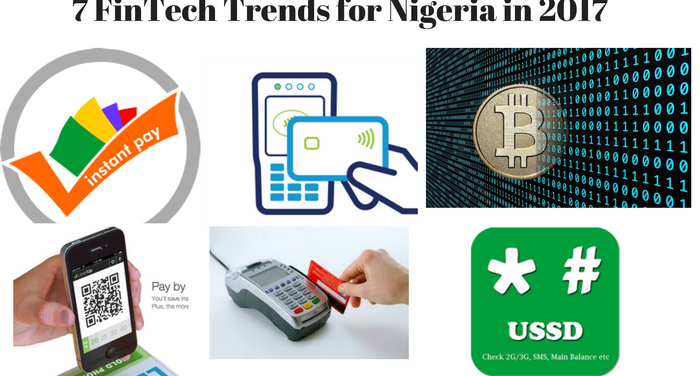
Seven FinTech Trends for Nigeria in 2017: QR Code Payment, USSD and More

0

by SOLA FANAWOPO

With the end of the year approaching, the amount of forecasts for 2017 is steadily increasing. How will the local FinTech industry develop and what will be the next big thing?

One can foresee the next Fintech trends more realistically by looking at the current developments. Exactly, they will determine the course for the next year. Seven areas are of special interest.

1.   QR Code Payments

QR code payments will effectively take off in Nigeria’s financial market in 2017. In 2016, the market witnessed the entrant of Access Bank’s PayByCapture and MasterCard’s Masterpass with minimal impact. VISA will definitely join the fray early in 2017 while local biggies –Interswitch and Remita – are working very hard to fight for market share. This market will be very interesting. However, interoperability and standardization may be the biggest challenge for fast adoption.

2.    USSD

The success of GTBank X737x USSD powered payment system in 2016 will encourage a lot of innovation on the platform in 2017 and beyond.

USSD (Unstructured Supplementary Service Data) is a Global System for Mobile (GSM) communication technology that is used to send text between a mobile phone and an application program in the network.

The NIBSS-powered micro cash (mCash) platform is layered on USSD. Even most QR code payments integrate the USSD option to target the G2 customers. Remita may also layer some of its payment and collection solutions on bank’s USSD platforms.

The Nigerian Communications Commission (NCC) has also promised to put in place a friendly USSD’s tariff regime in 2017 to encourage financial inclusion project of the federal government.

3.   Contactless

With the increasing consumers’ trust of the payment networks, contactless may likely sneak into the payment market in 2017.

4.   Hyper competition in POS business

With the eventual take off of the deregulated Merchant Service Charge (MSC) in 2017, I foresee a cut-throat competition among the banks in the troubled POS market. With the new regime, the banks are empowered to determine the MSC with their merchants.

Most banks are likely to adopt zero MSC charge to gain market share as deposits still make up the highest percentage of fund sources for the banks.

5.   T+1 may become history

With most payment platforms like USSD and QR code adopting instant payment settlement for the merchants, T+1 will be gradually phased-out from the market in 2017. If your acquiring solutions cannot give instant payments and settlements for your merchants, you may have to start re-working your process now as the market will be hostile to you in 2017. Even cheque truncation will likely embrace instant clearance in 2017.

6.   Flexible regulations

In order to promote financial inclusion, I foresee CBN becoming more flexible in most of its pro-bank regulations in 2017. The regulator having granted no objection to MasterCard and VISA on Person to Person (P2P) payments in the country, the big wall is already falling; I see some of the pro-banking regulation being discarded in 2017.

I foresee CBN toying with an idea of e-money regulation in 2017.

7.   Digital Currency

In response to the popularity of unregulated ponzi scheme like, Mavrodi Mudial Moneybox, MMM, I foresee CBN and Nigeria Deposit Insurance Commission (NDIC) adopting a digital currency regulation in 2017. This is the only way such scheme can be regulated.


[LinkedIn]

Five Things Every Modern Entrepreneur Needs

0

Editor’s Note: This was contributed by Brian Greenberg.

1. Transparency.  Operating with transparency used to be a luxury versus a necessity but, now, it’s quite mandatory. Millennials in particular, who wield a tremendous amount of influence and purchasing power, make buying decisions based largely on the provenance, manufacturing processes and overall business practices of a particular company. Because millennials are now the largest population in the U.S., to say that transparency will drive how businesses are perceived is an understatement at best. However, the good news is that establishing and maintaining transparency doesn’t have to be difficult. Simply communicating regularly with honesty and unequivocally holding yourself, your staff and your company accountable will go a long way toward fostering good will with not only consumers and prospects, but also with vendors, strategic partners and your industry at large.

2. Loyalty.  It used to be that only airlines had “loyalty” programs. Now, everybody from giant corporations like Pepsi Co. to mom and pop corner coffee shops have some sort of loyalty program. And, rightfully so. Every industry faces new competition on a daily basis and customers are understandably price sensitive, often buying from whoever has the best sale or perks. However, what loyalty programs really come down to is creating that coveted repeat customer. For instance, airlines offering free first class upgrades or hotels upgrading size of the room for elite travelers often creates an allegiance that trumps price point.  This principle can be applied in every business.  If you’re a service company and a client is at the end of their agreement, offer a specific service at a discount or another deliverable with a high perceived value. Those who do business online can easily build an awards program that fosters a faithful following.

3. Crowdfunding. The ugly truth is if you need a loan, chances are extremely high you won’t be able to get one. In fact, the recent small business study also revealed that the majority—a full 61%–of those who tried to get a favorable loan were unable to do so. Venture capital and private equity funding is equally difficult to come by, if not more. While some types of capital are actually easier to procure, the interest rates are usually more aggressive, often prohibitively so. Instead, focus on crowdfunding and non-traditional lenders such as Bond Street, Kabbage and Deal Struck. According to Massolution’s 2015CF–Crowdfunding Industry Report, global crowdfunding was anticipated to be over $34 billion. A revenue source of that size is simply too big to ignore and not tap into.

4. Pay-for-Play Social Media. Facebook was among the first to implement the “pay-for-play” model by removing organic reach and focusing on paid advertisement.  Since being acquired by Facebook, Instagram is destined to follow.  Pinterest and Twitter are also both currently growing into their pay-for-play systems and will likely make it difficult for pure organic reach as well.  Unfortunately, this means entrepreneurs will need to increase their social media budget. However, Facebook’s paid ads have been shown to reach a significantly greater percentage of users than organic posts, making paid ads well worth the investment. However, social media shouldn’t only be leveraged as a form of advertising. Rather, social media is an ideal way to handle customer service in such a way that not only improves marketplace loyalty but also your company’s transparency endeavor.

5. Instant Gratification.  Simply put, if you don’t offer some form of instant gratification your prospective customer will likely go somewhere that does. This truth is particularly problematic for businesses that require information from customers, such as insurance or financial services. Having prospects fill out contact request forms to be contacted later on for products or services is becoming less and less effective in the “Age of Impatience.” To be competitive, you need to deliver to the customer instantaneously in some way, whether that be with the provision of information they are seeking or other deliverable that will satiate them in the moment and keep them interested for a longer term.  Even just offering quicker and more efficient processes in dealing or transacting with your company is certainly a form of instant gratification. At every available touchpoint, strive to impress the customer—an incredibly effective way of evoking that gratified feeling.

No matter what industry you’re in or the type of business you run, you can still make a profit no matter what the current economic outlook happens to be. That begins with giving customers what they want, how they want it and in a way that’s more sensitive to marketplace vs. company needs. The above tools will put your business well on its way to doing exactly that, possibly making 2016 your most successful year yet.

Brian Greenberg is a multi-faceted entrepreneur who has founded and currently spearheads an assortment of successful online businesses. He currently co-owns and operates multiple entrepreneurial companies with his father

How to Invest Like an Entrepreneur to Outperform the Norm

0

It’s no secret the majority of entrepreneurs boast a strong feeling of self-reliance and self-confidence, particularly if they’ve already achieved success in their business. That’s why it makes sense that, when it comes to investing, many accomplished entrepreneurs entrust themselves with money management over an advisor at their local bank or neighborhood financial firm—or even a high powered Wall Street broker for that matter. For committed entrepreneurs, money is not a luxury, but the very lifeblood for their vision—it’s what sustains them in the here and now, and what fuels their dreams, aspirations and future goals.

“For the successful entrepreneur, achievement is not something that’s just possible; it’s an outright expectation, even when it comes to something as volatile and inherently risky as investing,” notes seasoned financial analyst Phil Ash, Co-Founder and CEO of Baton Investing—a company setting a new standard of transparency and performance for investing companies.

Below, Phil Ash details the nine key traits of the entrepreneurial investor: essential characteristics embodying the very spirit of entrepreneurial investors, capturing the dynamic essence of self-starters to ensure that entrepreneurs–and others who share their groundbreaking spirit–can always have the financial fuel they need to achieve their dreams.

1. Determination. Making the decision to take a specific course of action, setting appropriate goals and then having the grit to go accomplish those goals are the keys to successful business execution. The same is true with entrepreneurial-minded investing: calculate your financial goal, pick a proven strategy with the necessary average annual returns to get you there, and stay the course.

2. Risk-taking. Successful entrepreneurs are natural risk-takers; however, they are also smart about the kinds of risks they take and the method in which they are taken. Knowing when and how to separate from the herd and break away from norms and rules makes all the difference. That is the secret sauce for wildly accomplished “contrarian investors” like Warren Buffett.

3. Confidence. Being wishy-washy and indecisive rarely yields any positive results. Confidence comes from trusting a system, methodology or approach that has a proven track record—evidence that it can deliver desired results. So when it comes to investing, they seek out proven, tried-and-true systems that boost their odds of success.

4. Adaptability. Financial markets are fluid and your investment choices must be too. Successful investors no longer subscribe to conventional strategies like “buy-and-hold” and “broad diversification” to try to beat the market. Rather, they often use automated and other systems to constantly analyze markets and pick the handful of best investments in any market conditions and to buy and sell stocks monthly as the numbers change. Being nimble and knowing when to zig instead of zag can help you take advantage of tremendous buying opportunities.

5. Passion. Everyone falls in love with a story stock like Apple, Whole Foods or Tesla from time to time. And, like a passionate fling, they can be amazing for a while. But both the successful entrepreneur and the fruitful investor know how to moderate their passion and eliminate emotion from key decisions. And if they can’t easily do that, they’re smart enough to surround themselves with people or systems that can.

6. Money mastery. Even entrepreneurs who hate numbers eventually learn to understand and master them. Not understanding key investing metrics like returns and expenses is a sure-fire recipe for never hitting your goal. Entrepreneurs further understand the importance of budgeting, CapEx analysis, and protecting their hard-earned capital—all of which are important skills for improving your personal finances.

7. Vision. Entrepreneurs and savvy investors both know where they want to go and how they plan to get there. Entrepreneurs aim for their “Big Hairy Audacious Goal” (BHAG), as popularized by Jim Collins. It’s a goal that may take 15 years or more to achieve but if they hit it, life will be infinitely better. Likewise, smart investors set a clear goal that may seem impossible to others but is totally achievable with the right plan.

8. Networking. Visionaries like Steve Jobs seemingly blaze new ground with iPods and iPhones, but in large part they’re just building on what other successful people have done before them. These “visionaries” rely on their network to guide and help them along the way. Investing is no different. Just look at exactly how and why the greatest investors of all time like Buffett, Lynch and Graham have been successful and do that!

9. Lifelong learning. Like cultivating an entrepreneurial business acumen in an ever-evolving marketplace, continually honing finance and investment skills is an imperative. Commit yourself to the ongoing process of learning about myriad investment techniques and types. Remain a seeker of new wisdom. There is a wealth of information available that is always growing and changing so your knowledge base needs to grow and change with it.

”Entrepreneurs and investors are quite alike in the sense they are willing to take calculated risks for which the payoff can be substantial,” Ash notes. “It’s this shared spirit that can help the entrepreneurial-minded investor cultivate a profitable portfolio that outperforms most other investors and achieves your financial goal.”

See how America plans to secure NY Times Square on New Year’s Eve

0

As terrorists use trucks to ramp into people, American security has a new strategy. Use garbage truck filled with sand and surround where people gather.

Massive dump trucks filled with sand will line the streets surrounding New Year’s Eve celebrations in New York City this weekend. The 20-ton vehicles will hold an additional 15 tons of sand, the Associated Press reported Thursday night.

The trucks provide a dense, protective barrier in the event of a bomb. It is part of comprehensive anti-terrorism strategies law-enforcement officials deploy to ensure public safety.

The Times Square New Year’s Eve event is already a heavily policed affair, but this year, the stakes are even higher, after a series of terror attacks that erupted in Europe — some of which involved the use of heavy vehicles.

Russia retaliates to Obama actions, strikes back to U.S. with closure of a Moscow school

0

President Obama struck Russian hard on its meddling of U.S. presidential election. As Russia promised, the country has returned the favor in its own way.

Russian authorities on Thursday announced the closure of the Anglo-American School of Moscow, hours after the Kremlin vowed to retaliate against recent U.S. sanctions.

The nonprofit day school, which enrolls international students from pre-kindergarten through 12th grade, will be closed along with the U.S. Embassy vacation dacha in Serebryany Bor on the outskirts of Moscow, according to a CNN report.

Meanwhile, President-elect Donald Trump is calling U.S. to move on from the assertion that Russia hacked the election for him.

Insisting it’s time “to move on,” President-elect Donald Trump said Thursday he will nonetheless meet next week with leaders of the intelligence community “to be updated on the facts” of alleged Russian cyberattacks.

“It’s time for our country to move on to bigger and better things,” he said in a statement. “Nevertheless, in the interest of our country and its great people, I will meet with leaders of the intelligence community next week in order to be updated on the facts of this situation.”

The Department of Homeland Security and FBI released a joint report Thursday dubbed Grizzly Steppe that “provides technical details regarding the tools and infrastructure used by the Russian civilian and military intelligence Services (RIS) to compromise and exploit networks and endpoints associated with the U.S. election, as well as a range of U.S. Government, political, and private sector entities.”