
DD
MM
YYYY

PAGES

DD
MM
YYYY

spot_img

PAGES

Home Blog Page 752

What the Cost of a Healthy Diet Reveals in Northern Nigeria

0
A farmer prepares water channels in his maize field in Ngiresi near the Tanzanian town of Arusha on Tuesday, July 17, 2007. Millions of farmers around the world will be affected by a growing movement to change one of the biggest forces shaping the complex global food market: subsidies. Many experts agree farmers need help to grow food year in and year out, but Western farmers may get too much and African farmers too little. (AP Photo/Karel Prinsloo)

Between December 2024 and May 2025, the Cost of a Healthy Diet (CoHD) in Nigeria dropped by 13.36% from N1,276.17 to N1,105.52. On the surface, it looks like a win, prices are falling, and for many households, it feels like a step toward relief, a chance to put healthier food on the table without breaking the bank.

But behind the numbers lies a different story. In Northern Nigeria, where hunger cuts deeper and recovery is slower, falling prices don’t always lead to full plates. The barriers go beyond economics, they’re built into the land, the systems and the daily lives of those who still struggle to access even the most basic nutrition.

The CoHD, tracked by the National Bureau of Statistics, measures the minimum cost to meet daily nutritional needs. It’s not just another statistic. Our analyst notes that it’s a direct reflection of whether people can afford food that nourishes. And while the trend suggests progress, the reality on the ground tells us there’s more to uncover.
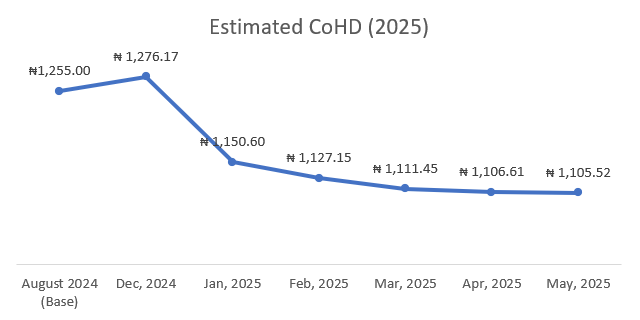
Exhibit 1: Steady decline in the estimated Cost of a Healthy Diet (CoHD) between December 2024 and May 2025, signalling improved affordability but not necessarily improved access.

Why Are Prices Dropping?

The decline in CoHD stems largely from seasonal abundance. In the first quarter of 2025, prices for staples like yams, maize, soybeans, and sorghum fell significantly due to post-harvest supply surges. Yam, in particular, emerged as a key driver, with its price movements closely tied to CoHD trends (correlation: 0.954). This aligns with a dip in the Food Consumer Price Index (CPI), reflecting broader food price relief.

National averages blur the truth. A N100 drop in yam prices may sound like progress, but what it means depends entirely on where you live and how much you earn. For a family in Katsina, Kebbi, or Jigawa, scraping by on the bare minimum, it could mean an extra meal, a small but meaningful relief. For a household in Lagos, it may barely register.

These numbers don’t tell the full story. They hide the deep, daily inequalities in food access, income, and opportunity. In Northern Nigeria, the challenge isn’t just about rising prices, it’s about barriers that go far beyond cost. Because when roads are broken, markets are closed, and incomes are stretched to the limit, even the cheapest food can remain out of reach.

The Northern Nigeria Challenge

In Northern Nigeria, access to healthy food remains constrained by more than just prices. Insecurity has crippled farming and market systems, making food supply chains unreliable.

“Bandits are not allowing us to go to the farms. If you go to the farm, you will be kidnapped, and we don’t have the capacity to pay ransom. That is why we are avoiding our farm. Those who go to the farm are more vulnerable, said a farmer in Plateau State, highlighting how bandit attacks have disrupted agriculture in the region (Daily Post, July 29, 2025).

Even when food is available, poor roads and lack of storage cause spoilage and price swings. For families earning under N1,000 daily, small price drops offer little relief. Worse still, entire markets are now inaccessible. In some communities across Zamfara, Kaduna, and Niger states, residents are not just facing high prices, they’re being cut off from food altogether. Bandits have seized control of key areas, turning once-bustling markets into ghost towns. Movement is restricted. Trade is stalled. Hunger deepens.

“The bandits have barred them from accessing the only market… and threatened to kill anyone who violates the instruction,” reported The Sun in July 2025, describing the situation in Zumba, Niger State, where the Saturday market, a vital economic lifeline for the region, remains closed under threat of violence.

For these communities, it’s not a matter of whether food is affordable; it’s whether it’s even reachable. When markets vanish, so does the possibility of feeding a household, no matter how low the prices may fall. In this context, a national drop in the Cost of a Healthy Diet offers limited hope. Without addressing insecurity and access, affordability gains will remain out of reach for millions in the North.

What Should Be Done

The 13.36% drop in the Cost of a Healthy Diet is encouraging, but for millions in Northern Nigeria, it’s not a breakthrough. The dream of a nutritious meal remains painfully out of reach, held back by the heavy weight of poverty, insecurity, and broken systems. Because food security isn’t just about lower prices, it’s about real access, for every Nigerian, in every region, every day.

To make that possible, we need more than policy. We need purposeful action. Our analyst notes that starting with the safety of farmers, especially in rural areas, is important because without security, there’s no farming, no trading, no food. Then, support local production, invest in resilient crops, smart irrigation, and the farmers who know how to turn dry land into abundance. Let them grow, even in the face of conflict or climate.

And don’t stop at supply, equip communities with knowledge. Sometimes, better nutrition starts with knowing the value of what’s already growing in your backyard. A healthy diet shouldn’t be a privilege. With the right choices, it can become a guarantee, no matter where you live or how much you earn.

Editor’s Note: Abdulazeez Sikiru Zikirullah, a Data Analyst Intern at Infoprations, led the team that conducted analysis for this article.


Building Moats for AI SaaS Startups Against Foundation Model AI Companies [podcast]

0

The core argument of this podcast lecture is that AI SaaS companies, while relying on foundational models, are vulnerable to being disintermediated by those same providers. The historical parallels from the supermarket, Amazon, and Twitter examples illustrate this risk clearly.

However, there are viable and strategic paths to building a sustainable AI app-level business. By adopting a defensive strategy, companies can create a strong “moat” that protects them from their larger, foundational partners.

The key strategies are to:

  1. Go Full-Stack: Connect the digital application to the physical world by acquiring licenses or engaging in activities that are difficult for a pure-play software company to replicate.
  2. Focus on Niche Areas: Develop deep, domain-specific expertise that goes beyond the general capabilities of foundational models.
  3. Build Feedback Systems: Implement reasoning and feedback loops to continuously improve the product, leveraging proprietary data that only the niche application can generate.
  4. Embrace the “Human in the Loop” model: Acknowledge the need for human intervention in certain situations, creating a more robust and complete solution.

By following these strategies, AI SaaS companies can move from being simple “up-level” applications to indispensable full-stack solutions, ensuring their survival and long-term sustainability in the evolving AI ecosystem.


Podcast VideoSign-up at Blucera and check Tekedia Daily podcast category under Training module.

The Ultimate Guide to Using Laptop Screen Extenders for Better Focus

0

Working on a laptop is fine. Until you run out of space. One screen just isn’t enough. It is especially not when you’ve got emails, spreadsheets, documents, and websites. You need to open them all at the same time. That’s why more people are using laptop screen extenders. They give you extra space. So you can work faster and focus better.

But here’s the thing. Just adding a second screen isn’t the full solution. You must know how to use it correctly for better focus. Let’s see how!

Quality Tips to Use a Laptop Screen Extender Effectively

1. Set Up Your Screens the Right Way

Where and how you place your laptop screen extender make a big difference. If it’s not aligned properly, you may turn your head too much, straining your eyes.

Here’s what helps:

  • Keep both screens at eye level
  • Make sure the second screen is lined up with your main one
  • Use a stand or support if needed
  • Keep cables folded away to avoid clutter

Your workspace should feel clean and easy. Fewer distractions are equal to better focus.

2. Choose What Goes on Each Screen

Don’t spread things out randomly—that can get confusing quickly. Decide what belongs on each screen.

Try this setup:

  • Main screen for active work (like writing, designing, coding).
  • The second screen is for emails, chats, or research.
  • Use the extra screen to look at data. Or take notes while you work.

This simple method helps you stay organized. You won’t be jumping back and forth between windows all day.

3. Switch Your Layout Based on the Task

Different tasks require different setups. There is no rule that says your screens have to look the same every day.

Some ideas:

  • For writing: notes on one screen, draft on the other
  • For meetings: video call on one, notes or slides on the second
  • For design: tools on one screen, full view of your work on the other

You’ll work faster when your screens match your workflow. Try new setups until one feels just right.

4. Manage Notifications Like a Pro

Dings and pop-ups ruin focus. You may ignore them once. But they still grab your attention.

To fix this:

  • Turn off all non-urgent alerts during work time
  • Use “Do Not Disturb” mode when you’re busy
  • Let notifications show on just one screen

This way, you’re not being pulled in different directions. You control your time, not your apps.

5. Give Your Eyes a Break

Staring at two screens all day can wear you out. Even with a good setup, your eyes still need rest, so keep taking breaks.

Also:

  • Step away from the screen every hour
  • Stretch, walk around, or drink water
  • Come back refreshed and ready

You’ll feel more focused after just a few minutes away.

6. Clean Up Your Digital Space

A messy screen slows you down. With two screens, it gets even easier to lose track of things.

Once a week:

  • Clear your desktop
  • Close extra tabs and programs
  • Sort files into folders
  • Add shortcuts for tools you use daily

It only takes a few minutes. But it helps you feel in control again. Clean space = clear mind.

7. Keep Improving Your Setup

Your needs will change. A setup that worked last month may not be helping now. Take time every so often to think about how you’re using your extender:

  • Is one screen too crowded?
  • Are you still getting distracted?
  • Could your setup be simpler?

Try small changes. You don’t need to redo everything. Just move things around and see what helps. It’s your space. Make it work for you.

Final Thoughts

A laptop screen extender is a way to stay focused, feel less cramped, and work with less stress. But the magic only happens when you use it with purpose. Keep your setup tidy. Place the right tools on the right screens. Adjust based on your task. All of this is great for maintaining a better focus while working using an extender.

OpenAI Opens Washington Door with $1 ChatGPT Enterprise Offer to U.S. Government Agencies

0

In a bold move to embed itself within the fabric of U.S. federal operations, OpenAI on Wednesday launched an initiative to provide ChatGPT Enterprise to federal agencies for just $1 over the next year.

The announcement comes as the company intensifies its efforts to deepen government ties, influence policy, and scale public sector AI adoption—at “essentially no cost” to taxpayers.

The limited-time offer, launched in partnership with the U.S. General Services Administration (GSA), will provide executive branch agencies access to OpenAI’s most advanced AI models via ChatGPT Enterprise, its enterprise-grade product. The company is also offering a 60-day trial of its Advanced Voice Mode, allowing government workers to engage the chatbot in a more natural, spoken format.

“Helping government work better—making services faster, easier, and more reliable—is a key way to bring the benefits of AI to everyone,” OpenAI said in a blog post announcing the deal.

This initiative is part of OpenAI’s larger strategic push dubbed “OpenAI for Government,” which it officially rolled out in June. At that time, the company revealed it had secured a government contract worth up to $200 million from the U.S. Department of Defense, a milestone that signaled its growing footprint in national infrastructure.

The move also paves the way for OpenAI to shape the regulatory environment around AI from within Washington. It plans to open its first office in the capital early next year, a decision that underscores the tech firm’s escalating presence in federal policymaking and procurement discussions.

The federal push arrives as OpenAI courts investors in a potential stock sale that could value the company at roughly $500 billion—an enormous leap from its last reported valuation of $300 billion following a record-breaking $40 billion funding round in March. That deal remains the largest capital raise ever completed by a private tech company.

The share sale, intended for current and former employees, would allow early contributors to realize gains while helping the company retain top talent in an increasingly competitive AI labor market.

Critics have raised concerns that OpenAI’s deepening ties to government may grant the firm undue influence in shaping federal AI standards and contracts, especially at a time when many other startups struggle to secure comparable access. However, by offering its technology nearly free of charge, OpenAI is positioning itself as a default AI provider for government services, reinforcing its brand as not just a commercial innovator but a public utility.

The partnership with the GSA could also serve as a model for how large AI vendors enter into structured public-private relationships, combining strategic technology adoption with regulatory alignment. While other companies continue lobbying for favorable rules, OpenAI appears to be embedding itself directly into the federal machine, model by model, agency by agency.

The U.S. government, long criticized for its sluggish tech modernization, may finally accelerate its digital transformation with AI at the core as OpenAI’s tools gain traction in the federal sector. However, time will tell whether that transformation is broadly beneficial or disproportionately beneficial to OpenAI.

Apple Announces Plan to Spend Additional $100bn on U.S. Suppliers, Supporting Trump’s Industrial Revival Push

0

President Donald Trump and Apple CEO Tim Cook on Wednesday announced a sweeping plan that will see the tech giant invest an additional $100 billion into the U.S. economy over the next four years—a move Trump hailed as the largest commitment Apple has ever made domestically or abroad.

The announcement bolsters Apple’s total pledged U.S. investment under Trump’s presidency to $600 billion, solidifying the company’s position as a central player in the administration’s push to rebuild America’s industrial base.

Speaking alongside Cook at the White House, Trump praised the iPhone maker for “coming home” after years of being seen as more invested in foreign manufacturing.

“This is the largest investment Apple has ever made in America and anywhere else,” Trump said. “Apple has been an investor in other countries a little bit, I won’t say which ones, but a couple, and they’re coming home.”

The new $100 billion commitment builds on a $500 billion pledge Apple made in February, following what Cook described as a direct challenge from Trump to do more.

“President Trump shared some kind words about that work, but he also asked us to think about what more we could commit to doing,” Cook said. “Mr. President, we took that challenge very seriously.”

Apple’s expanded investment includes a wide array of U.S.-based suppliers and facilities, with a stated goal of creating a fully domestic chip and component supply chain. At the center of this is Apple’s so-called American Manufacturing Program, which now counts more than a dozen strategic partners, including Corning, Coherent, GlobalWafers, Applied Materials, Texas Instruments, Samsung, GlobalFoundries, Amkor, and Broadcom.

Glass, Lasers, and Chips: Building Apple’s Supply Chain in America

Apple said it would spend $2.5 billion to expand its partnership with Corning, which manufactures glass for iPhones and Apple Watches at its Kentucky facility. On Wednesday, Cook presented Trump with a souvenir made of Corning’s glass, symbolizing what both leaders described as a long-term commitment to reshoring advanced manufacturing.

The company also announced a multi-year deal with Coherent to produce lasers used in the iPhone’s facial recognition system. Apple said the partnership would bolster its U.S. sensor supply chain, which is becoming increasingly vital to its smartphone and wearables business.

Meanwhile, Apple revealed that it expects its U.S.-based supply chain to manufacture more than 19 billion chips this year alone, a scale of production that spans multiple states and suppliers. That includes chips produced by TSMC at its Arizona plant, as well as U.S.-made wafers from GlobalWafers, and semiconductor components from Texas Instruments, which will be installing new tools at facilities in both Utah and Texas.

Apple also named GlobalFoundries as the manufacturer for its wireless charging modules. The chips will be produced in New York, leveraging GlobalFoundries’ capabilities as a U.S.-based foundry that already supplies legacy chips for federal government contracts.

The initiative aims to create an “end-to-end” supply chain—a concept that means every phase of Apple’s chipmaking process, from raw materials to final assembly, can happen within the U.S.

Data Centers and Rare Earths

Beyond semiconductors, Apple is also expanding its data center footprint across North Carolina, Iowa, Nevada, and Oregon. The company originally announced $10 billion in planned data center investments in those states, a number that has since been exceeded.

The company also reiterated its earlier pledge to invest $500 million in a rare earths mining venture, part of a strategy to ensure that vital raw materials used in batteries and device motors can be sourced locally, reducing reliance on China and other foreign suppliers.

Trade Policy and Tariff Implications

The announcement comes amid escalating trade tensions, including new U.S. tariffs on India—a move by Trump in response to India’s increasing imports of Russian oil. While Apple has shifted much of its iPhone assembly to India in recent years to avoid tariffs on Chinese goods, the new India-focused import taxes, which raise rates to 25%, pose another layer of cost pressures.

However, White House officials told CNBC that Apple is expected to be “largely unaffected” by the India tariffs, thanks to existing exemptions and sourcing strategies.

Still, the company acknowledged that existing tariffs—particularly those on Chinese imports—will cost Apple an estimated $1.1 billion this quarter. Apple is also closely watching the outcome of a Section 232 investigation that could impose even higher import taxes on semiconductors, further impacting its bottom line.

This isn’t the first time Apple has made splashy U.S. investment announcements. In 2018, under pressure during Trump’s first term, the company committed to $350 billion in U.S. spending over five years. In 2021, it upped that figure to $430 billion.

But the latest commitments far outpace those earlier pledges. The combined $600 billion now represents an average of $125 billion in annual U.S. spending—nearly double the $70 billion per year Apple pledged in 2018.

Much of that investment has already materialized. The company has built out data centers, funded suppliers, and launched a $10 billion manufacturing fund, which supports U.S.-based firms like Corning. Suppliers do not publicly disclose how much of their revenue comes from Apple, but analysts say the tech company is among the largest private-sector drivers of advanced manufacturing growth in the country.

The Bigger Picture

Wednesday’s announcement reinforces Trump’s agenda to use executive and economic pressure to push multinational companies toward domestic reinvestment.

“There are a lot of factories and a lot of plants that are either under construction or soon we’ll be starting construction,” Trump said. “So can’t tell you exactly when, but I want to be around a year from now.”

The Apple deal is likely to serve as a flagship example of that policy in action. With tech manufacturing now entangled in geopolitics, tariffs, and supply chain reengineering, Apple’s massive U.S. commitment provides both political cover and strategic reassurance.